
Ford 6.0 Powerstroke Injector Problems: Why They Fail & How to Fix Them
02/22/2026
How to Bleed Kubota Diesel Fuel System (All Models)
02/22/2026
Published by Valley Fuel Injection & Turbo, Inc. | Woodland, CA Reviewed by VFI’s Bosch-Certified Diesel Technicians
A failing diesel injector doesn’t just cause a rough idle — it can lead to engine damage, wasted fuel, and expensive repairs if ignored. The challenge is that diesel injector symptoms often overlap with other problems, making it easy to misdiagnose the issue and throw money at parts that don’t need replacing.
This guide covers the key warning signs of diesel injector failure across all major platforms — Cummins, Duramax, Powerstroke, Kubota, Yanmar, and other diesel engines — so you can identify problems early and make informed decisions about repair.
7 Warning Signs Your Diesel Injectors Are Failing
1. Rough or Uneven Idle
A smooth idle depends on every injector delivering the exact same amount of fuel at the exact same time. When one or more injectors are worn, clogged, or leaking, the engine runs unevenly. You’ll feel the engine shaking, vibrating, or stumbling at idle — and it’s often worse when the engine is cold.
Rough idle is the most common early symptom of injector failure on almost every diesel platform. On a 6.7 Cummins, this shows up as injector balance rate codes. On an LB7 Duramax, it’s often accompanied by white smoke. On a 6.0 Powerstroke, stiction makes the rough idle worse on cold starts.
2. Excessive Exhaust Smoke
The color of your exhaust smoke tells a story about what’s going wrong:
- White smoke — unburned or partially burned fuel. Usually indicates an injector that’s leaking fuel into the cylinder without properly atomizing it. Common on cold starts with failing injectors. On an LB7 Duramax, white smoke is often the first sign of cracked injector bodies.
- Black smoke — over-fueling. An injector stuck partially open or a worn nozzle that’s delivering too much fuel. The engine is getting more diesel than it can burn. Also common when turbo boost is insufficient to match fuel delivery.
- Blue/gray smoke — oil burning. On HEUI engines like the 6.0 Powerstroke, this can indicate oil leaking past injector seals into the combustion chamber. On other engines, it may point to turbo seal problems or worn rings rather than injectors.
3. Loss of Power
Diesel engines produce power by burning fuel under extreme pressure. When injectors can’t deliver the correct fuel quantity, the engine starves. You’ll notice it most when the engine is under load — towing uphill, accelerating from a stop, or working hard in agricultural or construction applications.
Power loss from injector problems is usually gradual. You might not notice it day to day, but looking back you realize the truck doesn’t pull like it used to, or your Kubota equipment takes longer to do the same work.
4. Increased Fuel Consumption
Failing injectors waste fuel in two ways: a leaking injector dumps raw fuel into the cylinder that never burns, and a clogged or worn injector forces the ECM to over-fuel the remaining cylinders to maintain power. Either way, your fuel economy drops.
If your miles per gallon (or gallons per hour on stationary equipment) has declined noticeably with no other changes, injectors are a strong suspect. A full set of properly flowing injectors can improve fuel economy by 10–15% on a truck that’s been running on worn ones.
5. Hard Starting or Long Crank Times
Diesel engines rely on injectors to deliver finely atomized fuel into hot compressed air. If injectors can’t produce a good spray pattern, the fuel doesn’t ignite efficiently and the engine has to crank longer to start. This symptom is especially pronounced in cold weather when combustion is already harder to achieve.
On a 5.9 Cummins with a VP44 pump, hard starting can be a pump issue rather than injectors. On a 6.0 Powerstroke, the FICM voltage needs to be checked before blaming injectors. Proper diagnosis separates the expensive repairs from the simple ones.
6. Engine Misfires and Diagnostic Codes
Modern diesels monitor each cylinder’s contribution to power output. When an injector fails, the ECM detects the imbalance and sets diagnostic trouble codes. Common injector-related codes include:
- Cummins: P0201–P0206 (injector circuit codes), plus balance rate faults
- Duramax: P0300–P0308 (misfire codes), P0201–P0208 (injector circuit)
- Powerstroke: P0263, P0266, P0269, P0272, P0275, P0278, P0281, P0284 (cylinder contribution codes)
A misfire code tells you which cylinder has a problem, but it doesn’t tell you why. The cylinder could have a bad injector, low compression, a wiring issue, or (on HEUI engines) an oil pressure problem. That’s why bench testing the injectors provides the definitive answer.
7. Fuel in the Engine Oil (Fuel Dilution)
This is the most serious symptom and requires immediate attention. When an injector’s internal seals fail, raw diesel fuel leaks past the injector into the crankcase, mixing with the engine oil. You’ll notice:
- Oil level rising between changes
- Oil that smells like diesel fuel
- Oil that looks thin or watery on the dipstick
Do not continue driving with fuel-diluted oil. Diesel fuel destroys the oil’s lubricating properties. Running an engine on diluted oil causes rapid bearing wear, cylinder scoring, and potentially catastrophic engine failure. If you suspect fuel in your oil, stop driving and have the injectors tested immediately.
How Injector Problems Differ by Engine Platform
While the symptoms above are universal, each diesel platform has its own common failure patterns:
- 5.9 Cummins (VP44) — Often the injection pump fails before injectors. Hard starting and stalling point to the VP44 pump. Injectors on the 12-valve and early 24-valve are generally reliable.
- 6.7 Cummins — Common rail injectors with high failure rates above 150K miles. Balance rate faults, rough idle, and fuel dilution are the primary symptoms.
- LB7 Duramax — Notorious for cracked injector bodies causing white smoke and fuel dilution. All 8 should be replaced together due to labor intensity.
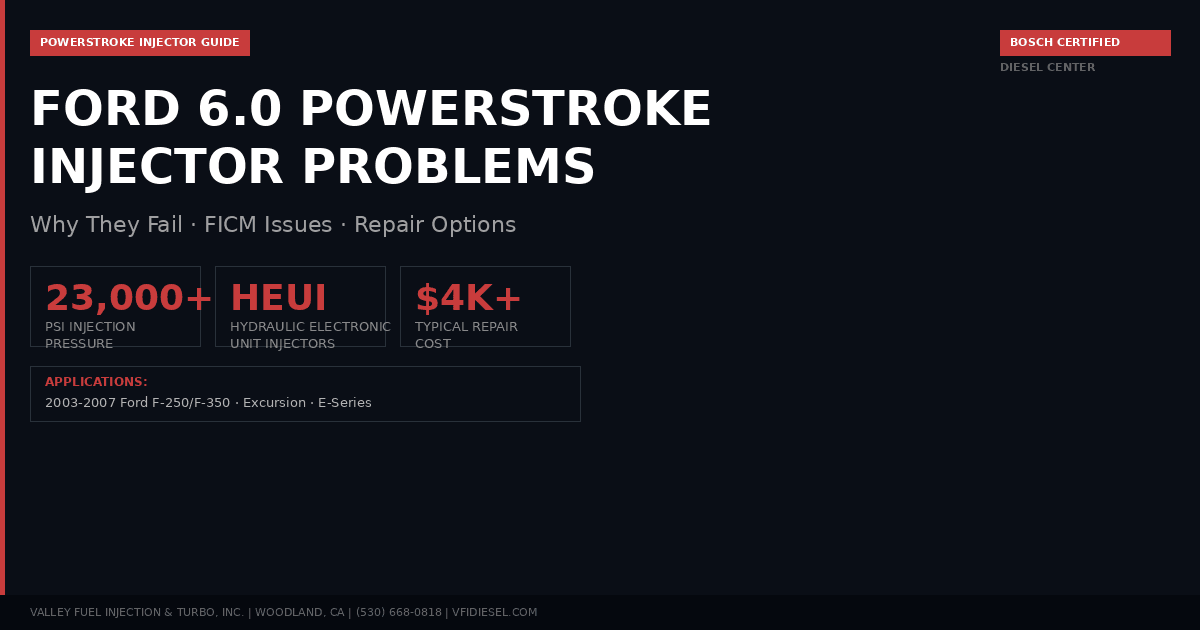
- 6.0 Powerstroke — HEUI system with stiction problems, FICM voltage issues, and O-ring failures. Often misdiagnosed because FICM, HPOP, and injector symptoms overlap.
- 7.3 Powerstroke — Generally reliable injectors, but after 200K+ miles they develop dead head pressure loss. Often shows up as a subtle power loss rather than dramatic symptoms.
- Kubota / Yanmar — Agricultural and compact diesel engines. Symptoms are similar but often noticed as decreased equipment performance rather than driving symptoms. Carbon buildup on nozzle tips is common in Tier 4 emissions engines.
The Difference Between Guessing and Knowing: Bench Testing
Here’s the reality of diesel injector diagnosis: symptoms alone can’t tell you which injectors are bad. A rough idle with white smoke could be one bad injector or four. A misfire code tells you the cylinder, but the injector might test fine — the problem could be electrical or mechanical elsewhere.
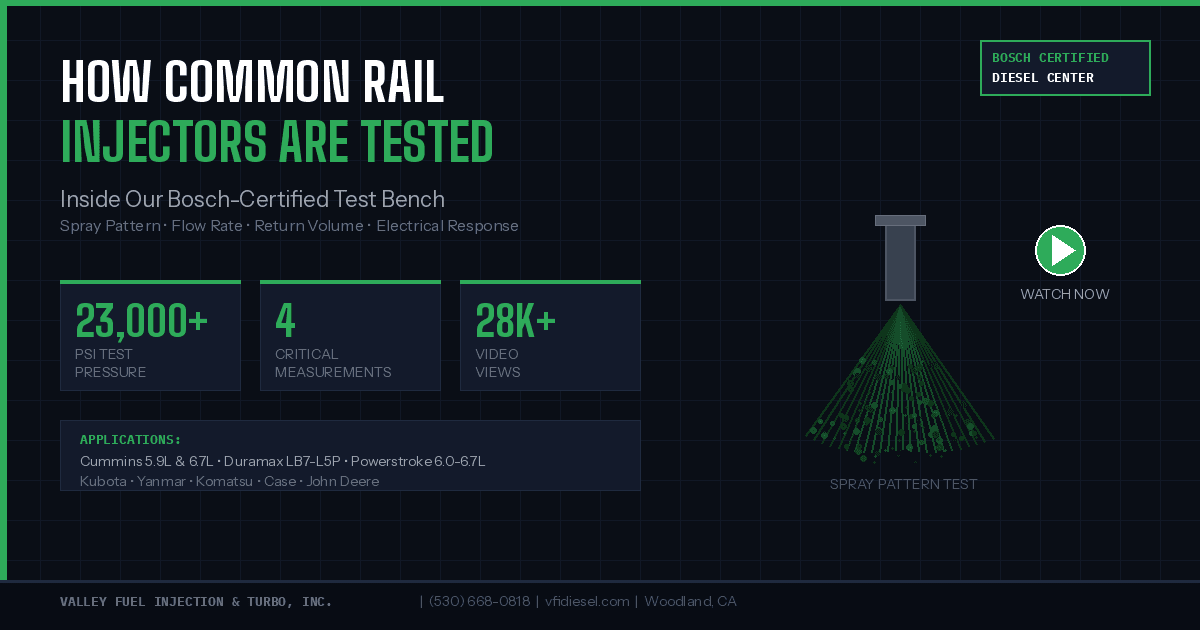
Professional bench testing on calibrated equipment — like the Bosch-certified test bench at Valley Fuel Injection — measures each injector’s actual performance:
- Spray pattern — Is the fuel atomizing properly or streaming?
- Flow rate — Is the injector delivering the correct fuel volume?
- Return volume (back-leak) — Are internal seals holding or leaking?
- Electrical response — Is the injector opening and closing at the correct speed?
This data tells you exactly which injectors have failed, which are marginal, and which are still good. You replace what needs replacing — not the entire set because you’re guessing. Watch how we test injectors →
When to Replace vs. When to Remanufacture
Not every failing injector needs to be thrown away. Depending on the failure mode and platform:
- Remanufactured injectors — Professionally rebuilt with new nozzles, seals, springs, and internal components, then tested to OEM specifications on calibrated equipment. This is the most cost-effective option for most trucks and provides performance equivalent to new. Browse remanufactured injectors →
- New injectors — Best for applications where warranty or OEM requirements matter. More expensive but comes with a factory warranty.
- Nozzle replacement only — On some older mechanical injectors, just the nozzle tip can be replaced if the injector body is in good condition. Significantly cheaper than a full replacement.
How Much Does Diesel Injector Replacement Cost?
Costs vary significantly by platform and engine:
- Injector testing: $30–$75 per injector
- 5.9 Cummins 12-valve (6 injectors): $1,200–$2,500 parts + labor
- 6.7 Cummins (6 injectors): $3,500–$6,000 parts + labor
- LB7 Duramax (8 injectors): $3,000–$5,000 parts + labor
- 6.0 Powerstroke (8 injectors): $3,000–$5,500 parts + labor
- Kubota/Yanmar (3–4 injectors): $500–$2,000 parts + labor
Testing first is always the smartest move. At $30–$75 per injector, bench testing a full set costs $200–$600 and can save you thousands by identifying exactly what needs to be replaced.
Don’t Ignore Injector Symptoms
Every day you run a diesel engine on failing injectors, you risk:
- Fuel dilution destroying your oil → bearing failure → engine replacement
- Raw fuel washing cylinder walls → ring and liner scoring
- Over-fueling cylinders → cracked pistons or head damage from excessive heat
- Wasted fuel → hundreds of dollars per month in lost efficiency
Catching injector problems early — when symptoms are mild — saves dramatically compared to waiting until the engine is damaged. If you’re seeing any of the 7 symptoms above, it’s time to get your injectors tested.
Experiencing diesel injector symptoms?
Get a definitive answer with professional bench testing. We test injectors for every major diesel platform — Cummins, Duramax, Powerstroke, Kubota, Yanmar, Komatsu, and more.
Call (530) 668-0818 or contact us online
Valley Fuel Injection & Turbo, Inc.
1243 E Beamer St, Suite C, Woodland, CA 95776
Monday–Friday, 7:00 AM – 4:30 PM PST
Shop Injectors Online →
Related reading: 6.0 Powerstroke Injector Problems · VP44 Injection Pump Failure · LB7 Duramax Injector Replacement · 6.7 Cummins Injector Problems · How Injectors Are Tested