Best Diesel Fuel Additive: What Actually Works (From Injection Experts)
02/22/2026
Duramax CP4 to CP3 Conversion: Is It Worth It?
02/22/2026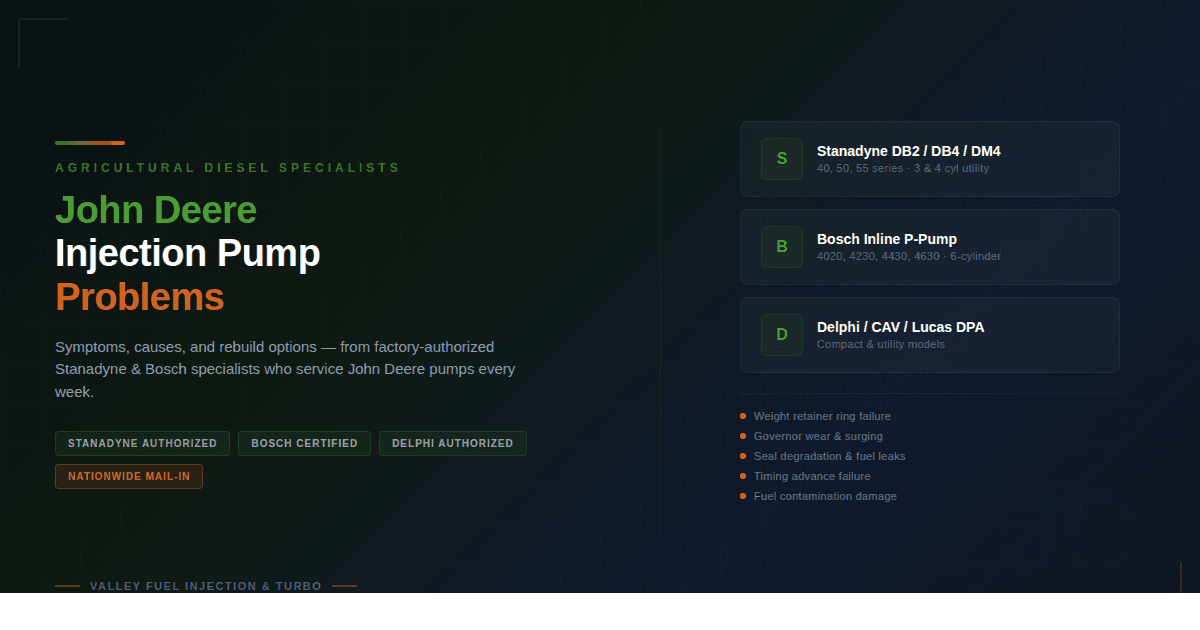
Why John Deere Injection Pumps Fail — And Why It Matters More Than You Think
John Deere has used diesel fuel injection pumps from nearly every major manufacturer over the past 60+ years — Stanadyne (Roosa Master), Bosch, Delphi (Lucas/CAV), and Denso. Each generation of pump brought improvements in power and efficiency, but also introduced new failure modes that most general mechanics aren’t equipped to diagnose or repair.
At Valley Fuel Injection & Turbo, we’re a factory-authorized service center for Stanadyne, Bosch, Delphi, and Denso — the same companies that built the pumps in your John Deere equipment. We rebuild and calibrate John Deere injection pumps every week, from 1960s inline Bosch units on 4020s to modern common rail systems on 8R series tractors. We see the same failure patterns repeatedly, and most of them are preventable.
This guide covers the most common John Deere injection pump problems by pump type, what causes them, how to recognize the symptoms before catastrophic failure, what repairs cost, and when to rebuild versus replace.
Which Injection Pump Is in Your John Deere?
Before diagnosing a problem, you need to know what you’re working with. John Deere has used several pump families across different engine generations, and each has its own failure patterns:
Stanadyne Rotary Pumps (DB2, DB4, JDB, DM4)
These are the most common pumps we see for John Deere rebuilds. Stanadyne rotary distributor pumps were used extensively in John Deere 3, 4, and 6 cylinder engines from the 1970s through the early 2000s. You’ll find them in the 40 series (2940, 4040, 4240, 4440, 4640, 4840), 50 series (2950, 4050, 4250, 4450, 4650, 4850), 55 series, and many utility and compact models. The JDB series was used in smaller engines, while the DM4 appeared in some 6-cylinder applications.
These pumps are identifiable by their round aluminum housing, single high-pressure outlet that distributes to each cylinder through a rotor, and the distinctive governor assembly on top. If you see “Stanadyne” or “Roosa Master” on the nameplate, this is your pump.
Bosch Inline Pumps (P-Pump, A-Pump, MW-Pump)
Bosch inline injection pumps were used in John Deere’s larger engines — particularly the 6-cylinder models in the 4000, 4020, 4230, 4430, 4630, and later in some 7000 and 8000 series tractors. These pumps have one plunger per cylinder (so a 6-cylinder engine has a 6-plunger inline pump) and are known for their durability and precision. They’re also significantly more complex and expensive to rebuild than rotary pumps.
Bosch inline pumps are recognizable by their rectangular housing, individual plunger assemblies, and rack-and-pinion governor mechanism. They’re the “heavy duty” option and tend to last longer than rotary pumps under sustained heavy loads.
Delphi (Lucas/CAV) Rotary Pumps (DPA, DPS, DPCN)
Lucas CAV (later Delphi) rotary pumps appeared in some John Deere compact and utility tractors, particularly models built outside the US or with Yanmar-sourced engines. The DPA pump is mechanically similar in concept to the Stanadyne rotary pump but uses a different internal design with opposed plungers rather than a single rotor.
Common Rail Systems (Denso, Bosch)
Starting in the mid-2000s with Tier 3 and Tier 4 emissions requirements, John Deere transitioned to high-pressure common rail fuel injection in many of its larger engines. These systems use a Denso or Bosch high-pressure pump (HP3, HP4, CP3, CP4) feeding a common fuel rail that supplies electronically controlled injectors. Common rail problems are a different category from mechanical pump failures — if you’re experiencing issues with a post-2007 John Deere, see our guides on CP4 pump failures and common rail injector symptoms.
The 7 Most Common John Deere Injection Pump Problems
1. Stanadyne Weight Retainer Ring Failure (The “Flex Ring”)
This is the single most common Stanadyne pump failure we see — and it’s been plaguing John Deere owners for decades. Inside every Stanadyne DB2 and DB4 pump, the governor assembly uses small flyweights held in place by a plastic retainer ring (sometimes called the flex ring or weight cage). Over time, this plastic ring deteriorates, cracks, and eventually disintegrates.
When the retainer ring breaks apart, the pieces migrate through the pump’s internal fuel passages. Small fragments restrict flow, causing erratic governor behavior. Larger pieces can jam the metering valve or rotor, causing complete pump failure. The worst-case scenario — which we see regularly — is when plastic fragments score the precision-lapped surfaces of the rotor and hydraulic head, requiring those components to be replaced rather than simply cleaned and reassembled.
Symptoms of weight retainer failure: Engine surging or hunting at idle, RPM fluctuation under steady load, sudden stalling (especially at low RPM), intermittent power loss that gets progressively worse, and eventually a no-start condition when fragments completely block fuel flow.
The fix: Complete pump teardown, cleaning of all internal passages, replacement of the plastic retainer ring with an upgraded one-piece metal design (which eliminates the failure permanently), inspection of all precision surfaces for scoring, and full recalibration on a test stand. This is a standard Stanadyne pump rebuild — typically $400–$800 depending on whether internal hard parts need replacement.
2. Internal Seal and O-Ring Degradation
Every injection pump — Stanadyne, Bosch, or Delphi — relies on dozens of internal seals and O-rings to maintain the pressure boundaries between fuel circuits, governor mechanisms, and the outside world. These seals are made of materials (Viton, Buna-N, PTFE) that have a finite service life, especially when exposed to modern Ultra Low Sulfur Diesel (ULSD), which has reduced lubricity compared to the higher-sulfur fuels these pumps were originally designed for.
As seals harden and crack with age, several things happen: fuel leaks externally (visible drips from the pump housing), fuel leaks internally between circuits (causing incorrect fuel delivery and timing), and air can enter the system through deteriorated shaft seals — particularly on the drive end where the pump shaft enters the housing.
Symptoms: Visible fuel weeping from the pump body or shaft seal area, hard starting (especially after sitting overnight — fuel drains back through failed check valves or seals), erratic idle or timing drift, and diesel fuel in the engine oil (internal seal failure allowing fuel to migrate past the drive shaft seal into the crankcase). If your oil level is rising and smells like diesel, suspect the injection pump shaft seal — and address it immediately, because fuel-diluted oil will destroy your bearings.
The fix: A seal kit replacement is the minimum repair, but it’s rarely sufficient on its own. A pump that’s leaking externally has been running with degraded seals internally too — the internal seals you can’t see are the same age as the external ones that failed. A proper rebuild replaces all seals and includes inspection of every mating surface. See our Stanadyne rebuild guide for the complete process.
3. Governor Wear and Calibration Drift
The governor controls engine speed by adjusting fuel delivery based on load. In mechanical pumps, this is done through a system of flyweights, springs, and linkage that senses RPM and adjusts the metering valve accordingly. Over thousands of hours of operation, these components wear: weight pivot pins develop slop, governor springs lose tension, metering valve bores wear oval, and linkage pins elongate their holes.
The result is progressive degradation of speed control. At first, you might notice the engine hunts slightly at idle or doesn’t respond as crisply to throttle changes. Over time, it gets worse — the engine may surge under load, over-speed momentarily when load is removed, or fail to reach full rated RPM.
Symptoms: Engine speed surging or hunting, slow response to throttle input, inability to reach rated RPM under load, engine over-speeding when load is suddenly removed (dangerous on PTO-driven equipment), and inconsistent power delivery.
The fix: Governor components are inspected and worn parts replaced during a rebuild. Critical here is the recalibration on a test stand — the pump is run at multiple RPM points and load conditions, and the governor is adjusted to meet John Deere’s original specifications. This is not something that can be done by feel or by ear — it requires a calibrated test bench, which is one of the main reasons injection pump work belongs in a specialized injection shop rather than a general repair facility.
4. Delivery Valve Wear and Dribble
Delivery valves sit between the pump’s high-pressure chamber and the fuel lines leading to each injector. Their job is to sharply cut off fuel delivery at the end of each injection event, creating a clean, precise end to the injection pulse. When delivery valves wear, they don’t seal completely — fuel “dribbles” past the valve after the main injection event ends.
This post-injection dribble has multiple consequences: it introduces extra unmetered fuel into the cylinder (causing smoke and poor combustion), it can cause nozzle carbon buildup on the injector tips (because the dribbled fuel doesn’t atomize properly), and it prevents the fuel system from maintaining proper residual pressure between injection events.
Symptoms: Black or dark gray exhaust smoke (especially at idle or light load), rough running, poor fuel economy, carbon-fouled injector nozzles (if you’re testing injectors and they keep fouling, the pump may be the root cause), and a general “tired” feel to the engine.
The fix: Delivery valves are replaced as a set during rebuild. They must be matched to the pump’s specifications and tested for proper sealing pressure and volume retraction. On Bosch inline pumps, each cylinder’s delivery valve can be replaced individually — on Stanadyne rotary pumps, the single delivery valve in the rotor is replaced as part of the rotor assembly or lapped to restore sealing.
5. Timing Advance Mechanism Failure
Most injection pumps include a mechanism that advances injection timing as engine RPM increases. On Stanadyne pumps, this is typically a hydraulic piston driven by internal fuel pressure. On Bosch inline pumps, it’s a centrifugal advance mechanism with flyweights and springs, similar in concept to a distributor advance on an old gasoline engine.
When the timing advance fails — whether from a stuck hydraulic piston, worn advance springs, or a seized mechanism — the pump delivers fuel at the wrong point in the combustion cycle across part or all of the RPM range.
Symptoms: Excessive engine knock (detonation sound, especially under load), poor power at certain RPM ranges, elevated exhaust temperatures (if timing is retarded), white smoke at startup (if timing is significantly off), hard starting, and poor fuel economy. Timing issues can also cause hard-to-diagnose no-start conditions.
The fix: The advance mechanism is disassembled, cleaned, inspected, and rebuilt with new seals and springs during pump service. Advance curve is verified on the test stand against John Deere specifications for your specific engine model.
6. Fuel Contamination Damage
This is the most destructive and most preventable problem we see. Water, dirt, and biological growth (algae/bacteria in fuel tanks) cause catastrophic damage to injection pump internals because of the extreme precision involved — clearances inside an injection pump are measured in ten-thousandths of an inch (0.0001″). Contaminants that you can’t even see with the naked eye can score pump surfaces beyond repair.
Water damage is the worst offender. Water causes corrosion on precision-lapped steel surfaces, and corroded surfaces can’t maintain the sealing pressure needed for proper fuel delivery. We see water damage most often in:
- Tractors that sit over winter with partially filled fuel tanks (condensation)
- Equipment fed from above-ground farm fuel tanks with deteriorated seals
- Machines that have been sitting unused for years in barns
- Any equipment where fuel filters and water separators have been neglected
Symptoms: Rough running that progressively worsens, loss of power, erratic speed control, hard starting, and visible corrosion or rust-colored fuel coming from bleed screws. In severe cases, the pump seizes completely.
The fix: Complete teardown, inspection, and replacement of all corroded or scored components. Water-damaged pumps often require new rotors, hydraulic heads, or plunger assemblies — making the rebuild more expensive than a pump that simply wore out from normal use. Prevention is far cheaper: drain water separators regularly, use fuel additive with water dispersal capability (we recommend Stanadyne Performance Formula), and keep tanks full during storage to minimize condensation.
7. Drive Component and Mounting Failures
The injection pump is gear-driven from the engine’s timing train. The connection point — whether a gear, coupling, or quill shaft — transmits significant torque and is subject to wear. On John Deere engines with Stanadyne pumps, the pump drive gear and coupling can develop wear that introduces timing variation (backlash). On Bosch inline pump applications, the drive coupling or quill shaft can shear if the pump seizes.
Symptoms: Rattling or knocking sound from the pump drive area, timing that drifts despite being correctly set, sudden loss of fuel delivery (if coupling shears), and visible wear on the drive gear or coupling during inspection.
The fix: Drive components should be inspected any time the pump is removed. Worn gears and couplings are replaced. Critically, the gear timing between the pump and engine must be precisely set during reinstallation — incorrect pump-to-engine timing is one of the most common mistakes we see when pumps are installed by shops that don’t specialize in fuel injection.
John Deere Injection Pump Problems by Engine Series
Different John Deere engine families have specific tendencies. Here’s what we see most often for the popular models:
3-Cylinder Engines (3179D, 3029D — Compact & Utility Tractors)
Found in the 650, 750, 850, 950, 1050, 2155, 2355, and similar compact utility tractors. Most use Yanmar-built engines with either Yanmar or Bosch mini inline pumps on the oldest models, and Stanadyne DB2/JDB pumps on later versions. Common issues: seal failures from sitting (these are often secondary/part-time use tractors), fuel contamination from neglected farm tanks, and governor drift from age.
4-Cylinder Engines (4239D, 4039D — Mid-Size Tractors)
Found in the 2940, 2950, 2955, 4030, 4230, and similar mid-size tractors. Typically equipped with Stanadyne DB4 pumps. The weight retainer ring failure is extremely common in these applications. Governor issues from wear at 5,000+ hours. These pumps respond well to rebuild — a properly rebuilt DB4 on a mid-size John Deere should give you another 5,000-8,000 hours.
6-Cylinder Engines (6359D, 6059D, 6068D — Row-Crop & Large Tractors)
Found in the 4040, 4240, 4440, 4640, 4840, 4050, 4250, 4450, 4650, 4850, and similar large tractors, plus combines and industrial equipment. Uses either Stanadyne DM4 (rotary) or Bosch inline (P-pump) depending on model year and horsepower. The Bosch inline pumps are extremely durable but expensive to rebuild ($800–$1,800). Stanadyne DM4 pumps share the same weight retainer and seal issues as the smaller DB pumps.
PowerTech and Tier 3/4 Engines (Post-2000)
The 4045 and 6068 PowerTech engines transitioned through several fuel system generations — from Stanadyne rotary to Bosch VP44 electronically controlled rotary to full common rail. If you have a PowerTech engine with electronic fuel injection and you’re experiencing problems, the diagnosis is different from mechanical pump issues. Common rail systems require electronic diagnostics and specialized test equipment — contact us for diagnosis.
How Much Does a John Deere Injection Pump Rebuild Cost?
Rebuild cost depends on the pump type and the extent of internal damage:
| Pump Type | Typical Rebuild Cost | Notes |
|---|---|---|
| Stanadyne DB2 (3/4 cyl) | $400–$700 | Most common John Deere pump. Weight retainer upgrade included. |
| Stanadyne DB4 (4 cyl) | $450–$800 | Similar to DB2 with additional advance mechanism. |
| Stanadyne DM4 (6 cyl) | $600–$1,000 | Larger pump, more internal components to inspect. |
| Bosch Inline P-Pump (6 cyl) | $800–$1,800 | Most expensive rebuild — 6 individual plunger assemblies to inspect/replace. |
| CAV/Delphi DPA | $450–$800 | Less common on John Deere but seen on some utility models. |
These costs are for the pump rebuild itself. Additional costs may include removal and reinstallation labor ($200–$500 depending on the tractor model and accessibility), new fuel lines if corroded ($50–$200), fuel filter and water separator replacement ($30–$80), and injector testing ($30–$75 per injector — highly recommended any time the pump is out, since injector problems can mask or mimic pump issues).
Rebuild vs. Exchange vs. New: What’s the Right Choice?
Rebuild your existing pump when the pump has a known, repairable problem (weight retainer, seals, governor wear) and you want to keep your original components. A proper rebuild restores the pump to factory calibration specifications and typically comes with a warranty. This is the most cost-effective option in most cases and is what we recommend for the majority of John Deere customers.
Exchange (remanufactured) pump when you need the tractor running immediately and can’t wait for your pump to be rebuilt. VFI stocks exchange units for common John Deere applications — you get a fully rebuilt, tested, and calibrated pump immediately and send your old pump back as a core. Exchange pumps cost slightly more than rebuilding your own but eliminate downtime. This is popular during planting and harvest season when every day matters.
New pump when the existing pump is damaged beyond economical repair (cracked housing, seized internals, extensive contamination damage to all precision surfaces). New Stanadyne and Bosch pumps are still available for most John Deere applications, though pricing has increased significantly — a new Stanadyne DB4 can run $1,200–$2,500+ depending on the application. For most owners, rebuild or exchange is the better value.
How to Ship Your John Deere Injection Pump for Rebuild
VFI provides nationwide mail-in pump rebuild service. Customers ship pumps to us from all 50 states. Here’s the process:
- Call us first at (530) 668-0818 to describe the problem and get a preliminary estimate
- Drain the pump completely — injection pumps contain diesel fuel, which is a hazardous material for shipping. Drain all fuel, cap all fittings, and wrap in plastic bags to contain any residual fuel
- Remove the governor linkage and throttle arm carefully — note the throttle arm position on the shaft (mark it with paint or a scribe line). Take photos before disassembly.
- Pack securely in a sturdy box with adequate padding. The pump should not move inside the box. These are precision instruments — don’t throw a bare pump in a box with newspaper.
- Ship via UPS or FedEx Ground to our shop in Woodland, CA. Include a note with your name, phone number, tractor model, engine model, and a description of the symptoms.
- We disassemble, inspect, and contact you with findings and a firm repair quote before proceeding
- Rebuild, test, calibrate, and ship back — typical turnaround is 3–7 business days once approved
Preventing John Deere Injection Pump Problems
The majority of injection pump failures we rebuild are preventable with basic fuel system maintenance:
Use quality fuel and treat it. Stanadyne Performance Formula adds back the lubricity that ULSD removed and provides detergency, water dispersal, and fuel stabilization. This is especially critical for agricultural equipment with on-farm fuel storage. The $25–$40 per year you’ll spend on additive for a tractor is trivial compared to a $400–$1,800 pump rebuild.
Maintain your fuel filters and water separator. Change fuel filters at the interval John Deere recommends — or sooner if you operate in dusty conditions or use fuel from older farm tanks. Drain the water separator regularly. If your tractor doesn’t have an aftermarket water separator, add one — it’s cheap insurance.
Keep tanks full during storage. A half-empty fuel tank is a condensation factory. When you park the tractor for the winter, fill the tank, add fuel stabilizer, and run the engine for 10 minutes to circulate treated fuel through the entire system.
Don’t ignore early symptoms. A slight surge at idle, a minor timing rattle, a small fuel drip from the pump housing — these are your pump telling you it needs attention. Addressing them now costs a fraction of waiting until the pump fails completely in the field during planting season. Pre-season pump inspection is one of the smartest investments a farmer can make.
Test your injectors when servicing the pump. A pump rebuild is wasted effort if you reinstall worn injectors. When the pump comes out, pull the injectors and have them bench tested. Bad injectors create backpressure that stresses the pump and masks pump calibration. Rebuilding the pump and testing the injectors together ensures the entire fuel system is performing as designed.
Frequently Asked Questions
What injection pump is in my John Deere tractor?
Most John Deere tractors from the 1970s through early 2000s use Stanadyne rotary injection pumps (DB2, DB4, or DM4 depending on engine size). Larger 6-cylinder models may use Bosch inline pumps. Post-2000 PowerTech engines transitioned to electronically controlled pumps and eventually common rail systems. The pump type is identified by the nameplate on the pump housing — look for “Stanadyne,” “Roosa Master,” “Bosch,” or “Delphi/Lucas/CAV.” If you can’t identify it, call us at (530) 668-0818 with your tractor model and engine serial number.
How much does it cost to rebuild a John Deere injection pump?
John Deere injection pump rebuild costs range from $400 to $1,800 depending on pump type and condition. Stanadyne DB2 and DB4 rotary pumps typically cost $400–$800. Bosch inline pumps for 6-cylinder engines run $800–$1,800. Water damage or severe contamination can increase costs if internal hard parts need replacement beyond the standard rebuild components. Additional costs include removal/installation labor ($200–$500), fuel filters ($30–$80), and injector testing ($30–$75 per injector, recommended).
What is the Stanadyne weight retainer ring problem on John Deere pumps?
The Stanadyne weight retainer ring (also called the flex ring or weight cage) is a plastic ring inside the governor assembly of DB2 and DB4 injection pumps. Over time, this plastic ring deteriorates and breaks apart. The fragments migrate through the pump, restricting fuel flow, causing erratic governor behavior (surging, hunting), and potentially scoring the precision internal surfaces. The fix is a complete pump rebuild with an upgraded one-piece metal retainer ring that permanently eliminates the failure. This is the most common Stanadyne pump repair we perform.
Can I rebuild a John Deere injection pump myself?
While a skilled mechanic can disassemble, clean, and replace seals in a Stanadyne rotary pump, the critical step — recalibration — requires a professional test stand that costs tens of thousands of dollars. A pump that’s been reassembled without being calibrated on a test stand is essentially a guess — fuel delivery, timing, governor behavior, and advance curve can’t be verified by feel or by running the engine. For this reason, we strongly recommend having injection pumps rebuilt by a factory-authorized service center with the proper test equipment. The cost of a professional rebuild is far less than the cost of engine damage from an improperly calibrated pump.
Why does my John Deere tractor surge at idle?
Engine surging at idle on a John Deere tractor is most commonly caused by injection pump governor problems — specifically worn governor components, the Stanadyne weight retainer ring failure, or calibration drift. Other possible causes include air in the fuel system (check for loose connections or cracked lines), partially clogged fuel filters, or worn injectors. If the surge gets worse over time or is accompanied by black smoke or power loss, the injection pump is the most likely culprit and should be tested.
How long does a rebuilt John Deere injection pump last?
A properly rebuilt injection pump should last 5,000 to 10,000+ hours under normal operating conditions with proper fuel maintenance. The key factors are fuel quality (using clean fuel with a lubricity additive), regular filter changes, water separator maintenance, and using the correct fuel stabilizer during storage periods. Many of the pumps we rebuild today have been in service for 20–30+ years on their original build — with proper care, a quality rebuild can deliver comparable longevity.
Does Valley Fuel Injection rebuild John Deere injection pumps by mail?
Yes. We provide nationwide mail-in injection pump rebuild service for all John Deere applications. Drain your pump, pack it securely, and ship it to our Woodland, California facility via UPS or FedEx Ground. We disassemble, inspect, and contact you with findings and a firm quote before proceeding. Typical turnaround is 3–7 business days after approval. We rebuild Stanadyne DB2, DB4, JDB, and DM4 pumps, Bosch inline pumps, and CAV/Delphi pumps for John Deere equipment. Call (530) 668-0818 to discuss your pump before shipping.
John Deere Injection Pump Problems? We Can Help.
Valley Fuel Injection & Turbo is a factory-authorized service center for Stanadyne, Bosch, Delphi, and Denso. We rebuild and calibrate John Deere injection pumps on professional test equipment every week — from 4020 Bosch inline pumps to 4440 Stanadyne DB4s to modern common rail systems.
Nationwide mail-in service available. Ship your pump from anywhere in the U.S.
📞 (530) 668-0818
📍 1575 East St, Woodland, CA 95776
🕐 Monday – Friday, 8:00 AM – 5:00 PM
Serving: Woodland · Sacramento · Davis · Vacaville · Yuba City · Stockton · Chico · Redding · Nationwide mail-in service