Tractor Injection Pump Rebuild: Cost, Process & Nationwide Mail-In Service
02/22/2026
Mail-In Diesel Injector Testing: Ship from Anywhere in the U.S.
02/22/2026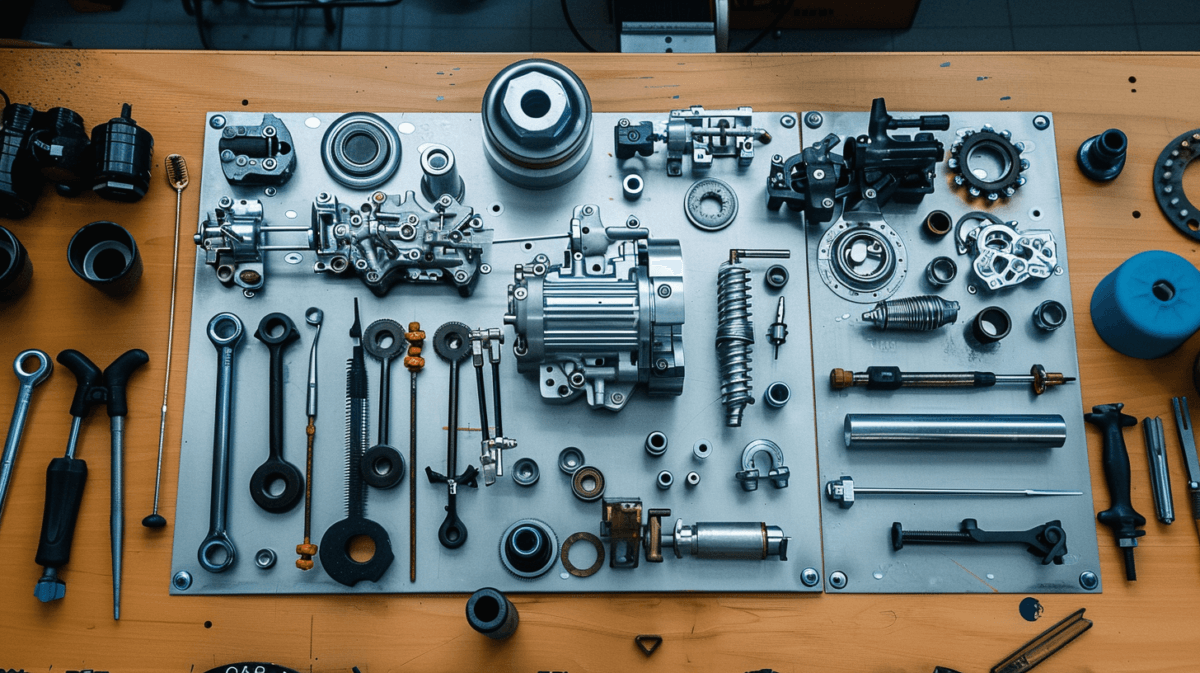
What Are the Stanadyne DB2 and DB4 Injection Pumps?
The Stanadyne DB2 and DB4 are rotary distributor-type diesel injection pumps originally manufactured by Roosa Master (later acquired by Stanadyne). These pumps powered millions of diesel engines from the 1960s through the early 2000s and remain in widespread service today across agricultural, industrial, automotive, and military applications.
The DB2 is a single-plunger opposed design that uses a rotating distributor to deliver precisely metered fuel to each cylinder in firing order. It’s mechanically governed, compact, and remarkably reliable when properly maintained. The DB4 (also called the DB4429) is the heavy-duty evolution of the DB2, featuring a larger housing, higher fuel delivery capacity, and improved governor response for demanding agricultural and industrial applications.
You’ll find these pumps under several names — Roosa Master, Stanadyne, and Hartford Division — depending on the era and application. They’re all the same fundamental design, and the naming can cause confusion when sourcing parts or rebuild services. At Valley Fuel Injection, we rebuild all variants as a Stanadyne factory-authorized service dealer.
Common Applications by Platform
The DB2 and DB4 were installed across an enormous range of equipment. Here are the most common platforms we see at our shop:
Agricultural Tractors: John Deere 2040, 2240, 2440, 2640, 4040, 4240, 4440, and 300/400 series; Case IH 385, 485, 585, 685, 785, 885; Ford/New Holland 2000, 3000, 4000, 5000, 6000, 7000 series; International Harvester 454, 574, 674, 784, 884; Massey Ferguson 200 and 300 series; and numerous other makes.
Automotive/Light Truck: GM 6.2L and 6.5L diesel (C/K trucks, Blazer, Suburban, M1008/M1009 CUCV military vehicles); some Ford IDI 6.9L and 7.3L applications.
Industrial/Construction: John Deere skid steers, backhoes, and generators; Case skid steers (1835, 1840, 1845); various Perkins and Caterpillar powered equipment.
Signs Your Stanadyne Pump Needs Rebuilding
Stanadyne DB2 and DB4 pumps are durable, but after decades of service they develop predictable failure patterns. Recognizing these symptoms early can save your engine from secondary damage caused by running a worn injection pump.
Hard Starting or Extended Cranking
A healthy Stanadyne pump should start the engine within a few seconds of cranking. If your tractor or truck requires 10, 15, or 30+ seconds of cranking — especially when warm — the pump’s internal transfer pressure is likely too low. Worn transfer pump blades, a scored transfer pump liner, or internal bypass leakage all reduce the pressure needed to properly charge the pumping plungers. This is one of the most common diesel starting problems we diagnose.
Rough Idle and Engine Hunting
The governor assembly inside the Stanadyne pump controls idle speed and prevents overspeeding. When governor components wear — particularly the governor thrust sleeve, governor arm pivot, or metering valve — the engine hunts at idle, surging up and down rhythmically. This is sometimes called “governor hunting” and is especially common in DB2 pumps with high hours.
The Weight Retainer Ring Problem
This is the most infamous failure point on agricultural Stanadyne pumps (DBG and JDB models used on tractors). The original plastic weight retainer ring (part of the governor flyweight assembly) deteriorates over time, sending plastic fragments throughout the pump’s internal fuel passages. Symptoms include erratic idle, surging, stalling, and eventually complete pump failure.
The fix is Stanadyne’s solid weight retainer (part #29111 for DBG/JDB pumps), which replaces the disintegrating plastic ring with a machined metal component. This is a standard part of our rebuild process — we never reinstall a plastic retainer. If your tractor’s Stanadyne pump was built before the mid-1990s and has never been rebuilt, the plastic retainer is almost certainly deteriorated or on its way out.
Loss of Power Under Load
If your tractor pulls strong initially but falls on its face under sustained load, the pump may not be delivering full fuel volume at higher RPMs. Worn pumping plungers and head assembly (the hydraulic head where fuel is pressurized and distributed) lose their ability to maintain delivery at the volumes and pressures the engine needs. A pump test on a calibration stand will reveal exactly where the delivery curve drops off.
Black or White Smoke
Excessive black smoke under load often indicates the pump is over-fueling — the governor isn’t cutting fuel delivery properly, or the pump timing is retarded. White smoke at startup (especially when cold) suggests the pump timing is off or fuel delivery is too low for proper combustion. Both conditions point to internal wear that requires more than a simple adjustment.
Fuel Leaking from the Pump
External fuel leaks around the pump shaft seal, throttle shaft seals, or line connections are obvious visual indicators. The shaft seal is the most common leak point and is a straightforward repair, but if the pump is already leaking externally, there’s a good chance the internal seals are equally worn. A reseal alone without inspecting hard parts is a gamble — you may fix the leak but still have a pump that doesn’t perform to spec.
Fuel in the Engine Oil
On engine-driven Stanadyne pumps (gear-driven off the engine timing gear), a failed pump shaft seal can allow diesel fuel to leak past the seal and into the engine crankcase. If your oil level is rising between changes or your oil smells like diesel, the pump seal is the likely culprit. This requires immediate attention — diesel fuel dilutes the oil’s lubricating properties and can cause catastrophic engine bearing failure.
What’s Actually Involved in a Stanadyne Pump Rebuild
There’s a massive difference between a proper rebuild and someone slapping a $35 seal kit in the pump on a kitchen table. Understanding what goes into a professional rebuild helps explain why it costs more — and why it lasts.
Step 1: Pre-Rebuild Testing
Before we disassemble anything, the pump goes on our calibration test stand. We run it at idle, rated speed, and every test point in between to document exactly what it’s doing. This baseline tells us where the pump is failing — and gives us data to compare against after the rebuild. Transfer pressure, fuel delivery at each cylinder port, timing advance function, governor cutoff, and return fuel flow are all measured and recorded.
Step 2: Complete Disassembly
The pump is fully disassembled — governor, hydraulic head, rotor, transfer pump, drive shaft, advance mechanism, and all internal components. Every piece is cleaned in an ultrasonic bath and laid out for inspection. Nothing is skipped, and nothing is assumed to be “good enough.”
Step 3: Inspection and Measurement
This is where a professional rebuild diverges from a DIY reseal. Critical dimensions are measured with precision gauges:
- Rotor-to-hydraulic head clearance — this is the heart of the pump. If the rotor or head bore is worn beyond tolerance (measured in tenths of thousandths of an inch), the pump cannot build proper pressure regardless of new seals.
- Transfer pump blade height and liner bore — determines whether the pump can generate adequate transfer pressure.
- Governor thrust sleeve wear — excessive play here causes idle hunting and erratic speed control.
- Advance piston bore — on DB2 automotive pumps, the aluminum advance bore wears against the steel piston, causing timing drift and excess return fuel.
- Metering valve and bore — controls fuel quantity; wear here means inconsistent fuel delivery.
- Drive shaft bearing surfaces and seal journals — worn shafts cause wobble that destroys seals.
Step 4: Hard Parts Replacement
Based on inspection, worn hard parts are replaced. This is not a seal kit job — rebuilding an injection pump is more like rebuilding a precision hydraulic instrument. Common replacements include the rotor and hydraulic head assembly, transfer pump blades and liner, governor components, advance piston and housing (or steel sleeve insert for DB2 automotive), delivery valves, and the drive shaft if journals are worn.
As a Stanadyne factory-authorized dealer, we source genuine Stanadyne parts — not aftermarket copies with questionable tolerances. This matters enormously when you’re dealing with components machined to 0.0001″ tolerances.
Step 5: Reassembly with New Seals
Complete reseal with a genuine Stanadyne seal kit. Every O-ring, shaft seal, gasket, and copper washer is replaced. The pump is reassembled to factory torque specifications using the proper special tools (Stanadyne pumps require several specific tools for correct assembly — the governor weight retainer, rotor shoe retaining clip, and head locking fixture are not optional).
Step 6: Test Stand Calibration
This is the step that separates a professional rebuild from everything else. The rebuilt pump goes back on the calibration test stand — the same type of equipment Stanadyne uses at their own factory. Every specification from the Stanadyne calibration data sheet for that specific pump code is verified:
- Transfer pressure at idle and rated speed
- Fuel delivery at each port (must be within tolerance of each other for balanced cylinder-to-cylinder fueling)
- Governor cutoff speed (prevents engine overspeeding)
- Idle fuel delivery and governor regulation
- Timing advance curve (automatic advance must match the engine’s requirements)
- Return fuel flow (excessive return indicates internal leakage)
- Throttle response and governor stability
Our test stands cost over $100,000 and are themselves calibrated regularly to maintain accuracy. This is not something you can replicate with hand tools in a shop — it requires purpose-built equipment running the pump at actual operating conditions.
Step 7: Final Quality Check
After calibration, the pump runs a final soak test to verify there are no leaks, the governor is stable, and all delivery specifications hold over sustained operation. Only then is it approved for return to the customer.
DB2 vs. DB4: Key Differences
While the DB2 and DB4 share the same fundamental rotary distributor design, there are important differences that affect applications, rebuild requirements, and parts sourcing.
The DB2 is the smaller of the two, designed for engines up to approximately 200 horsepower. It uses a single governor spring and has a more compact housing. DB2 pumps are found in the GM 6.2L/6.5L diesel trucks, smaller agricultural tractors, and light industrial equipment. The DB2’s aluminum advance bore is a known wear point on automotive applications — a steel sleeve modification during rebuild significantly extends the pump’s service life.
The DB4 (and its variant the DB4429) is the heavy-duty version, designed for larger agricultural and industrial engines. It features a larger housing, higher maximum fuel delivery, a more robust governor assembly, and improved transfer pump capacity. DB4 pumps are common on larger John Deere, Case IH, and International Harvester tractors. Rebuild procedures are similar to the DB2 but require different calibration data and some unique hard parts.
Both pump families include numerous sub-variants identified by their pump code number (stamped on the pump’s data plate — for example, DB2831-4911 or DB4629-5210). This code identifies the exact calibration specification, governor settings, and advance curve for that specific engine application. When sending a pump for rebuild, always provide the full pump code number so the correct calibration data is used.
Related Stanadyne Pump Models
Beyond the DB2 and DB4, Stanadyne manufactured several related pump families that we also rebuild:
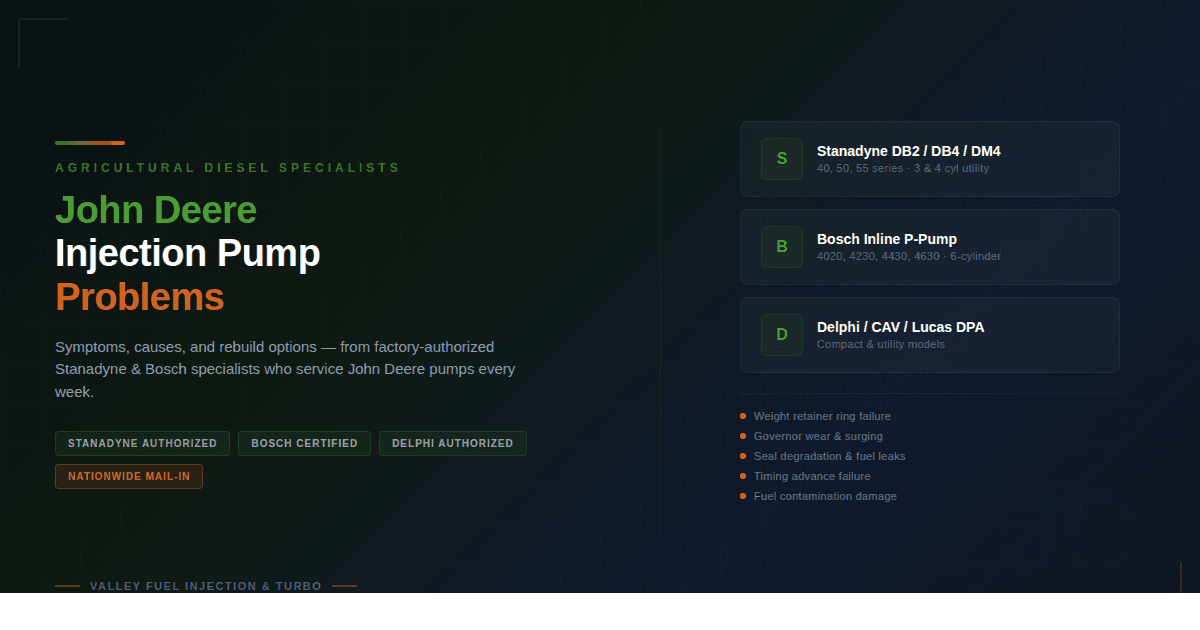
JDB — the agricultural version of the DB series, featuring a mechanical governor optimized for tractor applications. Common on John Deere 3-cylinder and 4-cylinder engines.
DBG — another agricultural variant with a variable-speed governor. Widely used on John Deere, Case IH, and Ford tractors. The DBG is where the plastic weight retainer ring problem is most prevalent.
DM — the mechanical governor version designed for stationary and generator applications where constant speed output is critical.
DE — an electronic version that adds an electronically controlled fuel metering actuator while retaining the basic rotary distributor design. Found on some later-model tractors and industrial equipment.
All of these share core internal components with the DB2/DB4, and our rebuild process, tooling, and calibration capabilities cover the entire Stanadyne rotary pump family.
How Much Does a Stanadyne Pump Rebuild Cost?
Rebuild costs vary depending on pump model, condition, and what hard parts need replacement. Here are typical ranges for our rebuild service:
| Pump Model | Typical Rebuild Cost | Common Applications |
|---|---|---|
| DB2 (automotive) | $400 – $700 | GM 6.2L/6.5L, Ford IDI, military CUCV |
| DB2 (agricultural) | $500 – $800 | Smaller JD, Case, Ford tractors |
| DB4 / DB4429 | $600 – $1,000 | Larger JD, Case IH, IH tractors |
| JDB / DBG (agricultural) | $500 – $900 | John Deere, Case, Ford ag equipment |
| DM (stationary/generator) | $500 – $800 | Generator sets, stationary engines |
These prices include disassembly, cleaning, inspection, standard seal kits, reassembly, and full test stand calibration. Hard parts (rotor/head assembly, governor components, transfer pump parts) are additional based on what’s needed — we never replace parts that are still within specification, and we always contact you before authorizing additional parts costs.
For comparison, a new Stanadyne pump from a dealer can run $1,500 to $3,000+ depending on application. A quality rebuild typically delivers equivalent performance for 40-60% of the new pump price.
Rebuild vs. Reseal: Why a Seal Kit Alone Isn’t a Rebuild
This is worth emphasizing because it’s the most common mistake we see — and the reason pumps come to us after someone already “rebuilt” them.
A reseal replaces external and internal seals and gaskets. Cost: $35-$80 for the Stanadyne seal kit (part #24370 for DB2 automotive, others vary by model). This fixes fuel leaks and restores sealing, but does nothing for worn internal components. If the rotor, head, transfer pump, or governor parts are worn, the pump will still perform poorly after a reseal.
A rebuild includes the complete reseal PLUS inspection and replacement of all worn hard parts, followed by test stand calibration to the pump’s original specification. This restores the pump to factory performance levels.
We regularly receive pumps that were “rebuilt” by someone who installed a seal kit, couldn’t get the pump timed properly, and gave up. The forums are full of threads from people who did exactly this — installed a $35 seal kit, reassembled the pump following the Stanadyne manual, and ended up with a tractor or truck that won’t start, surges, smokes, or runs worse than before. The manual is a guide for trained technicians with calibration equipment, not a DIY guide for rebuilding precision hydraulic components on a workbench.
Nationwide Mail-In Rebuild Service
You don’t need to be in California to use our Stanadyne rebuild service. We accept mail-in pumps from all 50 states and have rebuilt Stanadyne pumps for customers from Maine to Hawaii.
How the Mail-In Process Works
- Contact us with your pump code number (stamped on the data plate) and a description of the symptoms you’re experiencing. Call (530) 668-0818 or email us.
- Ship your pump to our shop in Woodland, California. Drain excess fuel before shipping (diesel fuel is a hazmat concern for carriers). Pack the pump securely — it’s heavy and precision-machined. Double-box if possible.
- We evaluate and quote the pump. After initial testing and inspection, we’ll contact you with a detailed assessment and cost estimate before any work is authorized.
- Rebuild and calibrate your pump to the original Stanadyne specifications for your exact pump code.
- Ship it back fully tested, calibrated, and ready to install.
Typical turnaround is 1-3 weeks depending on parts availability and shop workload. If you need your equipment running for a specific season (planting, harvest), let us know your timeline and we’ll do everything we can to accommodate it.
Why Choose a Factory-Authorized Dealer
There are plenty of places offering Stanadyne pump rebuilds — eBay sellers, Shopify stores, one-man shops. Here’s what sets a factory-authorized service dealer apart:
Genuine Stanadyne parts. We source directly from Stanadyne. Aftermarket seal kits and hard parts exist, but quality varies wildly. The precision required in these pumps — we’re talking 0.0001″ tolerances on rotor-to-head fitment — doesn’t leave room for “close enough” parts.
Factory calibration data. Every Stanadyne pump code has a unique calibration specification that defines the exact fuel delivery curve, governor settings, and timing advance for that engine application. As an authorized dealer, we have access to the complete Stanadyne calibration database. Without the correct spec, even a mechanically perfect pump won’t run right in your engine.
Proper test equipment. Our calibration test stands replicate actual engine-driven operating conditions. A pump is run at multiple speed points, and fuel delivery is measured at each cylinder port against the factory specification. There is no shortcut or substitute for this step.
Technical support. When you call with a question about your pump — what the symptoms mean, whether the timing is right after installation, how to set the throttle linkage — you’re talking to people who work on these pumps every day. We’re also a factory-authorized dealer for Bosch, Delphi, Denso, and Yanmar, so we understand how Stanadyne pumps fit into the broader diesel fuel injection landscape.
Tips for Removing and Shipping Your Stanadyne Pump
If you’re pulling the pump yourself to send in for rebuild, these tips will save you headaches on reinstallation:
Mark the timing before removal. Use a paint marker or scribe to mark the pump flange position relative to the engine timing cover or adapter plate. Mark the pump drive coupling or gear mesh position. Take photos from multiple angles. This gives you a reference point for reinstallation that’s specific to your engine.
Record the pump code number. It’s stamped on the aluminum data plate riveted to the pump housing. Write it down, photograph it, and include it when you contact us. This number tells us exactly what calibration spec your pump needs.
Cap all fuel connections. Open fuel ports allow dirt and debris into the pump — the fastest way to damage precision internal components. Use rubber caps, clean rags held with rubber bands, or even plastic bags taped tight. The cleaner the pump arrives, the better.
Drain excess fuel. Diesel fuel is classified as hazardous material for shipping. Drain as much fuel from the pump as possible, and let it drip-dry inverted for a few hours. You don’t need to get every last drop — just don’t ship a pump sloshing with fuel.
Pack it properly. A Stanadyne DB2 weighs approximately 15-25 pounds depending on the model. Double-box with foam or heavy packing material. Don’t let the fuel inlet fitting, throttle lever, or shutoff solenoid bear the weight of the pump in the box — pad around the main housing body.
Frequently Asked Questions
What is the difference between a Roosa Master and a Stanadyne injection pump?
They’re the same pump. Roosa Master was the original manufacturer, which was later acquired by Stanadyne (Hartford Division). Pumps labeled “Roosa Master” are typically older production, while “Stanadyne” branded pumps are newer — but the design, parts, and rebuild procedures are identical. Parts are fully interchangeable within the same pump model family.
How long does a Stanadyne DB2 pump rebuild take?
Typical turnaround at our shop is 1-3 weeks from when we receive the pump. This includes testing, disassembly, parts sourcing, reassembly, and full test stand calibration. Rush service may be available for time-critical agricultural situations — call us at (530) 668-0818 to discuss your timeline.
Can I rebuild a Stanadyne DB2 pump myself with a seal kit?
You can replace the seals, but that’s a reseal — not a rebuild. Without test stand calibration equipment, precision measuring tools, and the correct Stanadyne calibration data for your specific pump code, you cannot verify that the pump meets specification. Many DIY attempts result in pumps that leak less but still run poorly because worn hard parts weren’t addressed and delivery wasn’t calibrated. If the pump only has a seal leak and runs well otherwise, a seal kit might be all you need. If performance is affected, professional rebuild with calibration is the correct path.
What is the Stanadyne weight retainer ring problem?
Agricultural Stanadyne pumps (DBG and JDB models) used a plastic weight retainer ring in the governor flyweight assembly. Over decades, this plastic ring deteriorates, breaks apart, and sends fragments through the pump’s internal fuel passages. Symptoms include erratic idle, surging, hunting, and eventual pump failure. The fix is replacing the plastic ring with Stanadyne’s solid metal weight retainer (part #29111). This is standard in all our agricultural Stanadyne rebuilds.
How do I find my Stanadyne pump code number?
The pump code is stamped on an aluminum data plate riveted to the pump housing. It follows a format like DB2831-4911 or DB4629-5210. The first part identifies the pump family and configuration; the last four digits are the specific calibration code for your engine application. If the data plate is corroded or missing, we can often identify the correct code from the engine model and serial number.
Is a rebuilt Stanadyne pump as good as new?
A properly rebuilt pump — with all worn hard parts replaced and full test stand calibration — delivers equivalent performance to a new pump. The housing and non-wear components are reused, but every precision component that affects fuel delivery, timing, and governor function is renewed to factory specification. The key word is “properly” — a rebuild that only replaces seals without addressing worn hard parts or calibrating on a test stand will not match new pump performance.
My pump was rebuilt elsewhere and still doesn’t run right. Can you fix it?
Yes. We regularly receive pumps for a second rebuild after an initial attempt didn’t resolve the problem. Common issues include incorrect calibration, worn hard parts that weren’t replaced, improper reassembly, or use of aftermarket parts with incorrect tolerances. We’ll test the pump, identify what’s wrong, and rebuild it correctly to the factory Stanadyne specification for your pump code.
Do you rebuild electronic Stanadyne pumps (DE series)?
Yes. The DE (electronically controlled) Stanadyne pumps share the same basic rotary distributor design as the mechanical DB2/DB4 but add an electronic fuel metering actuator. We rebuild the mechanical internals and test the electronic components. If the electronic actuator has failed, replacement units are available. Contact us with your pump code for specific pricing.
Factory-Authorized Stanadyne Rebuild Service
Valley Fuel Injection & Turbo is a Stanadyne factory-authorized service dealer offering complete DB2, DB4, JDB, DBG, DM, and DE pump rebuilds with full test stand calibration.
📞 (530) 668-0818
📍 1575 East St, Woodland, CA 95776
🕐 Monday – Friday, 8:00 AM – 5:00 PM
Nationwide mail-in service: Ship your Stanadyne pump from anywhere in the U.S. for professional rebuild and calibration.
Serving: Woodland · Sacramento · Davis · Vacaville · Yuba City · Stockton · Chico · Redding · All 50 States via mail-in