Duramax CP4 to CP3 Conversion: Is It Worth It?
02/22/2026
Diesel White Smoke: Causes, Diagnosis & How to Fix It
02/23/2026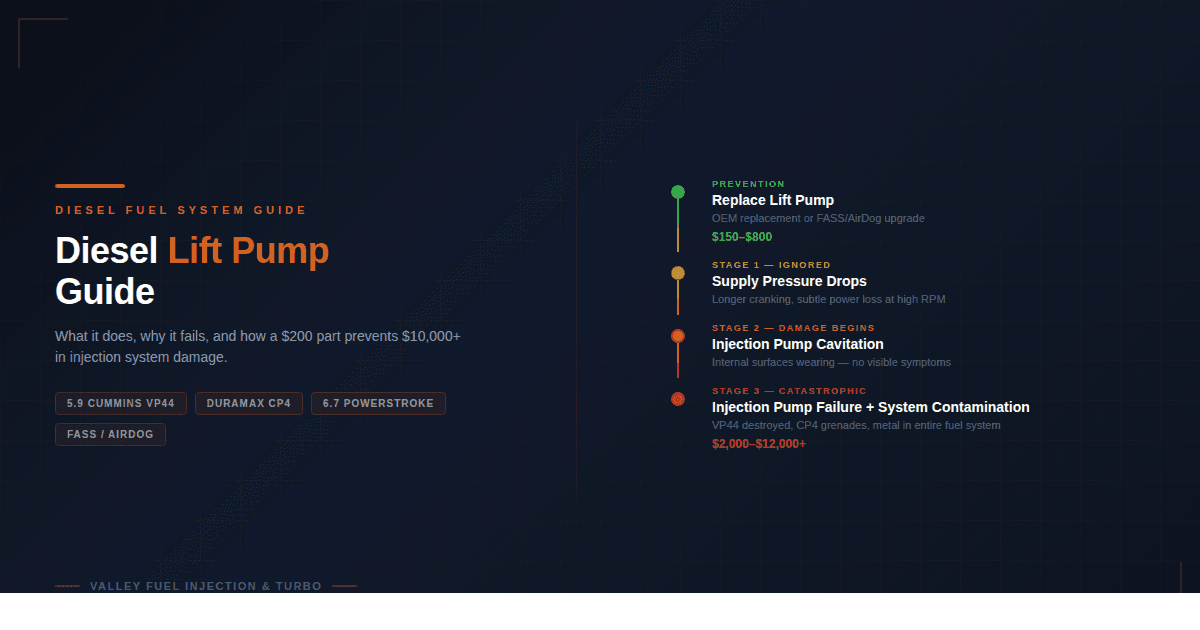
The Most Overlooked Component in Your Diesel Fuel System
Every diesel owner knows about injectors, turbochargers, and injection pumps. But the component that protects all of them — and that causes the most expensive collateral damage when it fails — is the one most people ignore until it’s too late: the lift pump.
A diesel lift pump (also called a fuel transfer pump or supply pump) does one job: it pulls fuel from the tank and delivers it at consistent pressure and volume to the high-pressure injection pump. It sounds simple. It is simple. But when the lift pump fails or underperforms, the consequences cascade through your entire fuel system — and the repair bills add up fast.
At Valley Fuel Injection & Turbo, we’re a Bosch-certified diesel injection center that rebuilds the injection pumps and injectors that lift pump failures destroy. We see the damage every week — scored VP44 rotors from fuel starvation, CP4 pumps full of metal because unfiltered fuel wore out the internals, and injectors that failed prematurely because contaminated fuel made it past inadequate filtration. The majority of these repairs could have been prevented with a properly functioning lift pump.
What a Diesel Lift Pump Actually Does
In a diesel fuel system, fuel has to travel from the tank (which is often below and behind the engine) to the high-pressure injection pump (which is on the engine). The lift pump handles this low-pressure supply side of the equation. Its responsibilities include:
Pulling fuel from the tank. The fuel tank on most trucks sits 4-6 feet below and behind the injection pump. Fuel doesn’t flow uphill on its own. The lift pump creates suction to draw fuel from the tank through the pickup tube and fuel lines to the engine.
Maintaining consistent supply pressure. The high-pressure injection pump — whether it’s a VP44, CP3, CP4, or mechanical Bosch/Stanadyne pump — needs a steady supply of fuel at a specific minimum pressure. Most systems require 8-15 PSI of supply pressure at the injection pump inlet. If supply pressure drops below spec, the injection pump cavitates (creates vacuum bubbles in the fuel), which causes internal wear, erratic fuel delivery, and eventually pump failure.
Providing adequate fuel volume. Pressure alone isn’t enough — the lift pump also needs to deliver enough volume (measured in gallons per hour) to keep up with the injection pump’s demand, especially under full load. A pump that can maintain pressure at idle but starves the injection pump at wide-open throttle under load is just as dangerous as a dead pump.
Pre-filtering fuel. The lift pump typically feeds fuel through one or more filters before it reaches the injection pump. On aftermarket systems, this includes water separation and 2-micron filtration — far finer than the factory 10-micron filter. Clean fuel is the single most important factor in injection system longevity.
What Happens When a Lift Pump Fails
This is where it gets expensive. A lift pump itself costs $150–$800 depending on type. The damage it causes when it fails costs $2,000–$12,000+. Here’s the chain of events:
Stage 1: Reduced Supply Pressure
The lift pump weakens but still moves some fuel. Supply pressure drops from the normal 8-15 PSI to 3-5 PSI. The injection pump works harder to pull fuel. You might notice slightly longer crank times, a subtle power loss at high RPM under load, or nothing at all. This stage can last weeks or months.
Stage 2: Cavitation Begins
As supply pressure drops further, the injection pump starts cavitating — creating tiny vacuum bubbles in the fuel. These bubbles collapse violently against internal pump surfaces (the same phenomenon that damages boat propellers). Cavitation rapidly wears cam lobes, plungers, bearings, and rotor surfaces inside the injection pump. The pump is being destroyed from the inside, and there are no external symptoms beyond what’s already present.
Stage 3: Injection Pump Damage
The cavitation damage accumulates. On a VP44 pump, scored internal surfaces cause erratic fuel delivery, timing faults, and eventually a no-start condition. On a CP4 pump, the damage can be catastrophic — the pump grenades, sending metal shrapnel through the fuel rail and into every injector. On mechanical pumps like Stanadyne DB2/DB4 units, cavitation wears the rotor and hydraulic head, requiring a complete rebuild.
Stage 4: System Contamination
Metal debris from the failed injection pump travels through the fuel rail, into injectors, and potentially back to the fuel tank through return lines. Now you’re replacing not just the injection pump, but injectors, fuel rail, high-pressure lines, and decontaminating or replacing the tank. On a CP4-equipped Duramax, this is the $8,000–$12,000 scenario described in our CP4 to CP3 conversion guide.
The math is brutal: A $150–$800 lift pump replacement prevents $2,000–$12,000+ in injection system damage. There is no repair in diesel maintenance with a better cost-to-prevention ratio.
Lift Pump Failure Symptoms
The challenge with lift pump failure is that early symptoms are subtle. By the time symptoms become obvious, damage to the injection pump may already be underway. Watch for:
- Longer crank times. If your diesel used to fire in 2-3 seconds and now takes 5-8 seconds, the injection pump may not be getting adequate fuel supply on startup. This is often the first symptom.
- Power loss under load. The truck feels normal at cruise but falls on its face when towing, climbing grades, or at wide-open throttle. The lift pump can keep up at low demand but starves the injection pump at high demand.
- Surging or stumbling at high RPM. Erratic fuel supply causes inconsistent injection pump output, which feels like a misfire or surge under acceleration.
- Engine stalling — especially hot. Some lift pumps (particularly the VP44-era Cummins factory pump) fail more readily when hot. The truck runs fine cold, stalls after reaching operating temperature, and restarts after cooling down.
- Fuel pressure gauge reading low. If you have a fuel pressure gauge (and you should), anything below 5 PSI at idle or below 10 PSI under load on most systems indicates a failing lift pump.
- Check engine light with injection pump codes. On electronically controlled systems, low fuel supply pressure causes the injection pump to set fault codes for rail pressure, timing, or fuel delivery — codes that look like injection pump problems but are actually supply-side problems. Many VP44s and CP4s have been condemned when the real issue was a $200 lift pump.
- Air in fuel lines or filter housing. A lift pump with worn seals can allow air into the suction side, causing air pockets that interrupt fuel delivery. If you’re repeatedly bleeding your fuel system and can’t find a line leak, the lift pump itself may be the source.
Lift Pumps by Platform: What’s in Your Truck
5.9 Cummins (1998.5–2002) — The Most Failure-Prone Factory Setup
The 24-valve 5.9 Cummins with the VP44 injection pump is the poster child for lift pump-related destruction. The factory lift pump (Cummins part #4988747 and variants) is a mechanical diaphragm pump mounted on the engine block, driven by the camshaft. It’s known for two critical weaknesses:
- It fails frequently. These pumps have a high failure rate, and when they fail, they often fail completely — zero fuel delivery. The VP44 depends entirely on the lift pump for fuel supply, and running a VP44 without adequate supply pressure will destroy it in minutes.
- Even when working, output is marginal. The factory pump was designed to meet — not exceed — the VP44’s minimum requirements. Any degradation in pump output puts the VP44 at risk.
This is why VP44 failures are so common on these trucks, and why a dead lift pump is the #1 suspect any time a VP44 fails. We’ve rebuilt hundreds of VP44 pumps, and the first question we always ask is: what was the condition of the lift pump?
Replacement options:
- OEM-style replacement — The Alliant Power AP4943048 Fuel Transfer Pump Kit is a direct-fit replacement for the factory pump. 50 GPH at 10 PSI, plug-and-play installation, and significantly more reliable than the original Cummins pump. This is the right choice if you want a stock-equivalent replacement at a reasonable price — around $285-$300 versus $400+ for the Cummins OEM part. Fits 1998.5–2002 Dodge Ram 5.9L with VP44 (frame-mounted pump location, not in-tank conversions).
- Aftermarket upgrade (FASS or AirDog) — If you want maximum protection, an aftermarket lift pump system from FASS or AirDog provides higher volume (95-150+ GPH), higher pressure (adjustable, typically 8-12 PSI), 2-micron filtration, and water separation. These systems cost $400-$800+ but provide significantly better fuel quality than any stock replacement. Strongly recommended if you’re running any aftermarket tuning or towing heavy regularly.
5.9/6.7 Cummins (2003–Present) — Improved but Not Bulletproof
The 2003+ common rail Cummins trucks use an electric in-tank fuel pump that feeds the CP3 (2003-2018) or CP3/updated high-pressure pump (2019+). The in-tank design is more reliable than the 98.5-02 mechanical pump, but it still fails — especially at high mileage or in trucks that frequently run the fuel tank low (the fuel cools and lubricates the pump, so running on fumes accelerates wear).
The good news: the CP3 is far more tolerant of marginal supply pressure than the VP44 was. A weakening lift pump on a CP3-equipped Cummins is less likely to cause catastrophic injection pump damage. You’ll notice power loss and fuel pressure codes before the CP3 sustains serious internal damage.
Aftermarket lift pump systems (FASS, AirDog) are still popular on these trucks for the filtration and water separation benefits, even though the factory fuel supply is more robust.
Duramax (2001–Present) — CP3 vs. CP4 Changes Everything
2001–2010 (LB7, LLY, LBZ, LMM with CP3): The factory fuel system uses a mechanical transfer pump integrated into the CP3 pump itself — there is no separate low-pressure lift pump from the factory. The CP3’s internal transfer pump pulls fuel from the tank through the factory filter. This system works adequately in stock form, but the CP3’s internal pump is doing double duty (low-pressure supply AND high-pressure injection), which means any restriction in the fuel supply — clogged filter, kinked line, fuel waxing in cold weather — puts extra load on the CP3.
Aftermarket lift pumps are a popular upgrade on these trucks to reduce the load on the CP3’s internal transfer pump and provide better filtration.
2011+ (LML, L5P with CP4): Same basic factory fuel supply design, but the stakes are dramatically higher because the CP4 is far less tolerant of fuel quality issues. As we covered in the CP4 to CP3 conversion guide, an aftermarket lift pump with 2-micron filtration and water separation is the single highest-impact preventive measure for protecting a CP4. The improved fuel quality and consistent supply pressure address the root cause of most CP4 failures.
If you do the CP4 to CP3 conversion, a lift pump isn’t just recommended — it’s essentially required, since the CP3 needs more supply volume than the factory system was designed to provide.
Ford Powerstroke
7.3L (1994–2003): Uses a cam-driven mechanical lift pump on the engine. Relatively reliable but output decreases with age. The HEUI injection system on the 7.3 is less sensitive to low fuel supply pressure than a VP44, but a failed lift pump still causes hard starting and power loss. Aftermarket electric lift pumps are a common upgrade.
6.0L (2003–2007): Uses an electric frame-mounted fuel pump. The 6.0 Powerstroke’s HEUI injection system is driven by oil pressure rather than fuel pressure, so lift pump failure primarily causes fuel starvation symptoms (hard start, no start, power loss) rather than injection pump damage. Still worth maintaining, but the failure mode is less catastrophic than on Cummins or Duramax platforms.
6.7L (2011–present): Uses a CP4.2 injection pump — the same pump that causes problems in the Duramax. The same lift pump and fuel quality recommendations apply: aftermarket lift pump with fine filtration significantly reduces CP4 failure risk. Ford’s factory filtration is better than GM’s, but an aftermarket system is still a worthwhile upgrade for trucks that tow or that will be kept long-term.
Agricultural & Industrial Equipment
Most agricultural diesel engines with mechanical injection pumps use either a mechanical diaphragm lift pump (driven by the engine’s camshaft) or a fuel transfer pump integrated into the injection pump itself. These systems are generally reliable but degrade with age — rubber diaphragms crack, check valves weaken, and mounting gaskets deteriorate.
On Kubota Tier 4 engines and other modern agricultural common rail systems, the fuel supply system is more critical. The electric lift pump on these systems needs to provide clean, pressurized fuel to the high-pressure pump. A failing lift pump on a Tier 4 tractor causes the same cavitation damage as on a truck — and the repair costs are just as high.
OEM Replacement vs. Aftermarket Lift Pump: Which Do You Need?
| OEM / Direct Replacement | Aftermarket (FASS / AirDog) | |
|---|---|---|
| Cost | $150–$400 | $400–$800+ |
| Flow Rate | 35–50 GPH | 95–260 GPH |
| Pressure | 8–15 PSI (fixed) | 5–15 PSI (adjustable) |
| Filtration | Factory 10-micron | 2-micron + water separation |
| Installation | Direct bolt-on | Requires mounting, wiring, plumbing |
| Best For | Stock trucks, budget replacement, daily drivers with light use | Towing, modified trucks, trucks with CP4, long-term reliability |
Our recommendation: If you’re replacing a failed factory lift pump and the truck is stock with light to moderate use, a quality OEM-equivalent replacement like the Alliant Power AP4943048 (for 98.5-02 Cummins) gets you back on the road reliably at a reasonable cost. If you tow regularly, run any aftermarket tuning, have a CP4-equipped truck, or just want maximum fuel system protection, an aftermarket FASS or AirDog system is the better long-term investment.
How to Know When Your Lift Pump Needs Attention
Install a fuel pressure gauge. This is the single most useful diagnostic tool for fuel supply issues. A mechanical gauge teed into the fuel line at the injection pump inlet costs $20–$40 and gives you real-time visibility into lift pump health. Normal readings are typically 8–15 PSI at idle and shouldn’t drop below 5 PSI under full load. If you see pressure dropping below spec, replace the lift pump before it causes downstream damage.
Check fuel pressure during VP44 or injection pump diagnosis. Before condemning an expensive injection pump, always verify fuel supply pressure. We see trucks come through where the owner or shop replaced a $1,500 VP44 when the real problem was a $200 lift pump. The new VP44 runs great for a while — until the same bad lift pump kills it again.
Replace proactively at high mileage. If you’re at 150,000+ miles on the original factory lift pump, consider replacing it during your next service interval. A new pump while you’re already working on the truck costs a fraction of what an emergency roadside failure costs — plus the potential injection pump damage.
Use quality fuel and additives. A lift pump’s job is easier when the fuel is clean. Stanadyne Performance Formula or similar additives improve fuel lubricity (which helps the lift pump’s internal components last longer) and provide water dispersal and detergency that reduce contamination throughout the system.
Valley Fuel Injection: Fuel System Specialists
Whether you need a lift pump replacement, injection pump diagnosis, or a complete fuel system evaluation, Valley Fuel Injection & Turbo has the equipment and expertise to get it right the first time.
- Injection pump rebuilds — VP44, Stanadyne DB2/DB4, Bosch inline, and common rail pumps
- Injector testing — bench testing on Bosch-certified equipment to diagnose fuel system problems accurately
- Lift pump parts — including the Alliant Power AP4943048 fuel transfer pump kit for 1998.5–2002 Cummins VP44 trucks
- Fuel additive sales — authorized Stanadyne Performance Formula dealer
- Nationwide mail-in service for injection pump and injector testing/rebuilds
Fuel System Problems? Don’t Guess — Diagnose.
Valley Fuel Injection & Turbo is a Bosch-certified diesel injection center specializing in fuel system diagnosis, injection pump rebuilds, and injector testing. Before you replace an expensive injection pump, let us verify whether the problem is the pump — or the lift pump feeding it.
We stock the Alliant Power AP4943048 fuel transfer pump for 5.9 Cummins VP44 trucks, Stanadyne fuel additives, and a full range of injection system parts.
📞 (530) 668-0818
📍 1243 E Beamer St, Suite C, Woodland, CA 95776
🕐 Monday – Friday, 7:00 AM – 4:30 PM PST
Serving: Sacramento · Woodland · Davis · Vacaville · Yuba City · Stockton · Chico · Redding · Reno · Nationwide mail-in service