
VP44 Injection System vs. Common Rail: A Technical Breakdown for Dodge Cummins Owners
09/24/2025
Why Your Diesel Engine Cranks But Won’t Start — 7 Common Causes (And How to Fix Them Fast)
11/12/2025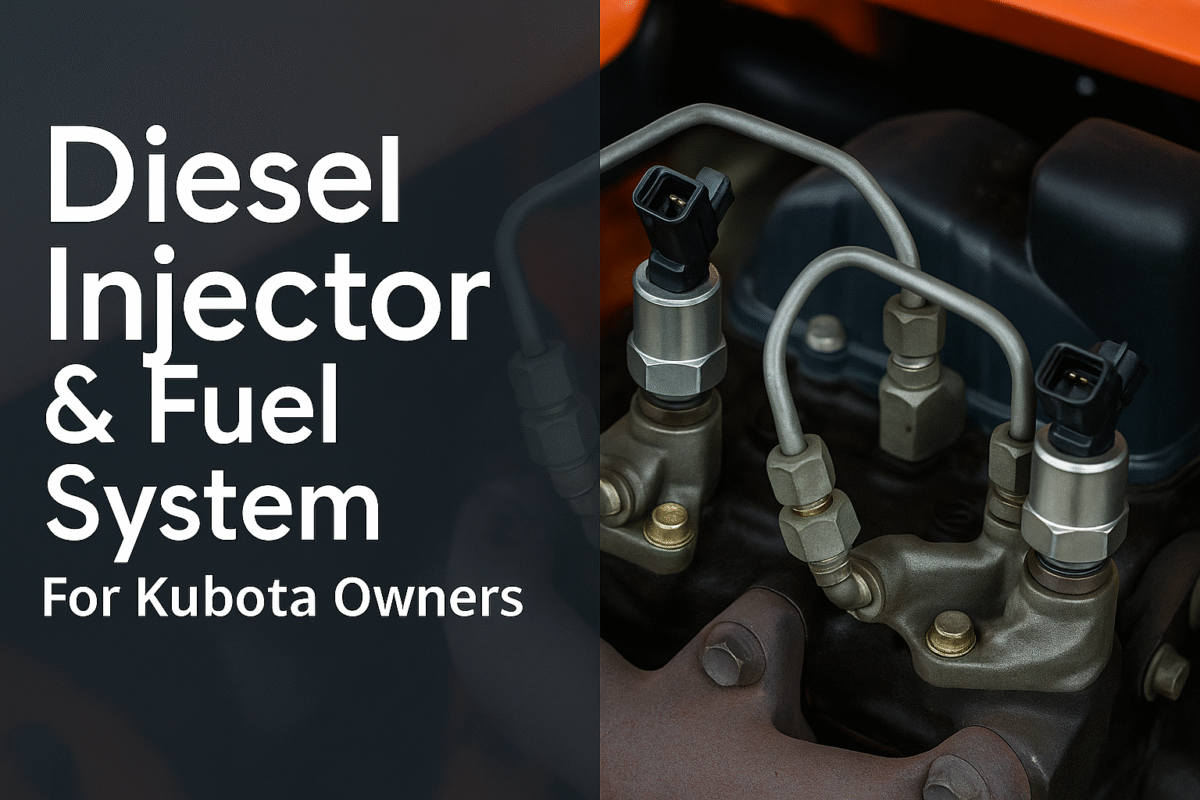
Published by Valley Fuel Injection & Turbo, Inc. | Woodland, CA
Authorized Kubota Engine Dealer & Bosch-Certified Diesel Specialists
Kubota diesel engines are built tough — they power everything from compact tractors and skid steers to generators, irrigation pumps, and industrial machinery across California’s Central Valley and beyond. But even Kubota’s legendary reliability depends on one critical system: the fuel injectors.
When Kubota injectors are clean and properly calibrated, your engine starts easily, runs smoothly, makes full power, and burns fuel efficiently. When they’re neglected, you get hard starts, rough running, black smoke, power loss, and eventually engine damage that costs far more than the maintenance would have.
As an authorized Kubota engine dealer, Valley Fuel Injection & Turbo services Kubota injection systems daily — from the small D902 and D1105 engines in compact equipment to the V2403 and V3307 engines in larger tractors and construction machinery. These 7 maintenance tips come directly from what we see in our shop and what prevents the most expensive repairs.
Why Kubota Injector Maintenance Matters More Than You Think
Kubota engines — especially the Tier 4 Final models that dominate current production — use precision fuel injection systems with extremely tight tolerances. The common rail injectors on newer Kubota engines operate at pressures exceeding 23,000 PSI, with nozzle holes smaller than a human hair.
At these tolerances, even small amounts of contamination, water, or carbon buildup degrade performance quickly. And because many Kubota-powered machines are used seasonally or intermittently — sitting idle between jobs — they’re especially vulnerable to fuel degradation problems that continuously operated engines never experience.
The good news: most Kubota injector problems are preventable with consistent, basic maintenance. Here are the 7 things that make the biggest difference.
1. Change Fuel Filters on Schedule — and Inspect What Comes Out
The fuel filter is your injectors’ first line of defense. Every particle of dirt, every drop of water, and every bit of rust that the filter catches is something that didn’t reach your injectors. When the filter clogs or saturates, that protection disappears.
- Replace filters every 200–500 hours depending on your model and operating conditions. Dusty agricultural environments, construction sites, and machines that refuel from portable tanks need more frequent changes.
- Always replace both primary and secondary filters at the same time. A fresh secondary with a clogged primary provides zero additional protection.
- Drain the water separator at every filter change — or more frequently in humid conditions. Water is the single most damaging contaminant for Kubota injector nozzles.
- Inspect the old filter. Cut it open if you can. Excessive dirt means contamination is getting into the tank. Rust flakes mean the tank is corroding internally. Any metallic debris is a red flag for pump or injector wear.
2. Use Clean, Fresh Diesel — and Treat Stored Fuel
Fuel quality is the biggest variable in injector life, and it’s the one most Kubota owners underestimate.
- Buy fuel from reputable, high-volume stations — their tanks turn over quickly, so fuel is fresh. Low-volume stations may have fuel sitting in underground tanks for weeks, accumulating water and microbial growth.
- Don’t let fuel sit in the machine for months. Diesel begins degrading within 30 days. If your equipment sits between seasons (harvest equipment, generators on standby, construction machinery between jobs), either run the tank low before storage and refill with fresh fuel before use, or add a fuel stabilizer.
- Use a lubricity additive. Ultra-Low Sulfur Diesel (ULSD) has significantly less natural lubricity than older diesel formulations. A quality lubricity additive protects injector internals and pump components. Use it consistently — not just when you remember.
- Avoid biodiesel blends above B20 unless your specific Kubota model is rated for it. Higher blends can accelerate injector deposit formation and interact poorly with certain seal materials.
- In cold weather, use winter-blend diesel or anti-gel additive. Gelled fuel clogs filters and starves injectors. If your Kubota powers equipment that runs year-round in Northern California’s cold Valley mornings, this matters.
3. Watch for Early Warning Signs — Don’t Ignore Them
Kubota injector problems rarely appear overnight. There are almost always warning signs that owners either don’t notice or choose to ignore until the problem becomes expensive.
Watch for these symptoms:
- Hard starting or extended cranking — especially cold starts. If it used to fire in 2 seconds and now takes 5-10, injector nozzles may be worn or carboned up.
- Rough or uneven idle — one or more injectors delivering inconsistent fuel amounts causes the engine to shake or “lope” at idle
- Black smoke under load — indicates incomplete combustion, often from poor fuel atomization due to worn injector nozzles
- White smoke at startup — unburned fuel passing through the cylinder, often a combination of worn injectors and glow plug issues in cold weather
- Loss of power — the machine doesn’t pull as hard, climb as well, or respond as quickly. Often so gradual the operator doesn’t notice until injectors are significantly degraded.
- Increased fuel consumption — worn injectors waste fuel. If you’re filling up more often with the same workload, injectors are a likely culprit.
If you notice any of these symptoms, don’t wait. A set of Kubota injectors tested and diagnosed early often means cleaning and recalibration rather than full replacement. For a complete breakdown of what to look for: 7 Diesel Injector Failure Symptoms →
4. Avoid Extended Idling — It’s Worse Than You Think
Extended idling is one of the most damaging operating habits for Kubota injectors, and it’s extremely common in agriculture and construction where machines idle while waiting for loads, operators, or conditions to change.
What happens during prolonged idle:
- Combustion temperatures drop well below optimal, causing incomplete fuel burn
- Unburned fuel washes past rings and dilutes engine oil (fuel dilution)
- Carbon deposits accumulate on injector nozzle tips because temperatures aren’t high enough to burn them off
- “Wet stacking” occurs — unburned fuel and carbon build up in the exhaust system
- On Tier 4 Kubota engines with DPF (diesel particulate filter), extended idling accelerates DPF loading and forces more frequent regeneration cycles
Best practices:
- If the machine will idle for more than 5 minutes, shut it down
- Periodically run equipment under moderate load to bring combustion temperatures up and burn off deposits
- For generators or standby equipment: run at 50%+ load for 30 minutes monthly to keep injectors clean and prevent wet stacking
5. Use Proper Torque and Installation Procedures
Improper injector installation is a surprisingly common cause of premature failure and fuel leaks on Kubota engines — especially when done by general mechanics unfamiliar with diesel injection tolerances.
- Always use a calibrated torque wrench. Over-torquing can crack the injector body or distort the nozzle seat. Under-torquing allows combustion gases to blow past the seal, causing carbon buildup and eventual injector damage.
- Replace copper sealing washers every time. Copper washers are single-use. Reusing an old washer virtually guarantees a leak, regardless of torque.
- Clean the injector bore thoroughly before installing new or remanufactured injectors. Carbon buildup in the bore prevents proper seating and can cause the new injector to fail prematurely.
- On common rail Kubota engines, ensure the return line connections are tight and leak-free. Even small return leaks cause rail pressure loss and hard starting.
- Follow the manufacturer’s injector coding procedure on Tier 4 engines with electronically controlled injectors. The ECU needs the correction codes from the new injectors to calibrate fueling properly.
6. Schedule Professional Testing and Cleaning
Even with perfect maintenance, injectors wear over time. Professional bench testing and cleaning is the most cost-effective way to extend injector life and catch problems before they become failures.
- Bench testing measures actual spray pattern, flow rate, opening pressure, and return volume on calibrated equipment. It gives you definitive answers — not guesses — about which injectors are good, which need cleaning, and which need replacement.
- Ultrasonic cleaning removes carbon deposits from nozzle tips and internal passages that field cleaning can’t reach
- Recalibration restores opening pressure and spray pattern to OEM specifications
When to schedule professional testing:
- Every 3,000–5,000 hours on commercial/fleet equipment
- Whenever symptoms appear (rough running, smoke, power loss)
- Before a busy season — test and service injectors during downtime rather than during harvest or construction season when the machine can’t be down
At Valley Fuel Injection, we test Kubota injectors on Bosch-certified equipment to OEM specifications. We can test, clean, recalibrate, or replace — and we’ll recommend only what’s actually needed. See how we test injectors →
7. Use Genuine or OEM-Equivalent Parts
Aftermarket Kubota injectors vary enormously in quality. The cheapest options often use inferior nozzle materials, have loose tolerances, and fail far sooner than genuine parts — costing more in the long run when you factor in downtime and repeat replacement.
- Genuine Kubota parts are the gold standard for OEM fit and calibration
- Bosch-remanufactured injectors are rebuilt to original specifications with new nozzles and tested to OEM standards — a cost-effective alternative to genuine parts
- Avoid no-name imports. If the price seems too good to be true for a Kubota injector, it is. We’ve tested cheap aftermarket injectors that were out of spec straight out of the box.
- Keep records. Log every filter change, injector replacement, fuel additive treatment, and symptom observation. This history is invaluable for diagnosing future issues and maintaining warranty compliance.
As an authorized Kubota engine dealer, Valley Fuel Injection stocks genuine Kubota parts alongside Bosch-remanufactured alternatives. We’ll match the right injectors to your specific engine model — D902, D1105, V2203, V2403, V3307, or any other Kubota application.
Common Kubota Engine Models and Their Injection Systems
Kubota uses different injection systems depending on the engine generation and emissions tier. Knowing which system your engine uses helps you understand its specific maintenance needs:
- D902, D1105, V1505 (pre-Tier 4): Indirect injection with mechanical injectors. Simpler system, very durable, but nozzles still wear and need periodic testing/replacement.
- V2403, V3307 (Tier 4 Interim/Final): Direct injection with common rail fuel system. Higher pressure, tighter tolerances, more sensitive to fuel quality. These engines need the most attention to filtration and fuel quality. Read about Tier 4 Kubota injector problems →
- V2607, V3800 (Tier 4 Final): Advanced common rail with DPF and EGR. Injector maintenance directly affects emissions system performance — worn injectors increase DPF loading and force more frequent regeneration.
Kubota Injector Service — Testing, Cleaning, Parts
Valley Fuel Injection is an authorized Kubota engine dealer and Bosch-certified diesel injection center. We stock genuine Kubota parts, test injectors to OEM specs, and service every Kubota injection system from mechanical to common rail.
Call (530) 668-0818 or contact us online
Valley Fuel Injection & Turbo, Inc.
1243 E Beamer St, Suite C, Woodland, CA 95776
Monday–Friday, 7:00 AM – 4:30 PM PST
Serving Sacramento, Davis, Woodland, Yuba City, Stockton, Chico, Redding, and all of Northern California.
Related reading: Kubota Tier 4 Injector Problems · Diesel Injector Failure Symptoms · How Injectors Are Tested · CP4 Pump Failures · Diesel Engine Maintenance Services · Yanmar Engine Parts & Service