

Mail-In Diesel Injector Testing: Ship from Anywhere in the U.S.
02/22/2026
John Deere Injection Pump Problems: Symptoms, Causes & Rebuild Options
02/22/2026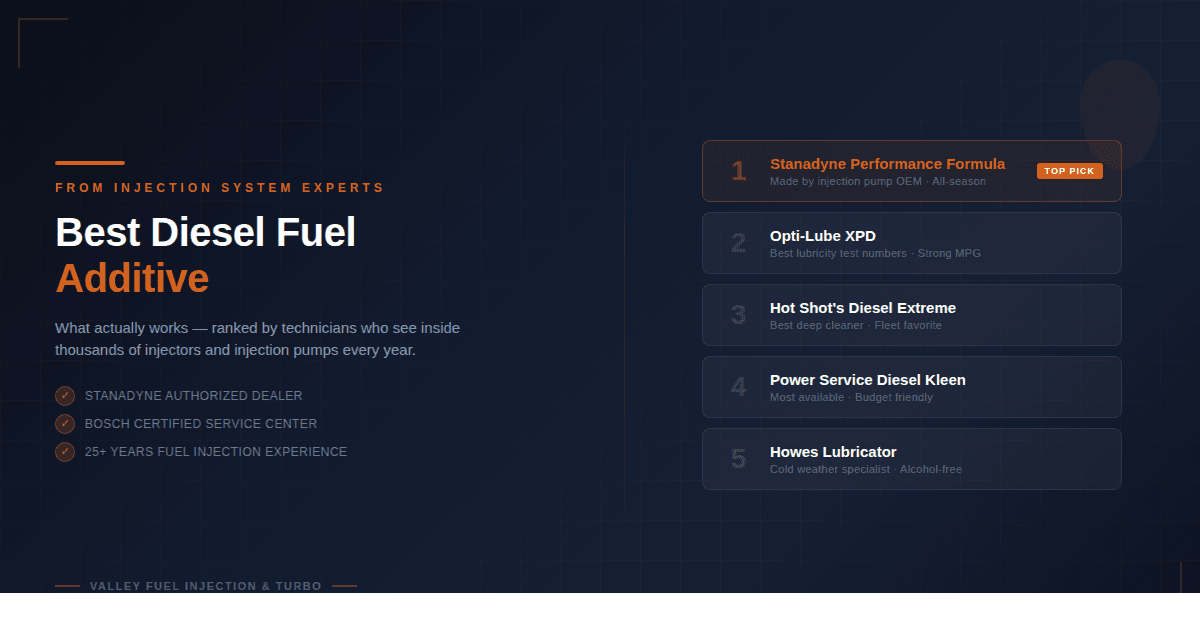
Why Listen to Us About Fuel Additives?
There are hundreds of articles ranking diesel fuel additives. Most of them are written by people who have never seen the inside of an injection pump or pulled carbon off a set of injectors.
We have. Valley Fuel Injection & Turbo is a Bosch, Stanadyne, Delphi, Denso, and Yanmar authorized service center that tests, rebuilds, and calibrates diesel fuel injectors and injection pumps every day. We see what fuel does to injection systems from the inside — the varnish deposits, the scored plungers, the carbon-packed nozzle tips, the corroded check valves. We see the difference between engines that run quality additives and engines that don’t. After thousands of teardowns over decades, we have opinions backed by physical evidence.
We’re also an authorized Stanadyne dealer — we sell Stanadyne Performance Formula and their other additive products. We’ll be upfront about that. But we recommend it because of what we see on the test bench, not because it’s on our shelf. We’ll cover the other major brands fairly and tell you what actually matters when choosing a diesel fuel additive.
Why Diesel Fuel Needs an Additive in the First Place
If you’re running a diesel built before 2007, this is important. If you’re running anything newer, it’s critical.
ULSD Changed Everything
In 2006, the EPA mandated Ultra Low Sulfur Diesel (ULSD) — reducing sulfur content from 500 parts per million down to 15 ppm. That was necessary for modern emissions equipment (DPF, SCR, DEF systems) to function. But sulfur wasn’t just a pollutant — it was a natural lubricant. Removing 97% of the sulfur removed a significant portion of the fuel’s ability to protect the precision surfaces inside injection pumps and injectors.
Modern common rail systems operate at 25,000-30,000+ PSI. The fuel itself is the only lubricant for the internal components of your injectors and high-pressure pump. When that fuel has reduced lubricity, internal wear accelerates — and at those pressures, even microscopic wear changes how the system performs.
What a Good Additive Actually Does
Not all additive claims are equal. Here’s what matters and what’s marketing:
Lubricity improvement — this is the big one. Replacing the lubricity lost when sulfur was removed from diesel fuel. This directly protects injection pump internals, injector needle valves, and high-pressure pump components from accelerated wear. If an additive does nothing else, lubricity improvement alone justifies its use.
Cetane boost. Higher cetane means shorter ignition delay — the fuel fires faster after injection. This produces smoother combustion, less knock, easier cold starting, and slightly better fuel economy. Most pump diesel is 40-42 cetane; premium diesel is 45-48. A good additive can add 3-5 cetane numbers.
Detergency/deposit cleanup. Detergent additives dissolve varnish and carbon deposits on injector nozzle tips and in injection pump passages. Clean injectors atomize fuel better, which means more complete combustion, less smoke, and better efficiency. We see the difference — injectors from engines running quality detergent additives consistently have cleaner nozzle tips during injector testing.
Water dispersal. Small amounts of water in diesel fuel are inevitable (condensation in tanks, handling, storage). A good additive emulsifies trace water so it passes through the combustion process harmlessly rather than collecting in fuel filters or — worse — reaching your injectors, where it causes corrosion and erosion at 25,000 PSI.
Cold weather protection. Anti-gel additives prevent wax crystal formation that clogs fuel filters in cold weather. Essential in northern climates, less relevant in California — but worth having if you operate nationally or in the mountains.
Fuel stabilizer. Prevents oxidation and degradation during storage. Important for seasonal equipment (tractors, generators, boats), less critical for daily-driven trucks.
The Additives We Recommend (and Why)
#1: Stanadyne Performance Formula
This is what we use, sell, and recommend to every customer who walks through our door. Here’s why:
Stanadyne manufactures injection pumps. They’re not a chemical company that decided to make a fuel additive — they’re the company that makes the Stanadyne DB2, DB4, and DE injection pumps found in millions of diesel engines worldwide. They developed Performance Formula specifically to protect the systems they build. When the company that machines fuel injection components to 0.0001″ tolerances tells you what to put in your fuel, that carries weight.
It’s the only additive made by an injection system manufacturer. Every other additive on this list is made by a chemical or petroleum company. Stanadyne is the only one that also happens to rebuild the pumps and test the injectors their additive is designed to protect.
What it does:
- Lubricity improvement exceeding ASTM D975 requirements
- Cetane boost (typically 3-5 numbers)
- Injector and pump deposit cleanup (detergent package)
- Water demulsification
- Anti-gel protection (the Performance Formula is an all-season product — Stanadyne also offers a separate Winter 1000 formula for extreme cold)
- Corrosion inhibitor
- Fuel stabilizer
What we see on the bench: Engines that run Stanadyne Performance Formula consistently show cleaner injector internals, less varnish in pump passages, and better spray patterns during testing. It’s not a miracle product — it won’t fix a mechanically worn injector — but it measurably slows the wear process and keeps clean components clean longer.
Cost: Approximately $0.04-$0.06 per gallon treated (16 oz bottle treats 60 gallons). Not the cheapest option, but not the most expensive either.
Approved by: John Deere, Caterpillar, Ford, GM, Navistar/International, and other major OEMs have tested and/or approved Stanadyne additives for use in their engines.
#2: Opti-Lube XPD
Opti-Lube has built a strong following in the diesel truck community, and their XPD (Xtreme Performance & Detergency) formula delivers genuinely good results.
Strengths: Excellent lubricity numbers in independent testing — Opti-Lube consistently scores at or near the top in HFRR (High Frequency Reciprocating Rig) lubricity tests. Strong detergent package. Many users report measurable MPG improvements (0.5-1.5 MPG), which is more than most additives can credibly claim.
Considerations: Opti-Lube is a chemical company, not an injection system manufacturer. That doesn’t mean the product is bad — it’s clearly good — but the R&D perspective is different. They optimize for test bench numbers; Stanadyne optimizes for what they see when they take pumps apart.
Cost: Approximately $0.05-$0.08 per gallon treated depending on size purchased. Competitive with Stanadyne.
Best for: Truck owners who want maximum lubricity and MPG improvement and prefer buying from an additive-focused company.
#3: Hot Shot’s Secret Diesel Extreme
Hot Shot’s Secret has earned credibility in the diesel performance and fleet world. Their Diesel Extreme is a concentrated cleaner/additive hybrid.
Strengths: Aggressive detergent package — this is one of the strongest deposit cleaners on the market. If you’re taking over a truck with unknown maintenance history or suspect significant injector deposits, Diesel Extreme is a good “reset” treatment. Also provides solid lubricity improvement and cetane boost.
Considerations: The aggressive cleaning action means it can loosen deposits that then need to be caught by the fuel filter. On a very dirty system, you might need to change the fuel filter after the first treatment. That’s actually a sign it’s working — but be prepared for it.
Cost: Approximately $0.08-$0.12 per gallon treated. More expensive than Stanadyne or Opti-Lube for regular use, but excellent as a periodic deep-clean treatment.
Best for: Periodic deep cleaning (every oil change or quarterly), fleet maintenance programs, engines with suspected deposit issues.
#4: Power Service Diesel Kleen + Cetane Boost
Power Service is probably the most widely available diesel additive — you can find the silver bottle at virtually any truck stop, auto parts store, or Walmart. That availability is its biggest strength.
Strengths: Widely available, affordable, decent cetane boost. The winter formula (white bottle — Diesel Fuel Supplement + Cetane Boost) is one of the most popular anti-gel products on the market and works well for cold weather protection.
Considerations: Lubricity improvement is adequate but not class-leading. Detergency is moderate. It’s a solid “better than nothing” additive, but testing data shows it doesn’t match Stanadyne, Opti-Lube, or Hot Shot’s in lubricity or cleaning power. Many forum users who’ve tried multiple brands report switching away from Power Service after trying the alternatives.
Cost: Approximately $0.03-$0.05 per gallon treated. The cheapest option on this list.
Best for: Budget-conscious users, emergency anti-gel situations (the winter formula is excellent), and cases where availability matters more than maximum performance.
#5: Howes Lubricator Diesel Treat
Howes has been around since 1920 and has a loyal following, particularly among long-haul truckers and fleet operators.
Strengths: Good all-around additive with solid anti-gel performance. Alcohol-free formula (some competitors use alcohol-based solvents that can affect certain seal materials). Strong cold weather reputation.
Considerations: Doesn’t contain a cetane improver in the standard formula — if cetane boost is important to you, you’ll need a different product or a supplemental cetane booster. Lubricity numbers are good but not outstanding in comparative testing.
Cost: Approximately $0.04-$0.06 per gallon treated. Competitive pricing.
Best for: Cold climate operations, users who prefer alcohol-free formulations, long-haul trucking.
What About 2-Stroke Oil and ATF in Diesel Fuel?
You’ll see this discussed in every diesel forum — adding a small amount of 2-stroke outboard oil (TCW-3 rated) or automatic transmission fluid (ATF) to diesel fuel for lubricity. Here’s our take:
2-stroke oil at 1-2 oz per 5 gallons does add lubricity. There’s legitimate chemistry behind it — TCW-3 oils contain ashless detergents and anti-wear compounds that supplement ULSD. Many fleet operators and long-time diesel owners swear by it. It won’t hurt anything at reasonable ratios, and it’s cheap. However, it doesn’t provide cetane boost, anti-gel protection, or the comprehensive additive package you get from a purpose-built diesel fuel additive. Think of it as a lubricity supplement, not a complete fuel treatment.
ATF is more controversial. It does contain detergents and friction modifiers, and some people report cleaner-running engines. But ATF isn’t formulated for combustion — it’s designed for hydraulic systems and clutch packs. The detergent composition isn’t optimized for injection system deposits, and at higher concentrations it can affect fuel system seals. We don’t recommend it when proper diesel additives are readily available.
How to Choose: What Matters for YOUR Engine
The “best” additive depends on your situation:
Modern common rail truck (Cummins, Duramax, Powerstroke): Lubricity is your top priority. Your injectors and high-pressure pump operate at extreme pressures where fuel lubricity directly impacts service life. Stanadyne Performance Formula or Opti-Lube XPD are the strongest choices. Use every tank — consistency matters more than occasional use. This is cheap insurance against injector problems and CP4 pump failures.
Older mechanical diesel (12-valve Cummins, 7.3 IDI, pre-common-rail): These engines are more tolerant of fuel quality variations, but they still benefit from lubricity and detergency. The VP44 injection pump in particular is sensitive to fuel quality. Stanadyne is especially relevant here since they manufactured many of the injection pumps in these older engines.
Agricultural equipment (tractors, combines, skid steers): Equipment that sits between seasons, runs in dusty conditions, and often gets fuel from on-farm tanks with variable quality needs a comprehensive additive. Lubricity, stabilizer, water dispersal, and detergency all matter. Stanadyne Performance Formula is the standard recommendation for tractor injection pump longevity — it’s what we tell every farmer who brings a pump in for rebuild. The money spent on additive is a fraction of a Stanadyne pump rebuild.
Cold climate operation: Anti-gel is non-negotiable. Stanadyne Performance Formula provides moderate anti-gel protection; for extreme cold (below 0°F), supplement with Stanadyne Winter 1000 or Power Service white bottle. Howes is also excellent for cold weather.
Fleet operations: Consistency and cost-per-gallon matter at scale. Stanadyne offers bulk pricing (5-gallon jugs and drums). Hot Shot’s Secret Diesel Extreme works well as a quarterly deep-clean treatment combined with a daily-use additive like Stanadyne or Opti-Lube.
How Much Does Fuel Additive Cost vs. What It Saves?
Let’s do the math on a typical diesel truck running 15,000 miles per year at 18 MPG:
| Item | Cost |
|---|---|
| Gallons per year | ~833 gallons |
| Stanadyne Performance Formula per year | ~$40-$50 (bulk pricing) |
| Set of 6 common rail injectors (Cummins) | $1,500-$3,300 |
| CP4 injection pump replacement | $2,000-$4,000+ |
| High-pressure pump + injectors + contamination cleanup | $5,000-$10,000+ |
You’re spending $40-$50 per year to protect $5,000-$10,000+ worth of fuel injection components. That’s not marketing — that’s basic math. Even if additive only extends your injector life by 20% (and evidence suggests it does more than that), the return on investment is enormous.
For agricultural equipment, the calculus is even more favorable. A tractor injection pump rebuild runs $400-$1,800. A year’s worth of Stanadyne additive for a farm tractor costs $15-$25. That’s a no-brainer.
Additives to Avoid
We won’t name specific brands, but avoid any diesel additive that:
Claims to “fix” mechanical problems. No additive will repair a worn injector nozzle, a scored pump plunger, or a failed solenoid. If your engine has a mechanical fuel system problem, it needs mechanical repair — not a bottle of miracle fluid. Additives prevent wear; they don’t reverse it.
Contains alcohol as a primary ingredient. Some cheap “fuel treatments” are mostly isopropyl alcohol with a small amount of detergent. Alcohol can affect seals in older fuel systems and doesn’t provide the lubricity improvement that modern diesel engines need.
Makes MPG claims over 10%. Independent testing shows that the best additives provide 2-5% fuel economy improvement through better cetane and cleaner injectors. Claims of 10-20% improvement are not credible. If your fuel economy improved that much after using an additive, you had a significant deposit problem that was already costing you — the additive fixed an existing issue, it didn’t create magical efficiency.
Has no independent test data. Reputable additive manufacturers publish or reference independent lubricity testing (HFRR/BOCLE), cetane testing (ASTM D613), and other standardized test results. If a brand can’t point to third-party testing, be skeptical.
How We Use Additives at VFI
When we rebuild an injection pump or return a set of tested injectors to a customer, we recommend Stanadyne Performance Formula with every single order. Not as an upsell — as preventive maintenance advice from people who see what happens when injection systems aren’t protected.
We stock Stanadyne Performance Formula, Stanadyne Lubricity Formula, and Stanadyne Winter 1000 at our Woodland, California shop. If you’re local, stop by and pick some up. If you’re a mail-in customer who just had injectors tested or a pump rebuilt, add it to your maintenance routine — the cost is trivial compared to the work we just did on your fuel system.
Frequently Asked Questions
What is the best diesel fuel additive for common rail engines?
For common rail diesel engines (Cummins 6.7L, Duramax, Powerstroke 6.7L), we recommend Stanadyne Performance Formula as the best all-around diesel fuel additive. It provides the lubricity improvement that high-pressure common rail systems need, along with cetane boost, detergency, and water dispersal. Opti-Lube XPD is a strong alternative with excellent independent lubricity test results. The key is consistency — use a quality additive every fill-up, not occasionally.
Is Stanadyne Performance Formula worth the cost?
At approximately $40-$50 per year for a typical diesel truck, Stanadyne Performance Formula costs a fraction of the fuel injection components it protects. A single common rail injector costs $250-$550; a high-pressure pump runs $1,000-$3,000+. Stanadyne is the only fuel additive manufactured by an injection system OEM — the same company that builds Stanadyne injection pumps developed this additive specifically to protect injection system internals. From our perspective as an authorized Stanadyne dealer who sees inside these systems daily, it’s one of the cheapest insurance policies available for a diesel engine.
Can I use 2-stroke oil instead of diesel fuel additive?
TCW-3 rated 2-stroke oil at 1-2 oz per 5 gallons does add lubricity to diesel fuel and won’t damage your engine at reasonable ratios. However, it doesn’t provide cetane boost, anti-gel protection, water dispersal, or deposit cleaning — it’s a lubricity supplement only. A purpose-built diesel fuel additive provides a more comprehensive package. Some diesel owners use both: a quality additive for the complete treatment plus a small amount of 2-stroke oil for extra lubricity insurance.
How often should I use diesel fuel additive?
Every fill-up. Consistency is more important than concentration. Using a quality additive every tank provides continuous protection to your injection system. Occasional use is better than nothing, but you lose the cumulative benefit of consistent detergency and lubricity. For deep cleaning treatments like Hot Shot’s Diesel Extreme, quarterly or at every oil change is a good schedule, in addition to your regular daily-use additive.
Do diesel fuel additives actually improve fuel economy?
Independent testing shows that quality diesel additives can improve fuel economy by 2-5% through cetane improvement (more complete combustion) and deposit cleanup (better injector spray patterns). Trucks with significant existing deposits may see larger initial improvements as the additive cleans the system. Claims of 10%+ improvement are not credible for a healthy engine. The fuel economy benefit alone often covers the cost of the additive, making the injector protection essentially free.
What diesel fuel additive is best for tractors and farm equipment?
Stanadyne Performance Formula is the standard recommendation for agricultural diesel equipment. Farm tractors face unique fuel quality challenges — on-farm fuel storage tanks, seasonal use with long storage periods, and dusty operating conditions. Stanadyne provides lubricity, stabilization, water dispersal, and detergency in one product. It’s particularly important for equipment with Stanadyne injection pumps (common in John Deere, Case IH, and Ford tractors), but benefits all diesel injection systems. The cost is $15-$25 per year for a typical farm tractor — trivial compared to a $400-$1,800 injection pump rebuild.
Does Valley Fuel Injection sell Stanadyne fuel additives?
Yes. As an authorized Stanadyne dealer, we stock Stanadyne Performance Formula, Stanadyne Lubricity Formula, and Stanadyne Winter 1000 at our Woodland, California shop. We also recommend Stanadyne additives to every customer who has injectors tested or injection pumps rebuilt through our mail-in service. Call (530) 668-0818 for pricing and availability.
Protect Your Diesel Injection System
Valley Fuel Injection & Turbo is an authorized dealer for Stanadyne, Bosch, Delphi, Denso, and Yanmar. We sell Stanadyne fuel additives and provide professional injector testing, injection pump rebuilds, and complete fuel system service.
📞 (530) 668-0818
📍 1575 East St, Woodland, CA 95776
🕐 Monday – Friday, 8:00 AM – 5:00 PM
Serving: Woodland · Sacramento · Davis · Vacaville · Yuba City · Stockton · Chico · Redding · Nationwide mail-in service