
Diesel Technician Career Guide: Training & Job Outlook 2026
04/05/2026
Diesel Engine High Idle RPM: 7 Causes and How to Fix It
04/08/2026
A diesel engine misfire creates a distinct rough idle, power loss, and unusual vibrations that diesel owners often mistake for other issues. While diesels don’t “misfire” in the traditional spark plug sense, they experience combustion irregularities that produce similar symptoms when fuel injection timing, compression, or air delivery goes wrong.
Diesel “misfires” are actually combustion irregularities caused by fuel injection problems, compression loss, or air delivery issues. The symptoms mirror gasoline misfires but require different diagnostic approaches focused on injection timing, fuel pressure, and cylinder compression.
What Does a Diesel Engine Misfire Feel Like?
A diesel engine misfire feels like a rough, uneven idle with noticeable vibrations through the steering wheel and floor. You’ll experience power loss during acceleration, especially under load, and the engine may produce unusual knocking or rattling sounds.
The most common symptoms we see at our Woodland shop include:
- Rough idle: The engine shakes and vibrates more than normal at idle
- Power loss: Reduced acceleration and pulling power, especially noticeable when towing
- Unusual engine noise: Knocking, rattling, or irregular combustion sounds
- Increased exhaust smoke: Black, white, or blue smoke indicating incomplete combustion
- Poor fuel economy: Decreased miles per gallon due to inefficient combustion
- Engine hesitation: Stumbling or jerky acceleration when pressing the throttle
Diesel engines can lose up to 25% of their power output when experiencing combustion irregularities, making early diagnosis crucial for preventing expensive engine damage.
Can Diesel Engines Actually Misfire?
Diesel engines don’t technically “misfire” like gasoline engines because they don’t use spark plugs for ignition. Instead, diesels experience combustion irregularities when the precise fuel injection timing, compression ratios, or air-fuel mixture gets disrupted.
The Society of Automotive Engineers defines diesel combustion irregularities as variations in cylinder-to-cylinder combustion timing or incomplete fuel burn cycles. These create symptoms identical to gasoline misfires but stem from different root causes.
In our 30+ years of diesel fuel injection service, we’ve diagnosed thousands of “misfiring” diesels that were actually experiencing:
- Injection timing problems: Fuel delivered too early or late in the compression cycle
- Fuel pressure variations: Inconsistent fuel delivery between cylinders
- Compression loss: Reduced cylinder pressure affecting combustion quality
- Air delivery issues: Turbocharger or intake system problems disrupting air-fuel ratios
When customers describe “diesel misfire” symptoms, we immediately focus on fuel injection system diagnostics rather than traditional ignition-related troubleshooting used on gasoline engines.
What Causes Diesel Engine Misfires?
Diesel engine misfires result from eight primary causes that disrupt the precise fuel injection and combustion process. Based on our diagnostic experience, fuel injection problems account for roughly 70% of diesel misfire complaints.
1. Faulty Fuel Injectors
Worn or clogged fuel injectors create uneven fuel spray patterns, leading to incomplete combustion and rough engine operation. We’ve tested thousands of injectors and found that even minor wear can cause noticeable performance issues.
Common injector problems include:
- Worn injector nozzles creating poor spray patterns
- Carbon buildup blocking fuel flow
- Internal seal failures causing fuel pressure loss
- Electrical connector corrosion affecting injector timing
2. Low Fuel Pressure
Insufficient fuel pressure prevents proper atomization and injection timing, especially problematic in common rail systems that require precise pressure control. Modern diesels need 1,800-2,500 bar (26,000-36,000 psi) for optimal combustion.
3. Contaminated Fuel
Water, dirt, or biological growth in diesel fuel disrupts combustion and damages injection components. The EPA’s renewable fuel standards have increased fuel quality variability, making contamination more common.
4. Compression Loss
Low cylinder compression reduces combustion chamber temperatures and pressures needed for proper diesel ignition. Worn piston rings, cylinder walls, or valve seals commonly cause compression problems.
5. Turbocharger Issues
Turbocharger problems reduce air delivery, disrupting air-fuel ratios essential for complete combustion. Our turbocharger service department regularly sees boost pressure loss causing misfire-like symptoms.
6. EGR System Problems
Exhaust Gas Recirculation (EGR) system malfunctions alter combustion chamber conditions, particularly affecting idle quality and low-speed operation where EGR flow is highest.
7. Fuel System Air Leaks
Air leaks in fuel lines, connections, or the lift pump create inconsistent fuel delivery and pressure fluctuations that mimic misfire symptoms. These are particularly common on older diesel trucks with high mileage.
8. Engine Timing Issues
Incorrect injection timing or camshaft timing problems disrupt the precise fuel delivery sequence needed for smooth diesel operation. This often occurs after engine rebuilds or timing component failures.
| Cause | Primary Symptoms | Repair Complexity |
|---|---|---|
| Faulty Injectors | Rough idle, black smoke | Moderate |
| Low Fuel Pressure | Power loss, hard starting | Simple to Complex |
| Contaminated Fuel | Erratic idle, white smoke | Simple |
| Compression Loss | Hard starting, blue smoke | Complex |
How Do You Diagnose a Diesel Misfire?
Diagnosing a diesel engine misfire requires systematic testing of fuel injection pressure, injector performance, and cylinder compression. We use specialized diesel diagnostic equipment that most general repair shops don’t have access to.
Our diagnostic process follows this sequence:
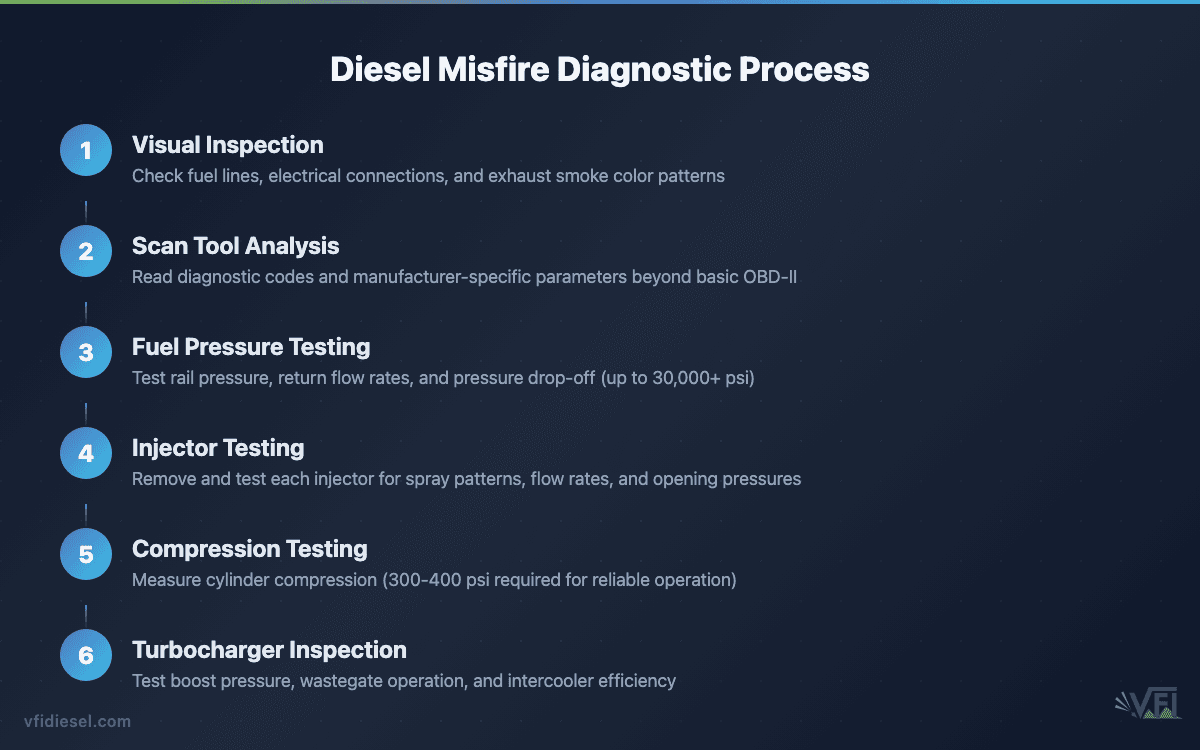
Step 1: Visual Inspection
We start with a thorough visual inspection of fuel lines, electrical connections, and exhaust smoke color. Black smoke typically indicates fuel-rich conditions, while white smoke suggests fuel contamination or injection timing problems.
Step 2: Scan Tool Analysis
Modern diesels store diagnostic trouble codes that pinpoint specific system failures. We use professional-grade scan tools that access manufacturer-specific parameters beyond basic OBD-II codes.
Step 3: Fuel Pressure Testing
We test fuel rail pressure, return flow rates, and pressure drop-off to identify fuel system problems. Common rail systems require specialized pressure gauges capable of reading 30,000+ psi accurately.
Never attempt to test common rail fuel pressure without proper safety equipment. Pressures exceeding 30,000 psi can cause severe injury or death if proper procedures aren’t followed.
Step 4: Injector Testing
We remove and test each injector on our Bosch-certified test equipment to measure spray patterns, flow rates, and opening pressures. This reveals injector-specific problems that cause uneven combustion.
Step 5: Compression Testing
Cylinder compression testing identifies internal engine problems affecting combustion quality. Diesel engines typically require 300-400 psi compression for reliable starting and smooth operation.
Step 6: Turbocharger Inspection
We test boost pressure, wastegate operation, and intercooler efficiency to ensure proper air delivery. Turbocharger problems often create symptoms similar to fuel injection issues.
If you’re experiencing power loss under load or surging at idle, these could be related misfire symptoms that require professional diagnosis.
When Should You Test Your Diesel Injectors?
You should test your diesel injectors immediately when experiencing rough idle, power loss, or unusual exhaust smoke, as these symptoms indicate potential combustion problems that worsen over time. Early testing prevents expensive engine damage and maintains optimal fuel economy.
Schedule injector testing when you notice:
- Rough idle lasting more than a few seconds after engine warm-up
- Power loss during acceleration or while climbing hills
- Increased fuel consumption without changes in driving habits
- Unusual exhaust smoke colors or density
- Engine hesitation or stumbling during throttle application
- Hard starting problems when the engine is warm
We recommend preventive injector testing every 100,000-150,000 miles on high-mileage diesel trucks, especially those used for towing or commercial applications. Fleet operators in Sacramento and surrounding areas often schedule annual injector testing to prevent unexpected breakdowns.
Don’t wait for severe symptoms before testing injectors. We’ve seen minor injector problems cause catalytic converter and turbocharger damage when left untreated, turning a $800 injector repair into a $4,000+ engine rebuild.
Professional injector testing involves removing injectors and testing them on calibrated equipment that measures:
- Spray pattern quality and fuel atomization
- Flow rate consistency between cylinders
- Opening and closing pressure specifications
- Internal leakage rates
- Electrical response timing
Unlike DIY injector cleaning methods, professional testing identifies specific performance parameters that determine whether injectors need cleaning, rebuilding, or replacement.
How Much Does Diesel Misfire Repair Cost?
Diesel misfire repair costs range from $200-$5,000 depending on the root cause, with fuel injector problems typically costing $800-$2,500 and engine compression issues requiring $3,000-$5,000+ for major repairs. Early diagnosis keeps costs on the lower end of this range.
Most diesel misfire repairs we complete fall in the $800-$1,500 range when caught early. Delaying repairs often doubles or triples the final cost due to secondary damage.
Here’s our typical cost breakdown for common diesel misfire causes:
| Repair Type | Cost Range | Typical Timeline |
|---|---|---|
| Fuel System Cleaning | $200-$500 | Same day |
| Injector Rebuild/Replace | $800-$2,500 | 2-5 days |
| Fuel Pump Repair | $1,200-$3,000 | 3-7 days |
| Turbocharger Service | $1,500-$4,000 | 3-5 days |
| Engine Rebuild | $8,000-$15,000 | 2-4 weeks |
Several factors affect final repair costs:
- Engine type and age: Newer common rail systems cost more to repair than older mechanical systems
- Parts availability: Some injectors and pumps require special ordering or remanufacturing
- Damage severity: Secondary damage to turbochargers or catalytic converters increases costs
- Labor complexity: Some engines require significant disassembly to access injection components
We always provide written estimates before beginning work and offer our team’s honest assessment of whether repair costs justify the investment compared to engine replacement.
For diesel owners in Davis or Roseville, we recommend getting a second opinion if quoted repair costs exceed 50% of your vehicle’s value, especially on high-mileage trucks.
Prevention Tips for Diesel Engine Misfires
Preventing diesel engine misfires requires consistent maintenance focused on fuel quality, filter changes, and injection system care. We’ve seen properly maintained diesels run 300,000+ miles without major misfire issues.
Follow these prevention strategies:
- Use quality diesel fuel from reputable stations with high fuel turnover
- Change fuel filters regularly — every 10,000-15,000 miles or per manufacturer recommendations
- Add fuel additives to prevent biological growth and improve lubricity
- Perform regular diesel engine maintenance including oil changes and air filter replacement
- Address warning signs early before they become major problems
- Keep fuel tanks full to minimize condensation and water contamination
Understanding the connection between maintenance and reliability helps prevent the diesel engine failures that cause accidents in commercial fleets.
Regular fuel system cleaning can extend injector life by 40-60% and prevent most misfire-related problems. We recommend professional cleaning every 30,000-50,000 miles for optimal performance.
When to Consult a Professional
Consult a qualified diesel technician immediately when experiencing persistent rough idle, power loss, or unusual exhaust smoke, as these symptoms indicate potential combustion problems that require specialized diagnostic equipment and expertise.
Professional diagnosis becomes essential when:
- Basic maintenance doesn’t resolve the symptoms
- Multiple cylinders show misfire-like behavior
- Engine codes indicate fuel injection system problems
- The vehicle fails emissions testing
- Safety concerns arise from unpredictable engine behavior
At Valley Fuel Injection, we use factory-certified diagnostic equipment and have over 30 years of experience with diesel fuel injection systems. Our diagnostic services can identify the exact cause of your diesel misfire and provide accurate repair estimates.
Don’t let diesel misfire symptoms worsen into expensive engine damage. Call us at 530-668-0818 to schedule a diagnostic appointment, or visit our Woodland, CA facility. We also provide nationwide shipping for injector testing and remanufacturing services.
Frequently Asked Questions
Can a diesel engine misfire damage other components?
Yes, diesel misfires can damage turbochargers, catalytic converters, and exhaust systems due to unburned fuel and abnormal combustion temperatures. Early repair prevents expensive secondary damage.
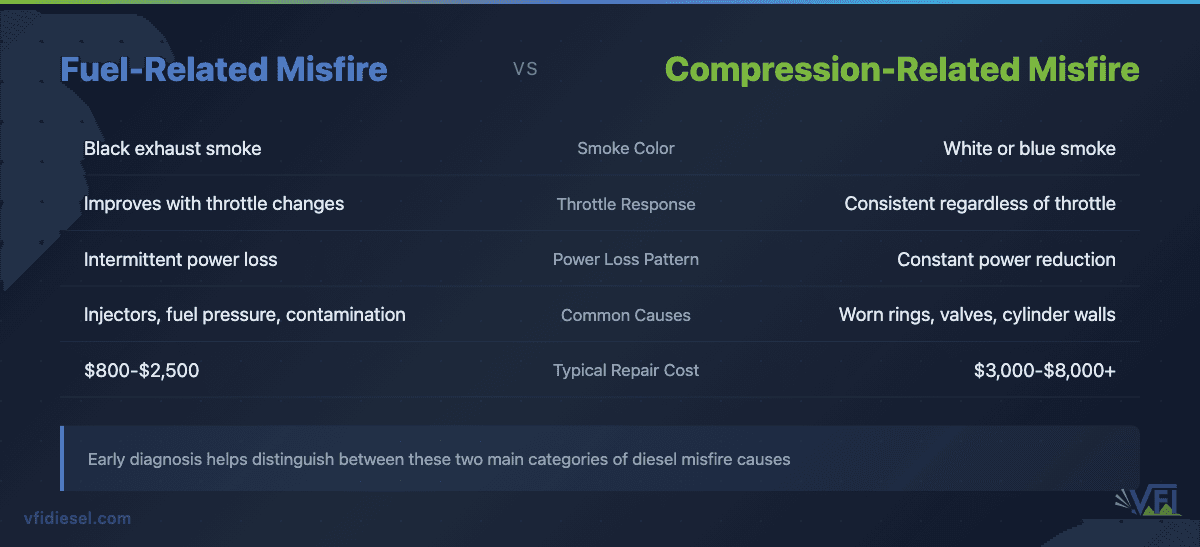
How do I know if my diesel misfire is fuel-related or compression-related?
Fuel-related misfires typically produce black smoke and improve temporarily with throttle changes, while compression-related issues cause white or blue smoke and consistent power loss regardless of throttle position.
Can I drive with a diesel engine misfire?
Limited driving is possible, but continued operation risks expensive engine damage and potential safety hazards. Seek professional diagnosis as soon as possible to prevent escalating repair costs.
Will fuel additives fix a diesel misfire?
Fuel additives may temporarily improve minor fuel quality issues but won’t fix mechanical problems like worn injectors, low compression, or fuel system failures that cause most diesel misfires.
How often should diesel injectors be professionally tested?
We recommend professional injector testing every 100,000-150,000 miles for preventive maintenance, or immediately when experiencing misfire symptoms regardless of mileage.