7 Essential Maintenance Tips for Diesel Fuel Injectors in Kubota Equipment
11/11/2025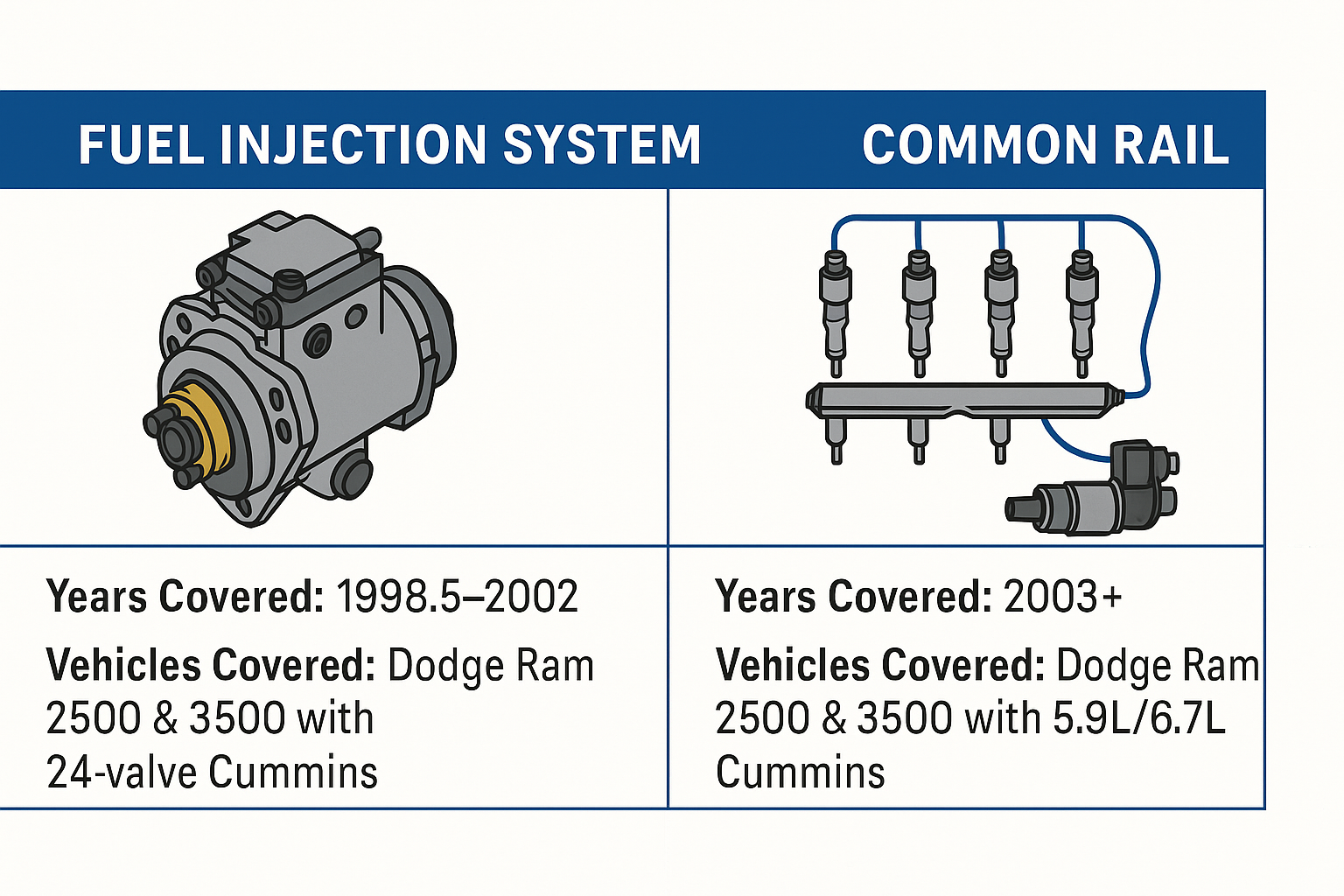
When it comes to diesel fuel injection systems, the debate between common rail vs VP44 often centers on performance, reliability, and long-term costs. Both systems have distinct advantages and challenges, but understanding their fundamental differences helps you make informed decisions about repairs, upgrades, and maintenance for your diesel engine.
Common rail systems offer superior performance and fuel economy but have higher repair costs, while VP44 systems are simpler and more affordable to maintain but less efficient. Your choice depends on your priorities: maximum performance or lower maintenance costs.
What’s the Difference Between Common Rail and VP44 Injection Systems?
The fundamental difference lies in how each system generates and delivers fuel pressure to your engine’s cylinders.
VP44 injection pumps use a rotary design where a single pump creates high pressure and distributes fuel to each cylinder in sequence. The pump contains an internal timing mechanism that controls injection timing mechanically, with some electronic control for fuel quantity. This system was widely used in 1998.5-2002 Dodge Cummins engines and various agricultural equipment.
Common rail systems separate pressure generation from injection timing entirely. A high-pressure pump feeds fuel into a common rail (hence the name) that maintains constant pressure. This architecture, pioneered by Bosch in the late 1990s, revolutionized diesel engine design. Individual electronically-controlled injectors at each cylinder draw from this rail and precisely control injection timing, duration, and pressure. This allows for multiple injection events per combustion cycle.
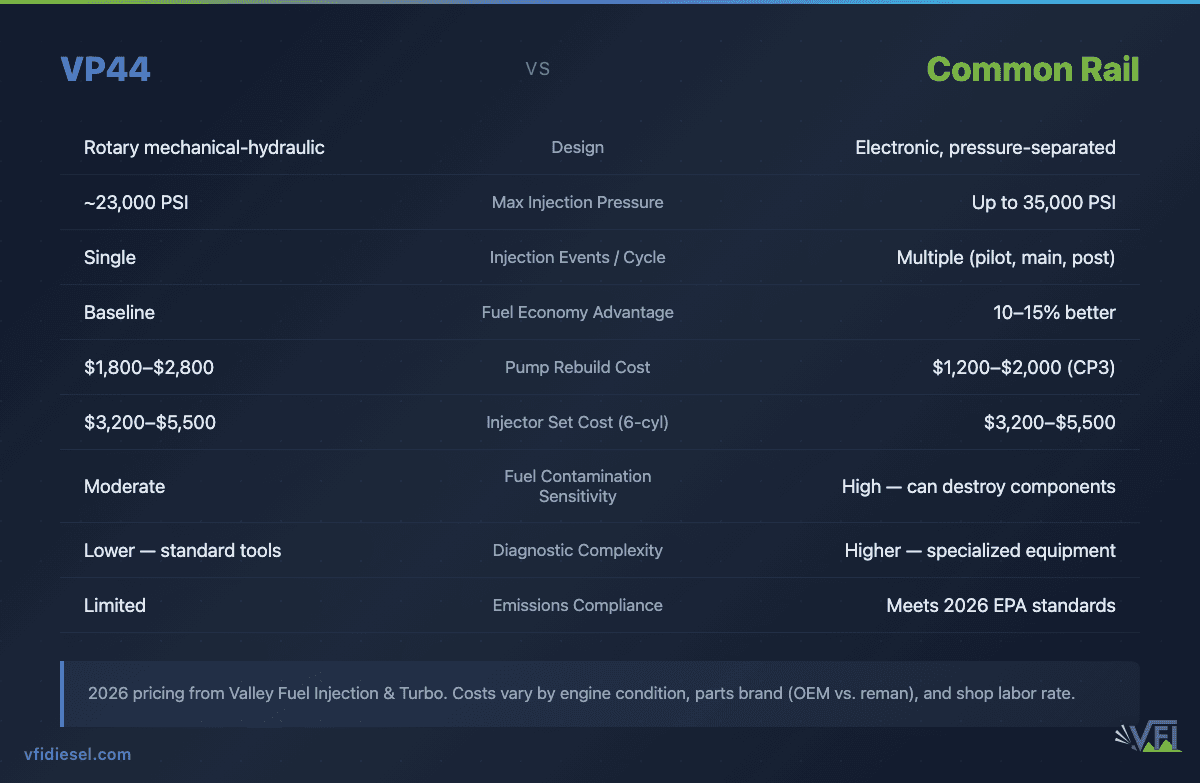
Modern common rail systems in 2026 can achieve injection pressures up to 35,000 PSI (compared to 30,000 PSI in earlier generations), while VP44 systems typically operate around 23,000 PSI. This higher pressure enables better fuel atomization and more complete combustion.
The VP44’s mechanical-hydraulic operation makes it simpler but less precise. Common rail’s electronic control over each injector provides vastly more flexibility in fuel delivery strategies. This is why our diesel fuel injection testing and repair services often involve sophisticated diagnostic equipment that can analyze injection timing down to fractions of a degree.
Which System Delivers Better Fuel Economy and Performance?
Common rail systems consistently outperform VP44 systems in both fuel economy and power output due to their superior injection control.
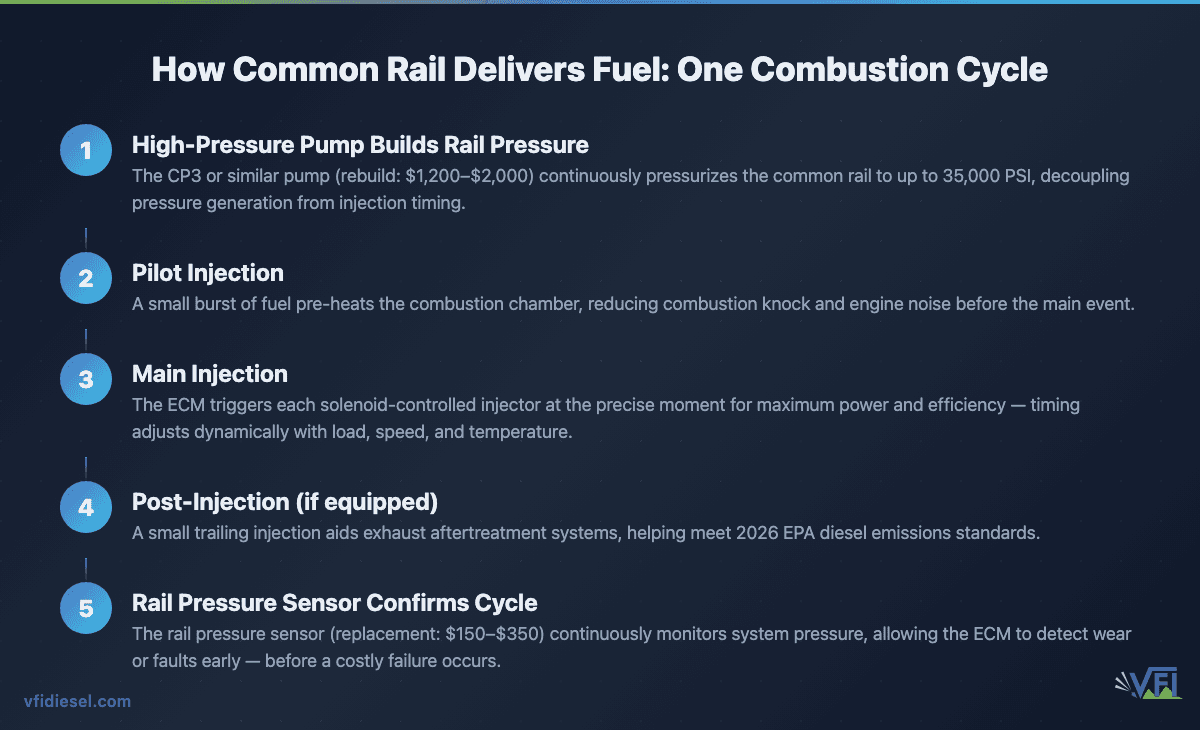
Common rail’s ability to perform multiple injection events per combustion cycle is the key advantage. A typical sequence might include a small pilot injection to pre-heat the combustion chamber, followed by the main injection for power, and potentially a post-injection to aid exhaust aftertreatment. This precise control results in:
- Better fuel atomization: Higher injection pressures create finer fuel droplets that burn more completely
- Optimized combustion timing: Electronic control allows injection timing to vary with engine speed, load, and temperature
- Reduced emissions: More complete combustion produces fewer particulates and NOx, helping meet 2026 EPA diesel fuel standards
- Quieter operation: Pilot injections reduce combustion knock and engine noise
VP44 systems, while robust, are limited by their mechanical timing and single injection event per cycle. You’ll typically see 10-15% better fuel economy with a properly functioning common rail system compared to a VP44 in similar applications.
If you’re experiencing poor fuel economy in either system, the issue is often contaminated fuel or worn injectors rather than the injection system design itself. Our diesel fuel injection testing services can pinpoint the exact cause and get your system running efficiently again.
How Do Repair Costs Compare Between Systems?
This is where the VP44 system shows its strength – repair and maintenance costs are significantly lower than common rail systems.
VP44 Rebuild: $1,800–$2,800
Common Rail Injector Set (6): $3,200–$5,500
Common Rail High-Pressure Pump: $1,200–$2,000
VP44 Injector Set (6): $3,200–$5,500
The higher costs of common rail components stem from their sophisticated electronic controls and precision manufacturing requirements. Each common rail injector contains multiple solenoids, pressure sensors, and precisely machined components that must operate at extreme pressures. VP44 injectors are simpler mechanical units with fewer failure points.
Common rail systems are extremely sensitive to fuel contamination. Water or debris that might only cause minor issues in a VP44 system can destroy expensive common rail components within hours. Always use quality fuel filters and change them regularly.
However, common rail systems often require less frequent major repairs when properly maintained. The electronic monitoring capabilities can detect issues early, preventing catastrophic failures. At Valley Fuel Injection & Turbo, we’ve seen well-maintained common rail systems run 300,000+ miles with only routine injector cleaning and calibration.
Consider having your injection system professionally tested annually. Early detection of wear patterns can save thousands in repair costs. Contact our team to schedule comprehensive diesel fuel injection testing.
Reliability and Longevity: VP44 vs Common Rail
Both systems can provide excellent reliability when properly maintained, but they have different failure patterns and maintenance requirements.
VP44 systems are known for their robust mechanical design. The main failure points are typically the internal timing piston, fuel metering valve, and electronic control module. These components usually give warning signs before complete failure, allowing for planned maintenance. The mechanical nature means repairs can often be completed with standard diesel shop tools.
Common rail systems have more potential failure points due to their complexity, but modern designs (2020+) have significantly improved reliability. The main concerns are:
- Injector carbon buildup: Requires periodic cleaning or replacement
- High-pressure pump wear: Usually occurs after 150,000-200,000 miles
- Rail pressure sensor failures: Can cause erratic engine performance
- Electronic control module issues: Requires specialized diagnostic equipment
As a Bosch-certified repair center, we use original equipment diagnostic tools that can perform advanced common rail calibrations impossible with generic scan tools. This ensures your system operates at peak efficiency.


Which System Is Right for Your Application?
The choice between VP44 and common rail depends on your specific needs, budget, and priorities.
Choose VP44 if you prioritize:
- Lower repair and maintenance costs
- Simpler diagnostics and repairs
- Proven reliability in harsh conditions
- Easier field repairs with basic tools
Choose Common Rail if you prioritize:
- Maximum fuel economy and performance
- Lower emissions compliance
- Quieter engine operation
- Advanced diagnostic capabilities
- Future-proof technology
For commercial operations where uptime is critical, many fleet managers prefer VP44 systems for their predictable maintenance schedules and lower repair costs. However, the fuel savings from common rail systems can offset higher repair costs in high-mileage applications.
If you’re unsure which system is best for your application, our experienced technicians can evaluate your specific needs and usage patterns. We’ve been helping Northern California and Nevada diesel owners make these decisions since 1993. Learn more about our expertise and get personalized recommendations.
Still running a VP44 and not local to Northern California? We handle a steady stream of mail-in VP44 work from the Mountain West, see our Utah diesel injection page.
Frequently Asked Questions
Can I convert from VP44 to common rail injection?
While technically possible, converting from VP44 to common rail requires extensive modifications including new injectors, high-pressure pump, fuel rail, electronic control modules, and wiring harnesses. The cost typically exceeds $10,000–$18,000+ and may not be cost-effective compared to engine replacement or sticking with VP44 system repairs.
How often should I service my common rail vs VP44 system?
VP44 systems typically need major service every 100,000-150,000 miles, while common rail systems benefit from injector cleaning every 75,000-100,000 miles. Both systems require high-quality fuel filtration and regular filter changes every 15,000-20,000 miles. Common rail systems are more sensitive to fuel quality and may need more frequent attention in contaminated fuel environments.
Which system handles biodiesel better?
VP44 systems generally handle biodiesel blends (up to B20) better than early common rail systems due to their simpler mechanical design and lower operating pressures. However, modern common rail systems (2015+) have improved seals and materials that handle biodiesel well. Both systems require more frequent fuel filter changes when running biodiesel due to its solvent properties and tendency to dissolve fuel system deposits.
Whether you’re running VP44 or common rail, proper maintenance and expert service are key to maximizing performance and minimizing costs. Valley Fuel Injection & Turbo offers comprehensive testing, repair, and remanufacturing services for both systems. Schedule your service today and keep your diesel running at peak efficiency.