6.7 Powerstroke Turbo Problems: Symptoms & Fixes
05/19/2026
Diesel Engine Loses Power in Hot Weather: Causes & Fixes
05/21/2026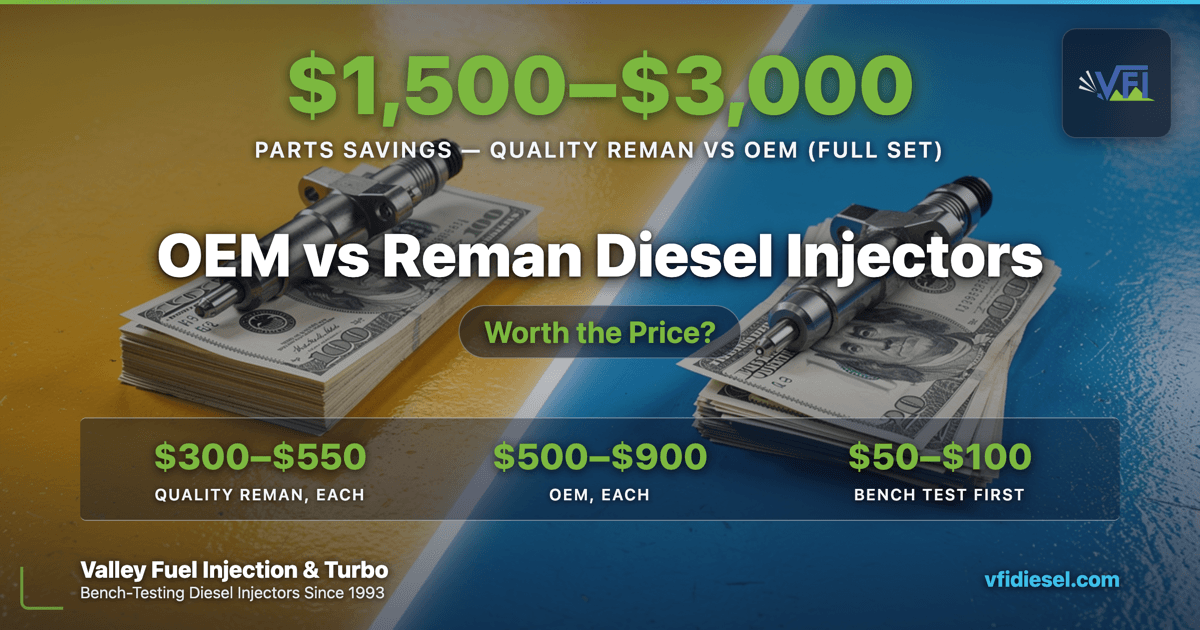
When it comes to OEM vs remanufactured diesel injectors, the honest answer is: it depends, but not in the way most parts counters will tell you. We test injectors on a certified Bosch test bench every single day at our Woodland, CA shop, and we source from Bosch, Delphi, and Alliant Power as authorized dealers. That puts us in a position most blogs and parts retailers simply don’t have: we can tell you exactly where the quality gap is real, where it’s marketing noise, and where a well-remanufactured injector will outperform an OEM part that’s been sitting in a warehouse for three years.
Quality remanufactured injectors from Bosch, Delphi, or Alliant Power typically save you 30–50% over OEM while meeting or exceeding original performance specs, but “reman” is not a single category. The difference between a certified reman and a cheap offshore rebuild is the difference between a 100,000-mile injector and a 10,000-mile paperweight. Know what you’re buying before you buy it.
Why Does the Price Gap Between OEM and Reman Diesel Injectors Vary So Wildly?
The price spread on remanufactured injectors is enormous, and that spread is the first warning sign you need to understand. A single common-rail injector for a 6.7 Cummins might run $400–$900 for a genuine OEM unit, while reman options span anywhere from $85 to $600 depending on who built it and how. That $85 injector and that $600 injector are both called “remanufactured.” They are not the same product.
The price gap exists because remanufacturing is not a regulated term in the diesel parts industry. Anyone can disassemble an injector, clean it with a parts washer, swap the nozzle tip, and call it remanufactured. The word tells you almost nothing about what actually happened to that injector before it went back in a box. What drives the price, and the quality, is the process behind the label.
On the OEM side, you’re paying for factory-new internal components, full traceability, and in most cases a known calibration baseline. On the quality reman side: Bosch Exchange, Delphi reman, Alliant Power, you’re getting many of those same internal components (often sourced from the same factories) at a lower total cost because the housing and non-wear parts are reused. On the budget offshore side, you’re getting a gamble.

Bosch remanufactures injectors using the same production lines and specifications as new OEM units. The Bosch Mobility diesel injection program requires that every reman injector pass the same end-of-line test as a brand-new part before it ships. That’s a standard most offshore rebuilders never come close to meeting.
What Actually Happens During a Professional Injector Remanufacturing Process?
A genuine remanufacturing process, the kind Bosch, Delphi, and Alliant Power perform, involves far more than cleaning and reassembly. Here’s what separates a quality reman from a parts-washer special:
Complete disassembly and inspection. Every component is disassembled, ultrasonically cleaned, and individually inspected. Wear surfaces are measured against OEM tolerances. Anything that doesn’t meet spec is replaced, not reused.
New wear components as standard. The nozzle tip, needle valve, control valve, solenoid (where applicable), and all seals and o-rings are replaced with new OEM-specification parts. The housing is reused only after passing dimensional inspection.
Calibration on a certified test bench. This is the step that separates professional remanufacturing from everything else. Every injector is flow-tested and calibrated on a test bench that replicates real-world fuel pressure and temperature conditions. At our shop, we use a Bosch-certified test bench to verify injection quantity, spray pattern, back-leak rate, and response time across the full operating range. An injector that can’t hit spec doesn’t ship.
Trim code assignment. For modern common-rail injectors, each unit receives a trim code (also called an IQA code) that tells the ECM exactly how that individual injector behaves. This code must be programmed into the ECM at installation. Quality remans ship with this code. Cheap rebuilds often don’t, which means your ECM is running blind.
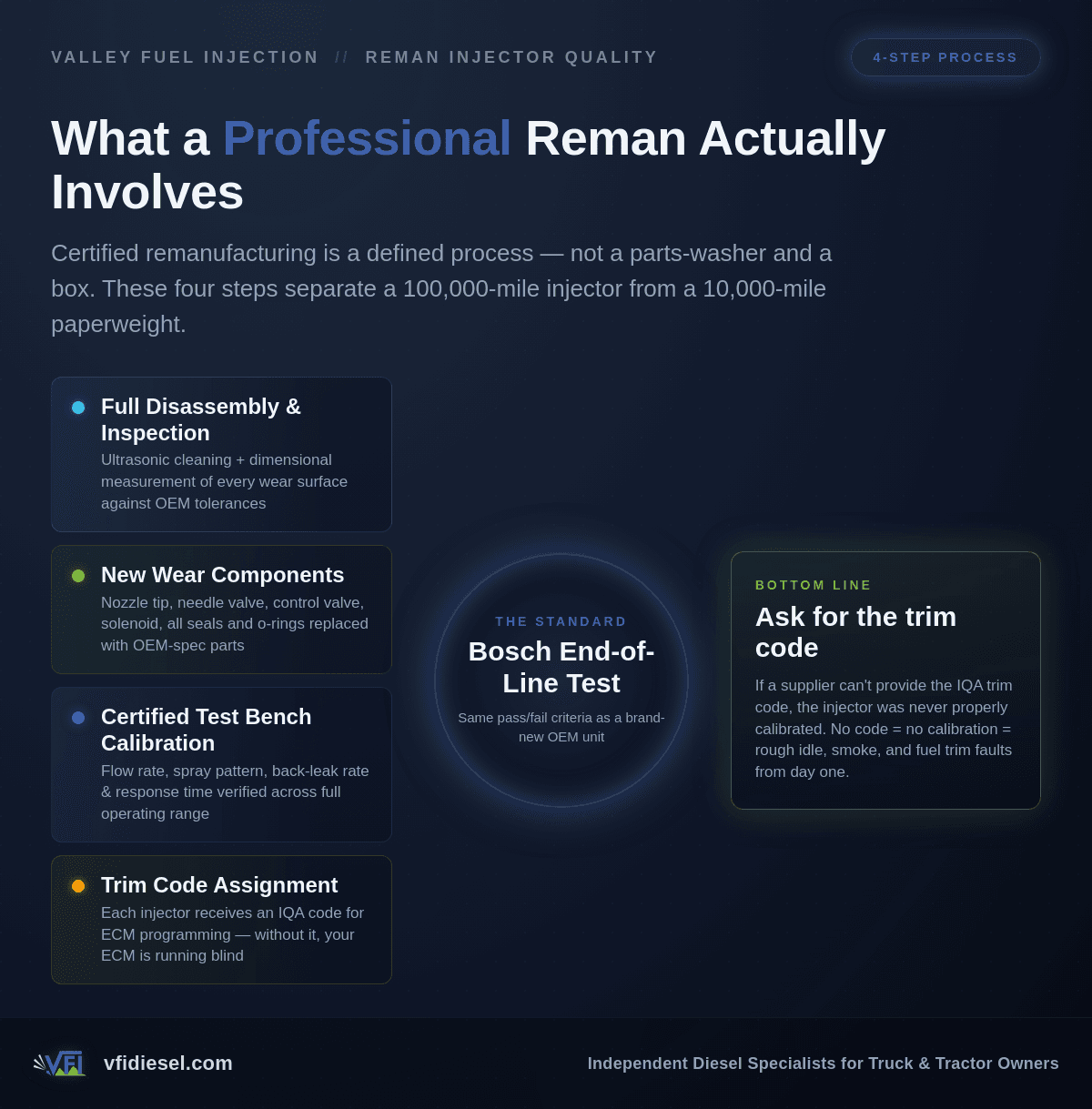
Always ask for the trim code before you accept a remanufactured common-rail injector. If the supplier can’t provide it, the injector was not properly tested and calibrated. Installing it without the trim code will cause rough idle, smoke, and fuel trim fault codes, and your ECM will never properly compensate for the injector’s actual fueling behavior.
Where Do OEM Injectors Genuinely Outperform Reman, and Where Is the Difference Negligible?
OEM injectors have a real edge in specific situations, and it’s worth being honest about that rather than overselling reman across the board.
Where OEM wins:
- High-performance and modified engines. If you’re running a compound turbo setup, a performance tune, or significantly elevated injection pressures, OEM injectors with known factory tolerances are the safer baseline. Reman units are built to stock specs, which is fine for stock applications.
- Warranty-sensitive situations. If your truck is still under a powertrain warranty or an extended service contract, OEM parts protect you. Many warranty administrators will deny claims if non-OEM parts are found in the fuel system.
- Brand-new low-mileage vehicles. For a truck with under 50,000 miles that has a single failed injector due to a manufacturing defect, OEM is the right call. You’re not replacing a worn system, you’re correcting an anomaly.
Where the difference is negligible:
- High-mileage fleet replacements. When you’re replacing a full set at 200,000+ miles, a quality reman calibrated to OEM specs will perform identically to OEM in real-world operation. The fuel system is the limiting factor at that mileage, not the injector brand.
- Agricultural and equipment applications. Kubota, Yanmar, and similar equipment engines run lower rail pressures and less aggressive duty cycles. Quality reman injectors perform excellently in these applications, and the cost savings on a full set are substantial. See our notes on Kubota injector maintenance for context on what these engines actually demand.
- Engines with documented fuel contamination history. If the engine has seen bad fuel, biodiesel damage, or a CP4 failure event, you’re replacing injectors into a compromised system anyway. OEM parts won’t protect you from the next contamination event, proper system flushing and fuel quality management will. Read more about biodiesel injector damage if you’re in California and concerned about fuel quality.
What Should You Watch Out for When Buying Reman Injectors?
The reman injector market has a serious counterfeit and quality problem that has gotten worse as common-rail platforms have aged into the replacement cycle. Here’s what we see coming through our shop, and what you need to avoid.
Counterfeit cores. Counterfeit Bosch and Delphi injector cores are a documented problem in the global parts supply chain. These are injectors built with substandard internal components but branded with Bosch or Delphi markings. They look identical to genuine parts in photos. The Bosch anti-counterfeiting program has identified thousands of fake units in circulation. Buying from an authorized dealer, not a third-party marketplace listing, is your primary protection.
Offshore rebuilds with no test documentation. A large percentage of budget reman injectors sold online are rebuilt overseas with no certified test bench validation. The seller may list flow specs on the product page, but those numbers were never verified on a calibrated machine. We’ve pulled injectors off engines that were “brand new reman” from online sellers and found them flowing 15–25% out of spec. That’s not a reman injector, that’s a liability.
Untested units sold as tested. Some domestic rebuilders do test injectors, but on uncertified equipment. A test bench that hasn’t been calibrated to Bosch or ISO standards will give you results that look good on paper and mean nothing in the engine. Ask specifically: what test bench was used, and when was it last certified?
Missing or incorrect trim codes. As noted above, any common-rail reman injector without a proper trim code was not fully calibrated. This is a non-negotiable quality indicator.
Marketplace platforms are flooded with injectors listed as “OEM remanufactured” that are neither OEM-quality nor properly remanufactured. If the price is 60–70% below what an authorized dealer charges, assume the quality gap is real. Installing a failed reman injector into a common-rail system running at 30,000+ PSI can cause downstream damage to the high-pressure pump, fuel rails, and return lines, turning a $300 injector gamble into a $10,000+ repair bill.
If you’re not certain about the quality of injectors you’ve sourced, we offer injector bench testing services, including mail-in testing for customers outside Northern California. We’ll test them on our certified Bosch bench and give you actual flow data before they go in your engine. That’s a service no parts retailer can offer.
Call us at 530-668-0818 or schedule a diagnostic. We ship remanufactured injectors nationwide and accept mail-in units for bench testing: Bosch-certified, every time.
How Do Bosch, Delphi, and Alliant Power Reman Injectors Compare to OEM on the Duramax, Cummins, and Powerstroke?
These three brands represent the top tier of remanufactured diesel injectors, and each has a platform where they’re particularly strong. Here’s how they stack up on the most common diesel platforms we service.
| Platform | OEM Injector (each) | Quality Reman (each) | Best Reman Source | Full Set Installed (CA) |
|---|---|---|---|---|
| LB7 Duramax (8 injectors) | $600–$900 | $350–$600 | Bosch Exchange | $5,500–$9,500 |
| LML/LLY/LBZ Duramax (8) | $500–$850 | $300–$550 | Bosch / Delphi | $4,800–$8,500 |
| 6.7 Cummins (6 injectors) | $550–$900 | $300–$550 | Bosch / Alliant Power | $4,500–$7,500 |
| 5.9 Cummins 24V (6) | $450–$750 | $270–$480 | Bosch / Delphi | $3,200–$5,500 |
| 6.7 Powerstroke (8) | $600–$900 | $350–$600 | Alliant Power / Bosch | $5,500–$8,500 |
| 6.0 Powerstroke (8, pickup) | $500–$800 | $300–$550 | Alliant Power | $5,500–$8,500 |
Parts and labor vary by region, engine condition, and current pricing, call us at 530-668-0818 for an accurate quote.
A note on Alliant Power specifically: Alliant Power is the OEM supplier for Ford Powerstroke fuel system components, meaning their remanufactured injectors for the 6.0, 6.4, and 6.7 Powerstroke are built to the same specifications as the parts Ford installs at the factory. For Powerstroke owners, Alliant Power reman is genuinely the equivalent of OEM at a lower price point. We stock and sell Alliant Power parts as an authorized dealer and have used them extensively on Powerstroke platforms with excellent results.
For Duramax owners, Delphi remanufactured injectors are a strong choice on the LLY through LMM platforms. Bosch Exchange covers virtually every common-rail platform and is our default recommendation when a platform-specific OEM supplier isn’t available.
The SAE’s published research on diesel injector remanufacturing confirms that properly remanufactured injectors from certified suppliers meet or exceed new-part performance benchmarks, a finding that aligns directly with what we see on our test bench every day.
What’s the Smartest Buying Decision for Your Engine, Mileage, and Budget?
Here’s the framework we use when a customer is standing at our counter trying to decide:
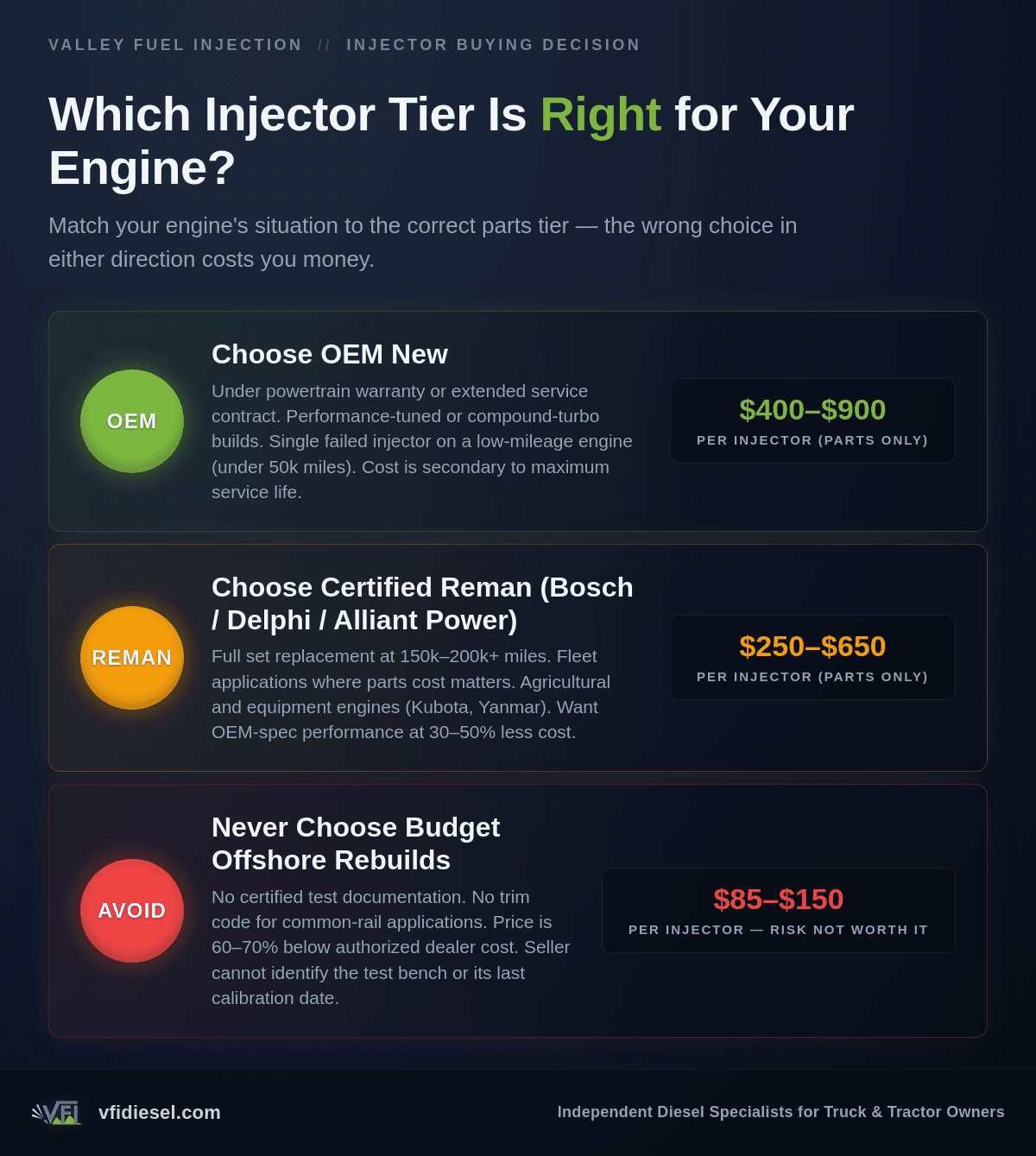
Choose OEM when: Your truck is under warranty or an extended service contract. You’re running a performance tune or modified fuel system. You have a single failed injector on a low-mileage engine. You need the absolute longest possible service life and cost is secondary.
Choose quality reman (Bosch, Delphi, Alliant Power) when: You’re replacing a full set at high mileage. You’re managing a fleet and need to control parts costs without sacrificing reliability. You’re working on agricultural or equipment engines. You want certified performance specs at 30–50% less than OEM cost.
Never choose: Unbranded offshore rebuilds. Marketplace listings with no test documentation. Any injector that ships without a trim code for a common-rail application. Any supplier who can’t tell you what test bench was used and when it was last calibrated.
If you want to understand the full cost picture, including what happens when you get this decision wrong, our guide on diesel fuel injection pump rebuild vs. replace costs walks through the same decision framework for pumps. The logic translates directly to injectors.
One more option worth knowing about: if you already have injectors on hand, pulled from your engine or sourced used, we can test them on our Bosch bench before you commit to a full set replacement. Many customers ship injectors to us from across the country for our common rail injector testing and rebuild service. You’ll get actual flow data, spray pattern results, and a clear recommendation on whether they’re serviceable, rebuildable, or scrap. It’s a fraction of the cost of buying new parts and finding out later that the problem was elsewhere. Learn more about professional injector testing vs. DIY approaches.
Diesel owners in the Sacramento area and throughout Northern Nevada can bring vehicles directly to our Woodland shop or ship injectors for mail-in service. We’ve been doing this work since 1993, and we test every injector we sell or rebuild on the same certified bench, the same way, every time.
- Single quality reman injector (parts only): typically $250–$650
- Single OEM injector (parts only): typically $400–$900
- Full set installed, 6.7 Cummins (6 injectors): typically $4,500–$7,500
- Full set installed, LB7 Duramax (8 injectors): typically $5,500–$9,500
- Full set installed, 6.7 Powerstroke (8 injectors): typically $5,500–$8,500
- ECM trim code / IQA programming: typically $95–$250
- Bench test (mail-in, per injector): typically $50–$100
Prices reflect typical California specialty-shop ranges as of 2026. Your actual quote depends on the condition of your specific components, parts availability, and current labor rates. Call VFI at 530-668-0818 for an accurate quote on your job.
Frequently Asked Questions: OEM vs Remanufactured Diesel Injectors
Are remanufactured diesel injectors as reliable as OEM?
Quality remanufactured injectors from certified suppliers like Bosch, Delphi, and Alliant Power are built to OEM specifications and tested on calibrated equipment, making them equally reliable in real-world use. The critical variable is the remanufacturer’s process and test standards, not the “reman” label itself. Budget offshore rebuilds with no test documentation are a different product entirely and should not be compared to certified reman units.
Do remanufactured injectors come with trim codes?
Quality remanufactured common-rail injectors should always ship with a trim code (IQA code). This code must be programmed into the ECM so it can accurately balance fueling across all cylinders. If a reman injector does not include a trim code, it was not properly calibrated on a test bench and should not be installed in a modern common-rail engine. Always verify this before purchasing.
How much do I save by choosing reman over OEM diesel injectors?
Quality remanufactured injectors from Bosch, Delphi, or Alliant Power typically cost 30–50% less than new OEM units. On a full set replacement for a Duramax or Cummins, that can mean $1,500–$3,000 in parts savings before labor. The savings are real and meaningful, provided you’re buying from a certified supplier, not a budget offshore rebuilder where the quality gap more than offsets the price difference.
Can I send my injectors to Valley Fuel Injection for testing before deciding whether to replace them?
Yes, we accept mail-in injectors for bench testing from customers nationwide. We test on a Bosch-certified test bench and provide actual flow data, spray pattern results, and a clear recommendation. This service typically costs $50–$100 per injector and can save you thousands by confirming whether replacement is actually necessary, or whether a cleaning and recalibration will restore performance. Call us at 530-668-0818 to arrange mail-in testing.
What’s the best remanufactured injector brand for a Ford Powerstroke?
Alliant Power is the strongest choice for Ford Powerstroke platforms (6.0, 6.4, 6.7) because Alliant Power is the OEM supplier for Ford’s Powerstroke fuel system components. Their remanufactured injectors are built to the same factory specifications as original Ford parts. Bosch Exchange is a strong alternative for platforms where Alliant Power coverage is limited. Both brands are available through Valley Fuel Injection as an authorized dealer.
Valley Fuel Injection has been an authorized Bosch, Delphi, and Alliant Power dealer since 1993. We test every injector on a certified Bosch bench, and we’ll give you straight answers about whether OEM or reman is the right call for your specific engine and situation. Local customers are welcome at our shop at 1243 E Beamer St, Suite C, Woodland, CA 95776. Call us at 530-668-0818 or schedule a diagnostic online. We ship remanufactured injectors and accept mail-in units for bench testing nationwide, because good diesel work shouldn’t be limited by geography.
Alliant Power vs Bosch Reman: Which Brand Fits Your Platform?
When both brands are certified, authorized-dealer reman, the choice comes down to which company has the deeper engineering history on your specific injection system. We sell and install both, and the recommendation almost always tracks platform heritage rather than price.
Alliant Power for HEUI Powerstroke. Alliant Power’s home turf is the hydraulically actuated, electronically controlled HEUI injector on the 7.3L and 6.0L. It sells new and remanufactured 7.3L injectors under its own name. Alliant says the new ones are built in the original equipment facility, and that both get the updates developed since the original design and are 100 percent end-of-line tested for fuel delivery, timing, peak injection and leakage. It also sells remanufactured 6.0L injectors. The company is ISO 9001:2015 certified and stocks the companion parts (HPOP units, IPR valves, standpipe seal kits) that a complete HEUI repair needs. For 7.3L and 6.0L Powerstroke owners, Alliant Power is our first call. See our Alliant Power parts and service page.
Bosch reman for Bosch common rail. Bosch supplied the original common rail system on the Cummins and the 6.7L Powerstroke, and on every Duramax from the LB7 through the LML. Bosch says its reman injectors are produced in the same Bosch facility as its new ones, with all wear parts and critical components replaced with Bosch parts and all OE updates included. On those platforms, that manufacturing foundation is the deciding factor. The exception is the 2017-and-later L5P Duramax: GM moved it to a Denso fuel system, so Bosch reman is not the automatic pick there.
Same warehouse, different warranty. It is not always either-or. Alliant Power also distributes Bosch: its injector catalog lists new and remanufactured Bosch injectors under Bosch part numbers, next to Alliant-brand reman common rail injectors for some Bosch platforms, such as the LB7 Duramax. If one is back-ordered, ask about the other. What counts is the brand on the box, because Alliant’s own warranty covers Alliant Power branded products, and a Bosch-numbered injector carries Bosch’s warranty whichever distributor it came through.
On paper, warranty is where the two brands differ most. Here is what each company publishes for its reman injectors:
| Warranty terms | Alliant Power brand reman | Bosch reman (common rail) |
|---|---|---|
| Published warranty | 24 months, unlimited miles on its remanufactured injectors (new Alliant injectors: 36 months, parts and labor) | 12 months, unlimited miles, unlimited hours for non-commercial use |
| Labor | You pick one: guaranteed acceptance on the part only, or a parts-and-labor claim that pays removal and reinstall at Alliant’s flat-rate schedule. Diagnosis labor is not covered | Parts only: labor for diagnosis, removal and reinstall is not covered |
| Making a claim | Claim filed and the failed part back to Alliant within 45 days of the failure; a full set or bank needs diagnostic information | Through the seller you bought from, with a dated receipt or repair order |
| Named exclusions | Fuel or oil contamination, power-enhancing devices or modifications, improper installation | Misuse, modification, improper application, installation or operation |
Sources: Alliant Power warranty policy and qualifying products (revised August 2025), and Bosch’s reman common rail injector listings and North American limited warranty policy. Terms change, so check the paperwork that comes with the part.
The practical read: a tuned truck, or one that just ate a high-pressure pump, is a hard warranty claim with either brand. Alliant names fuel contamination and power-enhancing devices outright, and Bosch covers defects in material or workmanship only. Fix the cause before the new injectors go in.
If your old common rail injectors are rebuildable, there is a third option: send them to us. Our in-house rebuilds are Bosch Authorized Remanufactured, rebuilt by Valley Fuel Injection & Turbo, and carry our 1-year, unlimited-mileage warranty on the rebuild (30 days on electrical and electronic components). Out-of-area customers can use our mail-in rebuild service.
One pricing note the headline number often hides: a reman injector bought on exchange carries a refundable core charge. On our own listings, pickup common rail and HEUI injector cores run $75 to $150 each (some heavy-duty and off-road injector cores run higher), so a full pickup set carries several hundred dollars or more in core charges until the old ones come back. Keep the old injectors complete, don’t take them apart, and ship them back in the boxes the new ones came in. Alliant’s published core policy, for example, requires cores to be complete, not taken apart and in the original box, and refuses cores damaged by fire, misuse, modification, abuse or improper removal. Always ask the dealer to spell out the core policy before you commit. Call us at 530-668-0818 and we will match the brand to your engine, not to what happens to be on the shelf.