

Common Rail Injector Problems: 6 Signs & Expert Solutions
04/13/2026
OEM Diagnostic Software Diesel: Why Generic Scanners Fail
04/16/2026
What Is Biodiesel Injector Damage and Why Is It Happening Now?
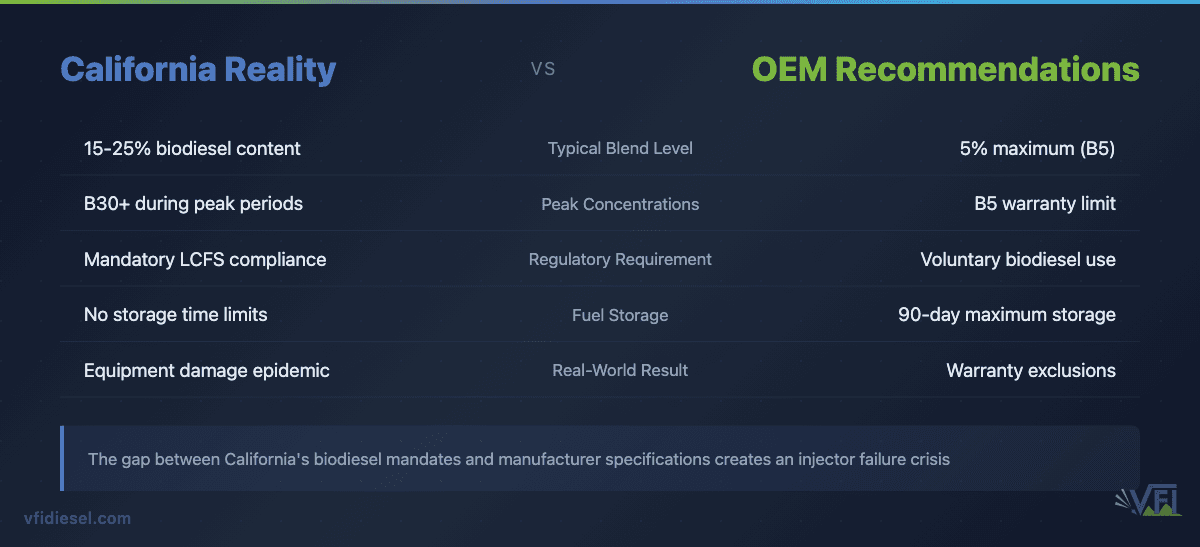
Biodiesel injector damage occurs when Fatty Acid Methyl Ester (FAME) biodiesel, the traditional soy or canola-based biodiesel, chemically attacks precision injection components. Unlike renewable diesel (which is chemically identical to petroleum diesel), FAME biodiesel has oxygen molecules that make it inherently unstable and corrosive to fuel system materials.California’s LCFS regulations have dramatically increased biodiesel content in diesel fuel. While the federal mandate caps biodiesel at B5 (5%), California’s carbon intensity scoring system incentivizes refiners to blend much higher concentrations. CARB data shows that biodiesel now comprises 15-25% of California’s diesel pool, with some blends reaching B30 or higher during peak production periods.How Does Biodiesel Destroy Diesel Injection Systems?
After testing thousands of failed injectors at our Woodland facility, we’ve identified six primary biodiesel injector damage mechanisms:1. Oxidation and Gum Formation
FAME biodiesel oxidizes rapidly when exposed to air, heat, and light. This oxidation creates gums, varnishes, and polymers that clog injector nozzles and stick injection components. The oxidation process accelerates exponentially, biodiesel stored for 90 days can have 10 times the oxidation products of fresh fuel.2. Acid Formation and Metal Etching
As biodiesel oxidizes, it forms organic acids that etch precision-machined surfaces inside injectors and high-pressure pumps. We regularly see acid etching on injector needles, pump pistons, and rail pressure sensors, damage that appears as microscopic pitting that destroys sealing surfaces.3. Deposit Formation on Critical Surfaces
Biodiesel combustion creates different deposit patterns than petroleum diesel. These deposits accumulate on injector tips, inside nozzle holes, and on intake valves. The deposits are often harder and more adhesive than traditional carbon deposits, requiring specialized professional cleaning techniques to remove.4. Water Absorption and Microbial Growth
FAME biodiesel is hygroscopic, it absorbs water from the air. This water promotes microbial growth in fuel tanks and creates emulsions that damage fuel system components. Water also accelerates the oxidation process, creating a cascade of fuel degradation.5. Elastomer and Seal Degradation
Biodiesel swells and degrades rubber seals, O-rings, and gaskets throughout the fuel system. This is particularly problematic in older equipment not designed for biodiesel compatibility. Seal failures lead to external leaks and internal pressure losses that affect injection timing and spray patterns.6. Thermal Breakdown Under High Pressure
Modern common rail systems operate at pressures up to 30,000 PSI with temperatures exceeding 200°F. Under these extreme conditions, biodiesel breaks down more rapidly than petroleum diesel, forming deposits and corrosive compounds directly inside the injection system.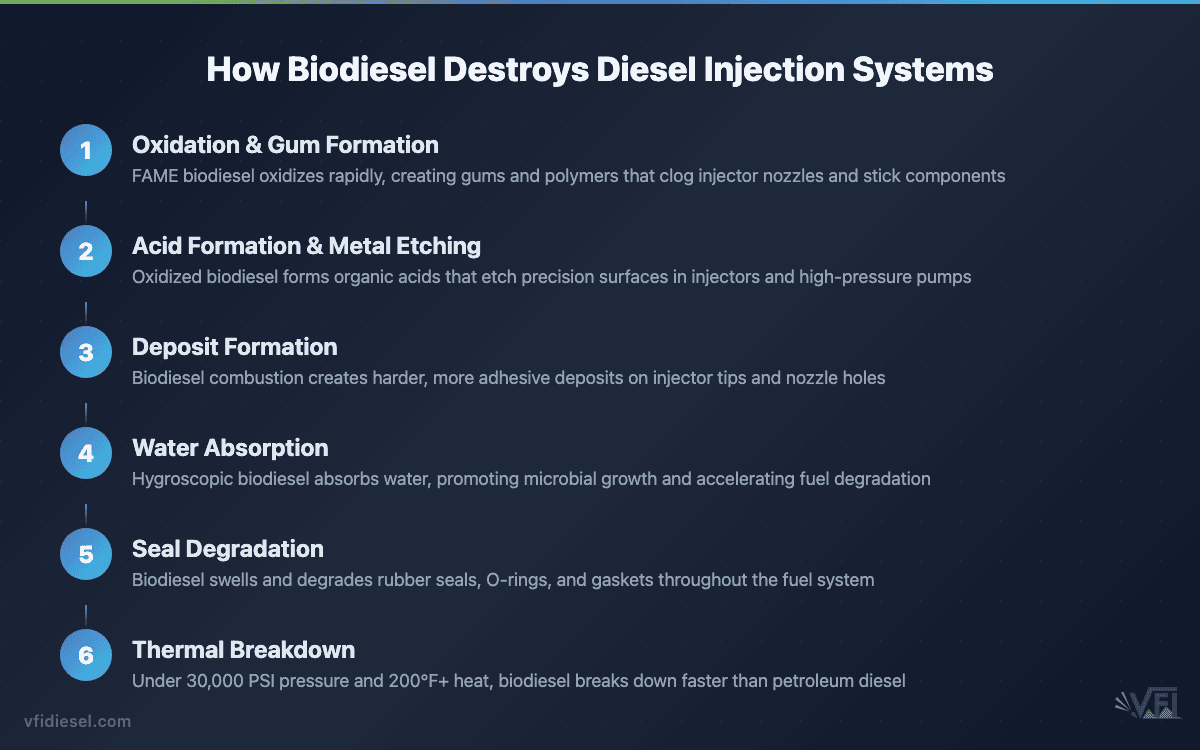
What Blend Levels Are Safe for Common Rail Injectors, VP44 Pumps, and Rotary Injection Pumps?
The answer depends heavily on the specific injection system, the age of the seals and elastomers already in the pump, and how well the biodiesel was produced and stored. There is no single universal safe threshold, but there are well-established guidelines based on OEM specifications and what we see on our test bench.
Common Rail Systems (CP3, CP4, Piezo Injectors)
Most modern common rail systems, including the Bosch CP3 used in Cummins and Duramax applications and the CP4.2 used in the 6.7 Powerstroke and LML Duramax, are OEM-approved for B5 to B20 depending on the manufacturer. Bosch’s own published guidance generally supports B20 in CP3 systems using ASTM D6751-compliant biodiesel. The CP4.2 is a different story. Its tighter tolerances and lower internal lubrication make it more sensitive to fuel quality variation, and many technicians and OEM service advisories treat B20 as the practical upper limit for CP4 systems with any caution applied.
Piezo-electric injectors, used in some Duramax and European common rail applications, are particularly sensitive to fuel chemistry changes. The piezo stack itself is not directly exposed to fuel, but the hydraulic amplifier and control valve inside the injector body are, and those components depend on precise fuel viscosity for correct response timing.
For our customers running common rail trucks in the Sacramento area, our general guidance is: B20 with quality fuel and shortened filter intervals is workable. B50 and above starts introducing real risk, especially for injector tip deposits and seal degradation. B100 in a common rail system not specifically designed and sealed for it is a path to expensive repairs. You can read more about the specific damage patterns we see in the damage mechanisms covered above.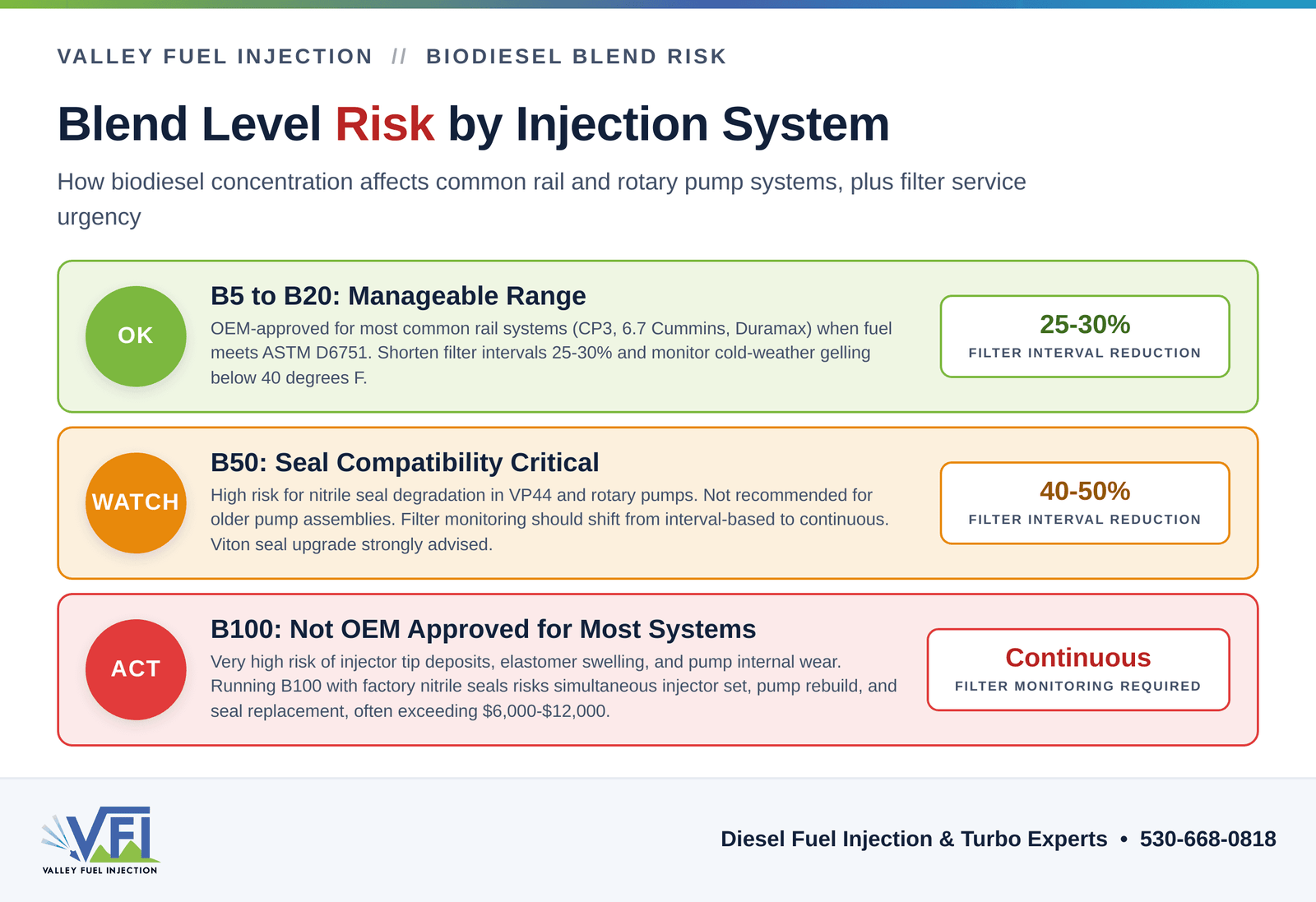
VP44 Electronic Rotary Pumps (98.5–02 Cummins 5.9)
The VP44 is one of the more biodiesel-sensitive pumps we work on. Its internal electronics module (the ECM bolted to the pump body) is vulnerable to heat and moisture, and biodiesel’s hygroscopic nature accelerates moisture intrusion around seals. The VP44’s internal seals and O-rings are also predominantly nitrile-based from the factory, and nitrile degrades with prolonged exposure to high-concentration biodiesel. We generally advise VP44 owners to stay at B20 or below and to inspect seals during any pump service. If you’re already dealing with VP44 problems, our Bosch injection pump testing and repair service covers full VP44 bench evaluation.
Mechanical Rotary Pumps (Stanadyne, Bosch VE, CAV/Lucas)
Older mechanical rotary pumps used in agricultural equipment, older pickups, and stationary engines are often cited as more biodiesel-tolerant because their tolerances are less tight than common rail systems. That is partially true, the pressure differentials are lower and the precision requirements less extreme. However, the seal compatibility issue is just as real. Stanadyne DB2 and DB4 pumps, Bosch VE pumps, and CAV/Lucas DPA units all use elastomers that can be attacked by high-concentration biodiesel. B20 is generally manageable. B100 over extended periods will degrade seals and can cause swelling that affects governor and delivery valve function.
NBR Nitrile vs. Viton Seals for Biodiesel Use
Beyond elastomers, biodiesel oxidation products create lacquer-like deposits on injector needle valves and spray hole edges. Unlike conventional carbon deposits, which tend to be hard and dry, biodiesel deposits can be softer and more adhesive at first, then harden over time. Either way, they alter spray pattern geometry, affect atomization, and reduce injector efficiency. We also see accelerated wear on high-pressure pump internals, particularly plunger and barrel assemblies in CP3 pumps, when biodiesel quality is inconsistent or blend levels exceed what the system was designed for.
What Do Equipment Manufacturers Say About Biodiesel?
Major diesel engine and equipment manufacturers have implemented strict biodiesel limitations due to injection system damage:| Manufacturer | Biodiesel Limit | Key Restrictions |
|---|---|---|
| John Deere | B5 (5%) | 90-day storage limit, no warranty coverage above B5 |
| Kubota | B5 (5%) | Common rail engines prohibited from biodiesel use |
| Cummins | B5 (5%) | Warranty exclusions for biodiesel-related failures |
| Caterpillar | B5 (5%) | Requires ASTM D6751 biodiesel specifications |
| Yanmar | B5 (5%) | Prohibits biodiesel in marine applications |
Why Are California Farmers Hit Hardest?
California’s agricultural sector faces unique biodiesel challenges that create perfect conditions for injection system failures:Seasonal Equipment Usage: Tractors, combines, and irrigation pumps often sit idle for months between seasons. Biodiesel degrades rapidly during storage, forming acids and deposits that destroy injection components when equipment is restarted.High Biodiesel Concentrations: California’s LCFS incentives mean agricultural diesel often contains 20-30% biodiesel during peak production periods, far exceeding manufacturer recommendations.Older Equipment: Many farm operations use older tractors and equipment with injection systems not designed for biodiesel compatibility. Seals, gaskets, and fuel system materials degrade rapidly when exposed to FAME biodiesel.Remote Locations: Farms often rely on bulk fuel delivery, meaning biodiesel sits in storage tanks for extended periods, accelerating oxidation and degradation.How Can You Protect Your Diesel Injection System?
While California’s biodiesel mandates aren’t going away, you can take steps to minimize biodiesel injector damage:Choose Your Fuel Carefully
– Seek out petroleum diesel or renewable diesel when possible. Renewable diesel (like Neste MY) is chemically identical to petroleum diesel and doesn’t cause injection system damage. – Avoid “biodiesel” labeled fuels unless your equipment manufacturer specifically approves them. – Check fuel receipts: California requires biodiesel content disclosure at the pump.Implement Fuel Management Practices
– Use fuel within 90 days, biodiesel degradation accelerates rapidly after this point. – Add fuel stabilizers designed for biodiesel blends (not just petroleum diesel stabilizers). – Keep fuel tanks full to minimize air exposure that accelerates oxidation. – Install water separators to remove moisture that biodiesel absorbs from the air.Monitor Your Injection System
Watch for early warning signs of common rail injector problems: – Rough idle or misfiring – Black smoke or excessive emissions – Reduced power or fuel economy – Hard starting, especially after sitting – Unusual engine noises or vibrationIf you notice these symptoms, schedule a diagnostic immediately. Early intervention can often prevent complete injection system failure.Consider System Upgrades
For high-risk applications, consider upgrading vulnerable components: – CP4 to DCR conversion for Ford and GM trucks – Biodiesel-compatible seals and gaskets for older equipment – Enhanced filtration systems to remove biodiesel degradation products

How Does Biodiesel Affect Fuel Filter Life, Cold-Start Performance, and Injector Deposits?
Fuel Filter Life
Biodiesel shortens fuel filter life in two ways. First, its solvent action loosens tank and line deposits that have built up during years of petroleum diesel operation. That material hits the filter all at once during a blend transition. Second, biodiesel’s higher affinity for water means more water reaches the primary filter, and water-saturated filters plug faster. On B20 blends, we typically recommend cutting filter change intervals by 25–30% for the first several fill cycles after a blend transition, then reassessing based on actual filter condition. On B50 and above, filter monitoring should be continuous, not interval-based.
California’s renewable fuel mandates mean that cardlock and retail diesel in the Central Valley increasingly contains biodiesel blends, sometimes without clear labeling. If your filter life has shortened noticeably without any other obvious cause, biodiesel content in your fuel supply is worth investigating. Our diesel fuel additive guide covers products that can help manage fuel quality, including dispersants that address biodiesel-related deposit issues.
Cold-Start Performance
Biodiesel’s higher cloud point is a real operational concern in Northern California and Nevada, where overnight temperatures in the mountains, high desert, and even the valley floor can drop enough to cause fuel gelling in high-blend tanks. B20 adds meaningful cold-flow risk compared to straight ULSD. B50 and B100 can gel at temperatures that occur routinely in Redding, Reno, or the Sierra foothills from November through March.
Gelled fuel does not just cause no-start conditions. It can force the lift pump to work against excessive restriction, starving the high-pressure pump of adequate supply pressure and causing wear or cavitation damage. Cold-start injector performance also suffers when fuel viscosity is elevated, the injection system may compensate with longer injection duration, which affects combustion efficiency and can increase white smoke during warm-up. Our post on diesel fuel system seasonal problems covers the flip side of this issue, but the cold-weather concern with biodiesel is equally real.
Injector Deposits
Biodiesel deposit chemistry is different from petroleum diesel deposit chemistry, and that matters for how you address it. Conventional diesel injector deposits respond well to standard detergent additives. Biodiesel-derived deposits, particularly polymerized fatty acid residues on injector tips, can be more resistant to standard detergents and may require more aggressive cleaning protocols. On the bench, we see biodiesel deposit patterns concentrated around the spray holes and needle seat in ways that are visually distinct from conventional fouling. If you are running biodiesel and notice power loss, rough idle, or increased smoke, injector deposits are a primary suspect worth evaluating before assuming pump failure.
| Blend Level | Common Rail Risk | VP44 / Rotary Risk | Filter Interval Change |
|---|---|---|---|
| B5 | Minimal: OEM approved | Minimal | No change needed |
| B20 | Low-moderate, manageable with OEM seals | Moderate, inspect seals regularly | Shorten 25–30% |
| B50 | High, seal compatibility critical | High, not recommended for older pumps | Shorten 40–50% |
| B100 | Very high, not OEM approved for most systems | Very high, significant seal and deposit risk | Monitor continuously |
What Maintenance Intervals Should Change When You Run Biodiesel Blends?
Running biodiesel requires a more active maintenance posture across several service categories. These are the specific interval adjustments we recommend to customers at our Woodland shop and to fleet operators throughout Northern California.
Fuel filters: As noted above, shorten primary and secondary filter intervals by 25–30% on B20, and more aggressively on higher blends. During any blend transition (switching from straight ULSD to any biodiesel content), inspect the filter at 500 miles or the first opportunity after the transition fill. The tank-cleaning effect can be dramatic and fast.
Water separator inspection: Check the water separator bowl at every fuel stop for the first few weeks on a new biodiesel blend. Biodiesel’s water affinity means water accumulation can happen faster than you expect, particularly in humid conditions or when fuel has been stored in tanks with temperature cycling.
Injector service: If you are running B50 or above, consider a bench-test injector evaluation every 60,000–75,000 miles rather than waiting for a symptom. Biodiesel deposit accumulation affects spray pattern before it causes obvious power loss. Catching it early is far less expensive than a full injector replacement. A diagnostic fuel system inspection at our shop typically runs $200–$400, which is a small investment compared to a full injector set replacement that can range from $3,500 to $9,000 depending on your engine.
Pump seal inspection: Any time a high-blend biodiesel vehicle comes in for pump service, we inspect all accessible seals and O-rings as a matter of course. We recommend that VP44 owners running B20 or above include a seal inspection with every pump-related service. For common rail CP3 systems, seal condition is worth checking at major service intervals. Our common rail service page covers what a full common rail inspection includes.
Cold-weather fuel management: If you operate in areas where overnight temperatures drop below 40°F, which includes much of Nevada and the NorCal mountains, add a winter cold-flow improver rated for biodiesel blends. Standard ULSD cold-flow additives may not address the higher cloud point of the biodiesel fraction. Consult your additive supplier for a product specifically rated for FAME-containing blends.
Storage and tank management: Biodiesel has a shorter storage life than petroleum diesel, typically 3–6 months for B20, less for higher blends. Oxidation stability becomes a real concern for seasonal equipment like agricultural tractors, generators, and construction machines that may sit for extended periods. Use a stabilizer with antioxidant properties if the equipment will sit for more than 60 days, and drain the tank or run the system dry before long storage periods. The U.S. Department of Energy’s Alternative Fuels Data Center has detailed storage guidance for biodiesel blends worth bookmarking.
If you are a fleet manager or equipment owner in the Sacramento area dealing with biodiesel-related maintenance questions, our diesel engine maintenance services page covers how we approach fuel system health across different applications. Call us at 530-668-0818 to discuss your specific situation, biodiesel maintenance is not one-size-fits-all, and a quick conversation can save you from an expensive surprise down the road.
- Fuel system diagnostic inspection: typically $200–$400
- Injector seal / O-ring service (parts + labor): typically $350–$900 per visit
- Fuel filter service (primary + secondary): typically $250–$550
- Lift pump replacement: typically $500–$1,100
- VP44 pump rebuild + R&I labor: typically $2,400–$3,400
- CP3 pump replacement: typically $2,800–$4,500
- Full common rail injector set (6-cylinder): typically $5,500–$9,000 installed