Diesel Engine Won’t Stay Running: 8 Causes & How to Fix
05/14/2026
OEM vs Reman Diesel Injectors: Worth the Price?
05/20/2026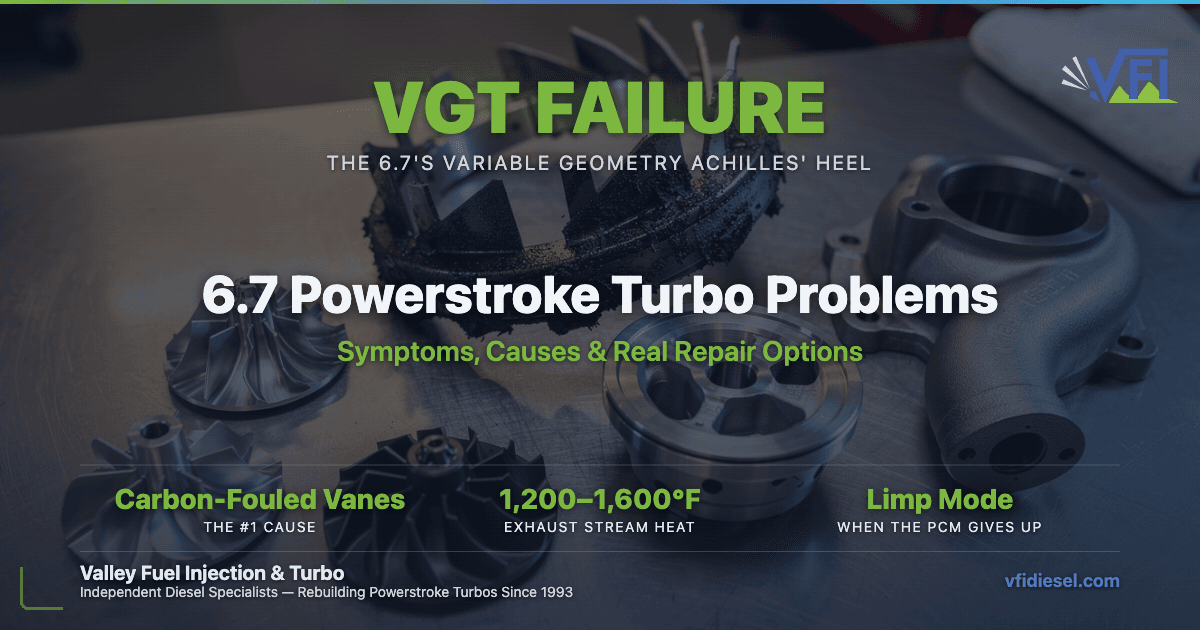
6.7 Powerstroke Turbo Problems: Symptoms, Causes & Repair Options
The 6.7 Powerstroke’s variable geometry turbocharger is one of the most sophisticated, and most failure-prone, turbo systems ever bolted to a production diesel pickup. Unlike a simple fixed-geometry turbo with a wastegate, the 6.7’s VGT uses a ring of movable vanes to control exhaust flow and boost pressure across the entire RPM range. When it works, it delivers outstanding low-end torque and strong top-end pull. When it doesn’t, you get limp mode, black smoke, lost power, and a repair bill that surprises most owners. If you’re searching for answers on 6.7 Powerstroke turbo problems, this guide covers exactly what’s happening inside that turbo, why it fails, and what your real repair options look like.
The 6.7 Powerstroke VGT turbo fails most often due to carbon buildup on the vane mechanism, not catastrophic mechanical failure. Caught early, a professional cleaning and actuator service can restore full function for a fraction of replacement cost. Ignored, a stuck VGT will put your engine into limp mode and can accelerate fuel system wear.
Why Is the 6.7 Powerstroke Turbo System So Different, and Why Does That Complexity Create Failure Points?
The 6.7 Powerstroke uses a Garrett variable geometry turbocharger (VGT), a single, electronically controlled unit that replaces the two-turbo compound system used on the 6.4 Powerstroke before it. This simplification reduced parts count, but it put enormous demand on one turbo to handle everything from idle to wide-open throttle.
Inside the VGT, a ring of pivoting vanes surrounds the turbine wheel. A stepper motor (the VGT actuator) rotates these vanes to change the effective throat area of the turbine housing. At low RPM, the vanes close down to accelerate exhaust flow and spool the turbine faster, giving you boost before the engine would otherwise generate enough exhaust energy. At high RPM, the vanes open to prevent over-boosting. The PCM manages this continuously, hundreds of times per minute, based on throttle position, boost pressure, exhaust backpressure, and EGT sensors.
That’s a lot of moving parts operating in a 1,200–1,600°F exhaust stream. The vane pivot pins, unison ring, and actuator linkage are exposed to soot, carbon, and thermal cycling every time the engine runs. On a work truck that sees long idle cycles, lots of short trips, or heavy towing in stop-and-go traffic, carbon deposits accumulate on the vane pivots faster than the exhaust heat can burn them off. The result: vanes that stick, an actuator that fights against them, and eventually a fault code that sends you into limp mode.
The 6.7 Powerstroke VGT actuator communicates with the PCM via a dedicated feedback signal. If the vane position doesn’t match the commanded position within a calibrated tolerance, the PCM sets a fault and can command reduced power or full limp mode, even if the turbo is otherwise mechanically sound. This is why many “turbo failures” are actually actuator or carbon-fouling issues, not bearing or wheel failures.
Ford revised the VGT design across the 6.7’s production run. The 2011–2014 first-generation trucks used a ceramic ball-bearing CHRA (center housing rotating assembly); the 2015+ second-generation trucks switched to a steel journal-bearing design in some configurations and updated the actuator calibration. Both generations share the same fundamental VGT vane vulnerability, but the 2011–2014 ceramic bearing units are more sensitive to oil contamination and can shed bearing material into the compressor housing if oil supply is compromised. Learn more about how turbo bearing failures differ from vane failures in our turbocharger service overview.
What Are the Most Common 6.7 Powerstroke Turbo Failure Symptoms Owners Report?
The symptoms of 6.7 Powerstroke turbo problems follow a predictable pattern, they usually start subtle and escalate quickly once the VGT vanes begin sticking.
- Limp mode / reduced power: The most common complaint. The PCM detects a VGT position fault and limits boost, cutting power dramatically. You’ll often see this triggered under load, merging onto a highway or pulling a grade.
- Black smoke under acceleration: When the VGT vanes stick in the closed position, exhaust backpressure spikes and EGT climbs. The engine may richen the fuel mixture trying to compensate, producing visible black smoke.
- Boost pressure that’s low or erratic: A partially stuck vane ring produces inconsistent boost, you might see normal numbers at light throttle and a significant drop at wide-open throttle.
- Surging or hesitation: Vanes that stick intermittently cause the boost curve to be uneven. The truck may feel like it’s hunting for power or surging at steady highway speeds.
- DTC codes P0299, P003A, P046C, or P2263: These are the most common OBD-II codes associated with 6.7 VGT faults. P0299 (underboost) and P003A (VGT position performance) are the two you’ll see most often.
- Turbo noise, whining, grinding, or chirping: Bearing wear or compressor wheel contact with the housing produces audible noise. A healthy VGT should be relatively quiet. Any new metallic noise warrants immediate inspection.
- Excessive crankcase pressure or oil consumption: Worn turbo seals allow oil to be pulled into the intake or expelled through the exhaust. You may notice blue smoke at startup or oil residue on the charge pipe.
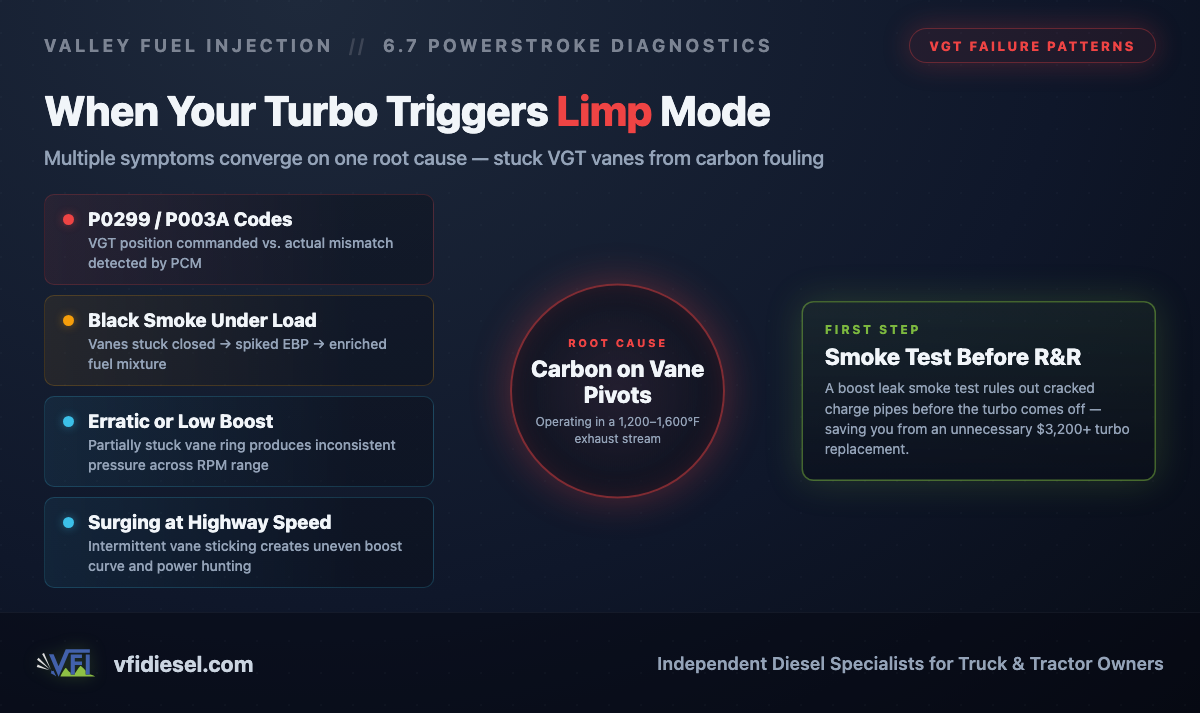
If you’re seeing black smoke AND your boost gauge is reading low AND you have a P0299 code, do not keep driving the truck under load. Sustained high EGT from a stuck closed VGT can damage the turbine wheel, warp the exhaust housing, and accelerate EGR cooler failure, turning a $1,000 vane cleaning into a $4,000+ turbo replacement. Pull over, let it cool, and get it diagnosed.
If you’re also noticing symptoms like hard starting, white smoke at idle, or rough running alongside turbo issues, it’s worth reading our post on common rail injector problems, the 6.7’s fuel and boost systems are closely linked, and a failing turbo often masks or accelerates injector wear.
What Causes the 6.7’s Variable Geometry Turbo (VGT) to Stick, Fail, or Underperform?
Carbon accumulation on the vane pivot pins is the root cause of the majority of 6.7 Powerstroke VGT failures, but it’s not the only one. Here’s the full breakdown of what we see on the bench:
1. Carbon and Soot Fouling of the Vane Mechanism
Every diesel engine produces soot. On the 6.7, exhaust gas passes through the EGR system and recirculates into the intake, and the exhaust side of the turbo sees all of it. Over time, carbon deposits build up on the vane pivot pins and the unison ring that links them. Light deposits cause sluggish vane response; heavy deposits lock the vanes in place. This is accelerated by extended idling, short-trip driving, and EGR system issues.
2. VGT Actuator Failure
The electronic stepper motor that moves the vane ring operates in a hot, vibration-heavy environment. The actuator can fail mechanically (stripped gears, broken linkage) or electrically (position sensor failure, wiring harness issues). An actuator that can’t move the vanes accurately will set a position fault code even if the vanes themselves are clean.
3. Oil Contamination and Bearing Wear
The turbo’s CHRA relies on clean, pressurized engine oil for lubrication. Neglected oil changes, extended drain intervals, or a failing oil supply line can starve the bearings. On the 2011–2014 ceramic bearing units specifically, oil contamination causes the ceramic balls to fracture, and the debris goes straight into the turbine and compressor housings. This is a catastrophic failure mode that typically requires full turbo replacement.
4. Coolant Contamination
The 6.7 uses a water-cooled CHRA to protect the center housing from heat soak after shutdown. A failing EGR cooler or coolant line can introduce coolant into the turbo oil circuit, causing bearing damage and accelerated seal wear. If you have a sweet smell from the exhaust or white smoke at idle, get the cooling system pressure-tested before condemning the turbo.
5. Boost Leaks Upstream or Downstream
This one is frequently misdiagnosed as a turbo failure. A cracked charge pipe, failed intercooler boot, or loose clamp between the turbo and the intake manifold will produce low-boost symptoms identical to a failing VGT. The factory plastic cold-side charge pipe on 2011–2016 trucks is notorious for cracking at the factory weld seam. Always do a boost leak smoke test before pulling the turbo.
Before any turbo diagnosis on a 6.7 Powerstroke, we run a boost leak smoke test first. It takes about an hour and costs a fraction of a turbo R&R. We’ve seen more than a few trucks come in diagnosed as “needing a turbo” that actually had a $40 boost hose leak. A shop that skips the smoke test and goes straight to condemning the turbo is a red flag.
How Does a Failing Turbo on the 6.7 Affect Fuel Injection System Health, and Vice Versa?
The 6.7 Powerstroke’s turbo and fuel injection system are more interdependent than most owners realize, a problem in one accelerates wear in the other.
When the VGT sticks in the closed position, exhaust backpressure increases. The EGR system, which uses exhaust backpressure to drive recirculation flow, responds by pushing more soot-laden exhaust into the intake. That soot ends up in the combustion chamber, increasing carbon deposits on injector tips and accelerating injector wear. At the same time, elevated EGT from poor boost efficiency can cause fuel to partially pyrolize in the injector nozzle, further fouling the spray pattern.
On the fuel side, the 6.7 Powerstroke uses a Bosch CP4.2 high-pressure fuel pump, a component with its own well-documented vulnerability to low-lubricity fuel. A failing CP4 can send metal debris through the entire high-pressure fuel circuit, including the injectors. If your truck has had a CP4 failure event, that debris can also contaminate the turbo oil supply if it reaches the return circuit, though this is less common than fuel system contamination. For a full breakdown of the CP4’s failure modes on the 6.7, see our dedicated post on diesel fuel injection services and our common rail system repair page.
The reverse is also true: a turbo that’s burning oil due to failed seals will introduce oil vapor into the intake. That oil coats the EGR cooler passages, the intercooler core, and the injector tips, reducing combustion efficiency and creating a feedback loop of fouling. We’ve seen 6.7s come in with injector deposit codes that traced back to a turbo seal failure that had been leaking for 20,000+ miles.
If you’re dealing with both turbo and injection symptoms simultaneously, schedule a comprehensive diagnostic, not a parts-swap approach. Addressing the turbo alone won’t fix injector damage that’s already occurred, and replacing injectors without fixing the turbo will just foul the new injectors faster.
Repair vs. Replacement: What Are Your Real Options for a 6.7 Powerstroke Turbo?
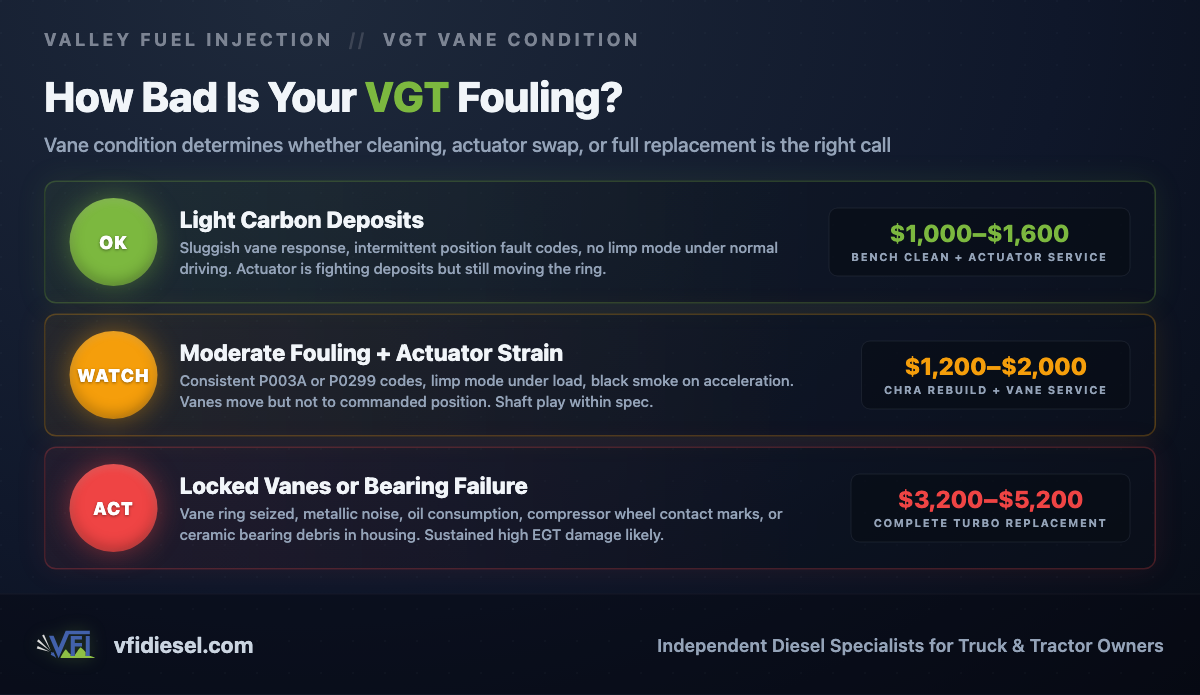
You have three realistic options when your 6.7 Powerstroke VGT fails, and the right choice depends entirely on the failure mode and the condition of your specific turbo.
Option 1: VGT Vane Cleaning and Actuator Service
If the failure is carbon fouling, which it is in the majority of cases, a professional bench cleaning of the vane mechanism, inspection and lubrication of the pivot pins, and actuator recalibration can restore full function. This is the most cost-effective repair when it’s appropriate. The turbo must come off the truck for proper access and cleaning; this isn’t something that can be done effectively with the turbo installed.
Option 2: VGT Actuator Replacement
If the vanes are clean but the actuator motor or position sensor has failed, a standalone actuator replacement is the right call. This is a more targeted repair than a full turbo R&R when the CHRA and vane assembly are confirmed to be in good condition.
Option 3: Turbo Rebuild (CHRA Service)
When bearing wear is confirmed, either through shaft play measurement, oil analysis, or visible scoring, a CHRA rebuild replaces the bearings, seals, and thrust components while keeping the compressor and turbine housings. This is appropriate for turbos with moderate bearing wear that haven’t shed debris into the housings.
Option 4: Complete Turbo Replacement
Catastrophic bearing failure (especially ceramic bearing fragmentation on 2011–2014 units), turbine wheel damage, cracked housing, or contaminated housings that can’t be cleaned require full replacement. OEM-spec remanufactured turbochargers and upgraded drop-in VGT assemblies are both available. See our detailed breakdown of turbocharger repair vs. replacement for a full cost-benefit analysis.

| Repair Option | Best For | Typical Cost (CA Specialty Shop) |
|---|---|---|
| VGT Vane Cleaning + Actuator Service | Carbon fouling, early-stage sticking | $1,000–$1,600 |
| VGT Actuator Replacement Only | Failed motor/sensor, clean vanes confirmed | $350–$650 |
| Turbo Rebuild (CHRA) | Moderate bearing wear, no housing damage | $1,200–$2,000 |
| Complete Turbo Replacement (installed) | Catastrophic failure, housing damage, debris | $3,200–$5,200 |
| Cold-Side Charge Pipe Upgrade | 2011–2016 trucks, cracked factory plastic pipe | $400–$750 |
| Boost Leak Smoke Test (diagnostic) | Any low-boost / underboost code, pre-repair | $175–$300 |
Prices reflect typical California specialty-shop ranges as of 2026. Your actual quote depends on the condition of your specific components, model year (2011–2014 vs. 2015+), parts availability, and current labor rates. Call VFI at 530-668-0818 for an accurate quote on your job.
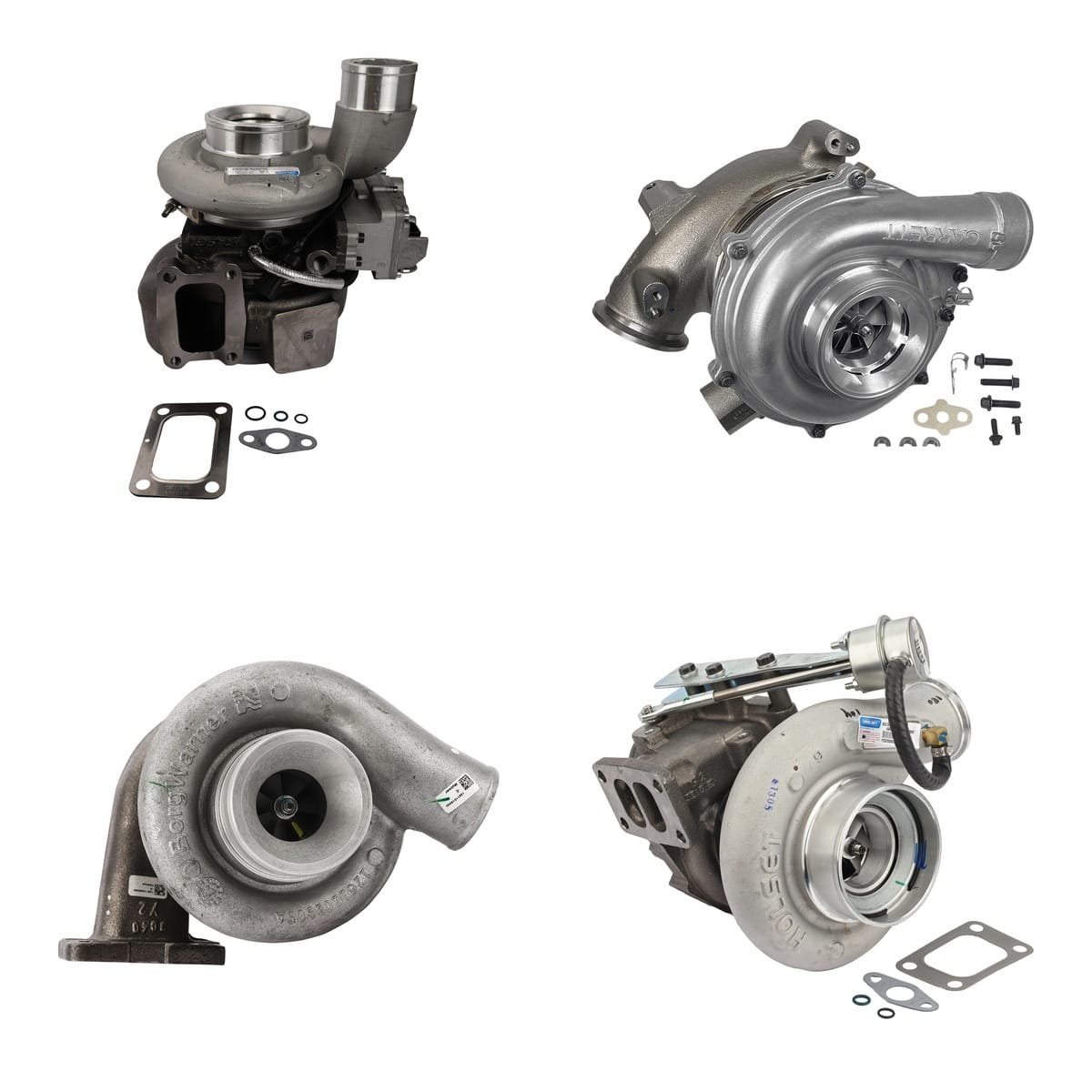
One note on aftermarket upgrades: several manufacturers, including KC Turbos and Garrett, offer drop-in performance VGT units for the 6.7 that use upgraded vane coatings and improved actuator designs to resist carbon fouling better than stock. If you’re running a modified truck or towing heavy regularly, the incremental cost over a stock reman unit is often worth it. Ask us about upgrade options when you call.
What Should You Expect From a Professional Diagnosis and Turbo Service on a 6.7 Powerstroke?
A proper 6.7 Powerstroke turbo diagnosis isn’t a parts-swap exercise, it’s a systematic process that identifies the actual failure mode before anything comes apart. Here’s what a thorough workup looks like at a qualified diesel specialty shop:
- Scan and data logging: Pull all stored and pending DTCs, then data-log a drive cycle to capture live boost pressure, VGT position commanded vs. actual, EGT, and EBP (exhaust backpressure). This tells us whether the fault is a vane position error, an underboost condition, or an actuator communication issue.
- Boost leak smoke test: Before the turbo comes off, we pressure-test the entire charge air system. A cracked charge pipe or failed intercooler boot will show up immediately and can be repaired without a turbo R&R.
- Turbo removal and bench inspection: The VGT comes off the truck for proper access. We measure shaft play (radial and axial), inspect the compressor and turbine wheels for contact marks or erosion, check the vane ring for carbon fouling and pivot pin wear, and test the actuator mechanically and electrically.
- Oil and coolant circuit check: We inspect the turbo oil supply and drain lines for restriction or contamination, and pressure-test the cooling circuit if coolant contamination is suspected.
- Repair or replace decision: Based on bench findings, we give you a clear recommendation with documented findings, not a guess. If cleaning will restore the turbo, we clean it. If the CHRA is worn beyond spec, we’ll tell you that too.
- Reassembly and verification: After any turbo service, we perform a boost leak smoke test on reassembly, verify VGT actuator calibration with a scan tool, and road-test or load-test to confirm boost targets are being met across the RPM range.
If your 6.7 is going in for turbo service, it’s an ideal time to have the up-pipe gaskets replaced (typically $150–$300, they’re almost always disturbed during turbo R&R anyway), inspect the EGR cooler, and upgrade the factory plastic cold-side charge pipe if you haven’t already. Bundling these services when the truck is already apart saves significant labor cost versus returning for each item separately.
The Bosch diesel fuel system engineering documentation and SAE International research on VGT performance both underscore that variable geometry turbo longevity is directly tied to oil quality and EGR system maintenance, two things that are entirely within an owner’s control. Regular oil changes with a quality diesel-spec oil (Ford WSS-M2C171-F1 or equivalent), EGR cooler inspection at 100K-mile intervals, and attention to early symptoms are the best prevention strategy for 6.7 VGT problems.
The California Air Resources Board (CARB) also notes that emissions-related components like the EGR system must be maintained in proper working order, a stuck VGT that drives elevated EGT and EGR malfunction can trigger opacity failures on California’s in-use compliance checks for commercial vehicles.
For diesel truck owners in the Sacramento area, our Sacramento diesel fuel injection service page has information on scheduling. If you’re coming from further north, we also serve customers in Redding and throughout Northern California, and we accept mail-in turbos and injection components for bench testing and rebuild service nationwide.
Our team has been diagnosing and servicing diesel fuel systems, including VGT turbochargers, since 1993. We’ve seen every variation of 6.7 Powerstroke turbo failure across the platform’s entire production run, and we have the equipment to diagnose it properly rather than guess. If you’re also dealing with fuel system concerns on your 6.7, our Bosch fuel injection testing and repair services cover the CP4.2 and injector side of the platform as well.
For context on how the 6.7’s turbo complexity compares to earlier Ford diesel platforms, our guides on 7.3 Powerstroke injection pump problems and 6.0 Powerstroke injector problems show how Ford’s diesel engineering has evolved, and where the recurring failure patterns are across generations.
Don’t let a VGT issue turn into a full turbo replacement. Call us at 530-668-0818 or schedule a diagnostic online. We’re located at 1243 E Beamer St, Suite C, Woodland, CA 95776, serving Northern California and Nevada. We also accept mail-in turbos and injection components for bench testing and rebuild service nationwide.
Frequently Asked Questions: 6.7 Powerstroke Turbo Problems
How do I know if my 6.7 Powerstroke turbo is failing or if it’s just a boost leak?
The symptoms overlap significantly, both produce low boost, a P0299 code, and reduced power. The only reliable way to differentiate them is a boost leak smoke test performed before the turbo is removed. A smoke test pressurizes the charge air system and reveals any leaks in charge pipes, intercooler boots, or couplers. If the system holds pressure, the fault is in the turbo or VGT actuator. Skipping this step and going straight to turbo removal is a common and expensive diagnostic mistake.
Can I clean the 6.7 Powerstroke VGT vanes without removing the turbo?
Some owners attempt chemical cleaning through the turbo inlet with the turbo on the truck, and there are products marketed for this purpose. In our experience, this approach provides temporary relief at best on lightly fouled turbos, and does nothing for turbos with significant carbon glazing on the pivot pins. Proper vane cleaning requires turbo removal, disassembly of the vane ring assembly, mechanical cleaning of each pivot point, and verification of free movement before reassembly. Cutting corners here typically means the problem returns within 10,000–20,000 miles.
How long does a 6.7 Powerstroke turbo typically last?
With proper maintenance, regular oil changes, attention to EGR system health, and avoiding extended idle cycles, the 6.7 VGT turbo can last 200,000+ miles. Trucks that are neglected, run on poor-quality oil, or used in heavy-duty towing applications with frequent short trips tend to develop VGT vane issues in the 80,000–130,000 mile range. The 2011–2014 ceramic bearing units are more sensitive to oil quality than the later steel-bearing designs. Proactive inspection at 100,000-mile intervals is recommended for any 6.7 used in demanding service.
Is it worth upgrading to an aftermarket VGT on the 6.7 Powerstroke?
For a stock or mildly modified daily driver, a quality OEM-spec remanufactured VGT is usually the most cost-effective choice. For trucks running tuning, larger injectors, or regular heavy towing, upgraded drop-in VGT units with improved vane coatings and stiffer actuator designs offer better durability and marginally improved flow characteristics. The cost premium over a stock reman unit typically runs $500–$1,000 in parts. Consult a qualified diesel technician to match the turbo spec to your truck’s actual power level and use case, oversizing a turbo for a stock truck creates its own problems.
Will a failing 6.7 Powerstroke turbo damage the engine if I keep driving it?
Yes, in several ways. A VGT stuck in the closed position drives elevated exhaust backpressure and EGT, which accelerates EGR cooler failure, increases thermal stress on the head gaskets, and accelerates injector tip fouling. A turbo with bearing failure can shed metal debris into the intake (compressor side) or exhaust (turbine side), causing engine internal damage. A turbo burning oil through failed seals will foul the intake, intercooler, and injectors. Any of these scenarios can turn a $1,000 turbo service into a $5,000–$15,000 repair bill if ignored long enough. If you have turbo symptoms, get it diagnosed promptly.