Diesel Fuel Injection Pump Rebuild Cost vs Replace: 2026 Guide
03/03/2026
Authorized Diesel Parts Sourcing: Bosch vs Compatible Parts
03/08/2026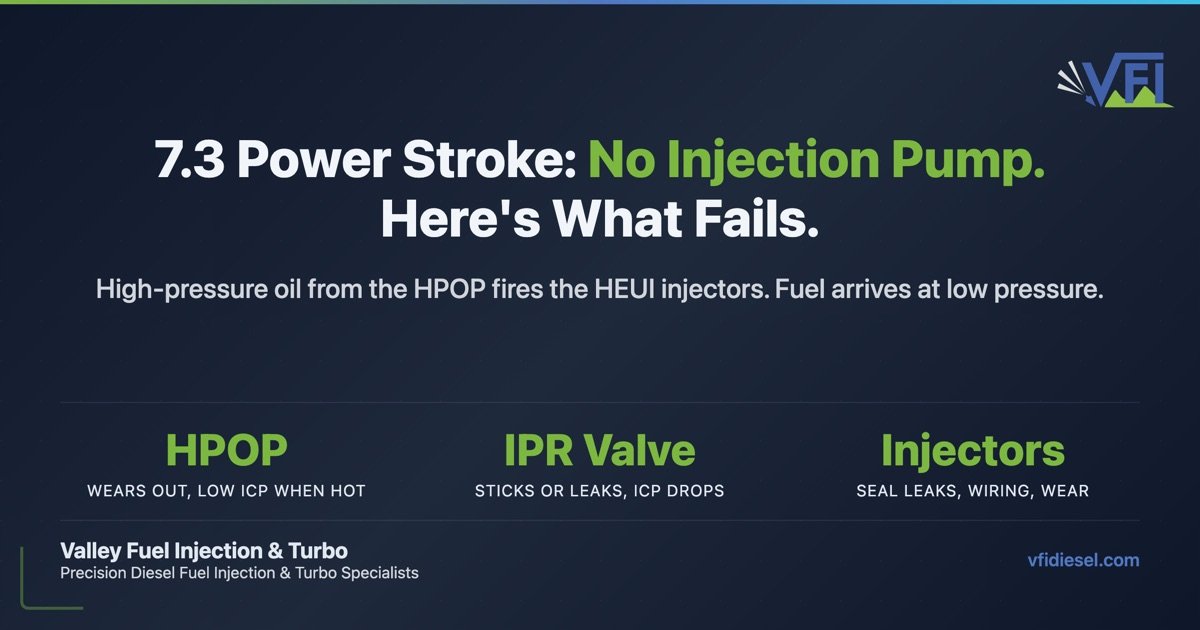
The 7.3 Power Stroke doesn’t have an injection pump. Here’s what does the job, what fails, and how to tell. The 1994.5 to 2003 7.3L (the Navistar T444E) fires its injectors with engine oil, so when a 7.3 Powerstroke injection pump is the suspect, the real list is the high-pressure oil pump (HPOP), the IPR valve, the injectors and their wiring, and the low-pressure fuel supply: the lift pump and the fuel bowl.
Hard starts, no-starts, misses and low power on a 7.3 Power Stroke come from the high-pressure oil side (HPOP, IPR valve, oil leaks), the injectors and their wiring, or low fuel pressure. Check injection control pressure (ICP) and fuel pressure before you buy parts. The only 7.3 with a true injection pump is the older 7.3 IDI (1988 to 1994), which uses a Stanadyne DB2.
We’ve serviced hundreds of 7.3 Powerstroke injection systems over our 30+ years in business.
How the 7.3 Power Stroke Injection System Works
The 7.3 uses HEUI injectors: hydraulically actuated, electronically controlled unit injectors. A gear-driven, swash-plate HPOP at the front of the lifter valley pulls oil from its own reservoir and pressurizes it to roughly 500 to 3,000 psi. That pressure, called injection control pressure (ICP), feeds oil galleries in the cylinder heads. The PCM sets ICP with the injection pressure regulator (IPR) valve on the pump, which dumps excess oil back to the crankcase, and the ICP sensor reports what the system is actually making.
To fire a cylinder, the injector driver module (IDM) energizes the injector solenoid, a poppet valve opens, and that oil pushes on an intensifier piston. The oil side of the piston has seven times the area of the fuel plunger, so fuel leaves the nozzle at about seven times ICP, up to roughly 21,000 psi (Diesel Hub’s HPOP reference has the full specs). The diesel itself arrives at low pressure through fuel galleries in the heads. No high-pressure fuel pump, no injection lines.
What “7.3 Powerstroke Injection Pump” Usually Means
These parts share the work an injection pump does on other diesels, and any of them can be what someone means by a 7.3 injection pump. Years below are for F-Series pickups; E-Series vans and Excursions can differ, so confirm on the vehicle.
High-Pressure Oil Pump (HPOP)
The closest thing the 7.3 has to an injection pump. Output falls off gradually as the pump wears. The classic sign of a worn pump is a hard start or no start when the engine is hot, because thin hot oil leaks past worn parts. Sudden failures are rare on a stock truck. Engines from 1994.5 to early 1999 use a 15-degree pump, and late 1999 to 2003 engines use a 17-degree pump. A 15-degree pump can’t feed the late-style injectors, so match the pump to your engine. Symptoms, testing and replacement are covered in our 7.3 Power Stroke HPOP problems guide.
IPR Valve
A normally open, PCM-controlled dump valve on the HPOP. If it sticks or its O-rings leak, the system can’t hold ICP: hard starts, rough running and low power. A leaking IPR can often be resealed instead of replaced, and it should be ruled out before anyone condemns the pump.
Injectors and Their Wiring
Each HEUI injector carries three O-ring grooves and a copper washer at the nozzle. Worn internals bleed off pressure and spray poorly; failed seals let fuel into the engine oil or the coolant. Wiring matters just as much: the under-valve-cover harness (UVCH) connectors and the IDM cause misses that look like bad injectors. Year-by-year injector matching is in our 7.3 Powerstroke injector symptoms and replacement guide.
Fuel Supply: Lift Pump and Fuel Bowl
The fuel side runs at low pressure. 1994.5 to 1997 trucks use a two-stage mechanical lift pump in the valley under the turbo, driven by a cam lobe; 1999 to 2003 trucks use an electric lift pump. The fuel bowl (filter housing) holds the filter, water-in-fuel sensor, fuel heater, drain valve and fuel pressure regulator. On the early trucks the regulator sits on the return side after the heads; on 1999 to 2003 trucks it controls supply pressure ahead of the heads, with no return line from the heads. A tired lift pump, a plugged filter or a weak regulator spring drops fuel pressure, and low fuel pressure means hard starts, stalling, misfires and low power. Leak points and the rebuild are in our 7.3 Power Stroke fuel bowl guide.
7.3 Power Stroke Symptoms and the Part Behind Each
Start with batteries and cranking speed on any hard start. After that, this is where each complaint usually leads.
| Symptom | Usual Suspects | Check First |
|---|---|---|
| Hard start or no start hot, starts fine cold | Worn HPOP, IPR valve leaking or sticking, injector O-rings, STC fittings (1999 to 2003) | ICP while cranking hot |
| Long crank cold, white smoke at startup | Glow plugs or glow plug relay, UVCH connectors, worn injectors, low fuel pressure | Glow plug circuit, fuel pressure |
| Cranks, no start, no RPM signal (tach dead while cranking on pre-2002 trucks) | Camshaft position sensor (CPS) or its wiring | RPM on the scan tool while cranking |
| Cranks, no start, RPM signal present | Low ICP (HPOP, IPR, high-pressure oil leak, low reservoir), IDM or wiring, no fuel pressure | ICP while cranking, HPOP reservoir level, fuel pressure |
| Rough idle or a miss | Injector, UVCH connector, IDM | Buzz test, cylinder contribution test |
| Low power | Low fuel pressure (lift pump, filter, regulator), HPOP not reaching commanded ICP | Fuel pressure, commanded vs. actual ICP |
| Oil level rising, oil smells like diesel | Failed injector seals | Oil sample, injector O-rings |
| Diesel in the coolant | Cracked injector sleeve, failed injector seals | Cooling system pressure test |
| Oil in the valley or around the HPOP | STC fitting O-rings on the high-pressure oil hoses (1999 to 2003), IPR O-rings, HPOP cover and reservoir seals | Clean, run and trace the leak |
| Diesel smell, wet fuel bowl | Fuel bowl O-rings, drain valve, regulator seals | Fuel bowl reseal |
The STC (snap-to-connect) fittings arrived with the 1999 update. They seal with O-rings and are far more prone to leaking than the flared fittings on 1994.5 to 1997 trucks. A high-pressure oil leak shows up as a long crank or a hot no-start.
A rising oil level with a diesel smell means fuel is reaching the crankcase, usually past failed injector seals. Diluted oil protects bearings poorly, and on a 7.3 that same oil fires the injectors. Find the leak before the truck goes back to work.
How a Shop Tests a 7.3 Injection System
Start with data, not parts: a scan tool that reads ICP, IPR duty cycle and RPM, plus a fuel pressure gauge.
ICP and IPR Duty Cycle
- Cranking ICP: the injectors won’t fire until ICP reaches roughly 500 psi. If the complaint is a hot start, test it hot.
- Warm idle: ICP typically runs about 500 to 700 psi, with IPR duty cycle around 16% or less.
- Commanded vs. actual: the PCM raises IPR duty cycle to close the valve and build pressure. High duty with ICP that won’t come up means the pump is worn or oil is escaping the high-pressure side (IPR, injector O-rings, hoses and STC fittings).
- HPOP reservoir: after the truck sits, oil should be about an inch below the top of the reservoir. A low reservoir points to a worn lube oil pump or a failed check valve in the front cover.
Before you blame the IPR or the pump, unplug the ICP sensor and try again. If the engine starts or the idle smooths out, the sensor was the problem, not the high-pressure oil system.
Fuel Pressure at the Bowl
- 1994.5 to 1997: 40 to 70 psi cranking or at idle, never below 40. Some pulsing is normal with the cam-driven pump. The test port is on the regulator housing of the fuel bowl.
- 1999 to 2003: the reading should be steady: about 50 to 60 psi at idle, and not below about 45 psi at full load. There’s no factory test port, so the plugs on the back of the filter housing are used with a 1/4 in. flare test fitting.
Test procedures for both generations are laid out in Diesel Hub’s 7.3 fuel pressure test.
Injectors, Wiring and the CPS
- Buzz test (key on, engine off): the PCM energizes all eight injector solenoids together, then each one in order. A weak solenoid sounds dull instead of sharp.
- Cylinder contribution test (engine running): the PCM reports each cylinder as a percent change in engine speed. Ideally no cylinder shows a change greater than 5%.
- Wiring first: an intermittent miss or injector fault is often the UVCH connectors or the IDM, so check the wiring before buying injectors.
- No RPM, no fire: without a camshaft position sensor signal the PCM won’t tell the IDM to fire the injectors, so a dead CPS is a crank, no-start with nothing wrong in the fuel system.
What 7.3 Repairs Cost
Replacing a 7.3 HPOP typically runs $2,500–$4,000 installed: the pump itself is typically $800–$1,300 and labor $1,400–$2,800. A scan-tool diagnostic typically runs $150–$300. For injectors, IPR work, fuel bowl rebuilds and lift pumps, call for a quote with your year and symptoms.
Parts and labor vary by region, engine condition and current pricing. Call us at (530) 668-0818 for an accurate quote.
Have a 7.3 IDI? That Engine Has an Injection Pump
If your 7.3 is a 1988 to 1994 IDI, the pump is real. The 7.3 IDI uses a Stanadyne DB2 rotary injection pump feeding mechanical pintle injectors through steel injection lines. It was naturally aspirated until a factory turbo version was offered for 1993 and 1994, and Ford replaced it with the Power Stroke midway through the 1994 model year. So a 1994 truck can have either engine: injection lines running to the heads mean IDI, none means Power Stroke, and the engine code in the VIN settles it.
On an IDI, hard starting, smoke, low power and pump leaks really can be the injection pump, and a DB2 can be rebuilt and calibrated on a test stand. We’re a certified Stanadyne service center and rebuild DB2 pumps; see our Stanadyne DB2 and DB4 rebuild guide, or ship yours in through our mail-in rebuild service. Our rebuilds carry a 1-year, unlimited-mileage parts and labor warranty, with 30 days on electrical components. Call for a quote on your IDI pump.
Talk to a Diesel Tech Not sure which 7.3 part is failing? Call first. Tell us the year and what the truck does hot and cold. Running a 7.3 IDI? Ship the DB2 pump to us for a rebuild and bench test. Two ways in: drive it into our Woodland shop near Sacramento, or ship it to us from anywhere in the country. ☎︎ Call 530-668-0818Out of the area? Start a mail-in rebuild → |
Frequently Asked Questions
Does the 7.3 Power Stroke have an injection pump?
No. The 1994.5 to 2003 7.3 Power Stroke uses HEUI injectors that are fired by engine oil. A high-pressure oil pump (HPOP) makes that oil pressure, the IPR valve regulates it, and a low-pressure lift pump and fuel bowl feed diesel to the injectors. The 1988 to 1994 7.3 IDI is the version with a Stanadyne DB2 injection pump.
Why won’t my 7.3 Power Stroke start when it’s hot?
The usual cause is the high-pressure oil side losing pressure once the oil is hot and thin: a worn HPOP, a leaking or sticking IPR valve, leaking injector O-rings, or on 1999 to 2003 trucks, leaking STC fittings on the high-pressure oil hoses. Check ICP while cranking hot. The engine needs roughly 500 psi before the injectors will fire.
What fuel pressure should a 7.3 Power Stroke have?
On 1994.5 to 1997 trucks, 40 to 70 psi cranking or at idle, never below 40. On 1999 to 2003 trucks the reading should be steady: about 50 to 60 psi at idle, and not below about 45 psi at full load. Test it at the fuel bowl.
How much does it cost to replace a 7.3 HPOP?
Typically $2,500–$4,000 installed, with the pump itself typically $800–$1,300 and labor $1,400–$2,800. Rule out the IPR valve, the ICP sensor and high-pressure oil leaks before you buy a pump.
Can fuel get into the oil on a 7.3 Power Stroke?
Yes, usually through failed injector seals, which can also let fuel into the coolant. A rising oil level with a diesel smell needs attention before the truck goes back to work, because that same oil lubricates the engine and fires the injectors.
Not sure which part your 7.3 needs? Call (530) 668-0818 (Monday to Thursday 7:00 to 4:30, Friday 7:00 to 4:00) and tell us the year and what the truck does hot and cold. Sacramento-area customers can come to our Woodland shop, and everything we work on is on our diesel fuel injection services page.