Diesel Injection Pump Losing Prime: Causes & Fixes
05/04/2026
Duramax Injector Balance Rates Explained
05/08/2026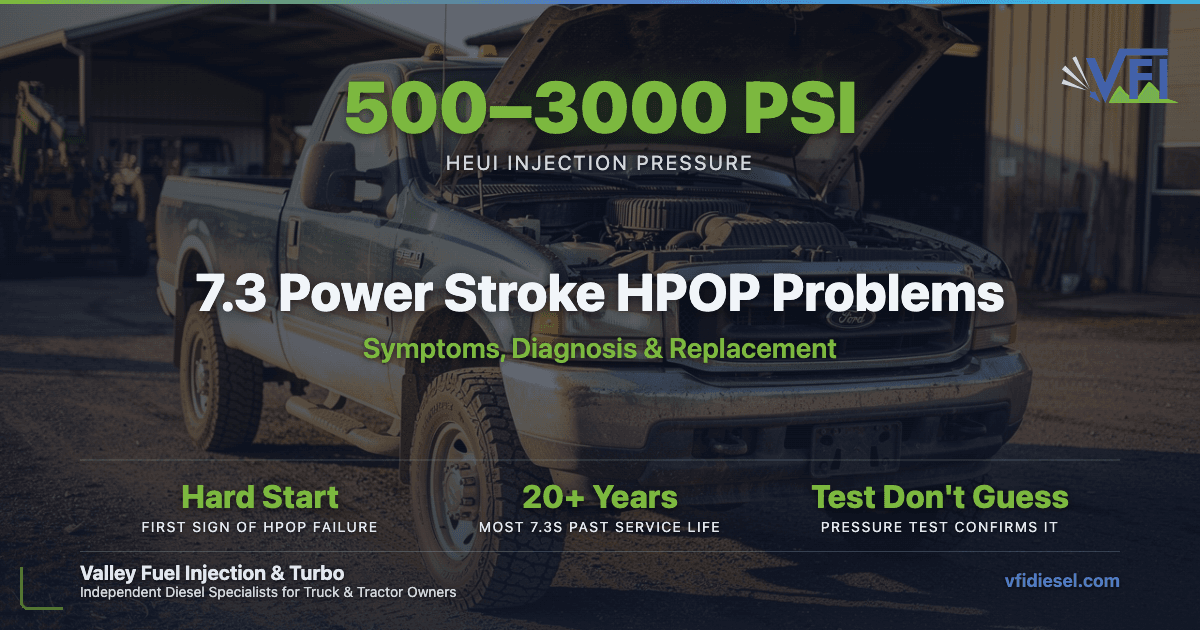
The High Pressure Oil Pump (HPOP) is the heart of your 7.3 Power Stroke’s HEUI fuel injection system, and when it starts failing, your truck’s performance suffers dramatically. HPOP problems in 7.3 Power Strokes typically manifest as hard starting, rough idle, reduced power, and eventually complete injection system failure if left unaddressed.
The 7.3 Power Stroke HPOP creates the high-pressure oil needed to operate HEUI injectors. When it fails, symptoms include hard starting, rough idle, and power loss. Early diagnosis and replacement prevent catastrophic injection system damage.
What Is the HPOP and Why Does It Fail in 7.3 Power Strokes?
The High Pressure Oil Pump (HPOP) in your 7.3 Power Stroke is a critical component that creates the high-pressure oil required to operate the HEUI (Hydraulically-actuated Electronically-controlled Unit Injector) fuel injection system. Unlike conventional diesel engines that use mechanical injection pumps, the 7.3 Power Stroke relies on high-pressure engine oil to actuate the injectors.
The HPOP pressurizes engine oil to 500-3000 PSI, which is then sent to the injectors through high-pressure oil rails. When the PCM signals an injector to fire, this pressurized oil forces a piston inside the injector to compress and inject fuel into the combustion chamber.
HEUI was Caterpillar’s design, licensed to Navistar, and the 7.3 Power Stroke was one of the first engines to use it.
HPOP failures in 7.3 Power Strokes occur for several reasons:
- Internal wear: High-pressure seals and pistons wear out over time, reducing pressure output
- Contaminated oil: Dirty oil causes accelerated wear of internal components
- High mileage: Most 7.3s are now 20+ years old with significant wear
- Poor maintenance: Extended oil change intervals damage the precision components
- System contamination: Metal particles from other components can damage the pump
We’ve rebuilt hundreds of 7.3 Power Stroke HPOPs at our Woodland shop, and the most common failure we see is internal seal deterioration that allows high-pressure oil to bypass back to the low-pressure side.
What Are the Early Warning Signs of HPOP Failure?
Recognizing early HPOP failure symptoms can save you from catastrophic injection system damage and expensive repairs. The symptoms typically progress from minor performance issues to complete engine shutdown.
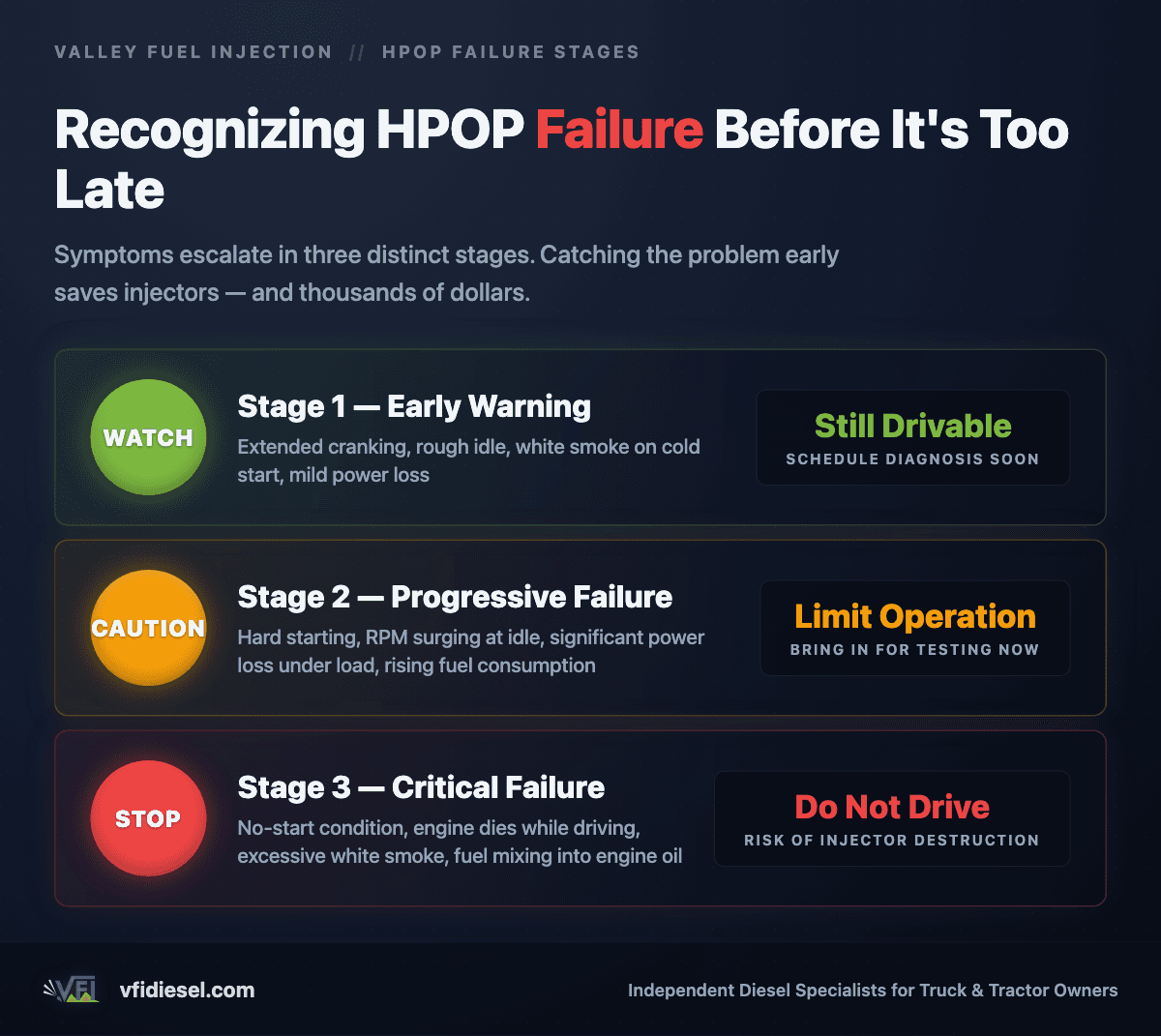
Stage 1: Early Warning Signs
- Extended cranking: Engine takes longer to start, especially when cold
- Rough idle: Engine stumbles or shakes at idle
- Reduced power: Noticeable power loss during acceleration
- White smoke on startup: Unburned fuel from poor injection timing
Stage 2: Progressive Failure
- Hard starting: Requires multiple attempts to start
- Surging at idle: RPMs fluctuate irregularly
- Power loss under load: Significant performance reduction when towing or climbing hills
- Increased fuel consumption: Poor injection efficiency wastes fuel
If your 7.3 Power Stroke won’t start or runs extremely rough, stop driving immediately. Continuing to operate with severe HPOP failure can damage injectors and require complete injection system replacement.
Stage 3: Critical Failure
- No start condition: Engine cranks but won’t fire
- Complete power loss: Engine dies while driving
- Excessive white smoke: Massive amounts of unburned fuel
- Oil contamination: Fuel mixing with engine oil
If you’re experiencing any of these symptoms in the Sacramento area, bring your truck in for immediate diagnosis. Early intervention prevents much more expensive repairs.
How Do You Test HPOP Pressure and Diagnose Problems?
Proper HPOP diagnosis requires specialized equipment and knowledge of the 7.3 Power Stroke’s HEUI system. Here’s how we test HPOP pressure and diagnose problems at Valley Fuel Injection.
Required Equipment
- High-pressure oil gauge (0-4000 PSI)
- HPOP test fitting kit
- Scan tool capable of reading Ford diesel codes
- Digital multimeter
- Oil analysis kit
Step-by-Step Testing Procedure
1. Visual Inspection
Check for obvious oil leaks around the HPOP, high-pressure lines, and injectors. Look for metal contamination in the oil and inspect the oil condition.
2. Scan for Codes
Use a quality scan tool to check for diagnostic trouble codes related to injection pressure or injector performance. Common codes include P1280 and P1281 (ICP sensor circuit out of range low and high), which are electrical faults, so check the ICP sensor, connector and wiring before you condemn the pump. P1211 (ICP above or below desired) is the code that points at the high-pressure oil system itself.
3. HPOP Pressure Test
Install the pressure gauge at the HPOP test port and perform static and dynamic pressure tests:
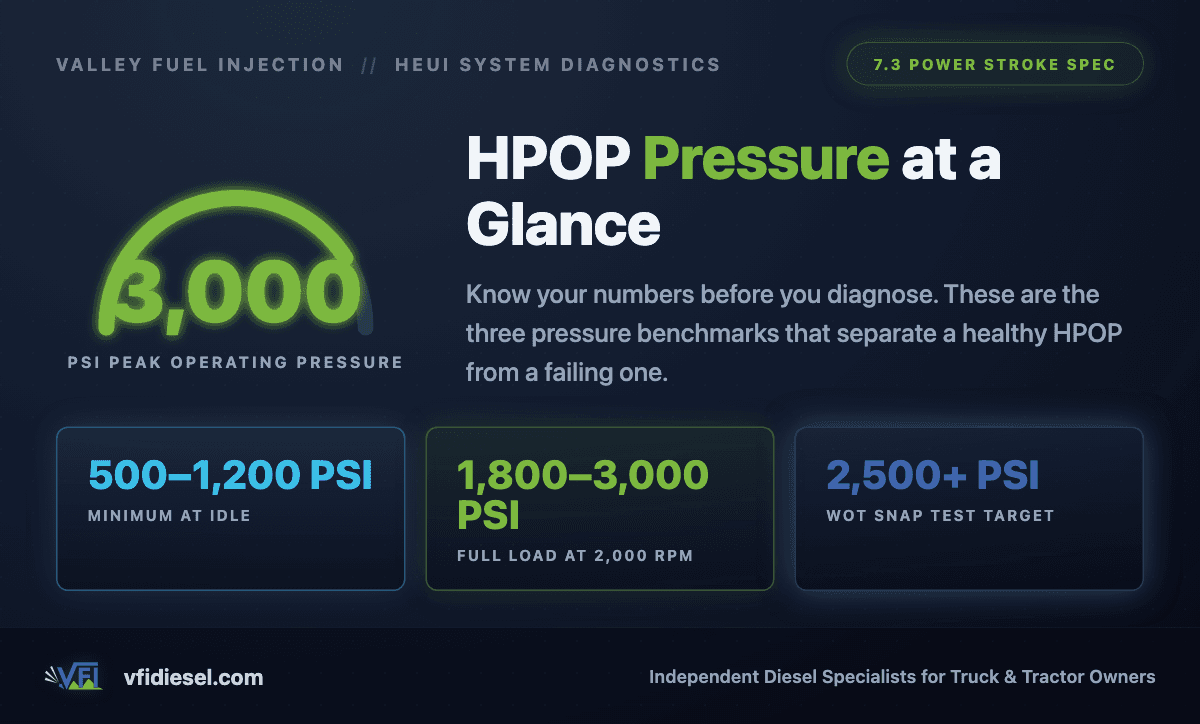
| Test Condition | Specification | What It Indicates |
|---|---|---|
| Cranking | About 500 PSI minimum | Least pressure the injectors need to fire; below it, no start |
| Idle | 500-1200 PSI | Minimum operating pressure |
| 2000 RPM | 1800-3000 PSI | Full load capacity |
| WOT Snap Test | 2500+ PSI | Peak pressure capability |
4. Leak-Down Test
With the engine off and system pressurized, monitor pressure drop over time. Excessive leak-down indicates internal HPOP wear or external system leaks.
Always test HPOP pressure with the engine at operating temperature. Cold oil viscosity can mask internal wear and give false readings.
Our certified technicians use professional-grade diagnostic equipment to accurately assess HPOP condition and determine whether rebuild or replacement is the best option.
Can You Rebuild an HPOP or Should You Replace It?
The decision between rebuilding and replacing a 7.3 Power Stroke HPOP depends on several factors including cost, downtime, and long-term reliability goals. Both options have their place in different situations.
HPOP Rebuild Considerations
When Rebuilding Makes Sense:
- High-mileage trucks with good maintenance history
- Budget constraints requiring lower upfront costs
- Core HPOP housing is in good condition
- Experienced shop with HEUI system expertise
Rebuild Process Overview:
- Complete disassembly and inspection
- Replacement of all seals, gaskets, and wear components
- Precision machining of worn surfaces
- Reassembly with proper torque specifications
- Pressure testing and quality verification
HPOP rebuild typically costs $800–$1,300 for the pump alone, while a remanufactured replacement runs $2,500–$4,000 installed. Factor in potential downtime and warranty coverage when deciding.
Replacement Advantages
When Replacement Is Better:
- High-mileage trucks needing maximum reliability
- Commercial applications with minimal downtime tolerance
- HPOP housing shows significant wear or damage
- Want longest possible warranty coverage
Quality remanufactured HPOPs from reputable suppliers like Bosch or Alliant Power offer the best combination of reliability and warranty coverage.

At Valley Fuel Injection, we evaluate each HPOP individually and recommend the most cost-effective solution based on your truck’s condition and your specific needs.
Our 30+ years of experience with diesel injection systems helps us make the right recommendation for your situation.
What Causes HPOP Failures and How Can You Prevent Them?
Understanding the root causes of 7.3 Power Stroke HPOP failures is essential for preventing premature replacement and extending system life. Most failures are preventable with proper maintenance and operating practices.
Primary Failure Causes
1. Contaminated Engine Oil
The HPOP circulates engine oil at extremely high pressures, making it sensitive to contamination. Dirty oil contains abrasive particles that accelerate wear of precision components.
Prevention:
- Change oil every 5,000 miles or less
- Use high-quality 15W-40 diesel engine oil
- Replace oil filters at every change
- Monitor oil condition between changes
2. Extended Oil Change Intervals
Many 7.3 Power Stroke owners follow the factory 7,500-mile oil change interval, which is too long for the HEUI system’s precision components.
Extended oil changes are the leading cause of HPOP failure in 7.3 Power Strokes. The high-pressure oil system is much more sensitive to oil condition than conventional diesel engines.
3. System Contamination
Metal particles from worn injectors or other components can circulate through the high-pressure oil system and damage the HPOP.
4. Overheating
Excessive engine temperatures break down oil viscosity and accelerate component wear. Common causes include:
- Faulty cooling system components
- Restricted airflow through radiator
- Heavy towing without proper cooling modifications
- Turbocharger problems affecting air/fuel ratios
If you’re experiencing turbo boost leak symptoms, address them promptly to prevent engine overheating that can damage the HPOP.
Preventive Maintenance Best Practices
| Maintenance Item | Interval | Impact on HPOP Life |
|---|---|---|
| Engine Oil & Filter | 5,000 miles | Critical – prevents abrasive wear |
| Oil Analysis | Every oil change | High – detects contamination early |
| Fuel Filter | 10,000 miles | Medium – prevents injector damage |
| Cooling System | Annual inspection | High – prevents overheating damage |
Regular maintenance at our diesel service facility can significantly extend HPOP life and prevent costly failures.
Why Do Some 7.3s Need HPOP Replacement at High Mileage?
High-mileage 7.3 Power Strokes (typically 200,000+ miles) often require HPOP replacement due to cumulative wear and the challenging operating environment of the HEUI injection system. Understanding why this happens helps set realistic expectations for maintenance costs.
Age-Related Factors
Seal Deterioration
The HPOP contains numerous high-pressure seals that naturally degrade over time, regardless of mileage. After 20+ years, even well-maintained trucks can experience seal failures that reduce system pressure.
Material Fatigue
Constant pressure cycling causes metal fatigue in HPOP components. High-stress areas like valve seats and piston bores gradually wear beyond serviceable limits.
System Contamination Accumulation
Even with regular oil changes, microscopic contamination accumulates over hundreds of thousands of miles, gradually wearing internal components.
A typical 7.3 Power Stroke HPOP cycles millions of times over its service life, creating pressures equivalent to 15-20 times normal engine oil pressure with every injection event.
High-Mileage Maintenance Strategy
For 7.3 Power Strokes approaching or exceeding 200,000 miles, consider these proactive measures:
Preventive HPOP Service
- HPOP pressure testing every 50,000 miles
- Oil analysis to monitor system contamination
- Proactive replacement before complete failure
- Budget planning for eventual HPOP service
Supporting System Maintenance
- Replace high-pressure oil lines if showing wear
- Service injectors to prevent contamination
- Upgrade to synthetic oil for better protection
- Install auxiliary oil filtration if operating in severe conditions
Many owners of high-mileage 7.3s find that proactive HPOP replacement, combined with injector service, gives their truck a “second life” with restored performance and reliability.
Our team has extensive experience with high-mileage 7.3 Power Strokes and can help you develop a maintenance strategy that maximizes your investment. If you’re dealing with 7.3 Powerstroke injection pump problems, we can diagnose whether the issue is HPOP-related or involves other system components.
For 7.3 Power Stroke owners in Reno or surrounding areas, we offer comprehensive HPOP testing and replacement services with warranty coverage and expert installation.
When replacing a high-mileage HPOP, consider having the injectors tested and serviced at the same time. This prevents contamination of the new HPOP and ensures optimal system performance.
Frequently Asked Questions
How long does a 7.3 Power Stroke HPOP typically last?
A well-maintained 7.3 Power Stroke HPOP typically lasts 200,000-300,000 miles. However, trucks with poor maintenance history may experience failures as early as 150,000 miles, while exceptionally well-maintained examples can exceed 400,000 miles.
Can I drive my 7.3 with a failing HPOP?
Limited driving is possible in early stages of HPOP failure, but continuing to operate with severe symptoms can damage injectors and other expensive components. If you experience hard starting or significant power loss, have the system diagnosed immediately.
What’s the difference between early and late model 7.3 HPOPs?
Early 7.3 Power Strokes (1994-1997) used a different HPOP design than later models (1999-2003). The later design is generally more robust and has better parts availability. 1998 was a transition year with some variation.
Should I upgrade to a high-volume HPOP?
High-volume HPOPs can improve performance on modified engines but aren’t necessary for stock applications. They may actually reduce reliability on unmodified trucks by creating excessive system pressure.
How much does 7.3 HPOP replacement cost?
Complete HPOP replacement typically costs $2,500–$4,000 depending on whether you choose rebuild or remanufactured replacement, labor rates in your area, and any additional repairs needed during installation.
If you’re experiencing 7.3 Power Stroke HPOP problems, don’t wait until complete failure occurs. Call us at 530-668-0818 to schedule diagnostic testing, or visit our Woodland, CA shop for expert evaluation. We also provide mail-in HPOP testing and rebuilding services for customers nationwide who need professional HEUI system expertise.