
Right to Repair Diesel Equipment: Owner’s Guide to Service Rights
04/27/2026
Diesel Injection Pump Losing Prime: Causes & Fixes
05/04/2026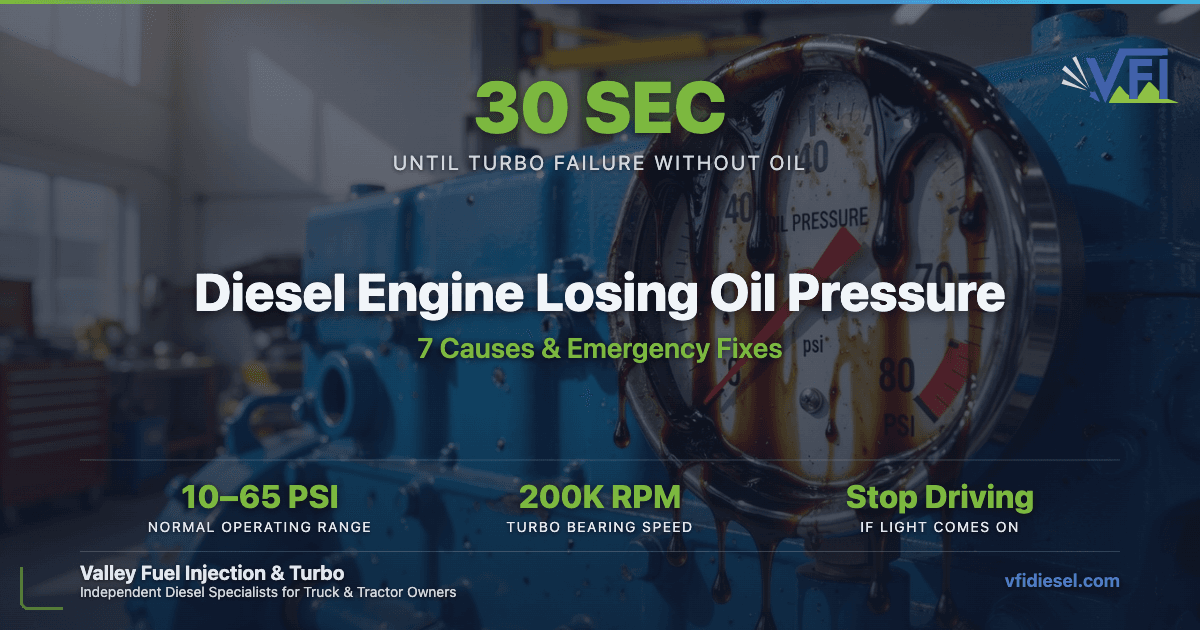
A diesel engine losing oil pressure is one of the fastest ways to turn a running truck into a pile of scrap metal, and it happens more quickly than most owners realize. Unlike gasoline engines, diesels run at higher compression ratios, higher operating temperatures, and with tighter tolerances throughout the fuel system and turbocharger. When oil pressure drops, those tight tolerances don’t get the lubrication film they need, and within minutes, sometimes seconds, you’re looking at catastrophic damage to bearings, turbo shafts, and the precision components inside your fuel injection system. If your oil pressure warning light just came on or your gauge is reading low, this guide is for you.
Low oil pressure in a diesel engine is an emergency, not a “watch it and see” situation. Beyond engine bearing damage, it directly destroys turbochargers and can starve high-pressure fuel injection components of the lubrication they depend on. Stop the engine, diagnose the cause, and call a specialist before you drive another mile.
Why Is Low Oil Pressure Especially Dangerous in a Diesel Engine?
Diesel engines are more vulnerable to oil pressure loss than gasoline engines because of how they’re built and how hard they work. The answer comes down to three things: higher compression, tighter tolerances, and turbocharging.
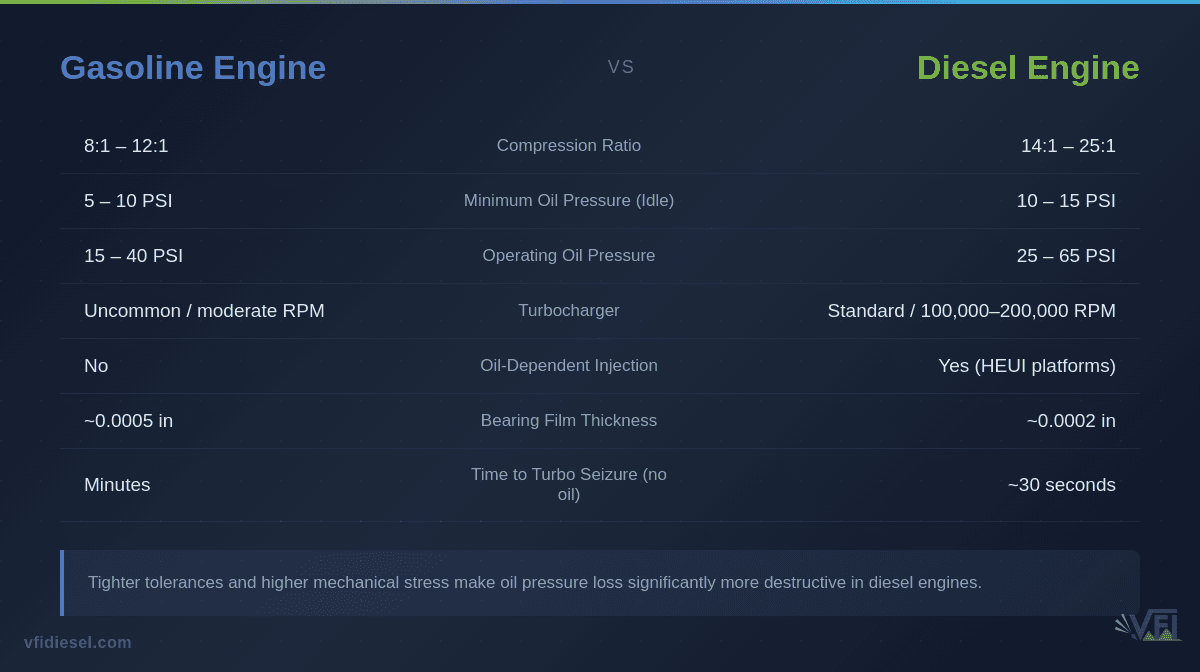
Diesel engines operate at compression ratios between 14:1 and 25:1, roughly double that of a gasoline engine. That means every internal component is under significantly more mechanical stress on every single stroke. The crankshaft bearings, connecting rod bearings, and camshaft journals all rely on a continuous pressurized oil film to prevent metal-to-metal contact. When pressure drops below the minimum threshold (typically 10–15 PSI at idle, 25–65 PSI at operating RPM depending on the engine), that film collapses.
Additionally, most diesel engines, especially modern common rail systems, use engine oil to actuate or lubricate components that gasoline engines simply don’t have. Ford’s 7.3L and 6.0L Power Stroke engines, for example, use high-pressure engine oil to fire the injectors themselves through a HEUI (Hydraulic Electronic Unit Injector) system. On those platforms, low oil pressure doesn’t just hurt the engine, it directly prevents fuel injection from functioning at all.
Turbocharged diesels face a compounding problem: the turbocharger’s center bearing cartridge is lubricated entirely by engine oil. A turbo spinning at 100,000–200,000 RPM with no oil pressure will seize and fail within 30 seconds. That’s not an exaggeration, it’s physics.
According to SAE International, hydrodynamic bearing failure, the type caused by oil starvation, is one of the leading causes of catastrophic diesel engine failure in commercial vehicles. The oil film in a loaded diesel bearing can be as thin as 0.0002 inches. That’s thinner than a human hair.
What Are the Warning Signs That Your Diesel Is Losing Oil Pressure?
The warning signs of low oil pressure in a diesel engine range from obvious dashboard alerts to subtle performance symptoms that most owners miss until it’s too late.
Dashboard and Gauge Warnings:
- Oil pressure warning light: If this illuminates at operating temperature, treat it as an emergency. Don’t assume it’s a faulty sensor without verifying actual pressure with a mechanical gauge.
- Low or falling oil pressure gauge reading: A gradual drop over weeks is a slow leak or wear issue. A sudden drop is a crisis.
- Check engine light with oil pressure-related fault codes: Many modern diesels log P0520, P0521, P0522, or P0523 codes related to oil pressure sensor circuit faults.
Performance and Sound Symptoms:
- Knocking or ticking at startup: Cold start knock that disappears within 10–15 seconds is often normal. Knock that persists or appears at operating temperature points to bearing starvation.
- Lifter tick or valve train noise: Oil pressure feeds the valve train. Low pressure starves lifters and pushrods first.
- Engine losing power under load: If your diesel is losing power under load, oil pressure issues can be a contributing factor, especially if the turbo is being starved.
- Blue or white smoke from the exhaust: Blue smoke means oil is burning, often because a turbo seal has failed due to oil starvation or overpressure. White smoke can indicate coolant intrusion from a failing head gasket, which also affects oil pressure and quality.
- High idle behavior: Some diesel ECMs will command a high idle RPM as a protective response to low oil pressure readings.
Never assume a low oil pressure warning is just a bad sensor without verifying it with a mechanical gauge first. We’ve seen engines destroyed because an owner assumed the sensor was faulty and kept driving. A $15 sensor check could save a $15,000 engine rebuild.
What Are the Most Common Causes of Oil Pressure Loss in Diesel Engines?
There are seven primary causes of oil pressure loss in diesel engines, and they range from simple five-minute fixes to indicators of deep internal damage.
| Cause | Severity | Drive Risk |
|---|---|---|
| 1. Low oil level | Low–High (depends on how low) | Stop immediately if critically low |
| 2. Worn oil pump | High | Do not drive |
| 3. Clogged oil filter or passages | Medium–High | Stop and inspect |
| 4. Wrong viscosity oil | Medium | Service immediately |
| 5. Internal oil leak / worn bearings | Critical | Do not drive |
| 6. Oil cooler failure / coolant contamination | Critical | Do not drive |
| 7. Faulty oil pressure sensor | Low (if confirmed) | Verify with mechanical gauge first |
1. Low Oil Level: The most obvious cause. Diesels can consume oil through worn piston rings, valve stem seals, or a failing turbo seal (our leaking turbo seal vs worn rings guide shows how to tell which one is using the oil). Check the dipstick first. If you’re more than a quart low on a typical diesel, you may already have pressure issues at high RPM or under load.
2. Worn Oil Pump: The oil pump is the heart of the lubrication system. As internal gears wear, the pump loses the ability to maintain pressure, especially at idle. This is common on high-mileage engines and often shows up as low idle pressure with acceptable pressure at higher RPM.
3. Clogged Oil Filter or Passages: A severely clogged filter will cause the bypass valve to open, sending unfiltered oil through the system, or in extreme cases, restricting flow entirely. Sludge buildup in oil galleries (often from extended drain intervals or the wrong oil) can also restrict flow to specific components.
4. Wrong Oil Viscosity: Running too thin an oil (e.g., 5W-30 in a 15W-40 application) reduces the oil film strength and pressure readings. Running too thick an oil in cold weather can cause the pump to cavitate. Always follow the OEM viscosity spec for your specific diesel application.
5. Worn Main or Rod Bearings: This is the scary one. As bearings wear, the clearance between the journal and bearing shell increases. Oil pressure bleeds off through those enlarged gaps instead of building system pressure. This is often the cause of low idle pressure with normal pressure at speed, and it means your engine is telling you a rebuild is coming.
6. Oil Cooler Failure or Coolant Contamination: On engines like the 6.0L Power Stroke, the oil cooler is notorious for clogging and failing. A failed oil cooler can restrict oil flow or allow coolant to mix with oil, turning it into a milky, non-lubricating sludge. This is catastrophic for every lubricated surface in the engine.
7. Faulty Oil Pressure Sensor: This is the cause everyone hopes for. Oil pressure sensors do fail, and they can send false low-pressure signals to the gauge and ECM. However, this should only be assumed after verifying actual pressure with a mechanical gauge. Never diagnose a sensor fault by feel alone.
Pull the dipstick and look at the oil quality, not just the level. Milky or foamy oil means coolant contamination. Very dark, gritty oil with a metallic sheen means bearing material is already in suspension. Either finding means stop driving immediately and call a specialist. Our team at Valley Fuel Injection can help you interpret what you’re seeing and point you toward the right diagnosis path.
How Does Low Oil Pressure Damage Fuel Injection Components and Turbochargers?
This is where the conversation goes beyond generic mechanic advice, and into the specialized territory that separates a diesel fuel injection shop from a general repair facility. Low oil pressure doesn’t just hurt the engine block. It creates a cascade of damage that reaches directly into your turbocharger and, depending on your platform, your fuel injection system.
Turbocharger Damage from Oil Starvation
Your turbocharger’s center section contains a floating bearing cartridge that is entirely dependent on pressurized engine oil for lubrication and cooling. The turbo shaft spins at speeds that would be impossible to support with grease or sealed bearings, it needs a continuous flow of pressurized oil to maintain the hydrodynamic film that keeps the shaft from touching the bearing housing.
When oil pressure drops, even briefly, that film collapses. At 150,000 RPM, metal-to-metal contact generates enough heat to score the shaft and bore within seconds. The result is a seized turbo, a scored bearing housing, and often a destroyed compressor wheel if the shaft deflects enough to contact the housing walls. You’ll typically see this as boost loss symptoms followed by blue smoke and eventually a complete loss of turbo function.
What makes this particularly damaging is that a failing turbo then becomes a source of oil contamination in the intake tract, pushing oil past worn seals into the intercooler, intake manifold, and ultimately the combustion chamber. We see this constantly at our turbocharger service bench, turbos that failed not because of a manufacturing defect, but because they were starved of oil pressure during an engine problem that could have been caught earlier.
Fuel Injection System Damage
The connection between oil pressure and fuel injection depends heavily on your engine platform:
- HEUI Injector Platforms (Ford 6.0L, 7.3L Power Stroke, early Navistar DT engines): These engines use a high-pressure oil pump (HPOP) to generate injection actuation pressure. Engine oil is pressurized to 500–3,000 PSI to fire the injectors. Low base oil pressure means the HPOP can’t build adequate actuation pressure, resulting in misfires, hard starting, and injector failure from inadequate hydraulic force. This is a direct, mechanical link between oil pressure and injection performance. On a 7.3, our 7.3 Power Stroke HPOP problems guide covers the pump’s symptoms and how to pressure test it.
- Common Rail Systems: While common rail injectors don’t use oil pressure directly for injection, the high-pressure fuel pump on many platforms is gear-driven off the engine and lubricated by engine oil. More critically, common rail injectors have extremely tight internal tolerances, and if oil contamination from a failing turbo or a cracked oil cooler enters the fuel system (through cross-contamination or improper repairs), it can destroy injector internals. Learn more about how fuel system pressure loss compounds these issues.
- VP44 Injection Pump Platforms (Dodge Cummins 5.9L 24V): The VP44 is driven off the front of the engine and relies on clean, correctly pressurized fuel for internal lubrication. While not directly oil-pressure dependent, these pumps fail rapidly when the engine has broader health problems, and low oil pressure events often precede or accompany VP44 failures on high-mileage trucks.
Bosch, the world’s largest diesel fuel injection manufacturer, specifies that common rail injectors operate with internal clearances as tight as 1–3 microns. For reference, a human hair is approximately 70 microns. Any contamination, including oil, entering the fuel system at those tolerances causes irreversible damage. Our common rail service team tests for exactly this kind of cross-contamination damage.
If you’ve experienced a low oil pressure event and your diesel is now running rough, misfiring, or showing reduced power, don’t assume the engine damage is limited to the block. Have your injection system inspected by a specialist. We’ve diagnosed and rebuilt injectors and pumps that were damaged as a direct downstream consequence of an oil pressure failure that the owner thought was “just an engine problem.”
How Do You Diagnose the Root Cause, and Can You Do It Yourself?
Some of this diagnosis you can do yourself. Some of it requires specialized equipment. Here’s an honest breakdown of what’s DIY-friendly and what isn’t.
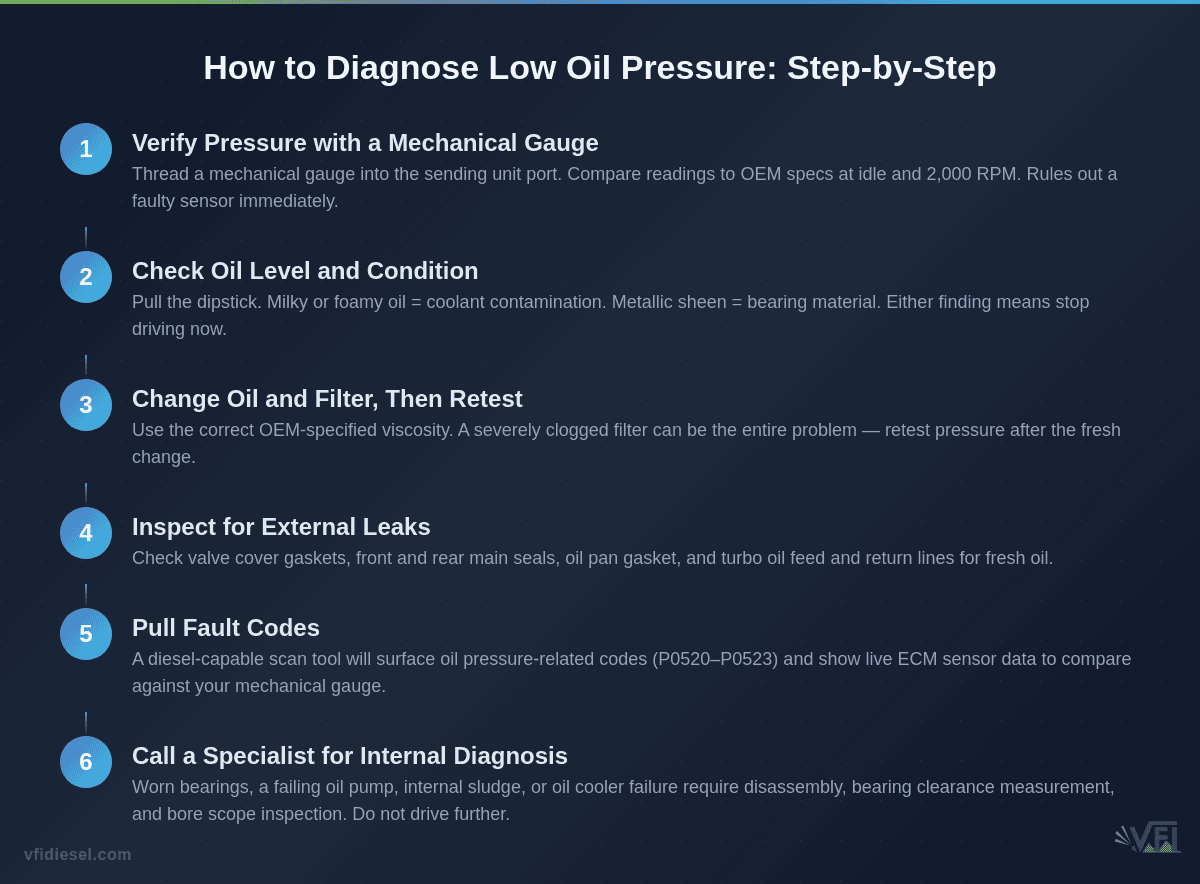
Step 1: Verify Actual Oil Pressure with a Mechanical Gauge (DIY)
Before anything else, thread a mechanical oil pressure gauge into the sending unit port. This takes about 15 minutes and costs $20–$40 for the gauge. Compare your readings to OEM specs at idle and at 2,000 RPM. This immediately tells you whether you have a real pressure problem or a sensor/wiring issue.
Step 2: Check Oil Level and Condition (DIY)
Pull the dipstick. Check level, color, and consistency. Milky = coolant. Metallic sheen or grit = bearing material. Extremely dark and thick = overdue for a change and possibly sludged passages. If the oil looks normal and the level is correct, you’ve ruled out the two easiest causes.
Step 3: Change the Oil and Filter, Then Retest (DIY)
If the oil is overdue or you’re unsure of its history, do a fresh oil and filter change with the correct OEM-specified viscosity. Retest pressure. Sometimes a severely clogged filter is the entire problem.
Step 4: Check for External Leaks (DIY)
Look under the engine for fresh oil. Check the valve cover gaskets, front and rear main seals, oil pan gasket, and turbo oil feed and return lines. A significant external leak can drop oil level fast enough to cause pressure loss under load.
Step 5: Pull Fault Codes (DIY with a scanner)
A diesel-capable scan tool will pull any oil pressure-related fault codes and can often show live oil pressure data from the ECM sensor, useful for comparison against your mechanical gauge reading.
Step 6: Internal Diagnosis: This Is Where You Need a Specialist
If steps 1–5 don’t reveal the cause, you’re likely looking at worn bearings, a failing oil pump, internal sludge, or oil cooler failure. These require disassembly, measurement of bearing clearances with plastigage or a micrometer, and often a bore scope inspection. This is not DIY territory for most owners. A qualified diesel technician needs to evaluate the engine before you drive it further.
Mechanical oil pressure test: $150–$300 at a shop. Oil pump replacement: $700–$1,800 depending on engine. Main bearing replacement: $2,200–$6,000+. Turbo replacement due to oil starvation: $1,500–$5,500. Full engine rebuild after catastrophic oil pressure failure: $10,000–$25,000+. The math strongly favors stopping early and diagnosing properly.
If you’re in the Sacramento area and need a second opinion on a diesel with low oil pressure, especially if you’re concerned about downstream injection or turbo damage, contact our Woodland shop or call us at 530-668-0818. We can help you figure out whether this is an engine issue, an injection issue, or both.
When Is It Time to Stop Driving and Call a Diesel Specialist?
Stop driving immediately if any of the following are true, and consult a qualified diesel technician before restarting the engine:
- The oil pressure warning light is on at operating temperature
- Your oil pressure gauge reads below 10 PSI at idle (warm engine)
- You hear knocking, ticking, or a new metallic noise from the engine
- You see blue or white smoke from the exhaust combined with a pressure warning
- The oil on the dipstick is milky, foamy, or has a metallic sheen
- You’ve had a recent overheating event, heat destroys oil viscosity and accelerates bearing wear
- Your diesel is also showing signs of power loss under load alongside pressure issues
The cost of towing a truck is always less than the cost of a seized engine. If you’re in Northern California or Nevada, our team at Valley Fuel Injection has been diagnosing and repairing diesel fuel systems and turbochargers since 1993. We’re one of the few shops in the region equipped to evaluate not just the engine itself, but the downstream damage to injection components that a low oil pressure event can cause.
Diesel owners in Sacramento, Redding, and across Northern California trust us for exactly this kind of multi-system diagnosis. We also accept mail-in injectors and pumps for testing and rebuilding from customers nationwide, so wherever you are, we can help evaluate whether your injection components were damaged in a low oil pressure event.
If you’ve already driven on low oil pressure and the engine seems to be running okay, don’t assume you got lucky. Have a diesel specialist perform a full inspection, including a bore scope of the cylinders, a bearing clearance check if accessible, and an inspection of the turbo for shaft play. Silent damage from a brief oil starvation event can show up as a catastrophic failure weeks later under load. The diesel engine maintenance cost of a post-event inspection is a fraction of what a deferred failure will cost you.
The EPA’s emissions standards for heavy-duty diesel engines also mean that a damaged turbo or injection system doesn’t just hurt performance, it can push your truck out of compliance and into smog failure territory, particularly in California under CARB regulations. Staying on top of oil pressure issues protects your engine, your injection system, and your compliance status simultaneously.
Frequently Asked Questions
How low is too low for diesel engine oil pressure?
Most diesel engines need a minimum of 10–15 PSI at idle (warm) and 25–65 PSI at operating RPM. Anything below 10 PSI at idle with a warm engine is a critical emergency, shut it down immediately. Always verify with a mechanical gauge before assuming the sensor is at fault. OEM specifications vary by engine, so check your service manual for your specific platform’s minimum threshold.
Can a diesel run with low oil pressure?
Technically yes, briefly. But every minute you run a diesel with inadequate oil pressure, you’re accelerating bearing wear, risking turbo seizure, and potentially damaging fuel injection components. Some diesel ECMs will derate power or shut the engine down automatically when pressure drops below a threshold, but not all platforms have this protection. Do not rely on the engine to protect itself, shut it down manually at the first confirmed sign of low pressure.
Will low oil pressure damage my diesel injectors?
On HEUI platforms (Ford 6.0L/7.3L Power Stroke, early Navistar DT), yes, directly. These engines use high-pressure engine oil to actuate the injectors, so low oil pressure directly prevents proper injection. On common rail platforms, the damage is indirect but still real: a turbo destroyed by oil starvation can push oil into the intake and eventually contaminate the fuel system. A failed oil cooler can allow coolant into the oil, which then contaminates injection components. Any significant oil pressure event warrants an injection system inspection.
How do I know if my turbo was damaged by low oil pressure?
Check for shaft play by grabbing the turbo shaft and wiggling it radially (side to side). Any noticeable play beyond minimal movement indicates bearing wear. Also look for blue smoke from the exhaust, oil in the intake piping or intercooler, and reduced boost pressure. A turbocharger that was run with inadequate oil pressure will often show scoring on the shaft and bearing housing when disassembled. Have a diesel specialist inspect the turbo before assuming it’s still serviceable after a confirmed oil pressure event.
What oil should I use in my diesel to maintain proper pressure?
Always follow the OEM-specified viscosity for your specific engine and climate. Most heavy-duty diesels specify 15W-40 for warm climates and 5W-40 synthetic for cold weather operation. Using the wrong viscosity, too thin or too thick, can cause false low pressure readings or inadequate film strength under load. For California diesel owners, also be aware that biodiesel blends above B20 can affect oil contamination rates and change intervals, something we’ve written about in depth in our guide on biodiesel injector damage.
If your diesel has experienced low oil pressure, or you’re seeing warning signs and aren’t sure what’s causing them, don’t wait. At Valley Fuel Injection in Woodland, CA, we’ve been diagnosing and repairing diesel fuel systems, turbochargers, and injection components for over 30 years. We’re Bosch-certified and equipped to evaluate the full scope of damage from an oil pressure event, not just the engine, but the turbo, the injectors, and the high-pressure fuel system.
Call us at 530-668-0818 or schedule a diagnostic online. We serve diesel owners throughout Northern California and Nevada, and we ship remanufactured injectors and pumps nationwide, so wherever you are, we can help.