

Duramax Injector Balance Rates Explained
05/08/2026
Diesel Engine Won’t Stay Running: 8 Causes & How to Fix
05/14/2026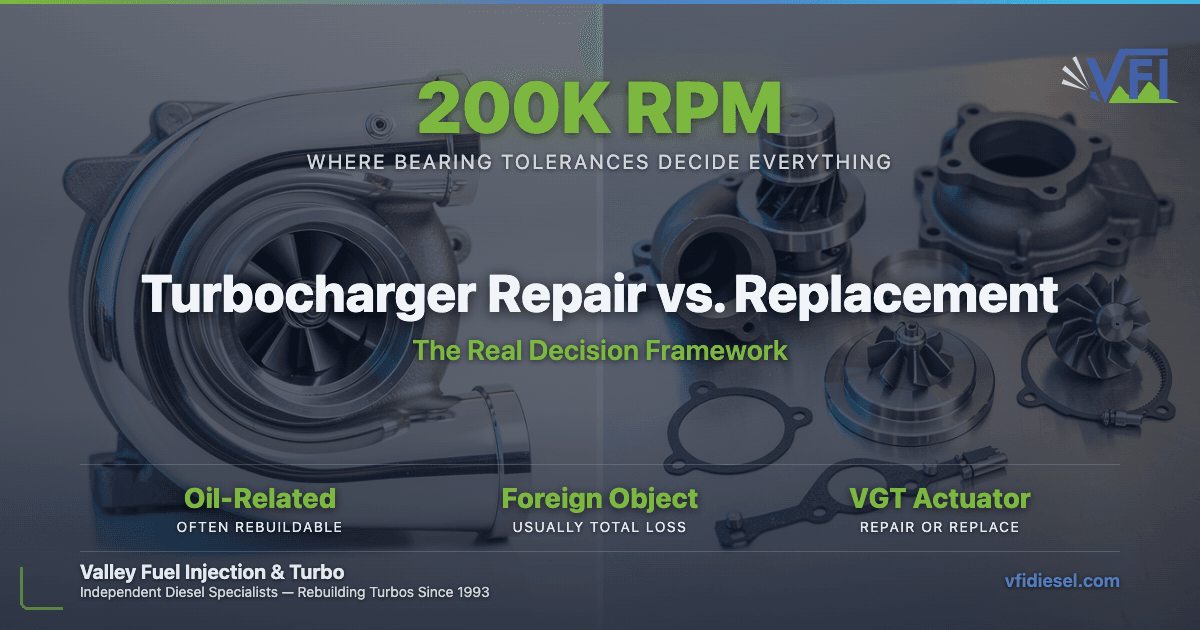
When your diesel turbocharger starts failing, the first question every owner asks is the same: can this be repaired, or do I need a new one? The honest answer depends on what failed, how long you drove on it, and, critically, who’s doing the work. At Valley Fuel Injection & Turbo, we’ve been testing, rebuilding, and replacing diesel turbochargers since 1993, and we see the full spectrum: turbos that are a straightforward rebuild, turbos that are total losses, and everything in between. This guide walks you through the real repair-vs.-replace decision so you don’t spend a dime more than you have to, or a dime less than you should.
Most diesel turbocharger failures are caused by oil starvation, contamination, or foreign object damage, and many can be professionally rebuilt at significant cost savings over a new unit. But a cheap rebuild from a general shop is often worse than no repair at all. The quality of the rebuild matters as much as the decision to rebuild.
What Are the Most Common Reasons a Diesel Turbocharger Needs Repair or Replacement?
The vast majority of turbocharger failures trace back to one of four root causes, and knowing which one you’re dealing with shapes every decision that follows.
1. Oil Starvation: This is the number one killer of diesel turbos. The turbo shaft spins at 100,000–200,000 RPM and depends entirely on a pressurized oil film to keep the bearing assembly alive. A clogged oil feed line, extended oil change intervals, or shutting a hot engine down without a cool-down period can starve the bearings in seconds. You’ll see bluish smoke, shaft play, and scoring on the journal bearings.
2. Oil Contamination: Dirty oil, coolant intrusion, or fuel dilution introduces abrasive particles into the bearing system. Even microscopic contamination accelerates wear dramatically. This is why we always ask about oil change history before quoting a turbo rebuild, a contamination failure that’s been running for 10,000 miles looks very different from one caught early.
3. Foreign Object Damage (FOD): Anything that gets sucked through the intake, a piece of a failed air filter, a broken intake boot, even a small stone, hits the compressor wheel at extreme speed and causes immediate, catastrophic blade damage. FOD failures are usually not rebuildable; the compressor housing and wheel are typically destroyed.
4. Boost Pressure / VGT Actuator Failure: Variable geometry turbos (VGTs), common on modern diesel trucks like the 6.7 Powerstroke and 6.6 Duramax, add a vane control system that can stick, seize, or fail electronically. This often presents as limp mode, over-boost, or under-boost rather than mechanical noise, and it’s frequently misdiagnosed as an injector or EGR issue.
According to Bosch Mobility, turbocharger bearing failures caused by oil-related issues account for the majority of all turbo warranty claims globally, making proper oil maintenance the single most cost-effective turbo protection strategy available.
If you’re already seeing symptoms, our detailed post on diesel turbocharger failure signs covers early detection before the damage compounds.
Can a Damaged Turbo Always Be Rebuilt, or Is Replacement Sometimes the Only Option?
Not every turbo is a rebuild candidate, and a specialist will tell you that upfront rather than take your money for a repair that won’t hold.
Here’s how we think about the rebuild/replace decision:
| Failure Type | Rebuild Viable? | Notes |
|---|---|---|
| Worn journal bearings (oil-related) | Usually yes | Most common rebuild scenario, housing intact, shaft/wheel salvageable |
| Shaft imbalance / minor blade tip rub | Often yes | Requires precision balancing equipment, not something a general shop can do |
| VGT vane sticking / actuator failure | Sometimes | Depends on vane/nozzle ring condition; actuator replacement often sufficient |
| Foreign object damage (FOD) | Rarely | Compressor wheel and housing usually destroyed, replacement is the answer |
| Turbine wheel heat cracking | No | Structural failure, a remanufactured or new unit is required |
| Cracked center housing (CHRA) | No | Core is scrap, full replacement necessary |
The key word here is viable. A turbo can technically be rebuilt in many cases, but if the core has been run to destruction, shaft contact with the housing, wheel blades ground down to nubs, housing walls scored, the rebuild cost approaches or exceeds replacement cost, and the result is less reliable. A straight-talking specialist will show you the core, explain what they found, and give you both options with honest numbers.
What Does Professional Turbocharger Repair Actually Involve, and What Separates a Quality Rebuild from a Cheap One?
A professional turbocharger rebuild is a precision machining and assembly process, not a parts swap. Here’s what it actually looks like when it’s done right.
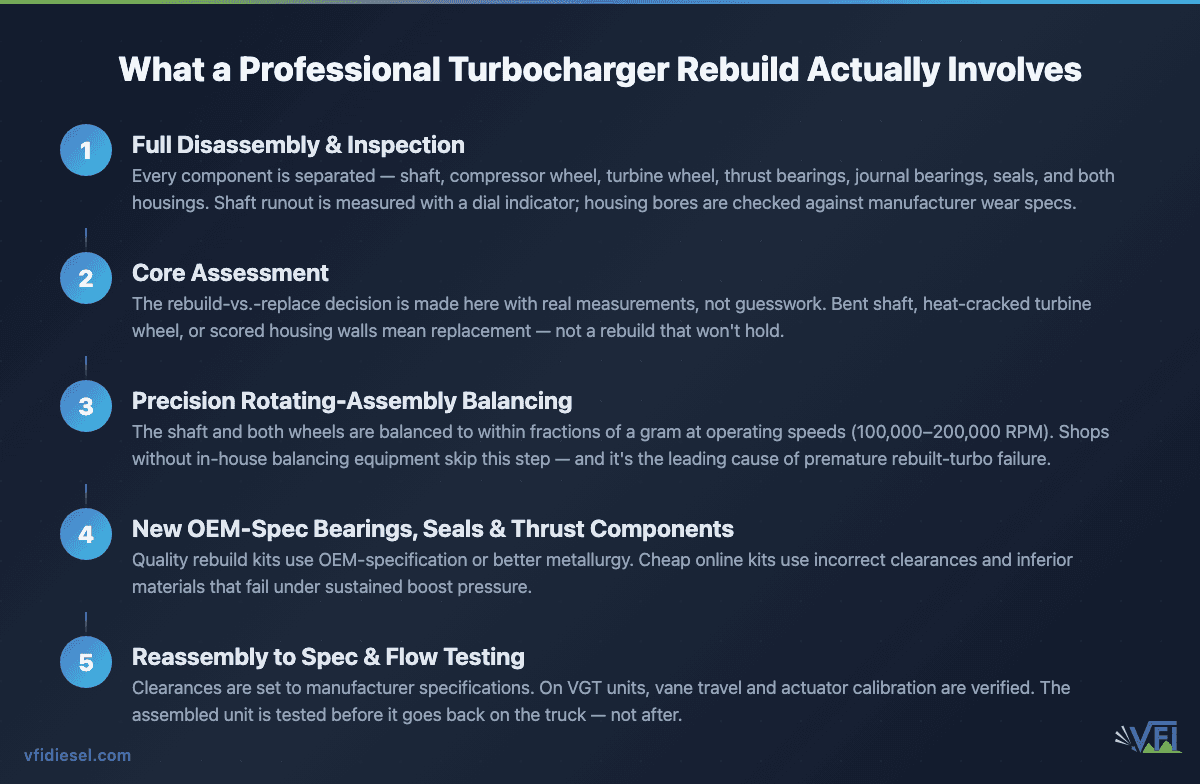
Step 1: Full Disassembly and Inspection: Every component comes apart. The shaft, compressor wheel, turbine wheel, thrust bearings, journal bearings, seals, and both housings are individually inspected. Shaft runout is measured with a dial indicator. Housing bores are checked for wear beyond spec.
Step 2: Core Assessment: This is where the rebuild/replace decision gets made with real data, not guesswork. If the shaft is bent or the turbine wheel has heat cracking, you know before you’ve committed to a rebuild.
Step 3: Precision Balancing: This is the step most general shops skip entirely, because the equipment costs tens of thousands of dollars. The rotating assembly (shaft + wheels) must be balanced to within fractions of a gram at operating speeds. An unbalanced turbo will destroy new bearings in short order, which is exactly what happens with cheap rebuilds that come back in 20,000 miles.
Step 4: New Bearings, Seals, and Thrust Components: Quality rebuild kits use OEM-spec or better components. Cheap kits use undersized clearances or inferior metallurgy that won’t survive sustained boost pressures.
Step 5: Reassembly to Spec and Flow Testing: Clearances are set to manufacturer specifications. On VGT units, vane travel and actuator calibration are verified. The assembled unit is tested before it goes back on your truck.
Always ask a shop if they balance the rotating assembly in-house. If they send it out, or worse, if they don’t balance it at all, that’s a red flag. Balancing isn’t optional on a component spinning at 150,000+ RPM. At our turbocharger service center in Woodland, balancing is a standard part of every rebuild, not an upsell.
The difference between a $200 “rebuilt” turbo from an online marketplace and a professionally remanufactured unit isn’t just price, it’s whether the shop has the equipment, training, and accountability to back their work. We see the failures from cheap rebuilds regularly, and they’re almost always a balancing or bearing-clearance issue.
How Much Does Turbocharger Repair Cost Compared to a Remanufactured or New Unit?
Cost is obviously a major factor, and the range is wide enough that it’s worth breaking down honestly.
Turbocharger Repair Cost Reference (2026)
The range is wide enough that it’s worth breaking down honestly. Pricing below reflects current 2026 specialty-shop rates and excludes vehicle R&R unless specifically noted.
| Service Type | Typical Cost Range | Best For |
|---|---|---|
| Actuator / solenoid replacement | $300 – $1,000 | VGT/VNT turbos with electronic faults, no bearing damage |
| Cartridge / CHRA swap | $400 – $900 | Worn bearings, shaft play, housing still serviceable |
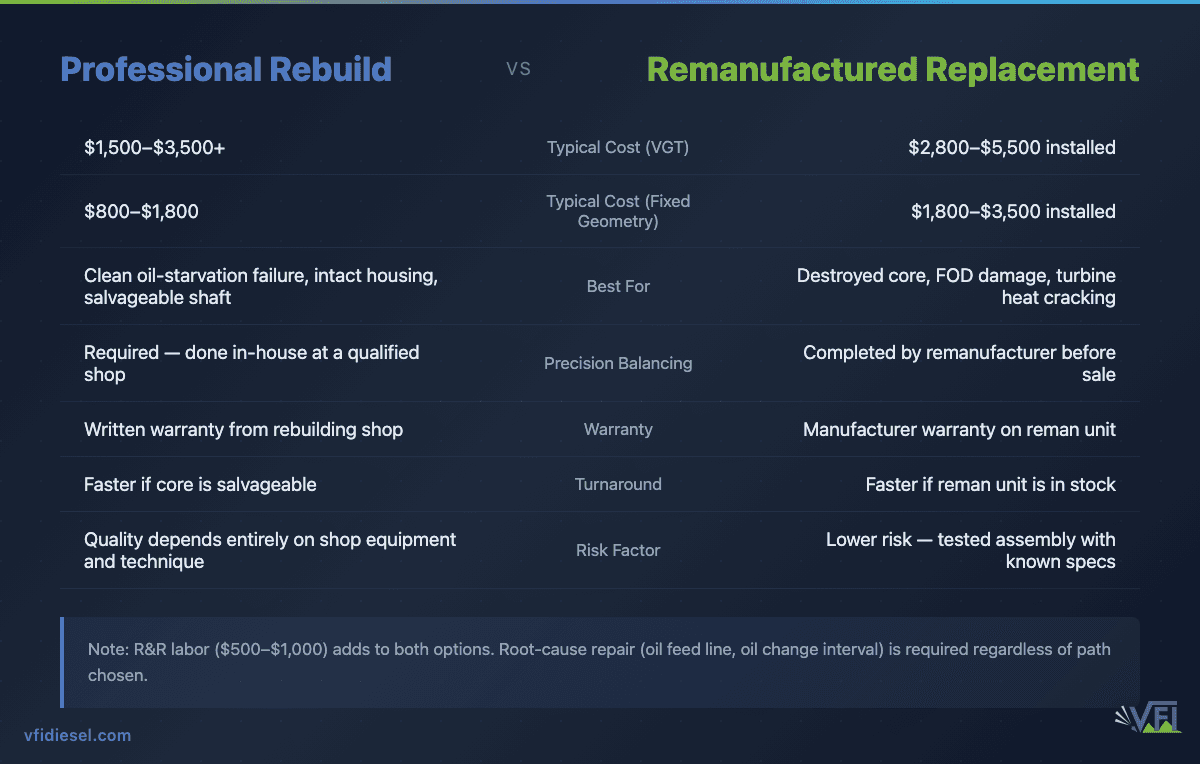
| Professional rebuild (fixed geometry) | $800 – $1,800 | Older fixed-geometry turbos, agricultural/industrial units |
| VGT rebuild / actuator service | $1,500 – $3,500+ | Variable-geometry turbos needing vane ring + actuator work |
| Reman replacement, light/medium pickup | $1,800 – $3,500 | Modern common-rail diesels, fleet uptime needs |
| Reman replacement: Class 8 / heavy duty | $3,500 – $7,500+ | Cummins ISX, Volvo D13, HD truck applications |
| New OEM turbocharger | $6,000 – $10,000+ | Warranty requirements, new builds, dealer service |
| Labor (R&R only, shop rate) | $500 – $1,000 | Added to any of the above, varies by engine access |
Note: Always get a written estimate after physical inspection, anyone quoting a firm price without seeing the core is guessing. Diagnosis often determines which row above actually applies.
The math usually works like this: if your turbo is a clean oil-starvation failure caught before the shaft contacted the housing, a professional rebuild saves you real money. If the core is destroyed, a quality new or remanufactured turbocharger is often the better value, you get a tested, balanced assembly with a warranty, and you’re not paying rebuild labor on a core that’s marginal.
One cost factor most owners overlook: fixing the root cause. If your turbo failed from oil starvation, replacing the turbo without addressing the oil feed line, the oil change interval, or the shutdown habits means you’ll be back in the same situation. We always diagnose the cause before we quote the fix, because a turbo is only as reliable as the engine it’s mounted to. Our diesel engine maintenance page covers the service intervals that protect your turbo long-term.
What Happens If You Keep Driving on a Failing Turbo, and How Bad Can the Damage Get?
Continuing to drive on a failing turbocharger is one of the fastest ways to turn an $800 repair into a $10,000+ engine rebuild, and it happens constantly.
A turbocharger that is leaking oil into the intake is feeding that oil directly into your combustion chambers. Diesel engines can “runaway” on their own oil, a condition where the engine accelerates uncontrollably and cannot be shut off by the key. This is a genuine safety emergency. If you see heavy blue/white smoke from the exhaust and the engine is revving on its own, do not attempt to drive it, get it off the road immediately and call for help.
Beyond the runaway risk, here’s the cascade of damage a failing turbo causes when it’s ignored:
- Bearing failure → shaft contact → housing destruction: What was an $800 bearing rebuild becomes a $3,000+ complete replacement.
- Oil pushed into the intake → coked intake manifold and EGR system: Carbon buildup from turbo oil contamination can require intake manifold cleaning or replacement on top of the turbo repair.
- Oil pushed into the exhaust → DPF contamination: On emissions-equipped trucks, turbo oil in the exhaust can saturate and destroy a diesel particulate filter. DPF replacement on a late-model truck typically ranges from $3,000–$6,500.
- Wheel contact with housing → FOD into the engine: If a compressor or turbine blade breaks loose, it goes into the engine. That’s a full engine rebuild conversation.
We cover the early warning signs in detail in our post on diesel turbocharger failure symptoms, if you’re seeing any of those signs, the time to act is now, not after the next trip.
The EPA’s emissions regulations for diesel vehicles also mean that turbocharger failures that damage aftertreatment systems can create compliance issues for fleet operators, another reason to address failures promptly rather than deferring them.
How Do You Find a Qualified Turbocharger Repair Specialist Versus a General Shop?
This is where the repair-vs.-replace decision often goes wrong, owners take the turbo to whoever is convenient rather than whoever is qualified, and end up paying twice.
Here’s what separates a genuine turbocharger specialist from a general diesel shop that “does turbos”:
In-house balancing equipment. Ask directly: do you balance the rotating assembly here, or send it out? If they send it out, ask to whom. If they don’t balance at all, walk away.
Factory training and certifications. Bosch-certified shops and authorized dealers for major turbocharger manufacturers have completed factory training on specific systems: VGT calibration, actuator programming, and proper clearance specs. General shops work from generic instructions.
Willingness to show you the core. A qualified shop will put the disassembled turbo in front of you and explain exactly what failed and why. If a shop can’t or won’t show you what they found, that’s a problem.
Diagnosis of the root cause. A specialist asks about your oil change history, checks the oil feed and drain lines, and looks at the overall engine condition before recommending a repair path. A parts-changer just swaps the turbo.
Warranty on their work. Professional rebuilds should come with a written warranty. Get it in writing, and understand what voids it (typically: continued oil neglect, FOD from an unaddressed intake leak).
If you’re not local to a specialist, many professional turbocharger rebuild shops, including ours, accept mail-in cores for testing and rebuilding. You ship the turbo, we inspect, quote, rebuild, balance, and ship it back. This is often faster and more cost-effective than a local general shop that will take two weeks and send the balancing out anyway. Contact us to discuss mail-in turbo service.
The SAE International technical literature on turbocharger failure analysis consistently shows that improper rebuild technique, specifically inadequate balancing and incorrect bearing clearances, is a primary cause of premature remanufactured turbo failure. This isn’t a minor detail; it’s the difference between a rebuild that lasts 100,000 miles and one that fails in 15,000.
Diesel truck owners in the Sacramento area and throughout Northern California can bring their vehicle or core directly to our Woodland shop. If you’re further out: Reno, Chico, Stockton, or beyond, we work with customers across the country on mail-in turbo service. Check our Sacramento diesel service page or Reno diesel service page for more on what we offer in your area.
It’s also worth noting that turbocharger health is closely tied to the rest of your fuel system. A failing injection pump that’s allowing fuel dilution into the oil will kill a freshly rebuilt turbo just as fast as the original failure did. Our diesel fuel injection services page covers the full system, because we look at the whole picture, not just the part that’s currently smoking.
—
Bring the core, or the whole truck, to Valley Fuel Injection & Turbo in Woodland, CA. We’ll disassemble, inspect, and give you an honest assessment with real numbers before you commit to anything. Call us at 530-668-0818 or schedule a diagnostic online. We also accept mail-in turbocharger cores for testing and rebuilding, we ship nationwide.
Frequently Asked Questions About Turbocharger Repair
How long does a professionally rebuilt turbocharger last?
A properly rebuilt turbocharger, with precision balancing, correct bearing clearances, and quality components, should last as long as a new OEM unit: typically 100,000–150,000 miles or more, depending on maintenance. The key variables are rebuild quality and whether the root cause of the original failure was corrected. A rebuild done without proper balancing or on a contaminated oil system will often fail within 20,000–30,000 miles.
Can I drive my diesel truck with a bad turbocharger?
Technically you can drive short distances at reduced power if the turbo is simply worn and underperforming, but it’s not advisable. A turbo that is leaking oil into the intake or exhaust should be considered a breakdown risk, particularly because diesel engines can experience a runaway condition when fed oil through the intake. Any turbo showing heavy smoke, excessive shaft play, or unusual noise should be inspected immediately by a qualified diesel technician before further operation.
Is a remanufactured turbocharger as good as a new OEM unit?
A quality remanufactured turbocharger from a reputable specialist is functionally equivalent to a new OEM unit and often comes with a comparable warranty. The critical factors are the remanufacturing process, specifically whether the rotating assembly was precision balanced, whether OEM-spec components were used, and whether the unit was tested before sale. Cheap “rebuilt” turbos from online marketplaces often skip balancing and use inferior bearing kits, which is why their failure rates are significantly higher than either quality remanufactured or new units.
What causes a diesel turbocharger to fail prematurely?
The most common causes of premature turbocharger failure are oil starvation (from clogged oil feed lines, extended oil change intervals, or immediate shutdown of a hot engine), oil contamination (dirty oil, coolant intrusion, or fuel dilution in the oil), and foreign object ingestion through a failed air filter or damaged intake system. On variable geometry turbos, sticking vanes from carbon buildup or actuator failure are also common. Addressing oil maintenance and intake system integrity is the most effective way to extend turbocharger life.
Do you accept mail-in turbochargers for testing and rebuilding?
Yes. Valley Fuel Injection & Turbo accepts mail-in turbocharger cores from customers across the country. You ship the core to our Woodland, CA facility, we disassemble, inspect, and provide a written assessment and quote. If you approve the rebuild, we complete the work, balance the rotating assembly, test the unit, and ship it back. This is a cost-effective option for diesel owners who don’t have a qualified turbocharger specialist in their area. Call us at 530-668-0818 to discuss your application before shipping.
Bosch-certified diesel fuel injection and turbocharger specialists serving Northern California and Nevada since 1993. We test, rebuild, and replace diesel turbochargers daily, and we ship remanufactured units and accept mail-in cores nationwide.
Call 530-668-0818 | Visit us at 1243 E Beamer St, Suite C, Woodland, CA 95776 | Schedule a diagnostic
Why Turbo Repair Cost Varies So Much by Diesel Platform
The same underlying failure can cost twice as much on one engine as another, purely because of turbo access, electronics, and parts availability. Here is how the major platforms compare.
6.7 Powerstroke (2011 to present): The rear-mounted turbo makes R&R labor intensive, and the electronic VGT actuator needs scan-tool recalibration, so a full replacement lands at the high end, roughly $2,800 to $5,500.
6.7 Cummins (2007.5 to present): The Holset VGT is well supported with quality reman units, but labor access and actuator calibration still push all-in replacement to about $2,800 to $4,500. Carbon-stuck vanes on high-mileage trucks add cleaning time.
6.6 Duramax LML/L5P: The LML compound arrangement means any job touching both turbos escalates fast. The LML also carries the CP4 injection pump failure risk, and severe CP4 contamination can reach the turbo oil supply.
Early 5.9 Cummins and 7.3 Powerstroke: Fixed-geometry turbos with little or no electronics are the cheapest to service. A clean HX35 or HY35 rebuild typically runs $650 to $1,200 for bench work.
Heavy-duty (Cummins ISX, Volvo D13, Cat C15): Larger cores and more labor push a complete service to $3,500 to $7,500 or more.