Turbocharger Repair vs. Replacement: Diesel Guide
05/13/2026
6.7 Powerstroke Turbo Problems: Symptoms & Fixes
05/19/2026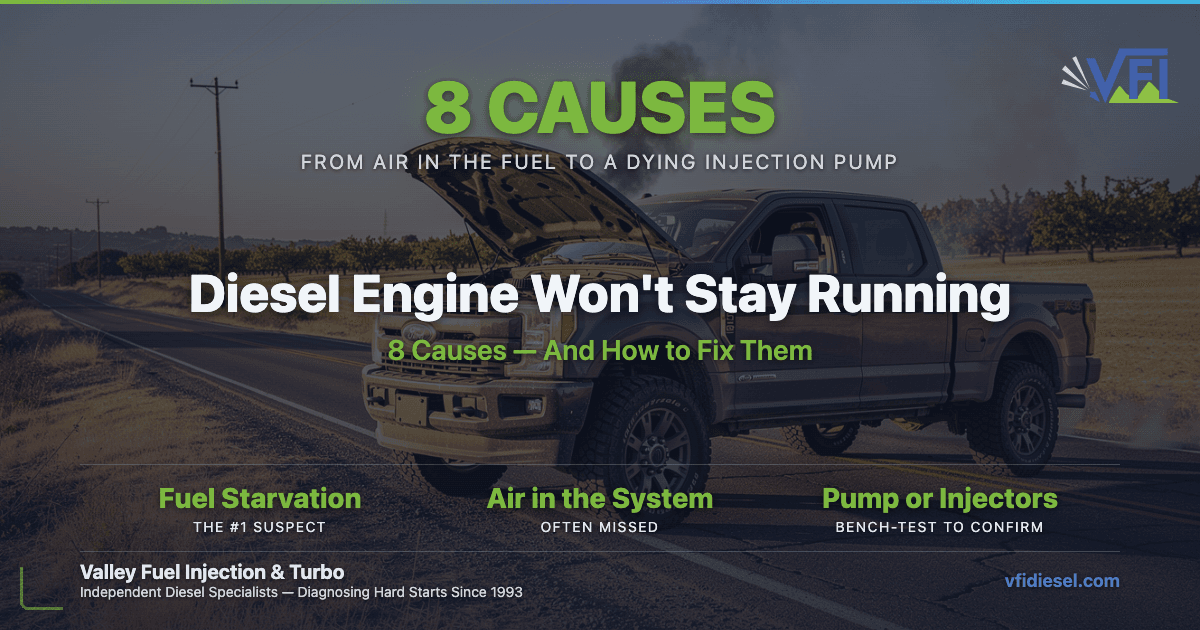
When your diesel engine won’t stay running after startup, you’re dealing with a fuel delivery or combustion issue that prevents sustained operation. Unlike engines that won’t crank at all, this problem indicates your starter, battery, and basic electrical systems are functioning, but something is interrupting the fuel supply or combustion process once the engine fires up.
A diesel engine that starts then immediately dies is typically caused by fuel starvation, air in the fuel system, faulty injectors, or injection pump problems. Systematic diagnosis starting with fuel supply checks will identify the root cause.
Why Does My Diesel Engine Start Then Die Immediately?
A diesel engine that starts but won’t stay running is experiencing fuel starvation or combustion disruption after the initial startup fuel reaches the cylinders. During startup, residual fuel pressure and priming can provide enough fuel for initial ignition, but sustained operation requires continuous fuel delivery at proper pressure and timing.
Talk to a Diesel Tech Fires for a few seconds, then quits? An engine that starts and dies has already proved the pump can build pressure briefly, which rules out a lot: the fault is usually air being pulled in on the supply side, or a pump that cannot hold delivery once it loads and warms. We bench-test injection pumps to settle which one it is. Two ways in: drive it into our Woodland shop near Sacramento, or ship it to us from anywhere in the country. ☎︎ Call 530-668-0818Out of the area? Start a mail-in rebuild → |
The most common causes include:
- Air in the fuel system: Creates inconsistent fuel delivery
- Clogged fuel filters: Restricts fuel flow after initial startup
- Faulty lift pump: Can’t maintain pressure for sustained operation
- Injection pump problems: Internal wear or timing issues
- Contaminated fuel: Water or debris disrupting combustion
- Faulty injectors: Poor spray pattern or incorrect delivery
- Turbocharger issues: Affecting air-fuel mixture
- EGR system problems: Disrupting combustion quality
If your engine runs longer when you keep your foot on the accelerator, you’re likely dealing with a fuel supply issue rather than an electrical problem. The higher RPM creates more suction, temporarily overcoming fuel delivery restrictions.
Is It a Fuel Supply Problem or Air in the System?
Fuel supply problems are the most common reason a diesel won’t stay running, and they are the first thing we check at our Woodland shop. Air infiltration into the fuel system is particularly common and creates erratic fuel delivery that prevents sustained operation.
Signs of air in the fuel system:
- Engine runs rough for a few seconds before dying
- White smoke from exhaust during brief running period
- Fuel system makes gurgling or sucking sounds
- Hard starting that gets progressively worse
- Engine runs better when fuel tank is full
Common air entry points:
| Component | Common Failure Points | Symptoms |
|---|---|---|
| Fuel lines | Cracked rubber, loose fittings | Intermittent stalling |
| Lift pump | Diaphragm tears, check valve failure | Won’t run without priming |
| Fuel filter housing | O-ring deterioration, housing cracks | Air bubbles in clear fuel lines |
| Tank pickup tube | Loose connections, tube damage | Worse when tank is low |
Fuel contamination issues:
Water contamination is especially problematic in California’s biodiesel blends. Biodiesel’s hygroscopic nature attracts moisture, which can cause immediate stalling after startup when water reaches the injectors.
Never attempt to run a diesel engine with known water contamination. Water in the cylinders can cause catastrophic engine damage through hydro-lock. Always drain and replace contaminated fuel before attempting restart.
Could Faulty Injectors Cause Stalling After Startup?
Faulty injectors can definitely cause a diesel engine that won’t stay running, particularly when multiple injectors are affected or when injection timing is severely compromised. Unlike single injector failures that typically cause rough running, multiple injector problems can prevent sustained combustion entirely.
Injector-related stalling patterns:
- Immediate stalling: Multiple injectors not firing or severely restricted
- Rough idle then stall: Some injectors working, others failing
- Stalling under load: Injectors can’t deliver enough fuel for power demands
- Cold-start stalling: Injectors not atomizing fuel properly when cold
Common injector problems that cause stalling include:
Mechanical failures:
- Stuck injector needles preventing fuel delivery
- Worn injector nozzles causing poor spray patterns
- Internal injector leakage reducing pressure
- Clogged injector screens or passages
Electrical issues (common rail systems):
- Failed injector solenoids
- Wiring harness problems
- ECM control issues
- Injector driver circuit failures
Modern common rail injectors operate at pressures up to 30,000 PSI and can fire multiple times per combustion cycle. A single faulty injector can disrupt the entire fuel rail pressure, affecting all cylinders. Our common rail diagnostic equipment can test each injector individually to identify the problem cylinder.
Injector testing should include:
- Flow rate testing: Measuring fuel delivery volume
- Spray pattern analysis: Checking atomization quality
- Leak-down testing: Identifying internal seal failures
- Electrical testing: Verifying solenoid operation (common rail)
- Pop pressure testing: Confirming opening pressure (mechanical injectors)
How Do I Check for Injection Pump Problems?
Injection pump problems are a critical cause of engines that won’t stay running, especially in older mechanical diesel systems and VP44 equipped trucks. The injection pump must maintain consistent fuel pressure and proper timing for sustained operation, any disruption in these functions will cause immediate stalling.
Mechanical injection pump symptoms:
- Engine starts with starter fluid but won’t run on diesel
- Fuel returns immediately to tank (no pressure buildup)
- No fuel delivery at injector lines during cranking
- Pump doesn’t build pressure when hand-primed
VP44 injection pump specific issues:
The VP44 pump, common in 1998-2002 Dodge Cummins trucks, has unique failure patterns that cause stalling:
- Internal pump wear: Can’t maintain pressure for sustained operation
- Timing piston failure: Causes erratic timing leading to stalling
- Electronic control problems: ECM communication failures
- Lift pump failure: VP44 requires 10+ PSI supply pressure to survive
VP44 pump replacement typically ranges from $1,800–$2,800 for the pump rebuild/reman plus $700–$1,400 for R&R labor (installed total often $2,500–$4,200 depending on shop location and parts brand). However, many VP44 failures are actually caused by lift pump problems (typically $500–$900 installed). Always diagnose the lift pump first, we’ve saved customers thousands by identifying the real culprit.
Injection pump diagnostic steps:
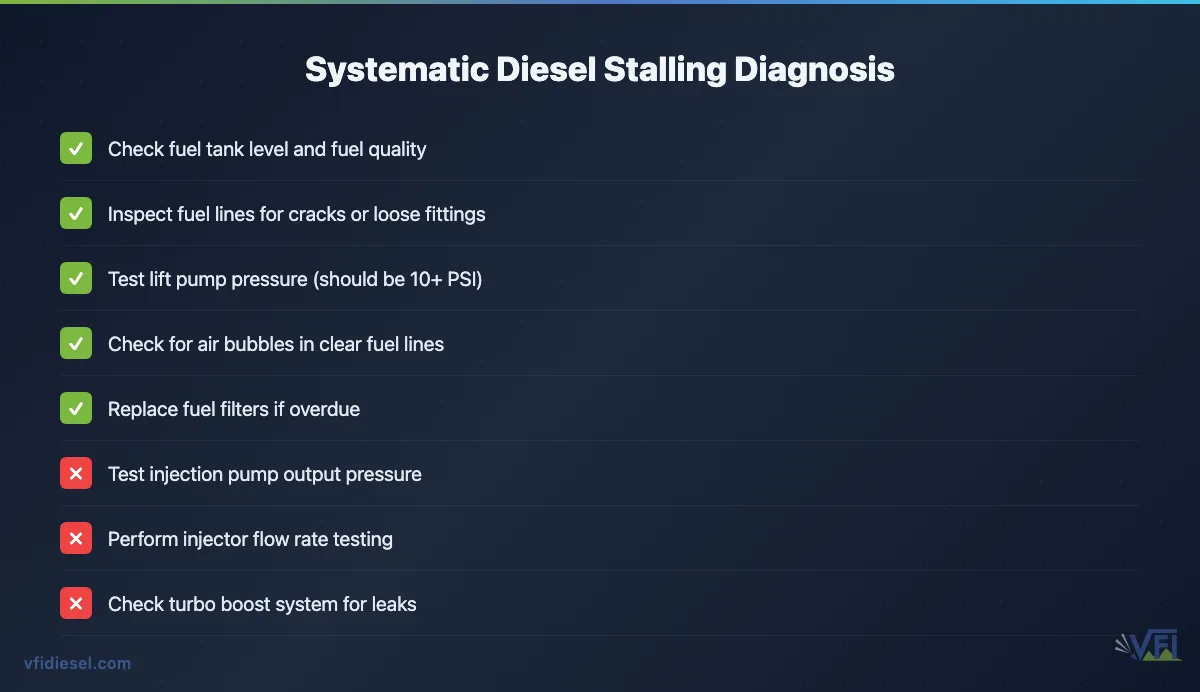
- Check fuel supply pressure: Verify lift pump operation
- Test injection pump output: Measure pressure at injector lines
- Verify timing: Check static and dynamic timing
- Inspect pump drive: Look for timing chain/gear wear
- Test electronic controls: Check ECM communication (electronic pumps)
Our Bosch-certified technicians use specialized test equipment to diagnose injection pump problems accurately. We can often determine if a pump is repairable or needs replacement without costly trial-and-error parts swapping.
When Should I Suspect Turbo or EGR Issues?
Turbocharger and EGR system problems can cause diesel engines that won’t stay running, particularly in modern emissions-controlled engines where these systems are critical for proper combustion. While less common than fuel system issues, turbo and EGR problems create specific symptoms that experienced technicians can identify.
Turbocharger-related stalling:
A failing turbocharger typically causes stalling under these conditions:
- Boost leak stalling: Engine dies when turbo tries to build pressure
- Seized turbo shaft: Creates massive air restriction
- Turbo oil starvation: Causes immediate bearing failure and shaft seizure
- Wastegate problems: Uncontrolled boost or no boost conditions
Signs pointing to turbo issues:
- Blue or white smoke during brief running period
- Loud whistling or grinding noises
- Oil consumption without external leaks
- Engine runs better at high altitude (less boost demand)
A seized turbocharger can cause catastrophic engine damage if you continue attempting to start the engine. If you hear grinding noises or see excessive smoke, stop immediately and have the turbo inspected before further operation.
EGR system stalling issues:
EGR (Exhaust Gas Recirculation) problems that cause stalling include:
- Stuck open EGR valve: Too much exhaust gas dilutes combustion
- EGR cooler failure: Coolant contamination or excessive restriction
- Carbon buildup: Blocks EGR passages causing pressure imbalances
- EGR position sensor failure: ECM can’t control EGR properly
EGR-related symptoms:
- Engine runs better with EGR disconnected
- Stalling occurs primarily at idle
- White smoke that smells like coolant (EGR cooler failure)
- Check engine light with EGR-related codes
Our turbocharger service department can diagnose boost system problems that may be causing your stalling issues. We see many cases where customers assume fuel system problems when the real culprit is a boost leak or failing turbo.
What Professional Diagnostics Can Pinpoint the Problem?
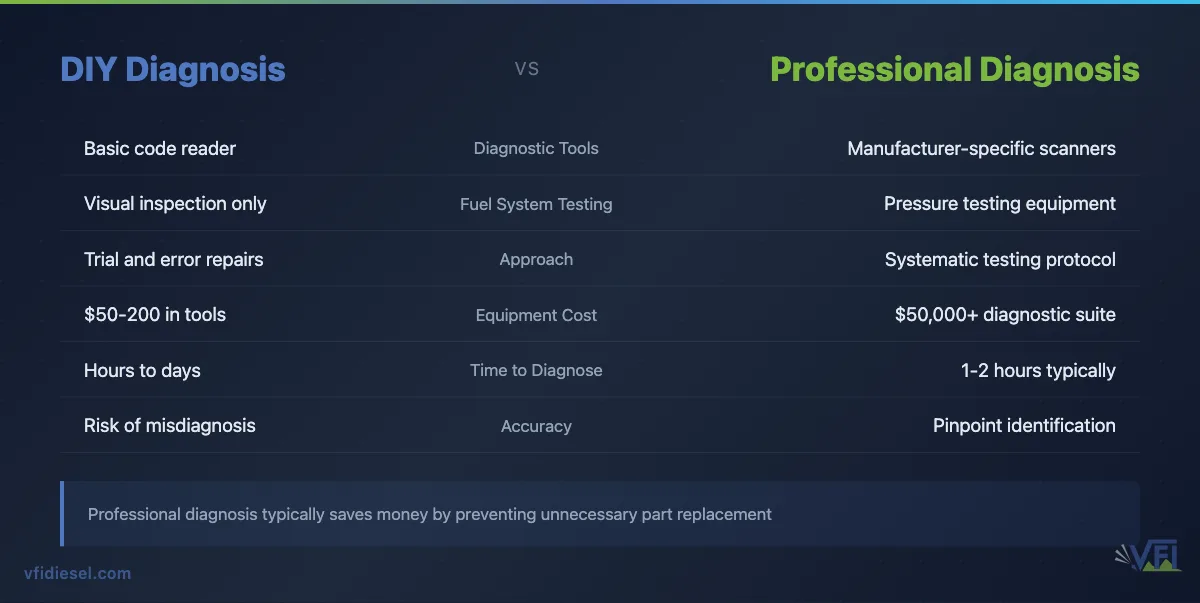
Professional diagnostic equipment can quickly identify why your diesel engine won’t stay running, saving time and preventing unnecessary parts replacement. At Valley Fuel Injection, we use manufacturer-level diagnostic tools that go far beyond basic code readers.
Advanced diagnostic capabilities:
| Diagnostic Test | What It Reveals | Typical Cost |
|---|---|---|
| Fuel system pressure test | Supply pump, injection pump, rail pressure | $150–$300 |
| Injector flow testing | Individual injector performance | $300–$700 |
| Compression testing | Engine mechanical condition | $300–$500 |
| ECM data stream analysis | Real-time sensor data and timing | $150–$300 |
Systematic diagnostic approach:
- Initial assessment: Review symptoms and operating conditions
- Fuel supply verification: Test lift pump pressure and flow
- Air system check: Inspect for leaks and restrictions
- Injection system testing: Verify pump and injector operation
- Electronic system scan: Check ECM codes and data streams
- Mechanical inspection: Assess compression and timing
Many shops start by replacing expensive components like injection pumps without proper diagnosis. Our systematic approach typically identifies the root cause within 1-2 hours, often saving customers thousands in unnecessary repairs. A $150–$300 diagnostic can prevent a $3,000+ mistake.
Manufacturer-specific diagnostics:
Different diesel engines require specialized diagnostic approaches:
- Cummins engines: INSITE software for comprehensive system analysis
- Duramax engines: GM Tech 2 or MDI for module programming
- Power Stroke engines: Ford IDS for injector coding and timing
- Mercedes/Sprinter: DAS/Xentry for SCR and injection system testing
If you’re experiencing stalling issues in the Sacramento area, our team has the diagnostic equipment and experience to identify the problem quickly. We’ve diagnosed thousands of “won’t stay running” cases over our 30+ years in business.
Related issues that can mimic stalling problems include surging at idle and high idle RPM conditions. Our comprehensive diagnosis will differentiate between these symptoms and true stalling issues.
When to Seek Professional Help
While some fuel system checks can be performed by experienced DIY mechanics, diesel injection system diagnosis requires specialized equipment and expertise. Attempting repairs without proper diagnosis often leads to expensive mistakes and additional damage.
Seek professional diagnosis when:
- Multiple symptoms are present simultaneously
- Basic fuel system checks don’t reveal obvious problems
- The engine has electronic injection controls
- You suspect injection pump or injector problems
- Previous repairs haven’t resolved the stalling
At Valley Fuel Injection, we specialize in the complex fuel system problems that cause diesel engines to start but not stay running. Our comprehensive diagnostic services can identify the root cause and provide cost-effective repair solutions.
Don’t let a stalling diesel keep you sidelined. Our expert technicians can diagnose and repair the fuel system problems causing your engine to start but not stay running. Call us at 530-668-0818 or visit our Woodland, CA shop. We also provide mail-in diagnostic services for customers nationwide.
Frequently Asked Questions
Why does my diesel start but die immediately?
A diesel that starts but dies immediately is typically experiencing fuel starvation caused by air in the fuel system, a failing lift pump, clogged filters, or injection pump problems. The engine gets enough fuel for initial startup but can’t maintain the continuous fuel delivery needed for sustained operation.
Can bad diesel fuel cause stalling after startup?
Yes, contaminated diesel fuel can cause immediate stalling. Water contamination is particularly problematic, as water in the cylinders disrupts combustion and can cause hydro-lock. Fuel contaminated with debris or incorrect fuel types can also prevent sustained engine operation.
How do I know if my injection pump is causing stalling?
Signs of injection pump problems include no fuel pressure at injector lines during cranking, fuel immediately returning to the tank without building pressure, and the engine starting with starter fluid but not running on diesel fuel. Professional testing can measure pump output pressure and timing.
Should I try to restart a diesel that keeps stalling?
Limit restart attempts to prevent potential damage. If the engine stalls repeatedly, continuing to crank can overheat the starter, drain the battery, and potentially cause engine damage if the problem is mechanical. Identify and fix the root cause before extended cranking.
Can a clogged fuel filter cause immediate stalling?
Yes, a severely restricted fuel filter can allow enough fuel flow for startup but not sustained operation. The initial fuel in the system provides startup fuel, but the restricted filter prevents adequate flow once the engine begins demanding more fuel for continued operation.