
Diesel Engine High Idle RPM: 7 Causes and How to Fix It
04/08/2026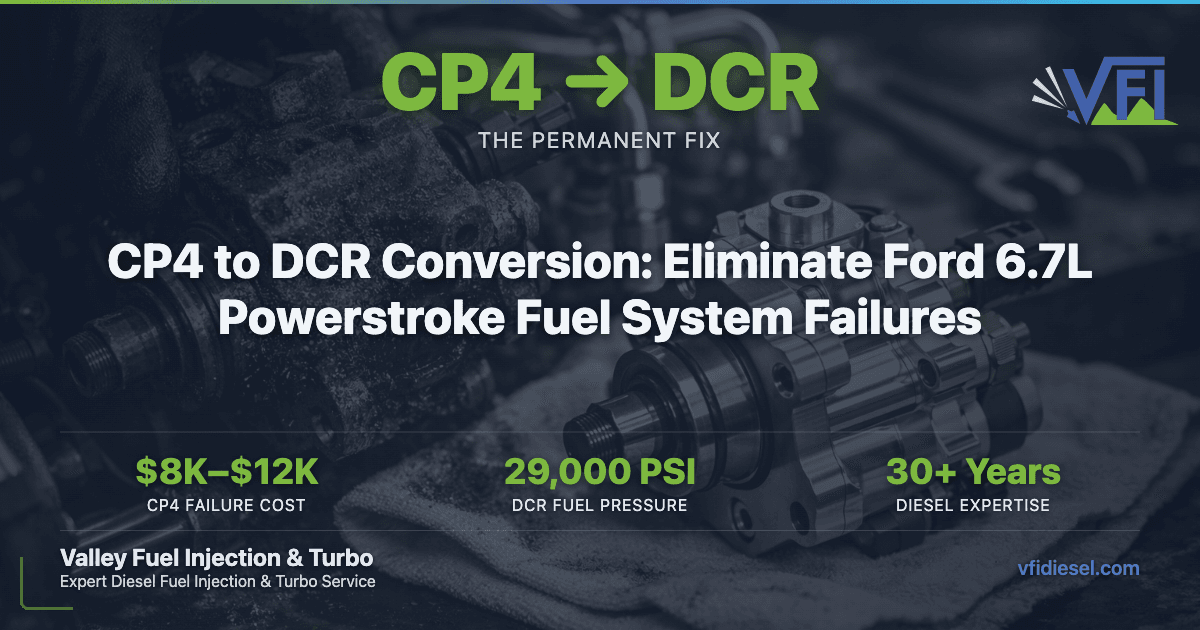
The CP4 to DCR conversion has become the gold standard solution for Ford 6.7L Powerstroke owners tired of catastrophic fuel system failures. After rebuilding thousands of diesel fuel injection systems over 30 years, we’ve seen firsthand how CP4.2 pump failures destroy entire fuel systems — and how DCR conversions eliminate this problem permanently.
Converting from CP4.2 to DCR (Delphi Common Rail) pumps eliminates the root cause of Ford 6.7L Powerstroke fuel system failures, providing superior reliability and long-term cost savings despite higher upfront investment.
Why Does the CP4.2 Pump Fail on Ford 6.7 Powerstroke Engines?
The CP4.2 pump fails due to fundamental design flaws that make it unsuitable for North American diesel fuel quality. Unlike the robust CP3 pumps used in earlier Powerstrokes, the CP4.2 relies on internal lubrication from diesel fuel — a critical weakness when dealing with low-sulfur diesel fuel that lacks adequate lubricity.
We see CP4.2 failures caused by several interconnected issues:
Inadequate Internal Lubrication: The CP4.2’s high-pressure piston and cylinder require constant lubrication from diesel fuel. Low-sulfur diesel fuel mandated in North America since 2007 provides insufficient lubricity, causing accelerated wear on internal components.
Contamination Sensitivity: When CP4.2 internal components wear, they generate metal particles that contaminate the entire fuel system. These particles flow downstream through fuel lines, fuel rails, and into injectors, causing system-wide damage that can cost $15,000-$20,000 to repair.
CP4.2 failure often occurs without warning between 100,000-150,000 miles. The pump can fail catastrophically during normal operation, leaving you stranded and facing extensive fuel system contamination.
Fuel Quality Dependence: The CP4.2 performs adequately with high-quality European diesel fuel but struggles with North American fuel standards. Biodiesel blends, water contamination, and fuel additives can accelerate wear patterns.
According to Bosch Mobility research, CP4 pumps show significantly higher failure rates in regions with lower fuel lubricity standards.
What Is a DCR Pump and Why Is It More Reliable Than CP4?
The DCR (Delphi Common Rail) pump represents a completely different design philosophy that addresses every weakness found in CP4.2 systems. DCR pumps use external oil lubrication from the engine’s oil system instead of relying on diesel fuel for internal lubrication.
External Oil Lubrication System: DCR pumps connect directly to the engine’s oil circulation system, ensuring consistent lubrication regardless of fuel quality. This eliminates the primary failure mechanism that destroys CP4.2 pumps.
Robust Internal Components: DCR pumps feature heavier-duty pistons, cylinders, and cam systems designed for commercial duty cycles. The pump housing and internal tolerances are built to withstand higher pressures and longer service intervals.
DCR pumps were originally designed for heavy-duty commercial applications where reliability is critical. They’re commonly found in Class 8 trucks, marine engines, and industrial equipment that can’t afford fuel system failures.
Contamination Resistance: When DCR pumps do wear (typically after 300,000+ miles), they don’t generate the fine metal particles that contaminate downstream components. Wear debris stays contained within the pump housing and oil system.
The SAE International studies show DCR pumps demonstrate 3-4 times longer service life compared to CP4 systems in identical operating conditions.
CP4 to DCR Conversion: What Does the Process Involve?
A proper CP4 to DCR conversion requires more than simply swapping pumps — it involves modifying fuel lines, adding oil supply connections, and recalibrating the engine management system. Here’s what we do during every conversion at our Woodland facility:
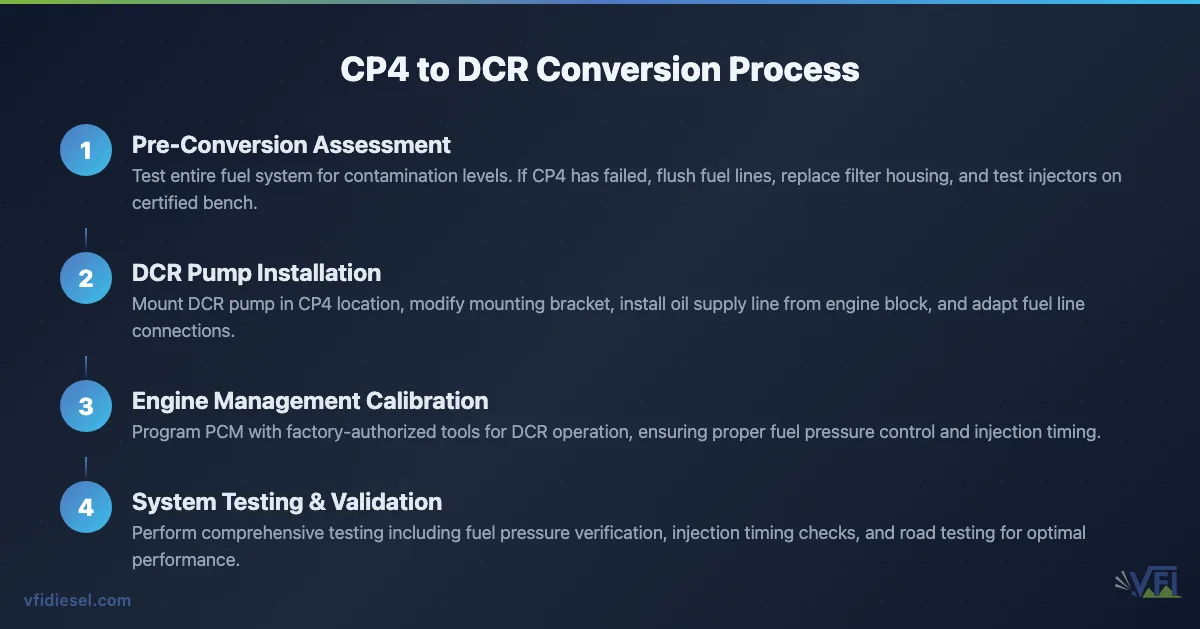
Pre-Conversion System Assessment: We start by testing the entire fuel system to determine contamination levels. If the CP4 has already failed, we flush all fuel lines, replace the fuel filter housing, and test injectors on our Bosch-certified test bench.
DCR Pump Installation: The DCR pump mounts in the same location as the CP4 but requires different fuel line connections and an additional oil supply line from the engine block. We modify the mounting bracket and install the oil supply fitting.
| Conversion Component | Purpose | Labor Hours |
|---|---|---|
| DCR Pump Assembly | Replace CP4.2 with DCR unit | 4-6 hours |
| Oil Supply Line | Connect DCR to engine oil system | 2-3 hours |
| Fuel Line Modifications | Adapt connections for DCR | 1-2 hours |
| ECM Programming | Calibrate for DCR operation | 1 hour |
Engine Management Calibration: The PCM (Powertrain Control Module) requires specific programming to operate with DCR pumps. We use factory-authorized calibration tools to ensure proper fuel pressure control and injection timing.
System Testing and Validation: After installation, we perform comprehensive testing including fuel pressure verification, injection timing checks, and road testing to ensure optimal performance.
Always replace the fuel filter housing during DCR conversion. The CP4 failure may have contaminated the housing with metal particles that could damage the new DCR pump. This preventive step saves thousands in potential warranty issues.
Cost Analysis: CP4 Replacement vs DCR Conversion Investment
While DCR conversion costs more upfront than CP4 replacement, the long-term economics strongly favor conversion — especially for high-mileage trucks and fleet applications.
CP4 Replacement Costs: A new CP4.2 pump with installation typically costs $3,500-$4,500. However, this doesn’t address the fundamental reliability issues, and many owners face repeat failures within 50,000-100,000 miles.
DCR Conversion Investment: Complete CP4 to DCR conversion ranges from $6,500-$8,500 depending on the specific DCR pump model and any additional fuel system repairs needed.
DCR conversion typically pays for itself within 100,000 miles through eliminated CP4 failures, reduced downtime, and lower maintenance costs. Fleet operators often see ROI within 18-24 months.
Hidden CP4 Failure Costs: When CP4 pumps fail catastrophically, repair costs extend far beyond pump replacement. Contaminated fuel systems require injector replacement ($2,000-$4,000), fuel line flushing ($500-$800), and fuel rail cleaning ($300-$500).
Downtime and Towing Expenses: CP4 failures often occur without warning, leaving trucks stranded. Towing costs, rental vehicle expenses, and lost productivity can add $2,000-$5,000 to total failure costs.
Our analysis shows that trucks experiencing two CP4 failures spend more than DCR conversion costs while still facing future reliability issues. For detailed cost comparisons, see our fuel injection pump cost analysis guide.
DCR Conversion Benefits for Fleet Operators and Owner-Operators
DCR conversion provides measurable benefits that extend beyond simple reliability improvements, particularly for commercial operations where downtime directly impacts profitability.
Predictable Maintenance Scheduling: DCR pumps follow predictable wear patterns tied to oil change intervals. Fleet managers can schedule maintenance during planned downtime rather than responding to emergency failures.
Extended Service Intervals: DCR pumps typically operate 300,000+ miles before requiring major service, compared to 100,000-150,000 miles for CP4 systems. This reduces lifecycle maintenance costs and improves vehicle utilization.
Fuel Quality Independence: DCR pumps perform consistently regardless of fuel quality variations. Trucks operating in remote areas or using biodiesel blends see particular benefits from this fuel-independent reliability.
Many fleet operators report 40-60% reduction in fuel system-related service calls after DCR conversion. This translates to significant savings in emergency service costs and improved customer satisfaction for service-based businesses.
Resale Value Protection: Trucks with DCR conversions command higher resale values due to eliminated CP4 failure risk. Buyers recognize the long-term reliability benefits and factor this into purchase decisions.
Insurance and Warranty Considerations: Some commercial insurance providers offer reduced premiums for fleets with DCR conversions due to lower breakdown risk. Extended warranty companies may also provide better coverage terms.
For fleet operations in Sacramento and throughout Northern California, we’ve helped numerous operators transition entire fleets to DCR systems with measurable improvements in uptime and maintenance costs.
Why Choose a Bosch-Authorized Shop for Your CP4 to DCR Conversion?
DCR conversion requires specialized knowledge, factory-authorized calibration tools, and access to genuine components — capabilities that separate professional diesel facilities from general repair shops.
Factory Training and Certification: Our technicians complete ongoing training through Bosch Mobility programs, ensuring we stay current with latest conversion procedures and calibration requirements.
Genuine Component Access: As an authorized dealer for Bosch, Delphi, and Alliant Power, we source genuine DCR pumps and components directly from manufacturers. This ensures proper fit, performance, and warranty coverage.
Advanced Diagnostic Equipment: DCR conversion requires precise calibration using factory-level diagnostic tools. Our common rail service equipment includes the latest Bosch and Delphi programming interfaces.
Improper DCR calibration can cause fuel economy loss, reduced power, or premature component wear. Always verify your shop has factory-authorized calibration tools and trained technicians before committing to conversion work.
Comprehensive System Knowledge: With over 30 years of diesel fuel injection experience, we understand how DCR conversions interact with other engine systems. This prevents compatibility issues and ensures optimal long-term performance.
Warranty and Support: We provide comprehensive warranties on DCR conversion work and maintain ongoing relationships with component manufacturers for technical support. This gives you confidence in both immediate performance and long-term reliability.
When you’re ready to eliminate CP4 reliability concerns permanently, schedule a consultation with our team. We’ll assess your specific truck’s condition and provide detailed conversion recommendations based on your operating requirements.
For Ford 6.7L Powerstroke owners throughout Northern California and Nevada, DCR conversion represents the definitive solution to CP4 fuel system problems. The investment pays dividends through eliminated failures, reduced maintenance costs, and improved reliability for years to come.
Call us at 530-668-0818 to discuss DCR conversion for your Ford 6.7L Powerstroke. We serve customers throughout Northern California and Nevada, and we ship DCR conversion components nationwide for qualified installers.
Frequently Asked Questions
How long does a CP4 to DCR conversion take?
A complete CP4 to DCR conversion typically takes 8-12 hours depending on the specific truck configuration and any additional fuel system repairs needed. We usually complete conversions within 1-2 business days.
Will DCR conversion affect my truck’s warranty?
DCR conversion may affect your Ford warranty depending on the specific warranty terms and truck age. However, most trucks requiring DCR conversion are beyond the original powertrain warranty period. We recommend consulting with your dealer before conversion if warranty coverage is a concern.
Can I convert to DCR before my CP4 fails?
Yes, preventive DCR conversion is often the most cost-effective approach. Converting before CP4 failure eliminates fuel system contamination and reduces total conversion costs. Many owners convert around 80,000-100,000 miles to avoid CP4 failure risk.
What maintenance does a DCR pump require?
DCR pumps require regular oil changes using the engine’s standard oil change intervals. The external oil lubrication system means DCR pump longevity is directly tied to proper oil maintenance. No special fuel additives or treatments are required.
Will DCR conversion improve my truck’s performance?
DCR conversion maintains stock performance levels while improving reliability. Some owners report slightly improved fuel economy due to more consistent fuel pressure control, but the primary benefit is eliminated CP4 failure risk rather than performance gains.