
Diesel Engine Failures That Cause Accidents: Fleet Safety Guide
03/21/2026
Diesel Engine Losing Power Under Load: 8 Causes & Solutions
03/26/2026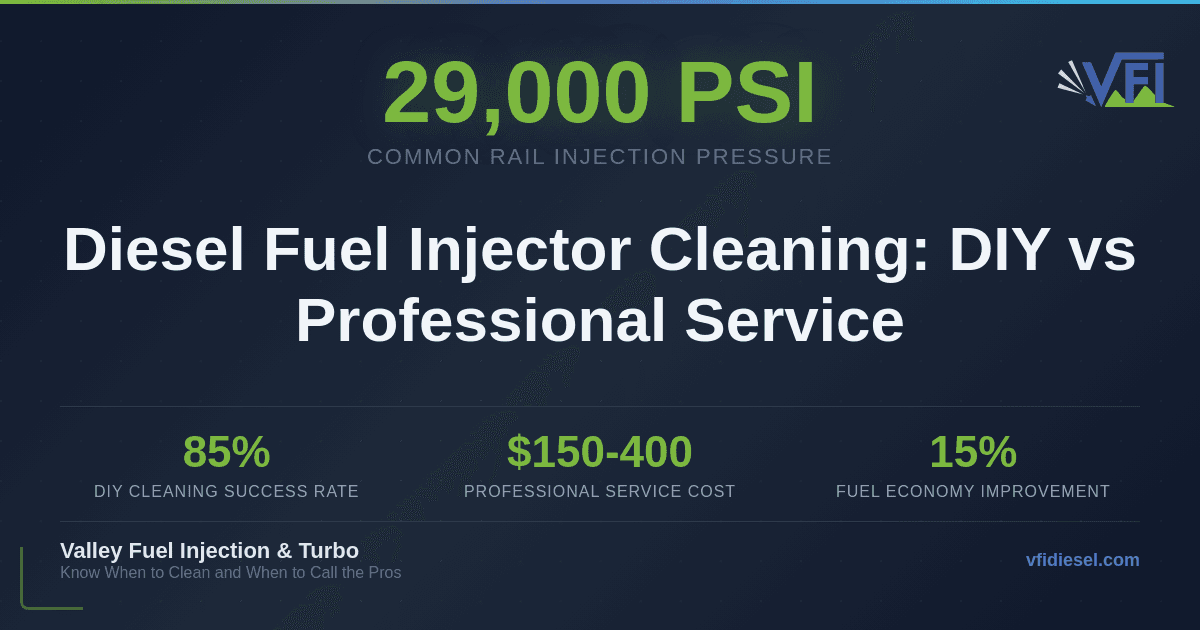
Diesel fuel injector cleaning is essential for maintaining optimal engine performance, but knowing when to tackle it yourself versus when to seek professional service can save you thousands in unnecessary repairs. While basic maintenance cleaning can be done at home, precision injectors operating at pressures up to 30,000 PSI require specialized equipment and expertise for proper restoration.
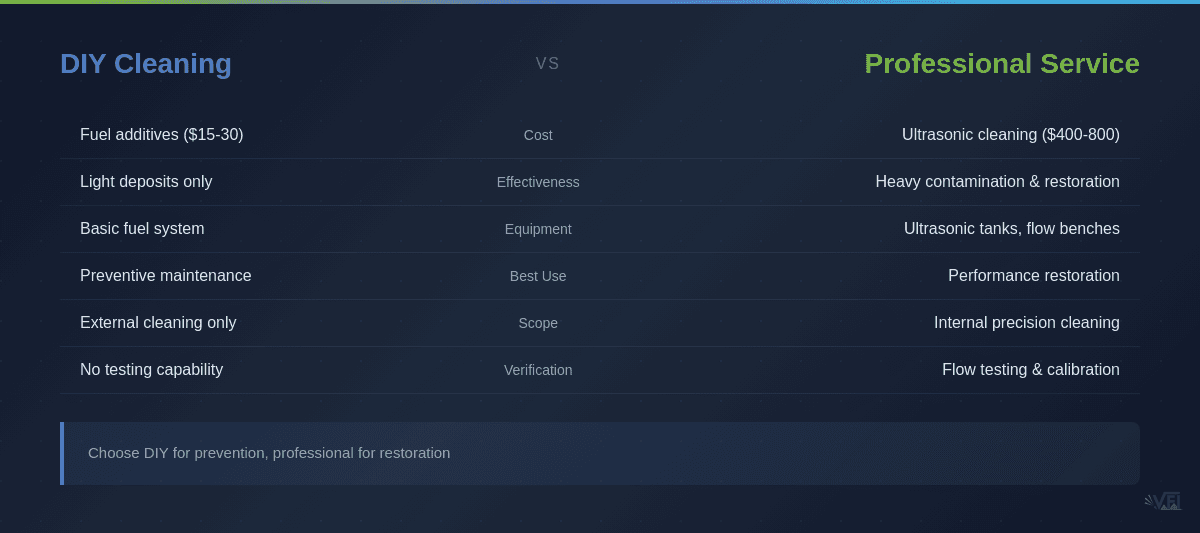
DIY cleaning works for preventive maintenance and light deposits, but professional ultrasonic cleaning and flow testing are necessary for severely contaminated injectors or performance restoration. Modern common rail injectors require specialized equipment that costs more than most trucks.
What Is Diesel Fuel Injector Cleaning and Why Is It Critical?
Diesel fuel injector cleaning removes carbon deposits, fuel varnish, and contaminants that accumulate inside the injector’s precision components over time. These microscopic passages must maintain exact tolerances to deliver the precise fuel atomization patterns your engine needs for complete combustion.
Modern diesel injectors operate under extreme conditions — common rail systems can reach injection pressures of 30,000 PSI while maintaining spray patterns accurate to within microns. Even tiny deposits can disrupt this precision, leading to poor fuel economy, increased emissions, and costly engine damage.
A single grain of dirt smaller than the period at the end of this sentence can cause a common rail injector to fail. That’s why professional cleaning requires Class 100 clean room conditions.
We’ve seen thousands of injectors over our 30+ years in business, and the difference between properly maintained and neglected injectors is dramatic. Clean injectors deliver consistent fuel metering, optimal spray patterns, and complete combustion — dirty ones waste fuel and damage engines.
How Do You Know When Your Diesel Injectors Need Cleaning?
Several symptoms indicate your diesel injectors need attention, ranging from subtle performance changes to obvious engine problems.
Early Warning Signs
- Reduced fuel economy: Often the first sign, as dirty injectors deliver inconsistent fuel metering
- Rough idle: Uneven fuel delivery creates irregular combustion
- Black or gray exhaust smoke: Incomplete combustion from poor fuel atomization
- Loss of power: Particularly noticeable under load or acceleration
- Engine knock or unusual noises: Poor fuel timing from sticky injector components
Advanced Symptoms
- Hard starting: Especially in cold weather when precise fuel delivery is critical
- Engine misfires: Individual cylinders failing to fire consistently
- Excessive vibration: Unbalanced combustion across cylinders
- Check engine lights: ECM detecting fuel delivery inconsistencies
Ignoring these symptoms can lead to complete injector failure, requiring expensive replacement rather than cleaning. We regularly see $3,000+ repair bills that could have been prevented with timely maintenance.
If you’re experiencing any of these symptoms, our team can perform comprehensive common rail system diagnostics to determine whether cleaning will restore performance or if replacement is necessary.
What Are the Different Methods of Diesel Injector Cleaning?
Diesel fuel injector cleaning methods range from simple fuel additives to sophisticated ultrasonic restoration processes, each with specific applications and effectiveness levels.
Fuel Additive Cleaning (DIY)
Fuel additives are the most accessible cleaning method, added directly to your fuel tank during fill-ups. Quality diesel fuel system cleaners can help prevent deposits and maintain injector performance.
Use fuel additives preventively rather than as a cure. They work best for maintaining clean injectors, not restoring heavily contaminated ones. We recommend quality brands like Stanadyne Performance Formula for regular maintenance.
On-Engine Cleaning Services
Professional on-engine cleaning connects specialized equipment to your fuel system, circulating concentrated cleaning solutions through the injectors while the engine runs. This method can address moderate contamination without removing components.
Ultrasonic Off-Engine Cleaning
The most thorough cleaning method involves removing injectors and placing them in ultrasonic baths with specialized solvents. High-frequency sound waves create microscopic bubbles that implode, creating powerful cleaning action that reaches every internal surface.
At our Bosch-certified facility, we use professional-grade ultrasonic equipment specifically designed for diesel injectors, combined with flow testing to verify restoration.
| Cleaning Method | Effectiveness | Cost Range | Best For |
|---|---|---|---|
| Fuel Additives | Light deposits | $15-30 | Prevention |
| On-Engine Service | Moderate contamination | $150-300 | Maintenance cleaning |
| Ultrasonic Professional | Heavy deposits/restoration | $400-800 | Performance restoration |
Can You Clean Diesel Injectors Yourself or Do You Need a Professional?
The answer depends on your goals, the severity of contamination, and your injector type. Some cleaning tasks are well-suited for DIY approaches, while others require professional equipment and expertise.
When DIY Cleaning Works
DIY diesel fuel injector cleaning is effective for preventive maintenance and addressing light contamination:
- Regular maintenance: Using quality fuel additives every 5,000-10,000 miles
- Light performance issues: Minor fuel economy reduction or slight rough idle
- Older mechanical injectors: Less precision required than modern common rail systems
- External cleaning: Removing external deposits from injector bodies
If you choose DIY cleaning, never attempt to disassemble modern injectors. The precision components require specialized tools and clean room conditions for proper reassembly. Focus on external cleaning and fuel system additives.
When You Need Professional Service
Professional diesel fuel injector cleaning becomes necessary when dealing with:
- Common rail injectors: Operating pressures up to 30,000 PSI require precision restoration
- Severe contamination: Heavy carbon deposits or fuel system contamination
- Performance restoration: Returning injectors to factory specifications
- Internal component issues: Sticky valves, worn seals, or damaged spray tips
- Flow testing requirements: Verifying proper fuel delivery patterns and volumes
Modern injectors contain components machined to tolerances measured in microns. Professional ultrasonic cleaning combined with flow testing ensures these precision parts function correctly. Our Bosch-certified test bench can verify that cleaned injectors meet factory specifications.
The Equipment Difference
Professional injector cleaning requires specialized equipment that costs more than most vehicles:
- Ultrasonic cleaning tanks: $10,000-50,000 for commercial-grade units
- Flow test benches: $25,000-100,000 for common rail capable systems
- Clean room facilities: Contamination-controlled environment
- Specialized solvents: Formulated specifically for diesel injector components
This investment allows us to restore injectors that would otherwise require replacement, often saving customers 60-80% compared to new injector costs.
How Much Does Professional Diesel Injector Cleaning Cost?
Professional diesel fuel injector cleaning costs vary based on injector type, contamination level, and required services, but typically range from $400-800 for a complete set.
Professional ultrasonic cleaning with flow testing typically costs $80-120 per injector, while on-engine cleaning services range from $150-300 for the complete system. Compare this to $300-800 per new common rail injector.
Factors Affecting Cleaning Costs
- Injector type: Common rail injectors require more sophisticated equipment than mechanical units
- Contamination severity: Heavy deposits may require multiple cleaning cycles
- Additional services: Flow testing, seal replacement, or calibration adjustments
- Quantity: Most shops offer better per-unit pricing for complete sets
- Geographic location: Labor rates vary by region
For diesel truck owners in Sacramento and the surrounding area, we provide transparent pricing and detailed estimates before beginning work. Our Sacramento-area customers appreciate knowing exactly what they’re paying for.
Cost vs Replacement Analysis
Professional cleaning becomes cost-effective when compared to injector replacement:
| Service | Cost Range | Success Rate |
|---|---|---|
| Professional Cleaning | $400-800 (set of 6-8) | 85-95% |
| Remanufactured Injectors | $1,200-2,400 | 98% |
| New OEM Injectors | $2,400-6,400 | 100% |
When cleaning successfully restores injector performance, customers save thousands compared to replacement costs. However, severely damaged injectors may require our remanufacturing services for reliable long-term performance.
What Happens If You Don’t Clean Dirty Diesel Injectors?
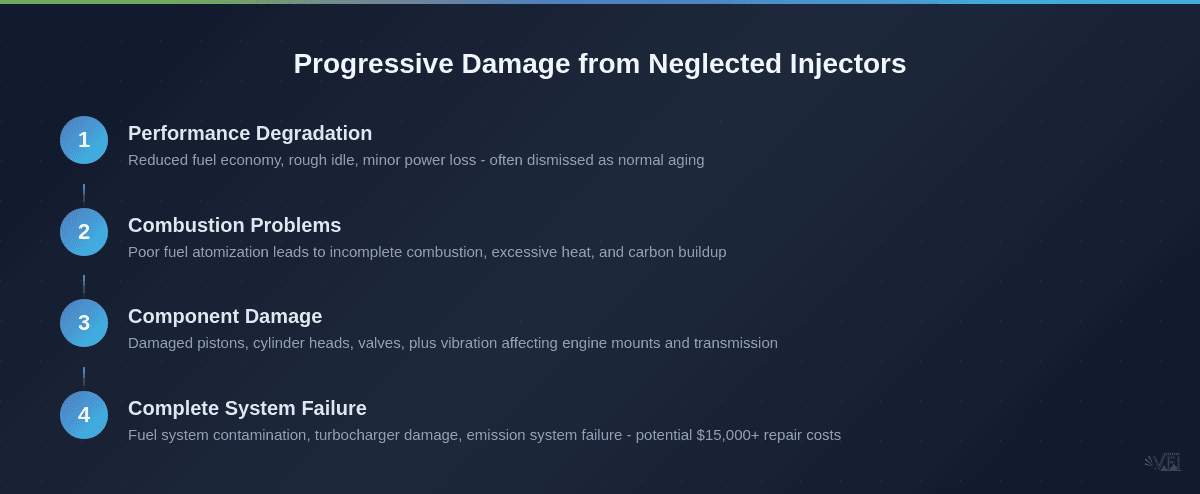
Neglecting dirty diesel injectors leads to progressively worse problems that can ultimately destroy your engine, making what could have been a simple cleaning job into a major overhaul.
Progressive Damage Stages
Stage 1: Performance Degradation
Initially, dirty injectors cause reduced fuel economy, rough idle, and minor power loss. These symptoms are often dismissed as normal aging, but they indicate the beginning of serious problems.
Stage 2: Combustion Problems
As deposits worsen, fuel atomization becomes increasingly poor, leading to incomplete combustion. This creates excessive heat, carbon buildup in combustion chambers, and increased emissions.
Stage 3: Component Damage
Poor combustion patterns can damage pistons, cylinder heads, and valves. Uneven fuel delivery between cylinders creates vibration that affects engine mounts, accessories, and transmission components.
We’ve seen engines with over $15,000 in damage from neglected injector problems. What started as poor fuel economy ended with cracked pistons, damaged cylinder heads, and complete engine failure.
Specific Failure Modes
- Injector seizure: Carbon deposits can cause internal components to stick, leading to complete failure
- Spray tip erosion: Poor fuel quality combined with contamination erodes precision-machined spray holes
- Seal failure: Deposits and heat cause internal seals to fail, allowing fuel to leak internally
- Electronic component damage: Modern injectors contain sophisticated electronics that can fail from contamination
Understanding these failure modes is why we emphasize preventive maintenance. Our maintenance guide for Kubota equipment applies to all diesel engines and can help prevent these costly failures.
Secondary System Damage
Dirty injectors don’t just damage themselves — they affect entire engine systems:
- Fuel system contamination: Failed injectors can contaminate the entire fuel system
- Turbocharger damage: Poor combustion can cause excessive exhaust temperatures
- Emission system failure: Incomplete combustion overwhelms emission control systems
- Engine oil contamination: Fuel dilution from leaking injectors degrades lubrication
We regularly service turbochargers damaged by injector problems, and our turbocharger service department often finds that injector maintenance could have prevented the failure.
How Often Should Diesel Fuel Injectors Be Professionally Cleaned?
Professional diesel fuel injector cleaning intervals depend on operating conditions, fuel quality, and injector type, but most diesel engines benefit from professional service every 60,000-100,000 miles.
Standard Maintenance Intervals
- Highway trucks: 80,000-100,000 miles for over-the-road applications
- City/delivery vehicles: 60,000-80,000 miles due to stop-and-go conditions
- Construction equipment: 1,500-2,000 operating hours in dusty conditions
- Agricultural equipment: Seasonal inspection and cleaning as needed
- Marine applications: Annual inspection due to fuel quality concerns
Don’t wait for symptoms to appear. Preventive cleaning at regular intervals costs far less than emergency repairs and maintains optimal fuel economy throughout the service life.
Factors Affecting Cleaning Frequency
Fuel Quality
Poor fuel quality dramatically shortens cleaning intervals. Diesel fuel containing high sulfur, water, or biological contamination requires more frequent injector service.
Operating Environment
Dusty conditions, extreme temperatures, and frequent idling all accelerate injector contamination. Equipment operating in agricultural or construction environments may need service every 40,000-60,000 miles.
Driving Patterns
Short trips, frequent idling, and low-speed operation prevent injectors from reaching optimal operating temperatures, allowing deposits to accumulate faster.
For customers in the Reno and Northern Nevada area, we’ve noticed that altitude and temperature variations can affect cleaning intervals. Our Reno-area customers often benefit from slightly more frequent service due to these conditions.
Monitoring Injector Health
Rather than relying solely on mileage intervals, monitor these indicators:
- Fuel economy trends: Gradual decreases indicate developing problems
- Exhaust smoke patterns: Changes in smoke color or density
- Engine performance: Power loss, rough idle, or starting difficulties
- Diagnostic codes: Modern engines provide early warning through ECM monitoring
Professional diagnostic equipment can detect injector problems before they become obvious to drivers. Our comprehensive fuel system pressure testing can identify issues early in the development cycle.
Fleet operators who implement preventive injector cleaning programs report 15-25% better fuel economy and 60% fewer injector failures compared to reactive maintenance approaches.
If you’re experiencing any symptoms of injector problems or it’s been more than 80,000 miles since your last professional cleaning, schedule a diagnostic with our team. We can assess your specific situation and recommend the most cost-effective approach.
Professional vs DIY: Making the Right Choice for Your Diesel
The decision between DIY and professional diesel fuel injector cleaning ultimately comes down to your specific situation, but understanding the limitations and capabilities of each approach helps you make an informed choice.
For preventive maintenance and light contamination, quality fuel additives and proper diesel engine maintenance practices can extend injector life significantly. However, when performance problems develop or you’re dealing with modern common rail systems, professional service becomes essential.
At Valley Fuel Injection, we’ve invested in the specialized equipment and training necessary to properly service today’s sophisticated diesel injection systems. Our 30+ years of experience with everything from mechanical injection pumps to the latest common rail technology means we can accurately diagnose whether cleaning will restore your injectors or if replacement is necessary.
Don’t let dirty injectors damage your engine or waste fuel. Call us at 530-668-0818 or visit our Woodland, CA shop for professional diagnosis and cleaning. We also accept mail-in injectors from across the country and can ship cleaned injectors back to you.
Whether you’re dealing with a single problematic injector or want to maintain your entire fleet, we have the expertise and equipment to keep your diesel engines running at peak efficiency. Contact us today to discuss your specific needs and get a detailed estimate for professional injector cleaning services.
Frequently Asked Questions
Can I use carburetor cleaner on diesel injectors?
No, never use carburetor cleaner on diesel injectors. Carburetor cleaners are formulated for gasoline systems and can damage the seals, O-rings, and precision components in diesel injectors. Use only cleaners specifically designed for diesel fuel systems.
How long does professional injector cleaning take?
Professional ultrasonic cleaning typically takes 2-4 hours per set of injectors, plus additional time for flow testing and calibration. On-engine cleaning services usually take 1-2 hours. We recommend calling ahead to schedule service and discuss turnaround times.
Will cleaning restore my injectors to like-new performance?
Professional cleaning can restore 85-95% of original performance in most cases, depending on the severity of contamination and whether any internal components are worn beyond specification. Flow testing after cleaning verifies actual performance restoration.
Can dirty injectors cause white smoke from my exhaust?
Yes, dirty injectors can cause white smoke, especially during cold starts. Poor fuel atomization from contaminated injectors leads to incomplete combustion, which appears as white or light gray smoke. However, white smoke can also indicate other problems, so professional diagnosis is recommended.
Is it worth cleaning injectors on a high-mileage diesel engine?
Absolutely. High-mileage engines often benefit significantly from injector cleaning because deposits have had more time to accumulate. Clean injectors can restore power, improve fuel economy, and extend engine life, making it a cost-effective maintenance investment even on older vehicles.