

Diesel Engine Loses Power in Hot Weather: Causes & Fixes
05/21/2026
Yanmar Diesel Injection Pump Problems & Fixes
06/08/2026
Diesel Turbo Surging and Hunting at Cruise: What’s Really Going On
Diesel turbo surging, that rhythmic push-and-pull sensation you feel at highway speeds when the engine can’t quite settle on a power level, is one of the most misdiagnosed complaints we see at our shop. Most owners assume it’s a turbocharger problem. Sometimes it is. But in our 30-plus years of diagnosing diesel fuel systems, we’d estimate that a significant portion of “turbo surge” complaints trace back to the fuel injection system, not the turbo itself. Understanding the difference between the two can save you from replacing a perfectly good turbocharger, and from missing the actual problem entirely.
Diesel turbo surging at cruise speed is often caused by fuel injection system faults (low rail pressure, failing injectors, or a faulty VP44 pump) rather than a turbocharger problem. Accurate diagnosis requires testing both systems before replacing any parts.
What Does Turbo Surging or Hunting Feel Like, and How Is It Different From Engine Surging?
Turbo surging at cruise is a distinct sensation: the vehicle accelerates and decelerates slightly in a rhythmic cycle, usually at steady throttle between 55–75 mph, without the driver touching the pedal. It can feel like a gentle wave, a mild lurch, or in worse cases, a pronounced hesitation-and-push cycle that makes the truck feel like it’s hunting for the right power output.
This is different from general engine surging, which tends to be more pronounced at idle or low load and often points directly to fueling or air metering issues. You can read more about idle-specific symptoms in our post on diesel engine surging at idle. Cruise-speed surging specifically implicates the interaction between boost control and fuel delivery under sustained load, which is exactly why it sits at the crossroads of two systems.
Key characteristics that help identify turbo-related surging versus fuel-system surging:
- Turbo surge: Often accompanied by a whooshing or fluttering sound, may worsen with sudden throttle lift, boost gauge swings are visible
- Fuel system hunting: Typically silent beyond normal engine noise, boost gauge may fluctuate as a result of fueling inconsistency, often worse under load on grades
- Combined symptoms: When both systems are involved, surging is usually more severe and harder to predict
On turbocharged diesel engines, the turbocharger and fuel injection system are in constant feedback with each other. The ECM uses boost pressure data to calculate fuel delivery, which means a fault in either system can produce symptoms that look like the other is failing.
Is Turbo Surge Always a Turbocharger Problem, or Can the Fuel System Be the Real Culprit?
No, and this is the most important thing we want diesel owners to understand. True aerodynamic turbo surge (where the compressor wheel stalls due to insufficient airflow) is actually less common in on-highway diesel applications than the name implies. What most people call “turbo surging” is really a drivability complaint that happens to involve boost pressure fluctuation.
Here’s the mechanism: your engine’s ECM continuously adjusts fuel delivery based on requested load, actual boost pressure, and various sensor inputs. If fuel delivery becomes erratic, whether from a worn injector, a failing high-pressure pump, or contaminated fuel, the engine’s power output fluctuates. The turbocharger responds to that fluctuation by spinning up and spooling down in rhythm with the fueling inconsistency. The result looks and feels like a turbo problem. The turbo is just reacting to what the engine is telling it.

We’ve seen this pattern repeatedly on Cummins ISX engines, 6.7 Powerstrokes, Duramax LML platforms, and especially on older VP44-equipped trucks where pump wear creates exactly this kind of irregular fuel delivery. Before assuming the turbo is the root cause, the fuel system has to be ruled out.
Replacing a turbocharger without diagnosing the fuel system first is a costly mistake. If a failing injector or pump caused the surge, the new turbo will be exposed to the same irregular combustion events, which can shorten its lifespan significantly.
What Role Do VGT Vanes, Actuators, and Boost Control Solenoids Play in Surge Complaints?
Variable geometry turbines (VGT) are the most common source of genuine turbo-side surge on modern diesel engines, and they deserve serious attention when diagnosing this complaint. VGT turbos use movable vanes inside the turbine housing to vary exhaust backpressure and boost output across the RPM range. When those vanes stick, carbon up, or the actuator controlling them fails, boost control becomes erratic.
The most common VGT-related surge scenarios we see:
| VGT Component | Failure Mode | Surge Symptom |
|---|---|---|
| Vane ring / unison ring | Carbon buildup, sticking | Erratic boost, hunting at cruise |
| Electronic actuator | Motor wear, position sensor fault | Boost oscillation, DTC codes |
| Boost control solenoid (EBPV) | Sticking, electrical fault | Inconsistent boost response, surge |
| Pneumatic actuator (older trucks) | Diaphragm failure, vacuum leak | Boost overshooting or hunting |
Carbon-coked VGT vanes are especially common on trucks used primarily for short trips or light loads, conditions that don’t generate enough exhaust heat to keep the vanes clean. On 6.0 and 6.4 Powerstroke engines, and on many Cummins ISB applications, stuck VGT vanes are a well-documented failure mode. Our diesel turbocharger failure signs guide covers the full range of turbo-side failures worth knowing about.
On trucks with electronic VGT actuators (like the Garrett GTB2056VZK on the 6.7 Cummins), the ECM can command a vane sweep test using a scan tool. If the actuator fails to hit its commanded position within spec, that’s a direct confirmation of a VGT control problem, not a fueling issue. Always run this test before condemning the turbo or the injection system.
How Does Low Fuel Rail Pressure Trigger Symptoms That Look Exactly Like a Turbo Failure?
Low or inconsistent fuel rail pressure is one of the most common fuel-system causes of diesel turbo surging, and it’s frequently overlooked because the symptoms are almost identical to a VGT fault. Here’s what happens at the mechanical level:
Common rail diesel engines maintain fuel at pressures typically between 5,000 and 30,000 PSI depending on load and RPM. When the high-pressure pump wears, when injectors leak internally, or when the pressure relief valve malfunctions, rail pressure drops or fluctuates. The ECM detects this and attempts to compensate by adjusting injection timing and duration. During that compensation cycle, which can happen multiple times per second, the engine’s power output wavers. The turbo, responding to exhaust energy, spools up and down in sync with those power fluctuations. From the driver’s seat, it feels like the turbo is surging.
Specific injection system faults that commonly produce this pattern:
- Worn high-pressure pump (CP3, CP4, or VP44): Reduced volumetric efficiency means the pump can’t maintain target rail pressure under sustained load
- Leaking or worn injectors: Internal bypass leakage bleeds rail pressure down, especially under high-load cruise conditions
- Failing fuel pressure regulator or IMV: Causes rail pressure to hunt rather than hold steady
- Contaminated fuel or clogged fuel filter: Restricts supply to the high-pressure pump, starving it under load
- Air intrusion in the low-pressure supply: Creates momentary pressure drops that the high-pressure pump can’t overcome
The VP44 injection pump used on ‘98.5–’02 Dodge Cummins trucks is particularly prone to this failure mode.
As the pump wears internally, it loses the ability to maintain consistent fuel delivery under load, and the resulting surge pattern is almost universally misdiagnosed as a turbo problem. Our Bosch diesel injection pump testing and repair services include full VP44 diagnostic and rebuild capability, and we’re one of the few shops in the country still doing this work at this level.
If you’re dealing with biodiesel blends in California, there’s an additional layer of concern. Biodiesel accelerates injector wear and can compromise seal integrity, leading to exactly the kind of internal leakage that drops rail pressure. We covered this in detail in our post on biodiesel injector damage and California’s fuel quality issues.
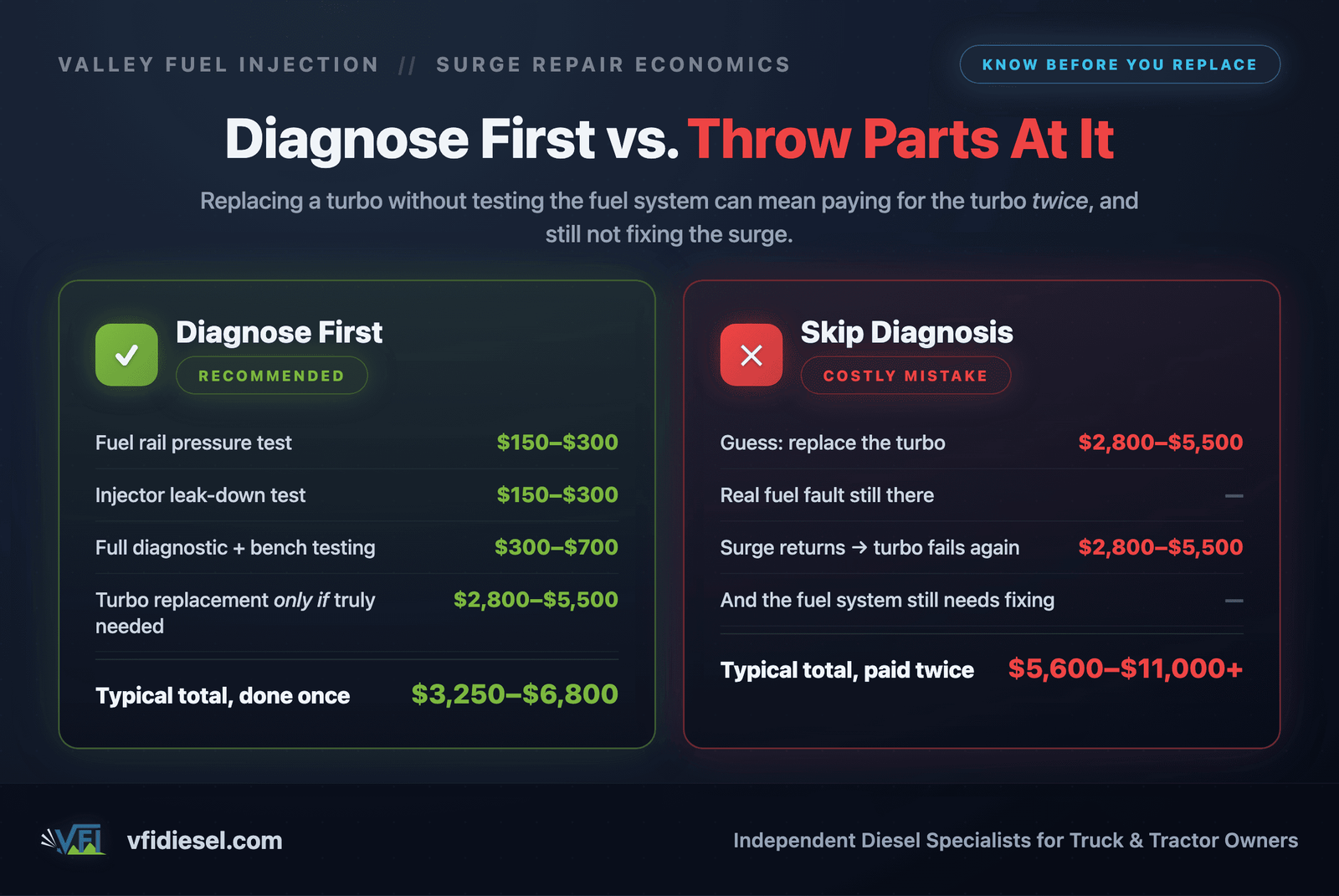
Fuel rail pressure diagnostic testing typically runs $150–$300 at a qualified diesel shop. Injector leak-down testing adds another $150–$300. Compare that to the cost of a replacement turbocharger ($2,800–$5,500+ depending on application). Proper diagnosis up front almost always saves money.
Not sure if it’s your turbo or your injection system?
We’ve been diagnosing exactly this kind of complaint since 1993. Call us at 530-668-0818 or schedule a diagnostic. We test both systems and give you a clear answer before recommending any repairs. We also accept mail-in injectors and pumps for testing from anywhere in the country.
What Diagnostic Steps Actually Pinpoint Whether the Turbo or Injection System Is at Fault?
A systematic diagnostic approach is the only way to confidently separate a turbo-side fault from a fuel system fault. Here’s the sequence we use, and that any qualified diesel technician should follow before recommending parts replacement:
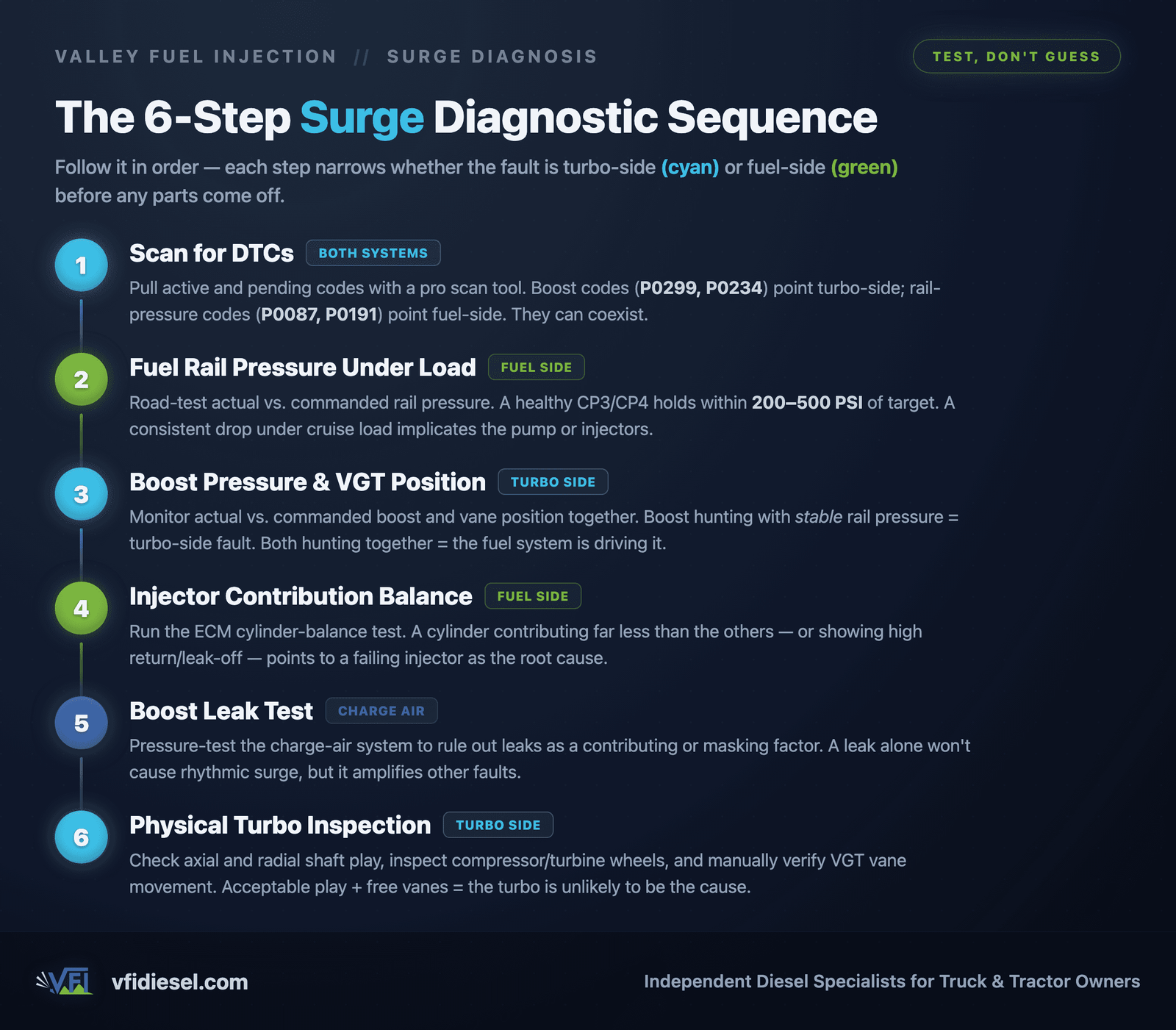
Step 1: Scan for Active and Pending DTCs
Pull codes with a professional-grade scan tool (not a basic OBDII reader). Boost-related codes (P0299, P0234, P0087, P0191) point you toward the right system. Note that fuel rail pressure codes (P0087, P0191) can coexist with boost codes when one system is causing the other to malfunction.
Step 2: Live Fuel Rail Pressure Under Load
Monitor actual vs. commanded fuel rail pressure during a road test. If actual pressure drops below commanded pressure under sustained cruise load, the high-pressure pump or injectors are the primary suspect. A healthy CP3 or CP4 pump should hold within 200–500 PSI of target across the load range.
Step 3: Live Boost Pressure and VGT Position
Monitor actual vs. commanded boost and VGT vane position simultaneously. If boost is hunting while fuel rail pressure is stable, the turbo system is the more likely culprit. If both are hunting together, the fuel system is typically driving the instability.
Step 4: Injector Contribution Balance Test
Most modern diesel ECMs can perform a cylinder contribution or injector balance test. A cylinder contributing significantly less than others, or showing high return/leak-off values, points to a failing injector as the root cause of the fueling instability.
Step 5: Boost Leak Test
Pressure-test the charge air system to rule out boost leaks as a contributing factor. A boost leak won’t cause rhythmic surging on its own, but it can mask other faults or amplify them. See our detailed guide on turbo boost leak symptoms for the full picture.
Step 6: Physical Turbo Inspection
Check shaft play (axial and radial), inspect the compressor and turbine wheels for damage, and, on VGT turbos, manually check vane movement for sticking. A turbo with acceptable shaft play and free-moving vanes is unlikely to be the primary source of surge.
On Duramax LML and LGH engines, the CP4.2 high-pressure pump is a known failure point that causes exactly the surge pattern described in this post. If you’re diagnosing a 2011–2016 GM diesel with cruise-speed hunting, rail pressure testing should be your first step, not a turbo inspection. Learn more about our Delphi fuel injection services and common rail system repair capabilities.
When Does a Surging Turbo Need Professional Testing Versus a Simple Cleaning or Adjustment?
Not every surge complaint requires a full teardown. Some situations genuinely respond to cleaning or minor adjustment, but knowing which ones is the difference between a $200 service and a $2,000 repair.
Situations where cleaning or adjustment may resolve the surge:
- VGT vanes sticking due to carbon buildup on a turbo with no physical damage, where an on-vehicle cleaning with appropriate chemical treatment or a shop removal-and-clean can restore proper function
- Boost control solenoid contamination, where cleaning or replacement of the solenoid is a relatively low-cost fix
- Clogged fuel filter causing intermittent supply restriction, where a filter change and low-pressure system inspection may be all that’s needed
- Minor air intrusion in the fuel supply, where finding and sealing the source resolves the issue without touching the high-pressure components
Situations that require professional testing and likely component service:
- Rail pressure consistently dropping below target under load, which means the high-pressure pump needs bench testing to determine if it can still meet flow and pressure specifications
- Multiple injectors showing high return rates on leak-off testing, which means the injectors need flow testing and likely rebuild or replacement
- VGT actuator failing position commands, which means electronic actuator replacement or recalibration is required
- Turbo shaft play outside manufacturer tolerances, which means the turbocharger needs rebuild or replacement regardless of other findings
The critical point: professional testing means bench testing on calibrated equipment, not just a visual inspection or a code scan.
At our facility, we use Bosch diesel test systems to evaluate injector flow rates, return volumes, and spray patterns against OEM specifications. A visual inspection alone cannot tell you whether an injector is delivering the right quantity of fuel at the right pressure. Similarly, the SAE has documented that high-pressure pump wear is not detectable without proper flow bench testing, since worn pumps often show no external signs of failure.
For turbocharger service specifically, our turbocharger service page outlines what’s involved in a proper inspection and rebuild. And for a broader look at early turbo failure indicators, our post on diesel turbocharger failure warning signs covers what to watch for before a minor issue becomes a catastrophic one.
Diesel owners in the Sacramento area can bring their truck in for a full diagnostic at our Woodland shop. If you’re further out, in Reno, Redding, or beyond, we accept mail-in injectors and pumps for bench testing and rebuilding, and we ship remanufactured components nationwide.
According to EPA emission standards for heavy-duty diesel engines, modern common rail systems must maintain injection precision within extremely tight tolerances. Even minor injector wear that falls within “acceptable” visual inspection standards can cause measurable fueling inconsistency, which is exactly why bench flow testing exists.
The Bottom Line on Diesel Turbo Surging
Diesel turbo surging at cruise is a symptom, not a diagnosis. The turbocharger you can hear spooling and hunting is often just responding to what the fuel system is, or isn’t, delivering. Before spending money on turbo components, invest in a proper diagnostic that tests both systems. The fuel injection system is implicated more often than most shops realize, and the only way to know for certain is to test it on calibrated equipment with live data under actual load conditions.
We’ve been doing exactly this work since 1993, testing, rebuilding, and remanufacturing diesel injection systems and turbochargers at a level most shops can’t match. If you’re chasing a surge complaint that hasn’t responded to the usual fixes, consult a qualified diesel technician who can test both systems before recommending parts. That’s where we come in.
Frequently Asked Questions: Diesel Turbo Surging
Can a clogged diesel particulate filter (DPF) cause turbo surging?
Yes. A heavily clogged DPF increases exhaust backpressure, which changes the operating conditions for the VGT vanes and can cause erratic boost behavior. On engines with active DPF regeneration, the additional fueling during a regen cycle can also temporarily affect the surge pattern. A DPF restriction test should be part of any complete surge diagnostic on emissions-equipped trucks.
Why does my diesel only surge at highway speeds and not at idle or low RPM?
Cruise-speed surging that doesn’t appear at idle points to a load-dependent fault. High-pressure pump wear, for example, often only shows up under sustained load when the pump is being asked to maintain maximum rail pressure. Similarly, VGT vane sticking tends to manifest at mid-to-high load when the vanes are being commanded to a specific position. Idle symptoms are caused by a different set of faults. See our post on diesel engine surging at idle for those scenarios.
How do I know if my CP4 pump is causing the surge before it fails completely?
The early warning signs of a failing CP4 pump include intermittent rail pressure drop codes (P0087), cruise-speed hunting that worsens under load, and slightly longer crank times. The only definitive way to confirm CP4 wear before catastrophic failure is a bench flow test, which measures the pump’s actual output volume against OEM specifications. A worn CP4 that’s still “running” can be delivering 15–20% less fuel than required, which is enough to cause surging without triggering a hard fault code.
Is diesel turbo surging dangerous to drive with?
It depends on the cause and severity. Mild hunting that’s been present for a while without worsening carries lower immediate risk, but it should still be diagnosed promptly, since the underlying fault will typically progress. If the surging is accompanied by loss of power, black or white smoke, unusual noises from the turbo, or a sudden worsening of symptoms, stop driving and have the truck inspected immediately. A failing CP4 pump, in particular, can deteriorate rapidly from “surging” to complete engine contamination in a short time.
Can dirty or contaminated diesel fuel cause turbo surging?
Absolutely. Contaminated fuel, whether from water intrusion, microbial growth, or poor-quality biodiesel blends, can cause injector tip deposits, accelerate wear in the high-pressure pump, and clog fuel filters in ways that produce intermittent fuel delivery. The result is exactly the kind of load-dependent surging described in this post. California diesel owners should be particularly aware of biodiesel blend quality issues, which we’ve documented in detail in our biodiesel injector damage post.
Stop Guessing. Get a Real Diagnosis.
Valley Fuel Injection & Turbo has been diagnosing and repairing diesel fuel injection and turbocharger systems since 1993. We’re a Bosch-certified testing and remanufacturing center, one of the few shops in the country with the equipment and expertise to bench test both your injection system and your turbocharger before recommending any repairs.
Call us at 530-668-0818 or schedule a diagnostic online. Visit us at 1243 E Beamer St, Suite C, Woodland, CA 95776. Not local? We accept mail-in injectors and pumps for testing and rebuilding, and we ship remanufactured components nationwide. Learn more on our diesel fuel injection services page.
Which Diesel Platforms Surge at Cruise, and What’s the Right Fix for Each?
Cruise-speed hunting traces back to different root causes depending on the platform, and the cheapest correct fix is not the same from one truck to the next. Knowing your platform’s weak point keeps you from throwing a turbo at a fuel problem, or a fuel pump at a turbo problem.
5.9L Cummins 24V (1998 to 2007), VP44 Pump
This is the most notorious platform for cruise hunting, but the turbo is rarely the cause. The VP44 injection pump is extremely sensitive to inlet pressure from the lift pump (the supply pump). When the stock lift pump weakens with age, it holds pressure at idle but drops under cruise load, and the VP44 cannot maintain steady fuel delivery. The result is a rhythmic surge that feels exactly like a turbo problem. A weak lift pump is the single most underdiagnosed cause of VP44 hunting, and a starved VP44 can fail within weeks. The fix is almost always a lift pump upgrade (FASS or AirDog), roughly $700 to $1,200 installed, before touching the pump itself. If the VP44 is already damaged, replacement runs about $2,200 to $3,200 installed. Our Bosch injection pump testing and repair includes full VP44 diagnosis and rebuild.
6.7L Cummins, 6.6L Duramax (LLY/LBZ/LMM), and 6.7L Powerstroke
These VGT platforms surge when carbon-fouled vanes or a failing actuator prevent a stable vane position. The LLY Duramax is especially prone due to a hot-running, smaller-wheel VGT. On the 6.7L Powerstroke, surge more often traces to the CP4.2 high-pressure pump struggling under load. A standalone VGT actuator, such as the Holset HE300VG electronic actuator kit for the Ram 6.7L Cummins, runs about $850 to $1,400 installed and requires ECM calibration afterward, while a full reman VGT turbo runs about $2,800 to $4,800 installed. See our turbocharger service page.