
John Deere Injection Pump Problems: Symptoms, Causes & Rebuild Options
02/22/2026
Diesel Lift Pump: What It Does, Why It Fails & When to Upgrade
02/22/2026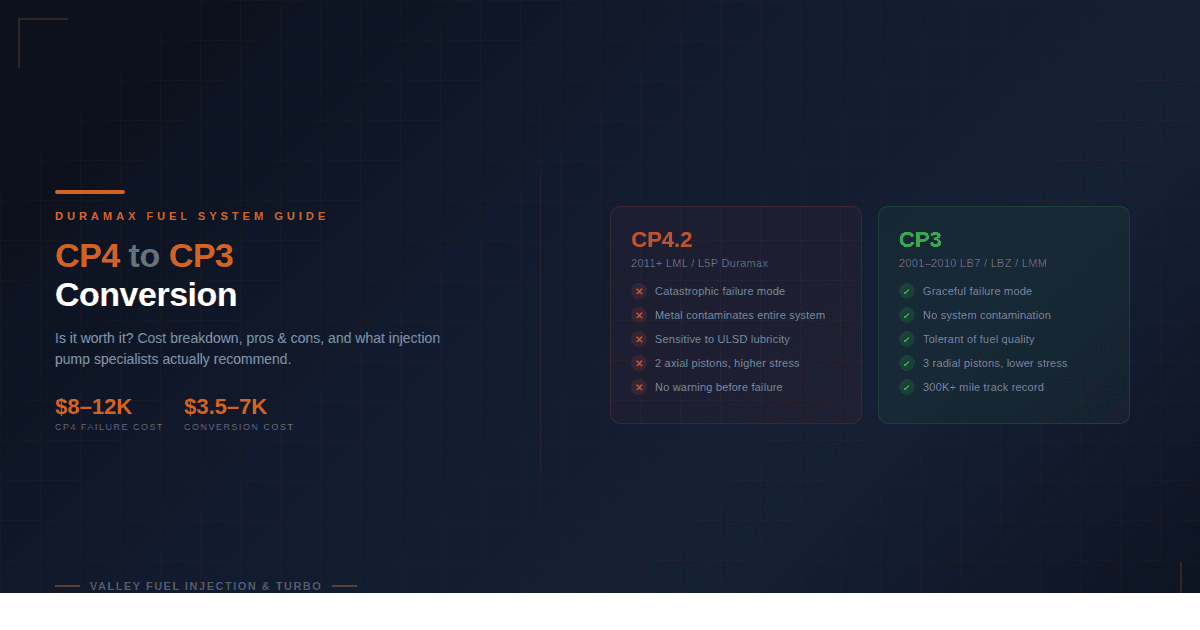
CP3 vs CP4: Head-to-Head Comparison
The short answer: the Bosch CP3 is the tougher pump on US diesel fuel. A worn CP3 loses rail pressure and you replace one pump; a failed CP4.2 can push metal through the rails, lines and all eight injectors, and that difference is the whole case for converting an LML Duramax to a CP3.
| Factor | Bosch CP3 | Bosch CP4.2 |
|---|---|---|
| Design / mechanism | Three radial pistons around a central cam ring; lower contact pressure per stroke | Two pistons driven by roller-on-cam; higher contact pressure, more efficient at very high rail pressure |
| Reliability track record | Decade-plus proven, very low catastrophic failure rate, 300,000+ miles common | Elevated failure rate, can grenade early with no warning lights |
| Failure mode | Graceful: gradual loss of rail pressure, low-pressure code, eventual no-start. Contained to the pump | Catastrophic: metal debris travels through all 8 injectors, rails, lines, sometimes the tank |
| Tolerance to low-lubricity ULSD | Forgiving; lower contact pressures make it far less sensitive to dry fuel | Highly sensitive; designed around higher-lubricity European diesel |
| Cost | Rebuilt or installed CP3 service typically $1,200 to $2,000 (a reman exchange pump alone costs less) | The replacement pump is not the big bill; a failure that spreads metal runs $10,000 to $18,000+ |
| Which trucks / years | Duramax LB7, LLY, LBZ and LMM (2001 to 2010); Ram 5.9L Cummins (2003 to 2007) and 6.7L Cummins (2007.5 to 2018, and again from 2021) | Duramax LML and LGH (2011 to 2016), Ford 6.7L Power Stroke (2011 on), Ram 6.7L Cummins (2019 and 2020). The 2017 and newer L5P Duramax uses a Denso HP4, not a CP4 |
| Bottom line | The more robust, fuel-tolerant design for US conditions | Efficient high-pressure design that trades durability on our fuel |
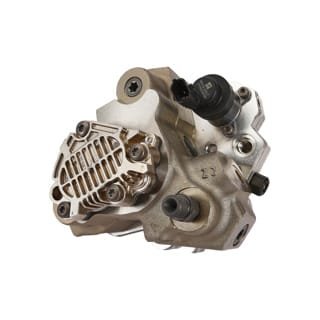
Truck already came with a CP3? We stock Bosch factory reman CP3 pumps on exchange for the Duramax LB7 through LMM and the 2003 to 2018 Ram Cummins. Weighing the swap on an LML? The parts list and 2026 prices are in CP3 conversion cost (2026) below, and how a CP4 comes apart is covered in our CP4 injection pump failure guide.
Why Duramax Owners Are Ditching the CP4
If you own a 2011–2016 Duramax LML (or the LGH version in the Express and Savana vans), your engine runs the Bosch CP4.2 injection pump, and you’ve probably heard the horror stories. The CP4 grenades without warning, sends metal shrapnel through the entire fuel system, and turns a running truck into a $10,000–$18,000+ repair bill in seconds. No warning lights. No gradual decline. Just sudden catastrophic failure.
The CP4 to CP3 conversion, replacing the failure-prone Bosch CP4.2 with the older, proven Bosch CP3 pump, has become one of the most discussed modifications in the diesel truck community. Forums, YouTube channels, and diesel shops across the country have strong opinions about it. Some call it the best insurance policy you can buy for a Duramax. Others say it’s unnecessary, overblown, or creates more problems than it solves.
Talk to a Diesel Tech Thinking about the CP3 swap on your Duramax? We do the swap here in our Woodland shop, and we build and bench-test the CP3 pumps these conversions run on. Call and we will tell you straight whether your truck needs it, and what a failed CP4 may have already sent downstream into your injectors. Two ways in: drive it into our Woodland shop near Sacramento, or ship it to us from anywhere in the country. ☎︎ Call 530-668-0818Out of the area? Start a mail-in rebuild → |
At Valley Fuel Injection & Turbo, we’re a Bosch-authorized service center that has rebuilt and tested both CP3 and CP4 pumps. We’ve seen the inside of failed CP4s, the scored cam lobes, the shattered pistons, the metal-contaminated fuel rails. We’ve also seen CP3 pumps with 300,000+ miles that look nearly new inside. We don’t sell conversion kits, so we don’t have a financial incentive to push you either way. Here’s the honest breakdown.
The CP4 Problem: Why It Fails
We covered this in depth in our CP4 injection pump failure guide, but here’s the summary:
The Bosch CP4.2 is a high-pressure injection pump that generates 26,000–29,000+ PSI to feed the common rail fuel system. It uses two opposing pistons driven by a cam to create pressure. The fundamental design problem is that the CP4 relies on diesel fuel, and only diesel fuel, to lubricate its internal cam, roller bearings, and piston surfaces. There is no separate oil supply like there is with a turbocharger.
American Ultra Low Sulfur Diesel (ULSD) has significantly less lubricity than the European diesel the CP4 was designed around. The sulfur removal process that made ULSD cleaner for emissions also stripped out natural lubricating compounds. The CP4’s tight tolerances and high contact pressures make it exceptionally sensitive to this reduced lubricity.
When lubrication is marginal, whether from fuel quality, ethanol contamination at the pump, water in the fuel, or simply the inherent dryness of ULSD, the CP4’s internal surfaces wear. Cam lobes develop scoring. Roller bearings pit. Pistons scuff. Eventually, a component fractures, and the pump dumps metal debris into the high-pressure fuel rail and through every injector in the engine.
The damage cascade: A CP4 failure doesn’t just kill the pump. Metal contamination travels through the fuel rail, into all 8 injectors, and often back through the return lines to the fuel tank. A complete cleanup typically requires replacing the CP4 pump, all 8 injectors, the fuel rail, high-pressure fuel lines, the fuel pressure regulator, and sometimes the tank and low-pressure lines, if metal made it that far. Total cost: $10,000–$18,000+ at a dealer, with typical cases running $12,000–$14,000.
The CP3: What Makes It Different
The Bosch CP3 was the high-pressure pump used in Duramax engines from 2001 through 2010 (LB7, LLY, LBZ, LMM). It’s also used in the 5.9L and early 6.7L Cummins, and in various European diesel applications. It has a fundamentally different internal design that makes it far more tolerant of fuel quality variations.
Three radial pistons instead of two axial pistons. The CP3 uses three pistons arranged radially around a central cam ring, compared to the CP4’s two opposing pistons. This design distributes wear across more contact surfaces and generates less stress per piston stroke.
More forgiving cam and bearing geometry. The CP3’s internal cam and shoe design creates lower contact pressures than the CP4’s roller-on-cam arrangement. Lower contact pressure means less sensitivity to marginal lubrication.
Proven track record. CP3 pumps ran in millions of diesel trucks for a decade with an extremely low catastrophic failure rate. LBZ and LMM Duramax trucks with CP3 pumps routinely reach 300,000–400,000+ miles on the original pump. The same cannot be said for the CP4.
When CP3s do fail, they fail gracefully. A worn CP3 typically loses the ability to maintain full rail pressure, you’ll notice a gradual loss of power at high RPM and load, a check engine light for low rail pressure, and eventually a no-start condition. It doesn’t explode and contaminate the entire fuel system. The failure mode is a repair, not a catastrophe.
For the full side-by-side on design, fuel tolerance, cost and which trucks run which pump, see the CP3 vs CP4 comparison table at the top of this page.
Is CP3 or CP4 Better?
For long-term reliability on American diesel, the CP3 is the better pump. The CP4.2 can make its rail pressure just fine, but its two-piston, roller-on-cam design is far less tolerant of low-lubricity ULSD, and when it does let go, it takes the whole fuel system with it. That single difference in failure mode is exactly why so many owners convert a CP4 truck back to the older CP3.
Not sure which pump you have, or whether yours is worth rebuilding? As a Bosch-authorized shop, we test and reman both. Browse our Bosch factory reman CP3 pumps or call us at 530-668-0818 and we will point you to the right part for your truck.
What’s Involved in a CP4 to CP3 Conversion
The conversion isn’t a simple bolt-on swap. The CP3 and CP4 have different mounting configurations, fuel line routing, and in some cases, different fuel supply requirements. Here’s what’s typically involved:
Conversion Kit Components
Several aftermarket companies produce CP4-to-CP3 conversion kits for the Duramax platform. Using the S&S Diesel Motorsport 50-state LML kit as the example, here is what goes on the truck:
- CP3 injection pump with a matched metering unit. S&S builds its no-tune kits with a metering unit that matches the CP4’s flow curve; its tune-required kit uses an LBZ-based metering unit. Whoever builds it, insist on a quality pump from a known builder, not a cheap import.
- Pump mounting adapter that puts the CP3 in the CP4’s spot in the engine valley. The drive gear moves over from the old pump.
- New high-pressure line from the pump to the right-hand rail, plus a plug for the open rail feed port.
- New low-pressure supply tube and hose, with feed and return fittings for the CP3.
- Metering unit extension harness and a mount to relocate the fuel temperature sensor from the old pump.
- Tuning, only if the kit calls for it. No-tune kits run on the factory ECM calibration. A tune-required kit needs a pump curve revision in the ECM.
What the Conversion Does NOT Include
The conversion replaces only the high-pressure pump. It does not change the injectors, fuel rail, fuel pressure regulator, or low-pressure fuel system. The existing common rail injectors work with either pump, they don’t care where the rail pressure comes from as long as it’s within spec.
Installation Complexity
This is not a weekend garage project for most owners. The pump sits in the engine valley, so on an LML the job means draining the coolant and pulling the fan, alternator(s), A/C compressor, EGR cooler and center intake manifold (the Y-bridge) to reach it. The drive gear moves over from the old pump, and the CP3 does not need to be timed to the camshaft, but every high-pressure fitting has to be torqued to spec and the system has to be primed before the truck will start.
Check for metal first. Before the new pump goes in, pull the metering unit off the old CP4 and look for metal. If you find any, it is no longer a pump swap: S&S calls for replacing the injectors, fuel rails, all high- and low-pressure lines, the return line, the hydrocarbon (aftertreatment) injector and the fuel filter.
You do not need a lift pump for the swap. The LML never had one from the factory: the gear pump on the high-pressure pump pulls fuel from the tank, and the CP3 has its own gear pump that does the same job. A lift pump still earns its place on high-horsepower builds, and because it pushes fuel instead of pulling it, a leak shows up as a drip instead of air getting into the fuel.
CP3 Conversion Cost (2026)
For a healthy LML with no metal in the system, plan on $3,700–$7,300 for the kit and installation, or $4,500–$8,700 if you add a lift pump. Here is where the money goes:
| Item | What it covers | Typical 2026 cost |
|---|---|---|
| CP3 conversion kit | CP3 pump with matched metering unit, pump mounting adapter, high-pressure line and rail plug, low-pressure supply tube, hose and fittings, metering unit harness and sensor mount | $2,800–$5,500 |
| Installation labor | Drain the coolant, pull the fan, alternator(s), A/C compressor, EGR cooler and Y-bridge, swap the pump, reassemble, prime and leak-check | $900–$1,800 |
| Fuel filter and coolant | New fuel filter (S&S recommends GM ACDelco 12664429) and the coolant refill | Small parts on the same invoice |
| Aftermarket lift pump (optional) | FASS, AirDog or similar. Not required for the swap | $800–$1,400 installed |
| Tuning | None with a no-tune kit; a tune-required kit needs a pump curve revision from your tuner | Varies by kit and tuner |
| Total, healthy truck | Kit and installation, lift pump optional | $3,700–$8,700 |
Compare that to the cost of a CP4 failure cleanup: $10,000–$18,000+ for pump, injectors, rail, lines, labor, and fuel system decontamination, with typical cases running $12,000–$14,000. The conversion costs a fraction of what a single CP4 failure costs, and it eliminates the risk of that failure permanently.
If the CP4 has already failed, you are not pricing a conversion anymore. You are pricing that full cleanup, with the CP3 going in as the replacement pump, which is why the metal check comes first.

The Honest Pros and Cons
Arguments FOR the Conversion
Eliminates catastrophic failure risk. This is the primary reason people do it. The CP4’s failure mode, sudden, total, system-contaminating, is unique among diesel injection pumps. The CP3 simply doesn’t fail this way. For owners who tow heavy, rely on their truck for work, or can’t afford $10,000+ in unexpected repairs, the peace of mind is worth the conversion cost.
Proven long-term reliability. The CP3 has a decade-plus track record in American diesel trucks. Hundreds of thousands of Duramax and Cummins trucks running CP3 pumps have proven its durability in real-world conditions with American ULSD fuel.
Lower cost than one CP4 failure. At $3,700–$8,700 for the conversion versus $10,000–$18,000+ for a CP4 failure, the math favors conversion, assuming you believe a CP4 failure is likely. The break-even calculation depends on your personal risk assessment.
Supports higher fuel delivery for modified trucks. If you’re running aftermarket tuning for increased horsepower, the CP3 can flow more fuel at high demand than the CP4. This is why the conversion is particularly popular with performance-oriented Duramax owners.
Arguments AGAINST the Conversion
Not every CP4 fails. This is important context. While CP4 failures are dramatically more common than CP3 failures, the majority of CP4 pumps do survive their service life. The actual failure rate, while higher than acceptable for such an expensive component, is not 100%. Some Duramax owners will run their CP4 for 200,000+ miles without incident. The question is whether you’re willing to gamble.
Cost of conversion vs. prevention. Using a quality fuel additive with every fill-up ($40–$50/year), installing an aftermarket lift pump with better filtration ($800–$1,400 installed), and being disciplined about fuel quality dramatically reduces CP4 failure risk. Some owners argue that $800–$1,400 in prevention is smarter than $3,700–$8,700 in conversion, especially if the CP4 might have survived anyway.
Emissions compliance and warranty. Buy the kit for where the truck is registered. In California, a modification like this needs a CARB Executive Order (an exemption from the state’s anti-tampering law) to be street legal, and smog check stations can verify the EO number. S&S Diesel Motorsport’s 50-state LML kit carries EO D-756-4: no tuning, stock fuel pressure regulator, factory emissions equipment kept. The competition versions of that kit are not covered by the EO, so they are not for a truck that has to pass smog. As for warranty, the newest LML is a 2016, so GM’s factory powertrain coverage has run out on all of them; if you carry an extended service contract, read what it says about fuel system modifications before you convert.
Installation quality matters enormously. A conversion done badly creates new problems: high-pressure fittings torqued wrong and leaking, an air leak on the suction side, a tune that does not match the pump’s metering unit, a cheap import pump, or metal from a CP4 that was already failing left in the rails and injectors. The conversion is only as good as the parts and the shop doing the work.
Resale considerations. Some buyers prefer stock trucks. A CP3 conversion may help or hurt resale value depending on the buyer, diesel enthusiasts generally view it favorably, while dealerships may see it as a modification that complicates trade-in valuation.
The Middle Ground: CP4 Protection Without Full Conversion
If you’re not ready to commit to the full conversion, or if you want to maximize your CP4’s lifespan, here’s what we recommend based on what we see inside these pumps:
1. Install an aftermarket lift pump with 2-micron filtration. FASS Titanium or AirDog systems provide consistent fuel pressure, remove water, and filter to a much finer level than the factory system. Clean, pressurized fuel is the single best protection for a CP4. This is the highest-impact preventive measure you can take.
2. Use a lubricity additive every fill-up. Stanadyne Performance Formula or Opti-Lube XPD restores the lubricity that ULSD removed. This directly addresses the root cause of CP4 wear. Every fill-up, not occasionally.
3. Know what a disaster prevention kit can and cannot do. On the Ford 6.7L Power Stroke, a CP4 disaster prevention kit gives the pumping elements and the pump case separate filtered fuel supplies and sends fuel leaving the pump case through its own return filter, so when the pump fails the metal is meant to end up in that filter instead of the rails and injectors. It does not stop the pump from failing. The LML is harder: its high-pressure pump pulls fuel from the tank through its own gear pump, so a kit would have to split the flow at that gear pump, and S&S Diesel Motorsport, which builds a Ford kit, does not offer one for the LML. On an LML, the CP3 swap is how you take the CP4 out of the equation.
4. Avoid fuel from questionable sources. Gas stations with low diesel volume (the fuel sits in the tank longer and degrades), stations where you suspect ethanol cross-contamination, and portable fuel containers that have been sitting are all higher-risk fuel sources. Buy from busy truck stops when possible.
5. Monitor fuel rail pressure. An aftermarket gauge or digital monitor that displays live fuel rail pressure can catch a failing CP4 before it grenades. If you see rail pressure dropping below normal values under load, you have time to shut down and address it before catastrophic failure. Some tuners include rail pressure monitoring in their display.
Which Duramax Models Are Affected?
| Engine Code | Years | Pump | Risk Level |
|---|---|---|---|
| LB7 | 2001–2004 | CP3 | N/A, already has CP3 |
| LLY | 2004.5–2005 | CP3 | N/A, already has CP3 |
| LBZ | 2006–2007 | CP3 | N/A, already has CP3 |
| LMM | 2007.5–2010 | CP3 | N/A, already has CP3 |
| LML | 2011–2016 | CP4.2 | Elevated, most conversion activity |
| L5P | 2017–present | Denso HP4 | N/A, not a CP4 |
| LGH (van/cab chassis) | 2011–2016 | CP4.2 | Elevated, same as LML |
If your Duramax has an LB7, LLY, LBZ, or LMM engine, you already have a CP3, no conversion needed. The CP4 to CP3 conversion is an LML job: kits like the S&S 50-state kit are listed for 2011–2016 Silverado and Sierra 2500 and 3500 pickups. The LGH in the vans runs the same CP4.2, so confirm kit fitment before you buy for a van. The 2017 and newer L5P uses a Denso HP4, not a CP4, so it is not part of this decision.
Our Take: What We’d Tell a Friend
If someone we know asked whether to do the conversion, here’s what we’d say:
If you tow heavy, depend on the truck for income, or plan to keep it long-term, the conversion is worth serious consideration. At $3,700–$8,700 for the conversion versus $10,000–$18,000+ for a CP4 failure, you eliminate a catastrophic risk that no amount of maintenance can fully prevent. Think of it like insurance, you might never need it, but if you do, you’ll be glad you had it.
If it’s a light-duty daily driver you may not keep long, prevention is a reasonable bet: a lift pump with good filtration, a lubricity additive at every fill-up and clean fuel from busy stations. You’re spending about $800–$1,400 instead of $3,700–$8,700, and you’re working on the root cause (fuel quality). Just know the limit: prevention lowers the odds of a CP4 failure, but it does not change what happens when one lets go.
If you’re building a performance truck, do it. You’re already tuning and modifying, the CP3 supports higher fuel demand, and you’re going to be running the fuel system harder than stock. The CP3 is the right pump for a modified Duramax.
Regardless of which path you choose, don’t ignore the CP4 risk entirely. The worst outcome is knowing about the problem, doing nothing, and then writing a $12,000–$18,000+ check when the pump fails at 80,000 miles on a towing trip.
Frequently Asked Questions
How much does a Duramax CP4 to CP3 conversion cost?
A Duramax LML CP4 to CP3 conversion typically costs $3,700–$7,300 for the kit ($2,800–$5,500) and installation labor ($900–$1,800), or $4,500–$8,700 if you add an aftermarket lift pump ($800–$1,400 installed). No-tune kits, including a 50-state version with a CARB Executive Order, need no tuning; a tune-required kit also needs a pump curve revision. If the CP4 has already failed and spread metal, you are looking at a full fuel system cleanup at $10,000–$18,000+, with typical cases running $12,000–$14,000.
Is the CP4 to CP3 conversion worth it?
The conversion is most worth it on an LML that tows heavy, earns its keep as a work truck or will be kept long-term. At $3,700–$8,700 for the conversion versus $10,000–$18,000+ for a CP4 failure, it takes the CP4 and its catastrophic failure mode off the truck. For a lightly used truck you may not keep, prevention (an aftermarket lift pump with good filtration, a lubricity additive and clean fuel) lowers the risk for less money, but it does not remove it.
Do I need a lift pump for a CP3 conversion on a Duramax?
No. The LML never had a lift pump from the factory: fuel is drawn from the tank by the gear pump on the high-pressure pump, and the CP3 has its own gear pump that does the same job. S&S Diesel Motorsport, which builds a 50-state LML kit, says a lift pump is not needed for the swap. A lift pump is still worth considering on high-horsepower builds, and because it pushes fuel instead of pulling it, a leak shows up as a drip instead of air in the fuel.
Will a CP4 to CP3 conversion void my Duramax warranty?
On an LML, the factory warranty is no longer the question: the newest LML is a 2016, so GM’s powertrain coverage has run out on all of them. If you carry an extended service contract, read what it says about fuel system modifications before you convert. The 2017 and newer L5P does not use a CP4 (it has a Denso HP4), so the CP4 to CP3 conversion does not apply to it.
Which Duramax engines have the CP4 pump?
The Bosch CP4.2 pump is used in the 2011–2016 Duramax LML and the 2011–2016 LGH (van and cab chassis applications). The 2017 and newer L5P uses a Denso HP4, not a CP4. Earlier Duramax engines: LB7 (2001–2004), LLY (2004.5–2005), LBZ (2006–2007), and LMM (2007.5–2010), use the Bosch CP3 pump and do not need conversion.
Can a CP4 failure be prevented without doing the conversion?
CP4 failure risk can be significantly reduced, though not completely eliminated, with preventive measures: installing an aftermarket lift pump with 2-micron filtration (FASS or AirDog), using a quality lubricity additive like Stanadyne Performance Formula with every fill-up, and buying fuel from high-volume truck stops. These measures address the root cause of most CP4 failures, inadequate fuel quality and lubricity.
How long does a CP3 pump last in a Duramax?
CP3 pumps in Duramax applications routinely last 250,000–400,000+ miles with proper fuel maintenance. Many LBZ and LMM Duramax trucks are still running on their original CP3 pumps with well over 300,000 miles. The key factors are consistent use of fuel additive for lubricity, clean fuel filtration, and adequate fuel supply pressure from a properly functioning lift pump or factory fuel system.
CP4 Problems? Need Injection Pump Diagnosis?
Valley Fuel Injection & Turbo is a Bosch-authorized service center specializing in high-pressure common rail fuel injection systems. We test and rebuild CP3 and CP4 pumps, diagnose injection system problems, and provide professional injector testing for Duramax and all diesel platforms.
Whether you’re dealing with a CP4 failure, considering a conversion, or just want your fuel system inspected, we can help.
📞 (530) 668-0818
📍 1243 E Beamer St, Suite C, Woodland, CA 95776
🕐 Monday–Thursday 7:00 AM – 4:30 PM · Friday 7:00 AM – 4:00 PM
Serving: Woodland · Sacramento · Davis · Vacaville · Yuba City · Stockton · Chico · Redding · Nationwide mail-in service