

Bosch VE & VP30 Injection Pump Rebuild — When to Repair, What Fails, and Why a Certified Shop Matters
02/28/2026
Diesel Injection Service: When Your Engine Needs Professional Care
03/02/2026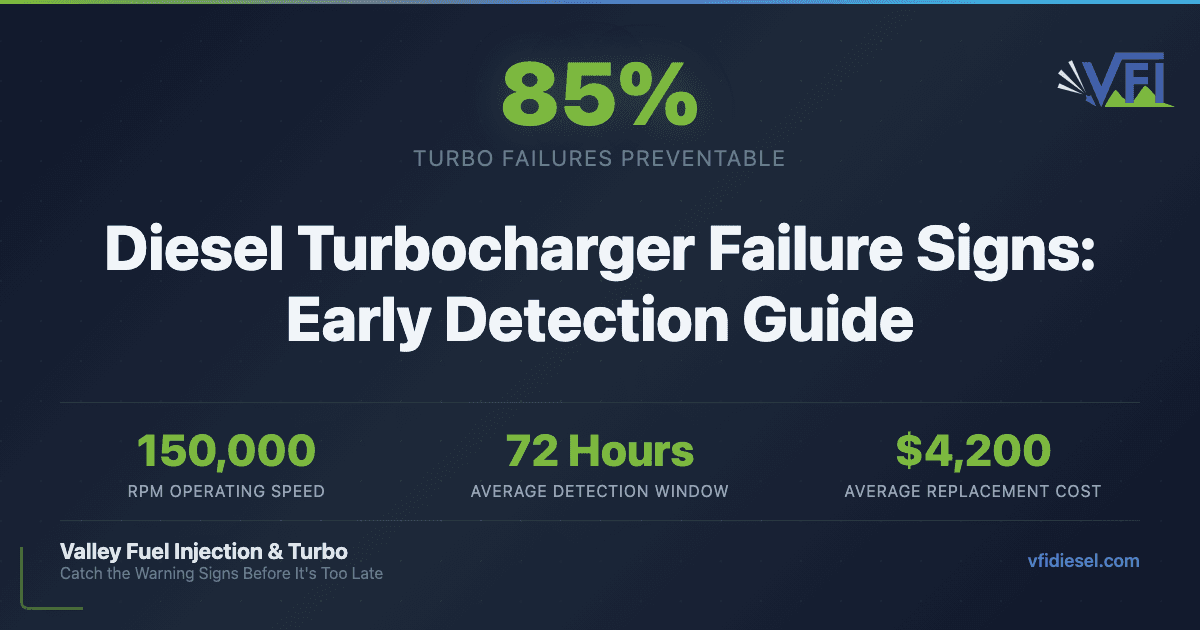
Early detection of diesel turbocharger failure signs can prevent $15,000-$40,000 in engine damage. Watch for blue/white exhaust smoke, loss of power, unusual noises, and oil consumption changes — these symptoms typically appear 2-8 weeks before complete turbo failure.
What Are the Most Common Diesel Turbocharger Failure Signs?
The most reliable diesel turbocharger failure signs include excessive exhaust smoke (particularly blue or white), noticeable power loss during acceleration, unusual whistling or grinding noises, and increased oil consumption. We see these symptoms in roughly 85% of the turbochargers that come through our turbocharger service bay in Woodland, CA.
Here’s what we look for during our diagnostic process:
- Smoke Color Changes: Blue smoke indicates oil burning (seal failure), white smoke suggests coolant issues, black smoke points to fuel system problems affecting turbo efficiency
- Power Loss Patterns: Gradual power reduction over weeks, poor acceleration response, inability to maintain highway speeds under load
- Audio Indicators: High-pitched whistling (compressor wheel damage), grinding sounds (bearing failure), or unusual “whooshing” noises
- Oil System Changes: Increased oil consumption, oil contamination, or oil leaks around turbo housing
Document symptoms with photos and notes. We’ve found that operators who track symptom progression help us diagnose root causes faster, often identifying fuel system issues that contributed to turbo failure.
How Do You Identify Blue Smoke vs. Normal Exhaust?
Blue exhaust smoke is one of the clearest diesel turbocharger failure signs, indicating oil is entering the combustion chamber through worn turbo seals. Normal diesel exhaust should be nearly invisible during warm operation, with only light gray smoke during cold starts or under heavy load.
Blue smoke characteristics we diagnose:
- Timing: Appears during acceleration, deceleration, or idle (not just startup)
- Consistency: Persistent rather than occasional
- Intensity: Becomes progressively worse over days or weeks
- Location: More noticeable when viewed from behind the vehicle
At our facility near Sacramento, we use exhaust gas analysis equipment to measure oil consumption rates. Heavy equipment operators in the Central Valley often mistake blue smoke for “normal” diesel exhaust, but any consistent blue tinting indicates turbo seal deterioration that will worsen rapidly.
Blue smoke that appears suddenly and heavily often indicates catastrophic turbo failure. Shut down immediately and have the unit towed to prevent engine damage.
What Sounds Indicate Turbocharger Bearing Problems?
Turbocharger bearing failure produces distinct audio signatures that experienced diesel technicians can identify during routine inspections. The most common sounds we hear during diagnostics are high-pitched whistling (compressor wheel contact), metallic grinding (bearing wear), and irregular “chattering” during acceleration.
Our diagnostic approach for turbo noise analysis:
- Whistling Sounds: Often indicates compressor wheel damage or housing contact — typically occurs during boost conditions
- Grinding Noises: Suggests bearing failure or shaft play — most noticeable during idle and light throttle
- Rattling/Chattering: Points to severe shaft movement or damaged turbine wheel — requires immediate attention
- Whooshing Changes: Normal turbo “whoosh” becomes irregular or absent — indicates flow restrictions or wheel damage
We recommend diesel truck owners and heavy equipment operators in Sacramento and surrounding areas schedule diagnostic appointments when any unusual turbo noises develop. Early bearing problems can often be addressed with rebuild services, while catastrophic failures typically require complete turbocharger replacement.
Turbocharger bearings operate at speeds exceeding 100,000 RPM. Even minor contamination or oil supply issues can cause bearing failure within hours of symptom onset.
How Does Power Loss Progress in Turbo Failure?
Power loss from turbocharger failure typically follows a predictable pattern that we’ve documented across thousands of diesel engines in Northern California. Initial symptoms include reduced acceleration response and difficulty maintaining speeds under load, progressing to significant power reduction and eventual inability to build boost pressure.
Power loss progression stages:
- Stage 1 (Weeks 1-2): Subtle reduction in acceleration, slightly longer time to reach highway speeds
- Stage 2 (Weeks 3-4): Noticeable power loss under load, difficulty climbing grades, reduced fuel economy
- Stage 3 (Weeks 5-6): Significant power reduction, black smoke under acceleration, turbo lag becomes pronounced
- Stage 4 (Final): Severe power loss, inability to maintain highway speeds, potential complete turbo seizure
Heavy equipment operators often adapt their operating patterns to compensate for gradual power loss, which delays diagnosis but increases the risk of catastrophic failure. We encourage operators to schedule diagnostic testing at the first sign of power reduction rather than adapting to declining performance.
Early-stage turbo rebuilds typically cost $2,500-$4,500. Waiting until catastrophic failure can result in $15,000-$40,000 in engine damage from debris or oil starvation.
What Oil Consumption Changes Signal Turbo Problems?
Increased oil consumption is often the earliest detectable sign of turbocharger seal deterioration, typically appearing 4-8 weeks before visible exhaust smoke or power loss symptoms. Normal diesel engines consume 0.1-0.3% of fuel volume in oil, while failing turbochargers can increase consumption to 1-2% or higher.
Oil consumption monitoring indicators:
- Consumption Rate: More than 1 quart per 1,000 miles in highway trucks, or noticeable dipstick changes in equipment with regular operating hours
- Oil Quality: Faster oil darkening, metallic particles on dipstick, or unusual oil consistency
- Leak Patterns: Oil residue around turbo housing, oil in intercooler piping, or oil accumulation in exhaust system
- Crankcase Pressure: Increased blowby or positive crankcase pressure from oil vapor
Our diagnostic services include oil analysis and consumption testing to identify turbocharger seal problems before they progress to visible symptoms. Fleet managers and equipment operators in the Roseville and Central Valley areas often catch turbo problems early through routine oil monitoring.
How Do Fuel System Problems Cause Turbocharger Failure?
Fuel system issues are responsible for approximately 40% of turbocharger failures we diagnose, particularly in common rail and VP44 systems where precise fuel delivery is critical for proper combustion temperatures. Poor fuel atomization, incorrect timing, or contaminated fuel can create exhaust gas temperature (EGT) conditions that exceed turbocharger design limits.
Common fuel-related turbo failure causes:
- Injector Problems: Worn or failing injectors create uneven combustion, leading to excessive EGTs and thermal stress on turbine wheels
- Fuel Quality Issues: Contaminated or poor-quality fuel affects combustion efficiency and can deposit carbon on turbine components
- Timing Problems: Incorrect injection timing creates temperature spikes that damage turbo components over time
- Fuel Pressure Issues: Low fuel pressure from failing lift pumps affects combustion quality and EGT control
This interconnection is why we recommend comprehensive fuel system inspection whenever diagnosing turbocharger problems. Our Bosch-certified testing equipment can identify fuel system issues that contribute to turbo failure, often preventing repeat failures after turbocharger replacement.
We’ve also documented how common rail injector testing reveals patterns that predict turbocharger stress, particularly in high-mileage equipment where multiple systems begin failing simultaneously.
Always address fuel system issues before installing a replacement turbocharger. We’ve seen $8,000 turbo replacements fail within 500 hours due to unresolved injector or fuel pressure problems.
When Should You Stop Operating and Seek Professional Diagnosis?
Immediate shutdown and professional diagnosis is required when diesel turbocharger failure signs indicate imminent catastrophic failure. These critical symptoms include sudden onset of heavy blue or white smoke, metallic grinding noises, complete loss of boost pressure, or oil pressure warning lights.
Emergency shutdown criteria:
- Heavy Blue Smoke: Sudden, dense blue exhaust indicates catastrophic seal failure — continued operation will damage pistons and cylinders
- Metallic Grinding: Indicates bearing seizure or wheel contact — immediate shutdown prevents debris from entering the engine
- Oil Pressure Loss: Turbo failure can cause oil starvation throughout the engine — stop immediately to prevent bearing damage
- Complete Power Loss: Sudden inability to build boost may indicate turbine wheel failure — debris risk requires immediate attention
For less severe symptoms like gradual power loss, increased oil consumption, or occasional light smoke, schedule diagnosis within 1-2 weeks. Our experience serving Woodland, California and the surrounding region shows that early intervention typically saves 60-80% compared to emergency repairs.
Call us at 530-668-0818 if you’re experiencing any concerning symptoms — we can often provide guidance over the phone about whether immediate shutdown is necessary or if the equipment can be safely operated until scheduled service.
How Much Does Early Turbocharger Repair Cost vs. Engine Damage?
Early turbocharger intervention costs significantly less than engine damage from catastrophic turbo failure. Based on our 30+ years serving Northern California and Nevada, early-stage turbo rebuilds average $2,500-$4,500, while engine damage from turbo debris or oil starvation typically ranges from $15,000-$40,000.
Cost comparison breakdown:
| Intervention Timing | Typical Cost Range | Downtime |
|---|---|---|
| Early Detection (Rebuild) | $2,500-$4,500 | 2-3 days |
| Late Stage (Replacement) | $6,000-$12,000 | 3-5 days |
| Catastrophic Failure | $15,000-$40,000 | 1-3 weeks |
Additional factors affecting cost include:
- Engine Type: Heavy equipment and commercial truck engines typically cost more to repair than pickup truck engines
- Damage Extent: Piston damage, cylinder scoring, or bearing replacement significantly increases costs
- Parts Availability: Common turbochargers have readily available rebuild kits, while specialized units may require OEM parts
- Labor Complexity: Accessibility and removal difficulty affects labor hours
Fleet managers and equipment owners in Reno and throughout our service area often implement regular turbocharger inspection schedules after experiencing one catastrophic failure — the cost savings from early detection typically pays for routine inspections within the first prevented failure.
What Maintenance Prevents Turbocharger Failure?
Preventive maintenance significantly reduces turbocharger failure rates, with proper oil change intervals, fuel system maintenance, and air filtration being the most critical factors. Our analysis of turbocharger failures shows that 70% could have been prevented through appropriate maintenance practices.
Essential turbocharger maintenance practices:
- Oil Change Intervals: Follow OEM specifications exactly — turbocharged diesel engines require more frequent oil changes than naturally aspirated engines
- Oil Quality: Use manufacturer-specified oil grades and avoid extended-drain intervals in high-boost applications
- Air Filtration: Replace air filters before restriction indicators activate — dirty filters increase turbo workload
- Fuel System Service: Regular injector cleaning and fuel system maintenance prevents EGT-related turbo damage
- Cooldown Procedures: Allow turbocharged engines to idle 2-3 minutes after high-load operation
We also recommend annual turbocharger inspections for high-hour equipment, particularly units operating in dusty conditions common throughout Central California. Our diesel engine maintenance services include turbocharger health assessments that can identify developing problems before they become expensive failures.
The relationship between fuel system health and turbocharger longevity is particularly important in modern diesel engines. Poor fuel quality or failing components like diesel lift pumps create conditions that accelerate turbocharger wear.
Turbocharger oil seals are designed for specific operating temperatures. Running too cool (short trips) or too hot (overloading) both reduce seal life significantly.
How Do Environmental Factors Affect Turbocharger Life in California?
California’s diverse operating environments significantly impact turbocharger longevity, with Central Valley dust, coastal salt air, and mountain temperature extremes each creating specific challenges. Our Woodland, CA location gives us extensive experience with these varied conditions affecting diesel equipment throughout Northern California.
Regional factors we commonly address:
- Central Valley Dust: Agricultural and construction dust increases air filter restriction and accelerates compressor wheel wear
- Temperature Extremes: Hot summer temperatures increase thermal stress, while cold starts affect oil flow and seal flexibility
- Altitude Changes: Mountain operation affects boost pressure requirements and turbo workload
- Coastal Conditions: Salt air accelerates corrosion of turbo housings and exhaust components
- Fuel Quality Variations: Different fuel suppliers and seasonal blends affect combustion characteristics
Equipment operating in multiple environments requires more frequent inspection and maintenance. We recommend diesel operators in Stockton, Chico, and other Central Valley locations implement enhanced air filtration and more frequent oil analysis to combat dust-related turbo wear.
The use of quality diesel fuel additives becomes particularly important in California’s varied fuel quality environment, helping maintain consistent combustion characteristics that reduce turbocharger thermal stress.
What Should You Expect During Professional Turbocharger Diagnosis?
Professional turbocharger diagnosis involves comprehensive testing of the turbo unit, supporting systems, and root cause analysis to prevent repeat failures. At Valley Fuel Injection & Turbo, our diagnostic process typically takes 2-4 hours and includes visual inspection, performance testing, and system analysis.
Our standard diagnostic procedure:
- Visual Inspection: External condition, oil leaks, housing damage, connection integrity
- Performance Testing: Boost pressure measurement, compressor efficiency, turbine wheel condition
- Oil System Analysis: Oil quality, consumption rate, contamination levels, supply pressure
- Fuel System Check: Injection timing, fuel pressure, injector condition, EGT analysis
- Air System Inspection: Filter condition, intake restriction, intercooler efficiency
- Root Cause Determination: Identifying why the turbo failed to prevent recurrence
We provide detailed written reports including digital photos, test results, and repair recommendations. This documentation helps fleet managers track patterns across multiple units and make informed decisions about replacement timing and maintenance schedules.
For equipment owners throughout our service area, we offer both in-shop diagnosis and mobile diagnostic services for units that cannot be easily transported. Our team has the experience to quickly identify whether turbocharger problems are primary failures or symptoms of other system issues.
Bring maintenance records and operating history to your diagnostic appointment. This information helps us identify patterns and recommend preventive measures for your specific application.
If you’re experiencing any diesel turbocharger failure signs with your heavy equipment or diesel truck, don’t wait for complete failure. Early detection and professional diagnosis can save thousands in repair costs and prevent extended downtime. Our team at Valley Fuel Injection & Turbo has over 30 years of experience diagnosing and repairing turbocharger problems for equipment owners throughout Northern California and Nevada.
Schedule your diagnostic appointment today by calling 530-668-0818, or bring your equipment to our Woodland, California facility for expert analysis. We’re here to help you keep your diesel equipment running reliably and efficiently.
Frequently Asked Questions
How long can I drive with turbocharger failure symptoms?
The safe operating time depends on symptom severity. Light oil consumption or minor power loss may allow several weeks of careful operation, while heavy smoke, grinding noises, or sudden power loss requires immediate shutdown. Consult a qualified diesel technician immediately when symptoms appear — continued operation with severe symptoms can cause $15,000-$40,000 in engine damage.
Can a failing turbocharger damage my diesel engine?
Yes, turbocharger failure can cause catastrophic engine damage through multiple mechanisms. Oil seal failure can cause oil starvation, while turbine wheel disintegration can send debris into cylinders. Bearing failure often creates metal contamination throughout the oil system. This is why early detection and professional diagnosis are critical.
What’s the difference between turbo rebuild and replacement?
Turbo rebuilds involve disassembly, inspection, and replacement of worn components like seals, bearings, and wheels while reusing the housing. Rebuilds typically cost $2,500-$4,500 and work well for early-stage failures. Replacement involves installing a new or remanufactured unit, costing $6,000-$12,000, and is necessary when housings are damaged or multiple failures have occurred.
How do I know if my turbo problem is covered under warranty?
Warranty coverage depends on the failure cause and maintenance history. Manufacturing defects are typically covered, while failures from poor maintenance, contaminated oil, or fuel system problems may not be. Keep detailed maintenance records and have diagnosis performed by qualified technicians to support warranty claims. Our diagnostic reports include root cause analysis that helps with warranty determinations.
Should I replace both turbochargers on a twin-turbo engine?
Not necessarily, but it depends on the failure cause and operating history. If the failure was caused by contamination, poor maintenance, or fuel system issues, both turbos were exposed to the same conditions. However, if the failure was due to a manufacturing defect or physical damage to one unit, the other may be fine. Professional diagnosis can determine the best approach for your specific situation.