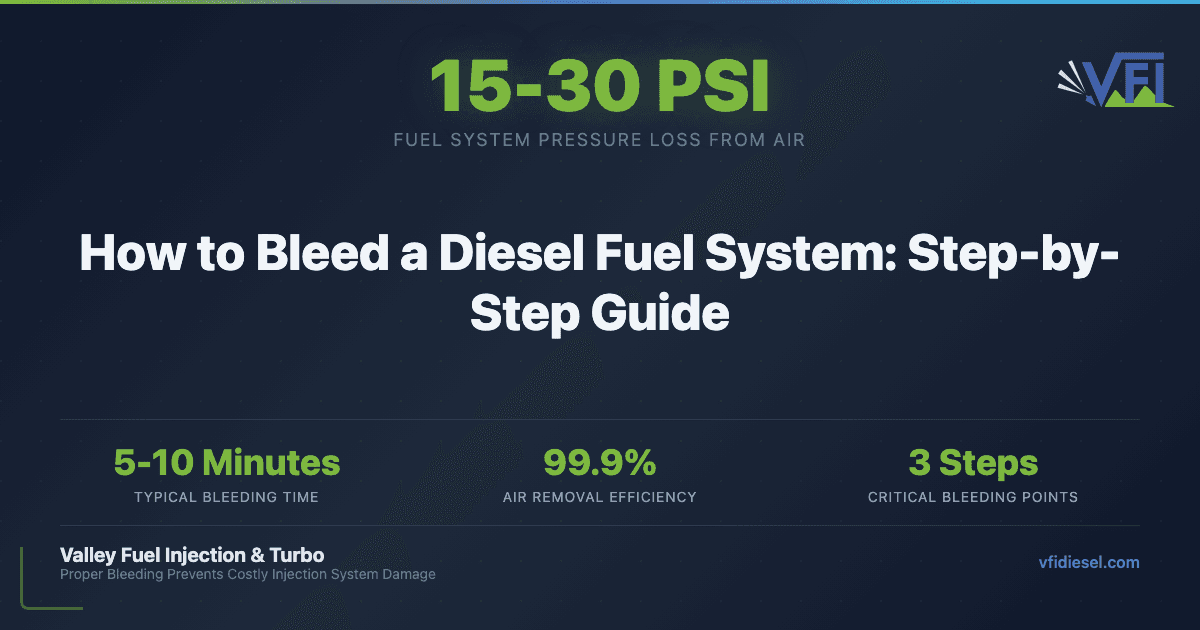

How to Bleed a Diesel Fuel System: Step-by-Step Guide
02/23/2026
Diesel Turbocharger Failure Signs: Early Detection Guide
03/01/2026
Bosch VE & VP30 Injection Pump Rebuild — When to Repair, What Fails, and Why a Certified Shop Matters
Everything diesel owners need to know about the rotary injection pumps that power millions of Cummins, Perkins, John Deere, Case, and industrial engines worldwide.
If you run diesel equipment built from the late 1980s through the mid-2000s, there’s a good chance the fuel system depends on a Bosch rotary injection pump — either the mechanically governed VE or its electronically controlled successor, the VP30. These pumps are found in everything from Dodge pickups and school buses to agricultural tractors, forklifts, skid steers, and marine generators. They’re well-engineered, reliable units that routinely run for thousands of hours — but they don’t last forever.
At Valley Fuel Injection & Turbo, VE and VP30 pump rebuilds are one of the most common jobs that come through our shop. We see them from farms in the Sacramento Valley, fleets running up and down I-5, construction sites, and equipment dealers throughout Northern California. This post covers what these pumps do, how they differ, what goes wrong, and what a proper rebuild actually involves.
What Are the Bosch VE and VP30 Pumps?
Both the VE and VP30 are rotary distributor-type injection pumps — meaning a single rotating plunger generates high-pressure fuel and distributes it sequentially to each cylinder. This is fundamentally different from inline pumps (like the Bosch P7100) where each cylinder gets its own dedicated pumping element, or modern common rail systems where a single high-pressure pump feeds a shared fuel rail.
The rotary design makes VE and VP30 pumps compact and relatively lightweight, which is why they were used so widely across small- to medium-displacement diesel engines.
The Bosch VE Pump
The VE (short for Verteilereinspritzpumpe, German for “distributor injection pump”) is a fully mechanical unit. Fuel delivery is controlled by a combination of centrifugal governor weights, a mechanical throttle linkage, and an altitude-compensating aneroid (AFC housing) on turbocharged applications. Injection timing is managed internally through fuel pressure acting on a hydraulic timing piston.
VE pumps were used extensively in:
- Cummins 4BT and 6BT engines — found in 1989–1993 Dodge Ram trucks (the legendary 12-valve), as well as commercial trucks, buses, RVs, and industrial equipment. The VE was later succeeded by the VP44 on 24-valve trucks.
- Volkswagen TDI engines — the 1.6L and 1.9L diesels that powered millions of European passenger cars and commercial vans
- Agricultural and industrial applications — various 3-, 4-, and 6-cylinder configurations from multiple engine manufacturers
The VE’s mechanical simplicity is both its greatest strength and its limitation. There are no electronics to fail, no wiring harnesses to chase, and a skilled technician can diagnose most problems with basic tools and a test bench. But mechanical governing limits the precision of fuel delivery compared to electronic control, which is why the VP series replaced it.
The Bosch VP30 Pump
The VP30 is the next step in the evolution of the rotary pump. It shares the same basic rotating-plunger architecture as the VE, but replaces the mechanical governor and timing mechanism with electronic control. A pump-mounted ECU (sometimes called the PCU) manages fuel metering and injection timing through solenoid valves, using input from an angle rotation sensor on the pump driveshaft.
VP30 pumps are commonly found on:
- Cummins ISB and QSB 5.9L engines (24-volt) — the mid-range workhorses used in medium-duty trucks, school buses, motorhomes, and industrial equipment
- Cummins ISB and QSB 3.9L and 4.5L engines — common in smaller commercial and industrial applications
- Perkins 1000 and 1100 series engines — widely used in Caterpillar, AGCO, Massey Ferguson, and JCB equipment
- John Deere PowerTech engines — found across agricultural and construction equipment lines
- Case, New Holland, and Sisu-powered equipment
The electronic control gives the VP30 finer control over fuel delivery and timing, which translates to better emissions compliance, smoother operation, and improved fuel economy compared to the purely mechanical VE. However, it also means there are electronic components — solenoids, sensors, and the ECU — that can fail in addition to the mechanical wear items.
Common Failure Modes: What Actually Goes Wrong
After rebuilding hundreds of VE and VP30 pumps, we see the same failure patterns over and over. Understanding what wears out helps you recognize symptoms early, before a minor issue becomes an engine-down emergency.
Failures Common to Both VE and VP30
Internal transfer pump wear. Both pump types use a vane-style internal transfer pump to pull fuel from the supply and pressurize the low-pressure side of the system. As the vanes and housing wear, internal fuel pressure drops. The result is poor starting (especially when hot), reduced power, and erratic fuel delivery. Low transfer pump pressure also starves the hydraulic timing advance, which can cause timing-related symptoms like excessive smoke, knock, or poor fuel economy. Note: transfer pump wear inside the injection pump is separate from the external lift pump (fuel transfer pump) that feeds it — but both must function properly for the system to work.
Cam ring and roller wear. The cam ring and rollers are the heart of the high-pressure generation system. Over time, the cam lobes develop wear patterns and the rollers can pit or develop flat spots. This reduces injection pressure and can cause uneven fuel delivery between cylinders, producing rough running and a noticeable miss.
Plunger and barrel wear. The central distributor plunger operates at extremely tight tolerances — we’re talking microns. Fuel contamination, water intrusion, or simple high-mileage wear allows fuel to bypass the plunger, reducing injection pressure and volume. Symptoms include hard starting, loss of power under load, and white or blue-white exhaust smoke.
Delivery valve deterioration. Each outlet on the pump has a delivery valve that maintains residual line pressure and provides a clean end to each injection event. Worn delivery valves cause dribbling at the injector nozzles, which leads to carbon buildup on injector tips, rough idle, and increased exhaust emissions.
Seal and O-ring failures. The external shaft seal, head gasket O-ring, and various internal seals all deteriorate over time. External leaks are obvious — you’ll see fuel weeping from the pump. But internal seal failures can allow air into the fuel circuit, causing intermittent stalling, hard starting, and the classic symptom of an engine that runs fine for hours and then suddenly won’t restart.
VE-Specific Failures
AFC housing diaphragm leak. On turbocharged VE applications (like the Cummins 6BT), fuel leaking from the AFC vent tube is a dead giveaway that the internal diaphragm or fuel pin O-ring has failed. This is one of the most common VE service calls we get. The repair requires careful disassembly — if the fuel screw isn’t backed out before removing the AFC top, the fulcrum lever inside the pump will bend or break, turning a seal job into a full rebuild.
Governor spring fatigue. The centrifugal governor springs control fuel delivery at various RPM ranges. Over time, springs can weaken or break, causing the engine to hunt at idle, surge under load, or lose its governed top speed.
Cold start advance (KSB) failure. VE pumps use a cold start device — either a wax pellet type or a solenoid-operated unit — that advances injection timing for cold starts. A stuck or failed KSB causes hard cold starting with excessive white smoke, or in extreme cases, internal overpressure that can crack the pump housing.
VP30-Specific Failures
Timing solenoid failure. The timing solenoid controls injection advance and is one of the most common VP30 failure points. When it fails, the pump can’t properly adjust timing. Symptoms include rough running, loss of power, increased smoke, and poor fuel economy. The engine will still run, but performance degrades significantly.
Metering solenoid failure. The metering solenoid controls fuel quantity. When this fails, the engine typically stops suddenly and won’t restart — similar to the sudden-death failures seen on the closely related VP44 pump. This is the “truck just died on the highway” scenario that brings a lot of VP30 pumps to our bench.
Pump ECU (PCU) failure. The onboard computer can fail due to heat cycling, vibration, or internal component degradation. Symptoms are similar to metering solenoid failure — sudden shutdown and no-start. Diagnosis requires isolating whether the solenoid or the ECU driving it has failed, which is where proper test equipment becomes critical.
Angle rotation sensor failure. The sensor on the pump driveshaft tells the ECU the exact rotational position of the pump. A failing sensor causes erratic running, timing faults, and can trigger engine fault codes on vehicles with electronic engine management.
The Rebuild Process: What a Proper VP30 or VE Rebuild Involves
A quality injection pump rebuild isn’t just replacing seals and putting it back together. The pump has to be completely disassembled, inspected, reconditioned, reassembled with new wear components, and then calibrated on a precision test bench to meet original equipment specifications.
Here’s what happens when a VE or VP30 comes through our shop:
Complete disassembly and cleaning. Every component is removed, cataloged, and ultrasonically cleaned. This includes the housing, drive shaft, distributor head and plunger, cam ring and rollers, delivery valves, governor assembly (VE) or solenoids and ECU (VP30), transfer pump, and all seals and gaskets.
Inspection and measurement. Critical components are measured against factory tolerances using micrometers, dial indicators, and bore gauges. We’re looking at plunger-to-barrel clearance, cam ring lobe profiles, roller condition, delivery valve seating, governor weight wear (VE), and solenoid response characteristics (VP30). Components outside tolerance are replaced.
Genuine Bosch parts. We use only OEM Bosch repair kits and replacement components. Aftermarket seal kits and no-name replacement parts might save a few dollars, but they can cause premature failure and often don’t meet the tolerances these pumps demand. When we put our name on a rebuild, it has Bosch parts inside it.
Reassembly. The pump is reassembled by experienced, factory-trained technicians following Bosch service procedures. Torque specifications, assembly sequences, and component orientation all matter — a pump assembled incorrectly won’t calibrate properly and can fail prematurely.
Test bench calibration. This is where the rebuild is proven. The completed pump is mounted on a Bosch-specification test bench and run through a full calibration sequence. We verify fuel delivery quantity at multiple RPM points, check delivery balance between all outlets, confirm timing advance operation (both mechanical and electronic), test transfer pump pressure, and verify that all parameters fall within the factory-specified windows. A pump that doesn’t pass every test point doesn’t leave our shop.
VE vs. VP30: Quick Comparison
| Feature | Bosch VE | Bosch VP30 |
|---|---|---|
| Control Type | Fully mechanical (governor, throttle linkage) | Electronic (solenoid valves, onboard ECU) |
| Timing Control | Hydraulic advance piston | Electronic timing solenoid |
| Common Applications | Cummins 4BT/6BT, VW TDI, older ag/industrial | Cummins ISB/QSB, Perkins, John Deere, Case |
| Typical Failure Modes | Seals, AFC diaphragm, governor, KSB | Solenoids, ECU, angle sensor, plus mechanical wear |
| Diagnosis Complexity | Lower — mechanical testing and visual inspection | Higher — requires electronic diagnostics plus mechanical |
| Rebuild Complexity | Moderate — skilled mechanical work | Higher — electronic components add steps |
Signs Your VE or VP30 Pump Needs Attention
Not every symptom means you need a full rebuild — but every one of these is worth investigating before it gets worse:
- Hard starting or extended cranking — especially if it gets worse as the pump warms up (hot-start problems are a classic transfer pump wear symptom)
- Loss of power under load — the engine runs fine at light throttle but falls flat when you need full power
- Excessive smoke — black smoke indicates over-fueling or poor atomization; white smoke on startup suggests timing issues
- Rough idle or engine hunting — RPM fluctuates without throttle input
- Fuel leaking from the pump — any external fuel leak from the pump body, shaft seal, or fittings
- Sudden engine shutdown — particularly on VP30 pumps, where solenoid or ECU failure cuts fuel delivery instantly. See our cranks but won’t start guide for related diagnosis.
- Engine won’t restart after sitting — indicates a drainback issue, often caused by worn check valves or internal seals
- Increased fuel consumption — worn delivery valves and poor calibration waste fuel
If you’re also seeing injector-related symptoms, the problem may be in both the pump and injectors — we can test both.
Why You Shouldn’t DIY a VE or VP30 Rebuild
We understand the appeal — there are forum posts, YouTube videos, and seal kits available online. And for some basic maintenance tasks (like replacing the VE shaft seal or AFC O-ring), a capable diesel mechanic with the right service manual can absolutely handle the job.
But a full pump rebuild is a different animal. These are precision hydraulic instruments with tolerances measured in microns. Without a calibrated test bench, you have no way to verify fuel delivery quantity, inter-cylinder balance, timing advance curves, or governor regulation. You’re essentially guessing — and an out-of-spec pump can cause injector damage, piston damage from over-fueling, poor emissions, or a no-start condition that’s difficult to diagnose.
The other issue is parts quality. The aftermarket is flooded with low-quality VE and VP30 seal kits and components — many sourced from overseas manufacturers with no quality control. We’ve had pumps come through our shop with failed “new” seals that were clearly not to Bosch specifications. Using genuine Bosch parts isn’t just about brand loyalty — it’s about dimensional accuracy and material quality that the pump was designed to use. Poor fuel quality accelerates pump wear too — see our diesel fuel additive guide for protecting your injection system.
Rebuild vs. Replace: Making the Right Call
In most cases, rebuilding your existing pump is the better value — especially if the housing is in good condition and there’s no catastrophic internal damage. A rebuild gives you a pump that’s been recalibrated to factory spec with new wear components, typically at significantly less cost than a new or remanufactured unit.
Replacement makes more sense when the pump housing is cracked, the drive shaft is broken, or internal damage is so extensive that the cost of parts approaches the price of a reman unit. We’ll always give you an honest assessment after we’ve inspected your pump — if it’s not worth rebuilding, we’ll tell you.
For time-critical situations, we also stock select remanufactured VE and VP30 pumps that can ship immediately while we rebuild your core on an exchange basis.
Frequently Asked Questions
How long does a VE or VP30 rebuild take?
Typical turnaround is 3–5 business days from the time we receive your pump, depending on parts availability and shop workload. For critical-down situations, ask about rush service when you call.
Do you need the whole pump, or just specific components?
We need the complete pump assembly for a full rebuild and calibration. If you’re just dealing with a specific issue (like a VP30 solenoid or VE shaft seal), call us first — we may be able to help with individual components.
Can you ship my pump to you for rebuild?
Absolutely. We work with diesel owners and shops across the country. Drain any residual fuel, pack the pump securely (the housing is cast aluminum and can crack if dropped), cap all fittings to keep contamination out, and ship to our Woodland, CA location. We’ll call you with a diagnosis and quote before proceeding with any work. For pump reinstallation tips, see our diesel fuel system bleeding guide.
What’s the warranty on a rebuilt pump?
Call us for current warranty details — coverage depends on the specific pump and application. We stand behind our work because we use genuine parts and test every pump before it ships.
My VP30 pump has an electronic fault code. Does it need a rebuild?
Not necessarily. VP30 fault codes can be caused by wiring issues, connector corrosion, failed sensors, or solenoid problems that can sometimes be repaired without a full rebuild. We recommend a thorough diagnosis before committing to a rebuild — and we can help with that too.
Need Your VE or VP30 Pump Rebuilt?
Valley Fuel Injection & Turbo is a Bosch-authorized diesel fuel injection shop with decades of experience rebuilding rotary injection pumps. We use genuine Bosch parts, calibrate on professional test equipment, and service customers both locally in Northern California and nationwide via mail-in repair.
📞 Call us: (530) 668-0818
📧 Email: info@vfidiesel.com
📍 Visit: 1243 E Beamer St, Suite C, Woodland, CA 95776
🛒 Shop Parts: Diesel Injectors · Injection Pumps · Bosch Service
Valley Fuel Injection & Turbo, Inc. is an authorized dealer for Bosch, Kubota, Delphi, Yanmar, and Alliant Power. Located in Woodland, CA, we serve diesel owners and fleets throughout Northern California and nationwide via our mail-in repair and parts shipping services.