Fleet Diesel Injection Parts Sourcing Guide for Shop Owners
03/12/2026
Diesel Engine Failures That Cause Accidents: Fleet Safety Guide
03/21/2026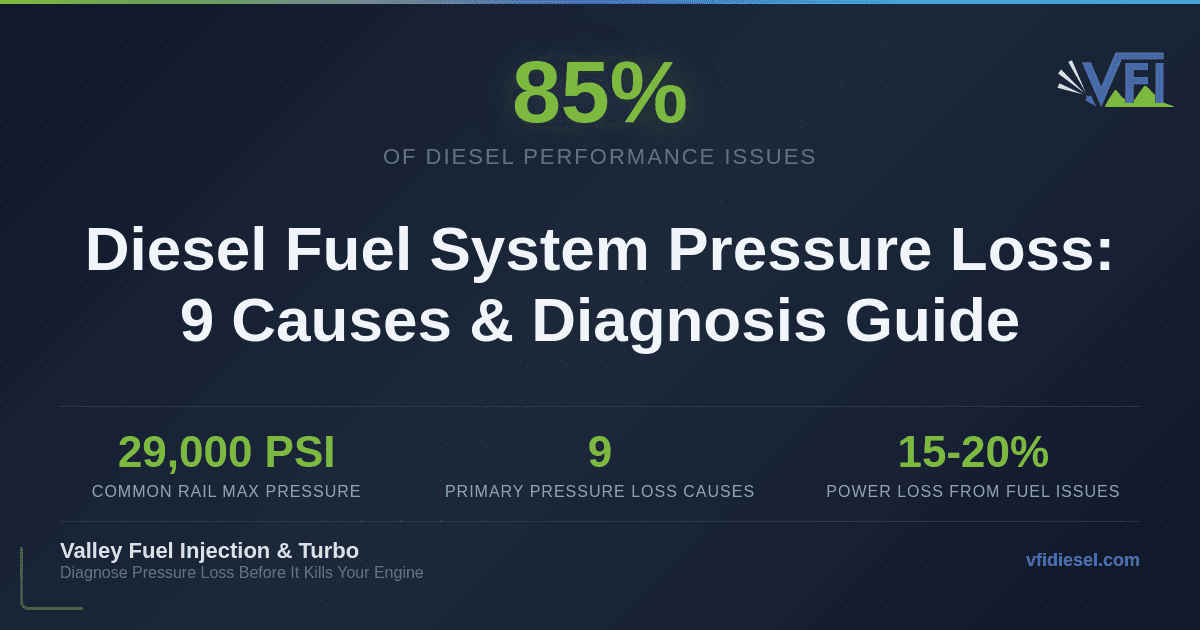
Diesel fuel system pressure loss is the inability of your fuel system to maintain adequate pressure throughout the fuel delivery chain, from tank to injectors. This critical issue can cause hard starting, power loss, rough idle, and complete engine failure if left unaddressed.
What Is Diesel Fuel System Pressure Loss and Why Does It Matter?
Diesel fuel system pressure loss occurs when your fuel system cannot maintain the precise pressure required for proper fuel delivery and injection. Modern diesel engines require specific fuel pressures at different stages: lift pumps typically operate at 5-15 PSI, while common rail systems can require up to 30,000 PSI at the injectors.
Unlike gasoline engines that can tolerate some pressure variations, diesel engines are extremely sensitive to fuel pressure changes. The high compression ratios and precise injection timing in diesel engines mean that even small pressure drops can cause significant performance issues.
The fuel system pressure requirements vary by engine type. Older mechanical injection systems typically need 10-15 PSI from the lift pump, while modern electronic diesel injection systems require much higher pressures for optimal performance.
How Do You Know If Your Diesel Has Fuel Pressure Problems?
Diesel fuel system pressure loss manifests through several distinct symptoms that progressively worsen as the problem develops. The most common early warning signs include hard starting, especially when the engine is cold, and a noticeable loss of power during acceleration or under load.
Here are the primary symptoms of diesel fuel system pressure loss:
- Hard starting or extended cranking: The engine takes longer to fire up, particularly on cold mornings
- Power loss under load: Reduced performance when towing, climbing hills, or accelerating
- Rough idle or engine stumbling: Inconsistent engine operation at idle or low RPM
- Black or white smoke from exhaust: Incomplete combustion due to inadequate fuel delivery
- Engine stalling: Complete loss of power, especially during idle or deceleration
- Fuel knock or unusual engine noise: Abnormal combustion sounds due to improper fuel delivery timing
Advanced symptoms may include complete engine shutdown, inability to restart, or damage to injection components. At our Woodland shop, we’ve seen cases where continued operation with low fuel pressure resulted in injection pump failure and injector damage.
What Are the 9 Most Common Causes of Diesel Fuel Pressure Loss?
Based on over 30 years of diesel fuel injection experience, we’ve identified nine primary causes of diesel fuel system pressure loss. Each cause affects different components and requires specific diagnostic approaches.
1. Failed or Weak Lift Pump
The lift pump (also called feed pump or transfer pump) is responsible for moving fuel from the tank to the injection pump. When it fails or weakens, the entire fuel system suffers from inadequate pressure.
Lift pump failure symptoms include:
- Hard starting, especially after sitting overnight
- Power loss at higher RPMs
- Engine stalling during acceleration
- Fuel starvation under load
2. Clogged or Restricted Fuel Filter
Fuel filters protect injection components from contamination, but they can become clogged with debris, water, or fuel gel. A restricted filter creates a bottleneck that reduces fuel flow and pressure throughout the system.
Signs of fuel filter restriction:
- Gradual power loss over time
- Improved performance immediately after filter replacement
- Hard starting that worsens progressively
- Engine performance that varies with fuel tank level
3. Air in the Fuel System
Air infiltration is one of the most common causes of diesel fuel system pressure loss. Even small amounts of air can disrupt fuel delivery and cause significant performance issues.
Common air entry points include:
- Loose fuel line connections
- Cracked fuel lines or fittings
- Faulty fuel tank cap or vent
- Damaged fuel pump seals
- Worn injection pump seals
If you suspect air in your fuel system, our guide on how to bleed a diesel fuel system provides step-by-step instructions for removing air bubbles.
4. Injection Pump Problems
The injection pump is the heart of the diesel fuel system, creating the high pressure needed for proper fuel injection. Injection pump issues can cause complete pressure loss or inconsistent pressure delivery.
Common injection pump problems include:
- Worn internal seals and gaskets
- Damaged pump elements or plungers
- Contaminated fuel causing internal wear
- Electrical issues in electronic pumps
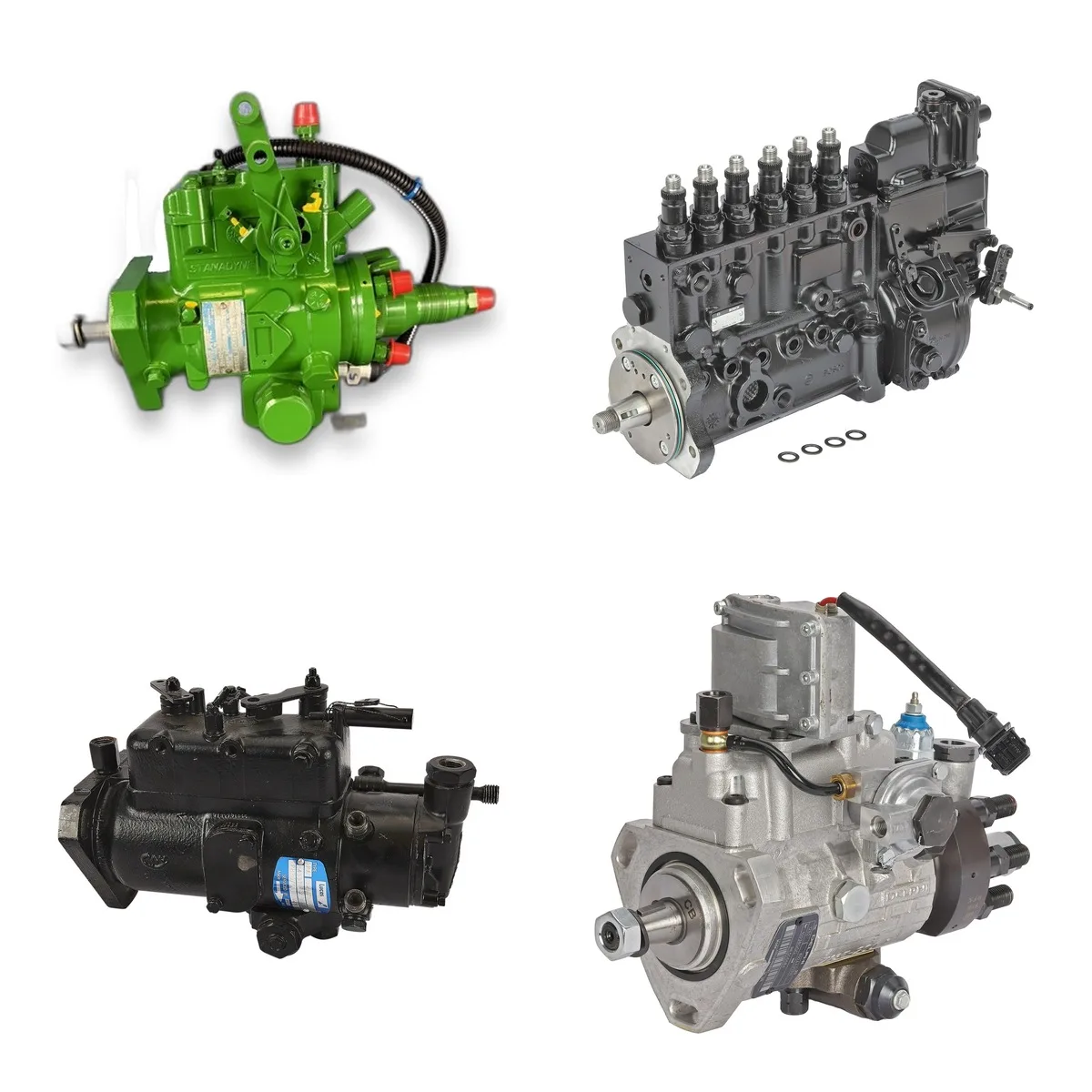
Our Bosch injection pump specialists can diagnose and repair most injection pump issues, often saving thousands compared to replacement costs.
5. Worn or Faulty Fuel Injectors
Fuel injectors that are worn, clogged, or damaged can cause pressure loss by allowing fuel to leak internally or failing to maintain proper spray patterns. This is particularly common in high-mileage diesel engines.
Injector-related pressure loss symptoms:
- Uneven engine operation
- Excessive black smoke
- Poor fuel economy
- Rough idle or misfiring
6. Damaged or Leaking Fuel Lines
Fuel lines carry pressurized fuel throughout the system. Cracks, corrosion, or loose connections can cause external leaks or allow air to enter the system, both of which reduce fuel pressure.
Inspect fuel lines regularly for:
- External fuel leaks
- Cracked or brittle rubber lines
- Corroded metal lines
- Loose or damaged fittings
7. Faulty Fuel Pressure Regulator
The fuel pressure regulator maintains consistent fuel pressure by returning excess fuel to the tank. When it fails, the system may experience pressure spikes, drops, or complete pressure loss.
Pressure regulator failure often causes:
- Inconsistent engine performance
- Fuel pressure that varies with RPM
- Hard starting or stalling
- Excessive fuel return to tank
8. Contaminated or Poor-Quality Fuel
Contaminated fuel can clog filters, damage injection components, and cause fuel system pressure loss. Common contaminants include water, dirt, algae, and fuel additives that have gelled or separated.
9. Electrical Issues
Modern diesel fuel systems rely heavily on electrical components including fuel pumps, pressure sensors, and electronic control modules. Electrical problems can cause complete fuel system shutdown or erratic pressure control.
Common electrical issues include:
- Failed fuel pump relays or fuses
- Damaged wiring harnesses
- Faulty pressure sensors
- ECM communication errors
Why Does Diesel Fuel Pressure Drop Only at Idle?
At idle, every engine-driven pump turns its slowest and the engine asks for the least fuel. A weak electric lift pump or a loaded filter usually shows up under load first, because that is when flow demand peaks. So when the complaint is low pressure at idle, watch what the gauge does as rpm comes up. The pattern points to the stage:
- Low at idle, worse under load: the supply side cannot keep up. Lift pump, filter, a restricted line or air. Idle is just where you noticed it first. Work through the stage table below.
- Low at idle, normal by 1,500 rpm: suspect a worn engine-driven pump. A mechanical lift pump, the gear pump on a CP3 and the vane transfer pump inside a VP44 or Stanadyne DB2 all turn with the engine. Leakage past worn clearances stays about the same at any speed, so at idle it eats a bigger share of what the pump moves. The internal pumps usually have to be proven on a test bench.
- Gauge flutters, engine hunts or dies at a stop: look for air getting in on the suction side. A short piece of clear line at the pump inlet will show the bubbles.
- Supply pressure good, rail pressure low at idle: on common rail, fuel is leaving the rail faster than a slow-turning pump can replace it. P0087 (fuel rail/system pressure too low) is the generic code. Check for leaking injectors with a return flow test before you blame the pump, then look at the metering valve, the pressure relief valve (where fitted) and the high-pressure pump.
An electric lift pump runs at its own speed, not engine speed, so the low at idle, fine at speed pattern does not point at it. If an electric pump reads low at every rpm, check voltage and ground at the pump connector with the engine running before you buy a pump.
If the truck runs a Bosch CP4, do not keep driving on a low rail pressure code. When a CP4 comes apart it sends metal through the rails, lines and injectors, and the repair grows from a pump to a whole fuel system. See our CP4 pump failure guide before you decide on a repair.
How Do You Test Diesel Fuel System Pressure Step-by-Step?
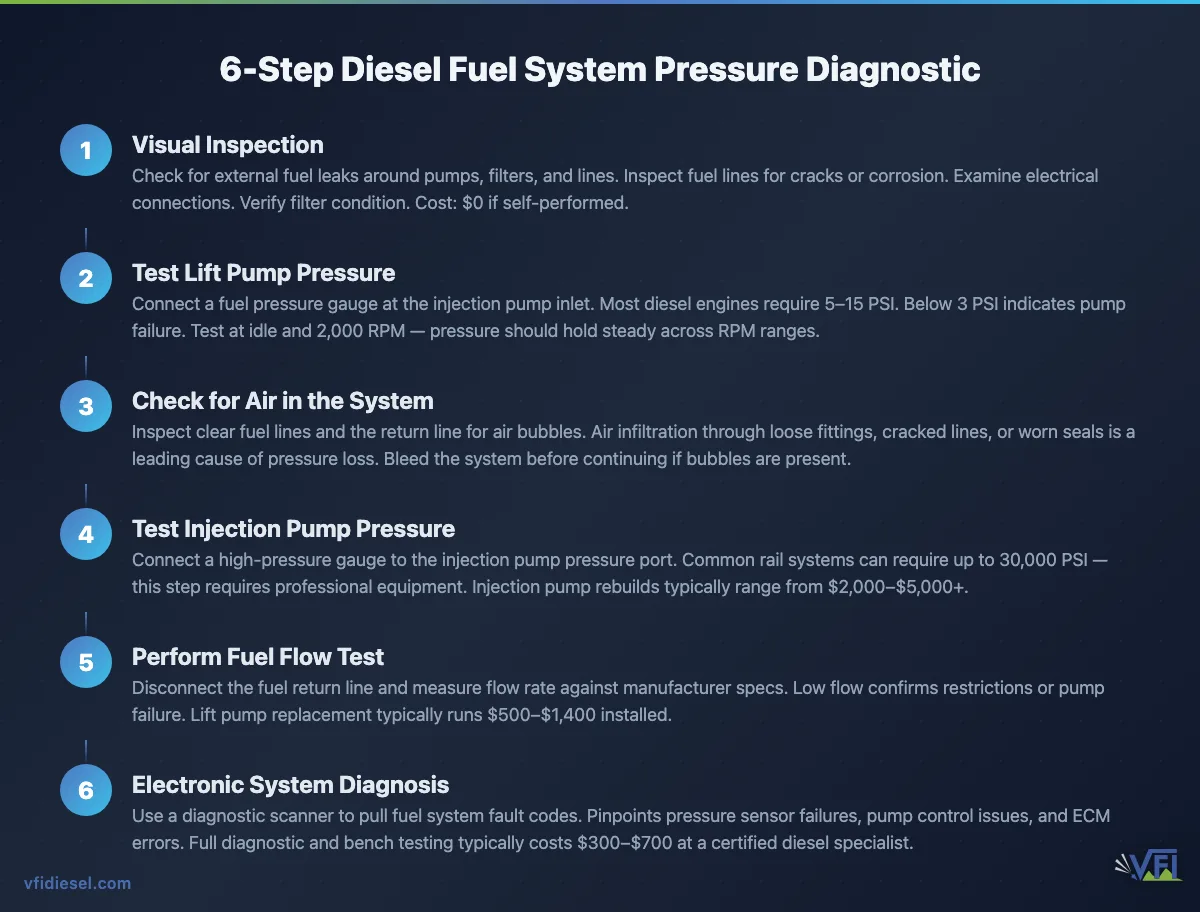
Proper diagnosis of diesel fuel system pressure loss requires systematic testing at multiple points in the fuel system. This methodical approach helps identify the exact location and cause of pressure loss.
Here’s our professional diagnostic procedure:
Step 1: Visual Inspection
Start with a thorough visual inspection of the entire fuel system:
- Check for external fuel leaks around pumps, filters, and lines
- Inspect fuel lines for cracks, corrosion, or damage
- Examine electrical connections for corrosion or damage
- Verify fuel filter condition and replacement date
Step 2: Test Lift Pump Pressure
Connect a fuel pressure gauge to the fuel line between the lift pump and injection pump. Most diesel engines require 5-15 PSI from the lift pump.
Step 3: Check for Air in the System
Look for air bubbles in the fuel return line or clear fuel lines. Air bubbles indicate air infiltration somewhere in the system. You may need to bleed the fuel system to remove air before continuing diagnosis.
Step 4: Test Injection Pump Pressure
For engines with accessible injection pump pressure ports, connect a high-pressure gauge to measure injection pressure. This requires specialized equipment and should typically be performed by professionals.
Step 5: Perform Fuel Flow Test
Disconnect the fuel return line and measure fuel flow rate. Compare the measured flow to manufacturer specifications. Low flow rates indicate restrictions or pump problems.
Step 6: Electronic System Diagnosis
Use a diagnostic scanner to check for fuel system-related error codes. Modern diesel engines store fault codes that can pinpoint specific pressure sensor or pump control issues.
Stage-by-Stage Test Map: Tank to Injectors
Move the gauge forward one stage at a time and write down each reading at idle and under load. Specs vary by engine, so compare against the service manual numbers for yours. Our injection pump pressure test guide covers gauge hookup and reading the results. On suction-fed systems with no lift pump, such as the 2001 to 2016 Duramax, you read vacuum ahead of the injection pump, not pressure.
| Stage | Where and What to Measure | A Bad Reading Points To |
|---|---|---|
| 1. Tank and pickup | Vacuum gauge on the suction line ahead of the first pump, if that pump sits outside the tank. Add a short clear section of line to watch for bubbles. | High vacuum: plugged pickup screen, collapsed hose, gelled fuel or a blocked tank vent. Bubbles: an air leak on the suction side. |
| 2. Lift pump | Pressure at the pump outlet at idle and under load, plus a timed volume check into a marked container. | Low pressure and low volume: worn pump, bad voltage or ground, or a restriction ahead of it. Pressure OK but short on volume: the pump can starve the engine under load. More in our lift pump guide. |
| 3. Fuel filter(s) | Pressure on both sides of each filter (vacuum on suction-fed systems). The difference is the filter restriction. | Big difference: plugged or waxed filter. Readings close together but both low: the problem is upstream. |
| 4. Injection pump inlet | Pressure at the inlet fitting at idle, at 1,500 to 2,000 rpm and on a loaded road test. | Good at the lift pump but low here: a restriction in between (filter, line or fitting). This is the number the pump actually sees. |
| 5. High-pressure pump and rail (common rail) | Scan tool: desired vs. actual rail pressure at idle and on a quick throttle snap, plus the metering valve command. | Actual below desired with good inlet pressure: worn high-pressure pump, sticking metering valve, a seeping relief valve or leaking injectors. Inline and distributor pumps (P7100, VE, DB2/DB4, VP44) have no rail sensor, so pump output is proven on a test bench. |
| 6. Injectors and return | Return flow from each injector, compared side by side and to spec. How to run it: our return flow test guide. | One injector well above the rest is leaking. On common rail, that leak bleeds rail pressure, and the pump has the least speed to cover it when cranking and at idle. |
For complex diagnostics or if you’re not comfortable performing these tests, schedule a diagnostic with our certified technicians. We have the specialized equipment and experience to quickly identify fuel system pressure issues.
Talk to a Diesel Tech Chasing a fuel pressure drop you can’t pin down? Tell us what your gauge and scan tool show at idle and under load, and we will help you narrow it down. If it is the pump or injectors, we test and rebuild them in house. Two ways in: drive it into our Woodland shop near Sacramento, or ship it to us from anywhere in the country. ☎︎ Call 530-668-0818Out of the area? Start a mail-in rebuild → |
Which Fuel Pressure Problems Can You Fix vs. Need Professional Help?
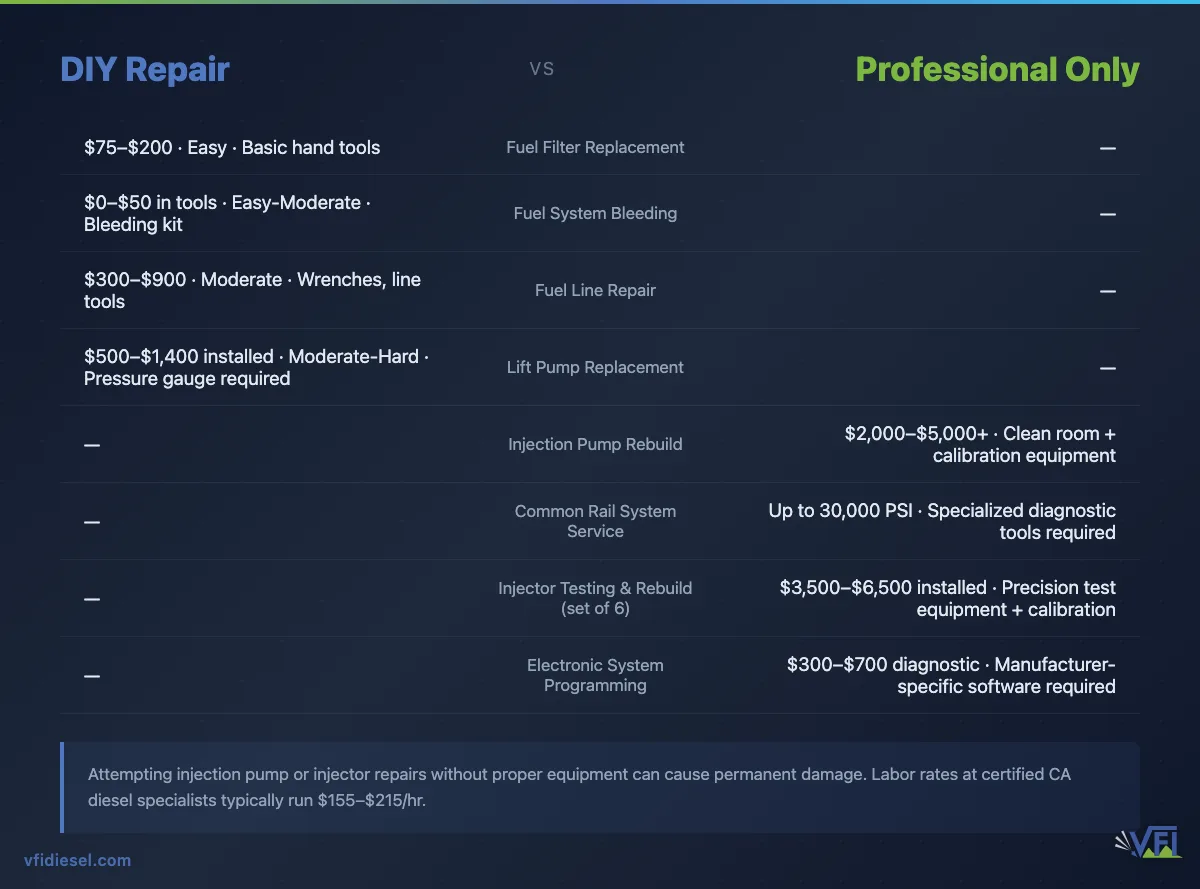
Some diesel fuel system pressure issues can be addressed by experienced DIY mechanics, while others require professional diagnosis and repair. Understanding the difference can save you time and prevent costly mistakes.
DIY-Friendly Repairs
These fuel pressure issues can typically be handled by mechanically inclined diesel owners:
| Problem | DIY Difficulty | Required Tools |
|---|---|---|
| Fuel filter replacement | Easy | Basic hand tools |
| Fuel system bleeding | Easy-Moderate | Hand tools, bleeding kit |
| Fuel line replacement | Moderate | Wrenches, line bending tools |
| Lift pump replacement | Moderate-Hard | Socket set, fuel pressure gauge |
Professional-Only Repairs
These issues require specialized equipment, training, and certification:
- Injection pump rebuild or repair: Requires clean room environment and precision calibration equipment
- Common rail system service: Involves extremely high pressures and specialized diagnostic tools
- Injector testing and rebuilding: Needs precision test equipment and calibration standards
- Electronic system programming: Requires manufacturer-specific diagnostic software
At Valley Fuel Injection, we’re Bosch-certified for injection pump and injector service, with the specialized equipment needed for proper diagnosis and repair. Our technicians have over 30 years of experience with diesel fuel systems.
For Kubota equipment owners, we also provide specialized service – check our Kubota fuel system bleeding guide for model-specific procedures.

How Much Does Diesel Fuel System Pressure Repair Cost?
Diesel fuel system pressure repair costs vary significantly depending on the root cause, engine type, and extent of damage. Understanding typical cost ranges helps you budget for repairs and make informed decisions about repair versus replacement.
Common Repair Cost Ranges
| Repair Type | Cost Range | Labor Time |
|---|---|---|
| Fuel filter replacement | $75–$200 | 0.5-1 hour |
| Lift pump replacement | $500–$1,400 | 2-4 hours |
| Fuel line repair | $300–$900 | 1-3 hours |
| Injection pump rebuild | $2,000–$5,000+ | 8-16 hours |
| Injector service (set of 6) | $3,500–$6,500 | 4-8 hours |
| Complete system diagnosis | $300–$700 | 1-2 hours |
Factors Affecting Repair Costs
Several factors influence the final cost of diesel fuel system pressure repairs:
- Engine type and age: Newer common rail systems are more complex and expensive to repair
- Extent of damage: Catching problems early prevents cascading failures
- Parts availability: Some older injection pumps require specialized or rebuilt components
- Labor rates: Certified diesel specialists typically charge $155–$215 per hour
- Geographic location: Repair costs vary by region and shop overhead
For detailed cost analysis of injection pump repairs, see our comprehensive guide on diesel fuel injection pump rebuild costs.
When to Repair vs. Replace
The decision between repairing and replacing fuel system components depends on several factors:
Repair makes sense when:
- The engine has low to moderate mileage
- Only one component has failed
- The cost is less than 50% of replacement
- Parts and service are readily available
Replacement may be better when:
- Multiple components have failed
- The engine has very high mileage
- Repair costs exceed 70% of replacement cost
- Reliability is critical for your operation
Our experienced technicians can help you make this decision based on your specific situation and budget. We provide honest assessments and work with you to find cost-effective solutions.
If you’re experiencing diesel fuel system pressure loss, don’t wait for the problem to worsen. Early diagnosis and repair can prevent expensive component damage and keep your diesel running reliably. Call us at 530-668-0818 to schedule a comprehensive fuel system diagnostic, or visit our Woodland, CA shop for immediate service.
Frequently Asked Questions
How do I know if my diesel fuel pump is losing pressure?
Can I drive my diesel truck with low fuel pressure?
What causes sudden diesel fuel pressure loss?
How much does it cost to fix diesel fuel pressure problems?
Can air in diesel fuel lines cause pressure loss?
Don’t let diesel fuel system pressure loss leave you stranded or cause expensive engine damage. Our certified technicians at Valley Fuel Injection have the expertise and equipment to quickly diagnose and repair fuel pressure issues. We serve diesel owners throughout Sacramento, Northern California, and Nevada with professional fuel system services.
Contact us at 530-668-0818 or visit our Woodland, CA facility for comprehensive diesel fuel system diagnosis and repair. We also ship remanufactured injection components nationwide and accept mail-in pumps and injectors for testing and rebuilding.