Why Your Diesel Engine Cranks But Won’t Start: 7 Common Causes (And How to Fix Them Fast)
11/12/2025
5.9 Cummins VP44 Injection Pump Failure: Complete Diagnosis & Repair Guide
02/16/2026
Published by Valley Fuel Injection & Turbo, Inc. | Woodland, CA
Modern diesel engines deliver impressive power, efficiency, and emissions compliance. But one component has become infamous for sudden and catastrophically expensive failures: the Bosch CP4 high-pressure fuel injection pump.
Talk to a Diesel Tech CP4 let go and sent metal through your fuel system? A CP4 rarely fails alone: once it grenades, the debris moves downstream into the lines, rails, and injectors. We rebuild CP4 pumps and test the injectors that ran on that fuel, so the replacement pump does not eat itself the same way. Two ways in: drive it into our Woodland shop near Sacramento, or ship it to us from anywhere in the country. ☎︎ Call 530-668-0818Out of the area? Start a mail-in rebuild → |
Originally engineered around European diesel fuel standards, the CP4 has proven far less forgiving under North American operating conditions. When it fails, it doesn’t just stop pumping fuel, it sheds metal shavings that contaminate the entire fuel system, turning a single component failure into a $10,000–$18,000+ repair bill.
At Valley Fuel Injection & Turbo, we see the aftermath of CP4 failures regularly, contaminated injectors, destroyed fuel rails, and tanks full of metal debris. This guide explains why CP4 pumps fail, how to recognize warning signs early, what a complete failure costs, and the preventative steps that can save you thousands.
What Is a CP4 Injection Pump?
The CP4 is a high-pressure common rail fuel injection pump manufactured by Bosch. It pressurizes diesel fuel to 29,000+ PSI and delivers it to the common fuel rail, where electronically controlled injectors fire it into each cylinder with precision timing.
Compared to its predecessor, the Bosch CP3, the CP4 operates with tighter internal tolerances and a thinner lubrication margin. While this improves efficiency and emissions performance, it also makes the pump extremely sensitive to fuel quality, water contamination, and air intrusion.
Which Trucks Have a CP4 Pump?
These are the common North American CP4 applications. Years are model years. Recall numbers are NHTSA campaign numbers; check yours by VIN at nhtsa.gov/recalls.
| Engine | Trucks and model years | High-pressure pump |
|---|---|---|
| Ford 6.7L Power Stroke | F-250 to F-550 Super Duty, 2011–2026, plus the 6.7L in the F-600 and F-650/F-750 | Bosch CP4. Recall 24V-957 (some 2020–2022 model years) is a software update, not a new pump. |
| GM 6.6L Duramax LML | Chevrolet Silverado and GMC Sierra 2500HD/3500HD, 2011–2016 | Bosch CP4.2 |
| GM 6.6L Duramax LGH | Chevrolet Express and GMC Savana vans, 2011–2016 | Bosch CP4.2 |
| Ram 6.7L Cummins | Ram 2500/3500 pickups and 3500/4500/5500 chassis cab, 2019–2020 (built October 2018 to November 2020) | Bosch CP4.2. Recall 21V-880 replaces the pump. |
| 3.0L EcoDiesel V6 | Ram 1500, 2014–2023; Jeep Grand Cherokee, 2014–2020; Jeep Wrangler, 2020–2023; Jeep Gladiator, 2021–2023 | Bosch CP4.2. Recalls 22V-406, 22V-767 and 23V-263 replace the pump. |
| Cummins 5.0L V8 | Nissan Titan XD, 2016–2019 | Bosch CP4.2 |
| Not a CP4 (these get mixed up) | ||
| GM 6.6L Duramax L5P | Chevrolet Silverado and GMC Sierra HD, 2017–2026 | Denso HP4 |
| GM 6.6L Duramax LB7, LLY, LBZ, LMM | Chevrolet Silverado and GMC Sierra HD, 2001–2010 | Bosch CP3 |
| Ram 5.9L and 6.7L Cummins | Ram 2500/3500, 2003–2018 and 2021–2025 | Bosch CP3 |
Outside the truck world, the single-piston CP4.1 is common on European passenger-car diesels, including VW and BMW. Not sure which pump your truck has? Call us with the year and engine. Ford 6.7L owners weighing a permanent fix can read our CP4 to DCR conversion guide.
If your truck was built after 2010 and runs a diesel, there’s a good chance it has a CP4. The earlier CP3-equipped trucks (like the 2007.5–2018 6.7 Cummins and pre-2011 Duramax) use a fundamentally more durable pump design.
Why CP4 Injection Pumps Fail
CP4 failures aren’t random. They result from a combination of design limitations and real-world fuel conditions that the pump wasn’t built to handle.
1. Ultra-Low Sulfur Diesel (ULSD) and Reduced Lubricity
When the U.S. mandated Ultra-Low Sulfur Diesel in 2006, it removed up to 97% of the sulfur content, and with it, much of the fuel’s natural lubricating properties. The CP4’s internal cam and roller assemblies rely on fuel for lubrication (not engine oil like the 6.0 Powerstroke’s HEUI system). Running on marginally lubricated fuel accelerates internal wear from day one.
2. Extremely Tight Internal Tolerances
The CP4’s precision is also its weakness. Microscopic debris that wouldn’t affect a CP3 can score internal surfaces in a CP4, creating metal-on-metal wear that escalates rapidly. Factory fuel filtration systems often aren’t fine enough to fully protect the pump in real-world conditions.
3. Water Contamination
Even small amounts of water in the fuel strip what little lubrication exists, promote corrosion on internal surfaces, and cause metal-to-metal contact. This is especially problematic for trucks that refuel from inconsistent sources, sit for extended periods, or operate in humid climates.
4. The Catastrophic Failure Mode
This is why you can’t just replace the pump. By the time you know it’s failed, the damage has already spread system-wide.
Early Warning Signs of CP4 Failure
Catching a CP4 problem early, before catastrophic metal contamination, can save you thousands. Watch for these symptoms:
- Hard starting or extended crank times, the pump can’t build sufficient rail pressure
- Sudden loss of power under load, especially noticeable while towing or accelerating
- Rough idle, misfires, or surging, inconsistent fuel pressure causes erratic engine behavior
- Fuel pressure fault codes: P0087 (fuel rail pressure too low), P0088 (too high), or platform-specific pressure codes
- Metal flakes or “glitter” in the fuel filter, this is the red flag. If you find metal during a fuel filter change, stop driving immediately
What Happens When a CP4 Fails Completely
When a CP4 fails catastrophically, metal debris is circulated throughout the entire fuel system. The damage typically includes:
- Contaminated fuel rails, metal particles embed in rail surfaces and cannot be cleaned
- Damaged or seized injectors, metal debris scores internal injector components, requiring full replacement of all injectors
- Contaminated fuel lines and return circuits, every line that carries fuel is now carrying metal
- Fuel tank contamination, the tank often needs to be removed, professionally cleaned, or replaced entirely
Because modern common rail fuel system components are built to micron-level tolerances, they cannot be reliably cleaned once metal contamination occurs. Flushing isn’t enough, the metal particles embed in surfaces and continue causing damage even after cleaning attempts.
How Much Does a CP4 Failure Cost to Repair?
This is the question everyone asks, and the answer is painful:
- CP4 pump replacement only (caught early before contamination spreads): $3,500–$6,000+
- Pump + injectors + rails (moderate contamination): $10,000–$14,000
- Full fuel system replacement (catastrophic failure, pump, all injectors, rails, lines, tank cleaning): $10,000–$18,000+
- CP3 conversion (preventative, before failure): $4,500–$8,500
The math is clear: a $4,500–$8,500 preventative CP3 conversion costs a fraction of the $10,000–$18,000+ catastrophic failure repair. For trucks that tow heavy, have high mileage, or are used commercially, the conversion pays for itself the moment you avoid a single CP4 failure.
Does Insurance or Warranty Cover a CP4 Failure?
Regular auto insurance usually does not. Collision and comprehensive coverage generally exclude mechanical breakdown and wear, and a pump that fails on its own is a mechanical breakdown. Mechanical breakdown insurance or an extended service contract may pay, depending on how its terms treat fuel system parts and fuel contamination. Where to look instead:
- Open recalls. Run your VIN at nhtsa.gov/recalls. Ram recall 21V-880 (2019–2020 HD 6.7L Cummins) and the 3.0L EcoDiesel recalls replace the pump, plus other fuel system parts as needed, at no charge. Ford recall 24V-957 (some 2020–2022 6.7L trucks) is a software update, not a new pump.
- Factory warranty. If the truck is still inside its diesel powertrain warranty, start at the dealer and get the answer in writing.
- Class actions. The GM settlement for 2011–2016 Silverado and Sierra 6.6L diesels covered trucks bought from GM dealers in seven states, including California. Its claim deadline was November 6, 2025, and its repair coverage ended May 6, 2026. Ford owners have filed their own CP4 lawsuits; ask an attorney where they stand.
- Protect the claim. Keep the failed pump, the old filter, a sealed fuel sample and your fuel receipts. Call the insurer or contract company before repairs start, since many want to approve the teardown, and do not let anyone scrap parts until the claim is settled.
Terms vary by policy, contract and model year, so treat this as a starting point, not legal advice.
CP4 vs. CP3: Why the Older Design Survives
The Bosch CP3 pump, used on 2003–2018 Ram Cummins and 2001–2010 Duramax trucks, has earned a reputation as one of the most reliable high-pressure diesel pumps ever made. Here’s why:
- Larger internal lubrication margins, more tolerant of ULSD’s reduced lubricity
- Greater contamination tolerance, less likely to catastrophically fail from minor debris
- Graceful failure mode, when a CP3 does eventually wear, it typically loses pressure gradually rather than shedding metal
- Proven longevity: CP3 pumps regularly exceed 300,000 miles with basic maintenance
This is why the CP3 conversion has become the most popular preventative modification for CP4-equipped trucks. The conversion replaces the CP4 with a CP3 and the necessary adapters to make it work on the newer platform. It’s a proven solution that eliminates the catastrophic failure risk entirely.
Cost, parts and the pros and cons of the swap are in our Duramax CP4 to CP3 conversion guide. If your truck came with a CP3 (2003–2018 Ram Cummins or 2001–2010 Duramax), we sell Bosch factory reman CP3 pumps on exchange.

How to Reduce the Risk of CP4 Failure
If you’re keeping your CP4 (or aren’t ready for a conversion yet), these steps significantly reduce failure risk:
Upgrade Fuel Filtration
Install an aftermarket fuel filtration system with water separation that exceeds factory spec. This is the single most impactful protection you can add. Look for systems that filter to 2 microns, factory filters are typically 5–7 microns.
Use Quality Fuel Additives
A lubricity additive restores what ULSD removed. Use it consistently, not just occasionally. Stanadyne Performance Formula and Hot Shot’s Secret Diesel Extreme are popular choices with proven results.
Inspect Fuel Filters Religiously
Every fuel filter change is a free diagnostic opportunity. Cut the old filter open and inspect it. Wipe the housing with a white cloth. Any metallic debris means internal pump wear has started, act immediately.
Address Symptoms Immediately
Hard starts, power loss, surging, or fuel pressure codes are not “wait and see” situations on a CP4 truck. Every mile driven after symptoms appear risks turning a pump-only replacement into a full system rebuild.
Consider Preventative Conversion
For trucks that tow heavy, are used commercially, or have exceeded 100,000 miles, a CP3 conversion eliminates the risk entirely and is the most cost-effective long-term strategy.
Why Choose Valley Fuel Injection for CP4 Diagnosis and Repair?
CP4 failures require specialized diagnosis and precision fuel system work. At Valley Fuel Injection, our Bosch-certified facility in Woodland, CA has the calibrated test equipment and expertise to:
- Diagnose early-stage CP4 wear before catastrophic failure
- Test and replace contaminated injectors on our Bosch-certified bench
- Perform complete fuel system decontamination when full failure has occurred
- Install CP3 conversions for preventative protection
We serve diesel truck owners from Sacramento, Roseville, Stockton, Vacaville, Reno, and across Northern California and Nevada. We also offer mail-in injector testing, if your shop suspects CP4 contamination, send us the injectors and we’ll test them on our bench and report exactly what’s needed.
Suspect CP4 problems? Don’t keep driving.
Every mile on a failing CP4 risks turning a $6,000 pump replacement into a $18,000+ fuel system rebuild. Call us for diagnosis and repair options, including CP3 conversion.
Call (530) 668-0818 or contact us online
Valley Fuel Injection & Turbo, Inc.
1243 E Beamer St, Suite C, Woodland, CA 95776
Monday–Thursday 7:00 AM – 4:30 PM PST · Friday 7:00 AM – 4:00 PM PST
Related reading: VP44 Injection Pump Failure Guide · 6.0 Powerstroke Injector Problems · Diesel Injector Failure Symptoms · 6.7 Cummins Injector Problems · How Injectors Are Tested · VP44 vs. Common Rail Systems
LML Duramax CP4 (2011-2016): California Street-Legal Repair and Conversion Rules
The 2011-2016 GM 6.6L Duramax LML is one of the most common CP4 failure platforms we see, and it carries an important wrinkle the Ford 6.7L Powerstroke does not: California emissions law. Both GM and Ford faced class-action litigation over CP4 contamination failures, but for LML owners registered in California or Nevada, the real planning question is not just “replace or convert” but “which fix keeps the truck street-legal.” Note that the LML was replaced by the L5P in 2017, which uses a redesigned Denso pump and is not affected by this CP4 issue.
On the LML, watch for the same warning signs covered above plus a few platform-specific trouble codes: P0087 (low rail pressure), P1093, and P228D. A P0087 on an LML with clean filters and a healthy lift pump should be treated as a high-pressure pump warning until proven otherwise.
How Metal Spreads Through an LML Fuel System
The classic CP4.2 failure starts at the roller tappet. When aerated fuel lets the tappet turn in its bore, or the fuel film between roller and cam gets too thin, the roller skids across the cam lobe instead of rolling on it, and the pump starts grinding steel into the fuel it is pressurizing. That debris leaves the pump at rail pressure and follows the fuel in this order:
- High-pressure lines from the pump to both rails.
- Both fuel rails, where debris settles in the rail bore and at the line and sensor ports.
- All eight injectors. Chips lodge at the inlet and score the needle and seat, so injectors stick, leak or lose their spray pattern.
- The return lines, which carry injector and pump return fuel, and the debris in it, back toward the tank.
- The tank. Once metal is in the tank, it cycles back toward the filter and pump every time the engine runs, until the tank is drained and cleaned.
How far it gets depends on how long the engine ran after the first symptom. A truck shut off at the first hard start or P0087 and towed in is a much smaller job than one driven home on a dying pump.
What Must Be Replaced After an LML CP4 Failure
Once metal has made it past the pump, plan on replacing the high-pressure side as a set. This is the usual call after a confirmed metal event:
| Part | Usual call after a metal event | Why |
|---|---|---|
| CP4.2 pump | Replace, or convert to a CP3 | It is where the metal came from. |
| All 8 injectors | Replace as a set | Debris scores the needle and seat. Putting exposed injectors back on a new pump and rails risks a repeat. |
| Both fuel rails | Replace | Debris settles in the rail bore, where you cannot see it or reliably flush it out. |
| High-pressure lines | Replace | Cheap next to the cost of one chip reaching a new injector. |
| Fuel filter | Replace, and cut the old one open | Metal in the filter means the debris has already circulated. |
| Return lines | Flush or replace | They carry debris back toward the tank. |
| Fuel tank | Drain, drop and clean if the truck ran after the failure | Metal left in the tank heads back toward the filter and the new pump. |
Do the cleanup before the new pump runs. A new CP4.2, or a CP3 if you convert, started on a dirty tank or dirty return lines will ingest the same debris.
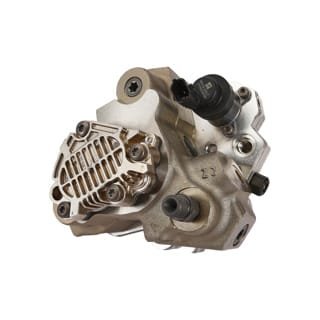
Alliant Power packages the high-pressure side as one LML fuel contamination kit (AP57004): a remanufactured pump, eight injectors, rails and high-pressure lines. If the failure was caught early, with a clean filter and injectors that test good on the bench, the pump may be the only part you need. For that job we carry a remanufactured LML CP4.2 pump (Bosch 0 986 437 421).
Typical 2026 cost: $3,500–$6,000+ for a pump-only job caught early and $10,000–$18,000+ for the full fuel system after metal spreads. If a stuck injector washed a cylinder, engine repair is a separate bill, typically $8,000–$25,000+.
Thinking about a CP3 instead of another CP4.2? That decision is covered in our CP4 to CP3 conversion guide, and the California rules are below.
The CARB Constraint on CP3 Conversion
A CP3 conversion is still the permanent fix for the lubricity problem, but in California it must use a kit carrying a CARB Executive Order number to remain legal on a registered street vehicle. The S&S Diesel 50-state kit (CARB EO #D-756-4) and Fleece Performance kits are the primary compliant options. Off-road or competition-only kits without an EO number are not viable for registered California or Nevada trucks. At a California specialty shop, a CARB-compliant CP3 conversion installed typically runs $3,500 to $5,500, with an optional FASS or AirDog lift pump adding roughly $900 to $1,500.