
Diesel Black Smoke: 7 Causes, Diagnosis & How to Fix It
02/23/2026
Diesel Hard Starting: 7 Causes, Diagnosis & How to Fix It
02/23/2026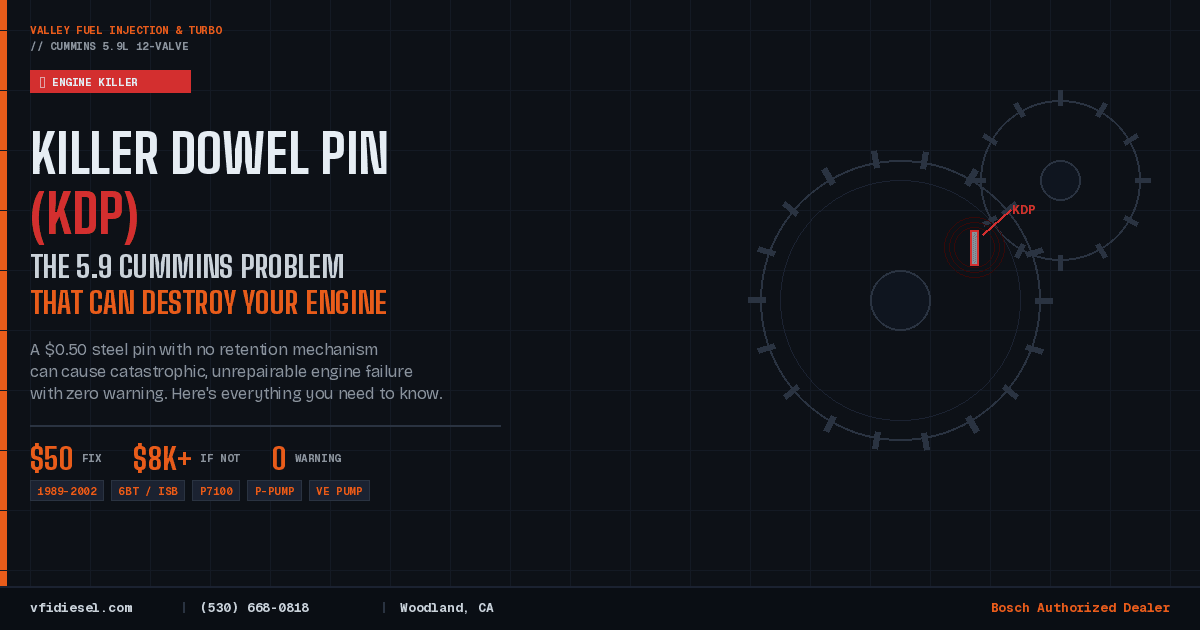
Published by Valley Fuel Injection & Turbo: Bosch-Certified Diesel Specialists, Woodland, CA
If you own a 1989–1998 Dodge Ram with a 5.9L 12-valve Cummins, there’s a ticking time bomb inside your timing cover, and it’s smaller than your pinky finger. It’s called the Killer Dowel Pin, or KDP, and it has destroyed more 12-valve Cummins engines than most owners want to think about. A steel dowel pin, roughly 5/16″ in diameter and 3/4″ long, can vibrate loose, fall into the timing gears, and cause catastrophic engine failure.
Talk to a Diesel Tech Timing cover already off for the KDP fix? If your P7100 is due for service too, plan it with the KDP job. We rebuild and bench-calibrate P7100 inline pumps, so a 30-year-old pump goes back on fresh. Two ways in: drive it into our Woodland shop near Sacramento, or ship it to us from anywhere in the country. ☎︎ Call 530-668-0818Out of the area? Start a mail-in rebuild → |
The fix costs under $100 in parts and takes an afternoon. Ignoring it can cost you the entire engine. This guide covers exactly what the KDP is, why it fails, what happens when it does, how to fix it, and why every 12-valve Cummins owner needs to address it, even if the truck runs perfectly right now.
What Is the Killer Dowel Pin?
The KDP is a small steel alignment pin pressed into the cast iron engine block during factory assembly. Its job is simple: it aligns the aluminum front timing gear housing to the engine block so the gears mesh correctly during initial assembly. Once the timing cover bolts are torqued down, the dowel pin has done its job, but it stays in place with nothing more than a friction fit.
The pin sits above the camshaft gear and to the left of the injection pump gear (when looking at the front of the engine). There’s no clip, no retainer, and no tab holding it in from the factory. It relies entirely on the interference fit between the steel pin and the cast iron bore to stay put.
Over thousands of hours of operation, engine vibration, thermal cycling between the aluminum housing and cast iron block (which expand at different rates), and gear train harmonics can gradually walk the pin out of its bore. Once it’s out, gravity takes over, and it drops straight into the gear train below.
Which Engines Are Affected?
The KDP issue affects 5.9L 12-valve Cummins (6BT) engines that still have the factory pressed-in pin with no retainer. By year and application:
- 1994–1998 Dodge Ram (P7100 / P-pump): These trucks use the Bosch P7100 mechanical injection pump. If you own a second-gen 12-valve, this is your truck: address the KDP immediately if it hasn’t been done.
- 1989–1993 Dodge Ram (VE pump): First-gen 12-valve trucks are also susceptible, and the pin design is identical. Don’t assume your first-gen is safe: plenty of VE-equipped trucks have had the pin walk out.
- 1998.5–2002 (24-valve ISB): Some early 24-valve Cummins engines use the same dowel pin and gear housing design. While failures are rarer on these engines, they’re not immune. If you have an early ISB, it’s worth inspecting.
- Non-Dodge applications: The 6BT Cummins was used in buses, medium-duty trucks, industrial equipment, and marine applications. Any 6BT with the same front gear housing is potentially affected.
What Happens When the KDP Fails
When the dowel pin vibrates out of its bore and drops into the timing gear area, one of three things happens, and only one of them is survivable without damage:
Scenario 1: Pin Falls Harmlessly (Best Case)
The pin drops out, bounces off the gears, and settles at the bottom of the timing cover or falls into the oil pan. The oil pump pickup has a screen that prevents the pin from being ingested. In this scenario, you’d never know it happened unless you pulled the front cover. The engine runs normally. This is the lucky outcome, and it does happen, but you can’t count on it.
Scenario 2: Pin Cracks the Timing Cover
The pin falls into the gear area, gets caught briefly, and is flung against the aluminum timing gear housing hard enough to crack it. You’ll develop an oil leak from the front of the engine, and inspection reveals the cracked housing and a missing or loose dowel pin. This is expensive, a new timing cover, gasket, seal, and labor, but the engine itself survives.
Scenario 3: Catastrophic Engine Failure (Worst Case)
The pin lodges between the camshaft gear and the injection pump gear (or the camshaft gear and the crank gear). The gear train jams. Gear teeth can break, the cam can jump time, and pistons can hit open valves.
The result: bent or broken valves, cracked or holed pistons, bent connecting rods, damaged cylinder head, scored cylinder walls, and potentially a cracked block. The engine can be a total loss, and your options are a complete engine swap or selling the truck for parts.
This is why it’s called the Killer Dowel Pin. A $0.50 steel pin with no retention mechanism can turn a perfectly running truck into scrap metal with little or no warning.
Warning Signs (There Usually Aren’t Any)
This is the most dangerous part of the KDP problem: there are almost no warning signs before failure. The pin doesn’t make noise as it works loose. There are no dashboard lights, no DTCs, and no performance symptoms. Your 12-valve can run perfectly right up to the moment it fails.
The only potential indicators, and these are unreliable, include:
- Small oil leak from the front timing cover: Could indicate the pin has shifted enough to disturb the gasket seal, or has already cracked the housing.
- Slight rattling or ticking from the front of the engine: Extremely rare to notice over normal diesel engine noise, but a new metallic sound from the timing cover area warrants investigation.
- Visual inspection: The only definitive way to check is to remove the front timing cover and physically inspect the pin. If it’s flush or protruding from the block, it needs to be tabbed.
Because there are essentially no reliable warning signs, the KDP should be treated as a preventive maintenance item, not something you wait to address until symptoms appear.
The KDP Fix: Prevention Kits and Installation
The fix is straightforward: install a small metal retention tab over the dowel pin using an existing bolt hole adjacent to the pin’s location. The tab physically prevents the pin from backing out of its bore.
What’s in a KDP Kit
Most KDP repair kits (typically $50–$100) include:
- KDP retention tab: A small stamped steel bracket that bolts over the pin.
- Longer mounting bolt: To secure the tab to the existing gear housing bolt hole.
- Front crankshaft seal: Since the timing cover has to come off, it makes sense to replace the crank seal while you’re in there.
- Timing cover gasket or RTV sealant: Some kits include a gasket; others recommend RTV silicone.
- Installation instructions
Installation Overview
Installing a KDP kit requires removing the front timing cover, which means pulling several components off the front of the engine. The typical procedure is:
- Drain enough coolant to remove the upper radiator hose.
- Remove the fan shroud, fan clutch, and fan.
- Remove the drive belt(s).
- Remove the harmonic balancer (damper), held on by four bolts.
- Remove the oil fill tube.
- Remove the front timing cover bolts and carefully separate the cover from the block.
- Inspect the dowel pin, note whether it’s flush, protruding, or missing entirely.
- Drive the pin back into the block if it’s backing out.
- Install the KDP retention tab over the pin and secure with the provided bolt. Use Loctite on the bolt.
- While the cover is off, check that all gear housing bolts are tight.
- Install the new crankshaft seal into the timing cover.
- Reseal the timing cover with gasket or RTV.
- Reassemble everything in reverse order.
The job takes 3–5 hours in a shop, or a full afternoon for a DIY mechanic with basic hand tools. It’s labor-intensive but not technically difficult, the hardest part is getting the balancer off and back on.
While You’re In There
Since you’re already pulling the front of the engine apart, it makes sense to address other items at the same time:
- Replace the water pump: If it’s original or has high mileage, now is the time.
- Inspect the thermostat: Easy access with the coolant already drained.
- Replace the front crank seal: Included in most KDP kits.
- Check timing gear condition: Inspect for cracks, wear, or chipped teeth on the cam, crank, and injection pump gears.
- Change the coolant: Since you’re draining it anyway.
Can I Check If My KDP Has Already Been Fixed?
If you bought a used 12-valve, the previous owner may or may not have addressed the KDP. Unfortunately, there’s no external indicator, you can’t tell from the outside whether a tab has been installed without pulling the cover.
Some clues that the timing cover has been off (and potentially the KDP addressed):
- Fresh sealant visible around the timing cover gasket line.
- Paint marks or witness marks disturbed on the harmonic balancer bolt.
- A receipt or service record from the previous owner.
If you can’t confirm it’s been done, assume it hasn’t. The cost of the kit and labor is trivial compared to the cost of a destroyed engine. Even if the previous owner tabbed the pin, you’ll get a fresh crank seal and timing cover reseal out of the job.
How Urgent Is This?
Extremely. Unlike most diesel maintenance items that give you warning signs and a window to schedule repairs, the KDP gives you little or no warning. It can fail at 50,000 miles or 300,000 miles. It can fail sitting at idle in your driveway or pulling a trailer at 70 mph on the interstate. There is no mileage threshold, no time-based interval, and no way to predict when, or if, it will happen.
Tabbing the KDP is standard preventive work on a 12-valve Cummins: if you haven’t tabbed your KDP, stop putting it off. A $50–$100 kit and an afternoon of work is the cheapest insurance you’ll ever buy for your engine.
Frequently Asked Questions
Can the KDP fix be done without removing the timing cover?
There is an alternative method that involves drilling and tapping a hole through the timing cover using a jig, then threading a bolt in front of the pin to retain it. This avoids removing the cover entirely and significantly reduces labor time. However, most mechanics and Cummins specialists prefer the full cover-off approach because it allows you to visually inspect the pin, the gears, and the cover for existing damage, plus you can replace the crank seal and reseal everything properly.
My truck has 250,000 miles and runs fine. Should I still do it?
Yes. High mileage doesn’t mean the pin hasn’t shifted, plenty of trucks have been found with the pin halfway out at well over 200,000 miles with no symptoms. The fact that it hasn’t failed yet is luck, not evidence that it won’t.
Does the KDP affect the VP44 24-valve trucks too?
Some early 1998.5 to 2002 24-valve ISB engines use the same front gear housing design and are technically susceptible. However, KDP failures on 24-valve trucks are significantly rarer. That said, if you’re already pulling the timing cover for other work on a 24-valve, tabbing the pin is a no-brainer.
What’s the worst-case repair cost if the KDP destroys my engine?
If the pin lodges in the gears and causes full valve-to-piston contact, the engine can be a total loss. A replacement 12-valve Cummins longblock typically runs $8,000–$14,000+ depending on condition and source. Add $2,200–$4,000 for labor to swap it. Compare that to $50–$100 for a KDP kit and $300–$700 in shop labor for the preventive fix. The math speaks for itself.
Need KDP Service or 12-Valve Cummins Work?
At Valley Fuel Injection & Turbo, we’re Bosch-certified diesel specialists with decades of experience on the 5.9 Cummins platform. Whether you need a KDP kit installed, VP44 injection pump diagnosis, or a complete fuel system overhaul, we have the expertise and the parts to get it done right.
We also carry remanufactured Bosch injectors and injection pumps for the 5.9 Cummins and ship parts nationwide.
📞 Call us: (530) 668-0818
📧 Email: info@vfidiesel.com
📍 Visit: 1243 E Beamer St, Suite C, Woodland, CA 95776
🛒 Shop Parts: Diesel Injectors · Injection Pumps · Bosch Service
Valley Fuel Injection & Turbo, Inc. is an authorized dealer for Bosch, Kubota, Delphi, Yanmar, and Alliant Power. Located in Woodland, CA, we serve diesel owners and fleets throughout Northern California and nationwide via our mail-in repair and parts shipping services.