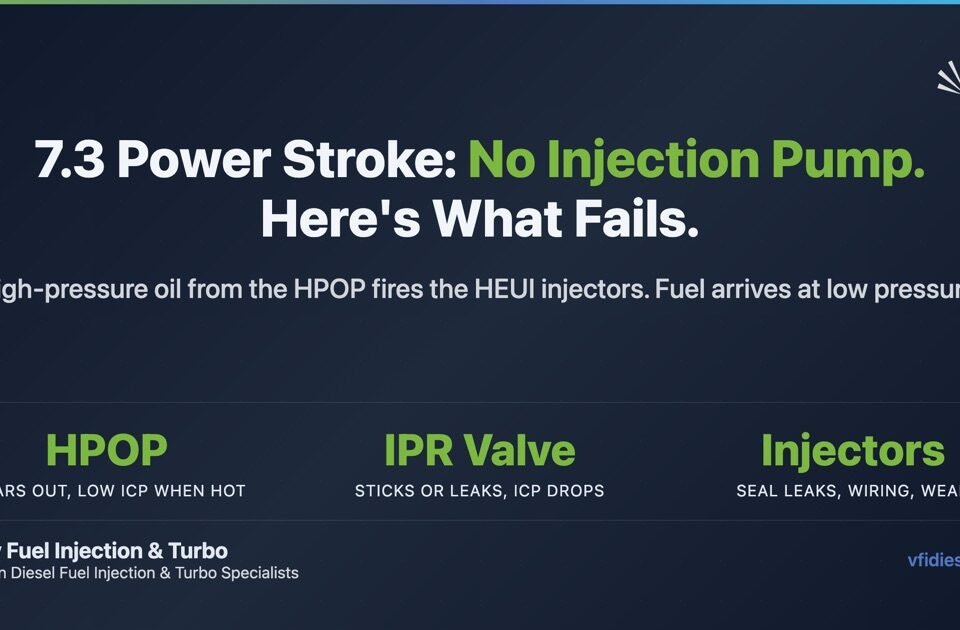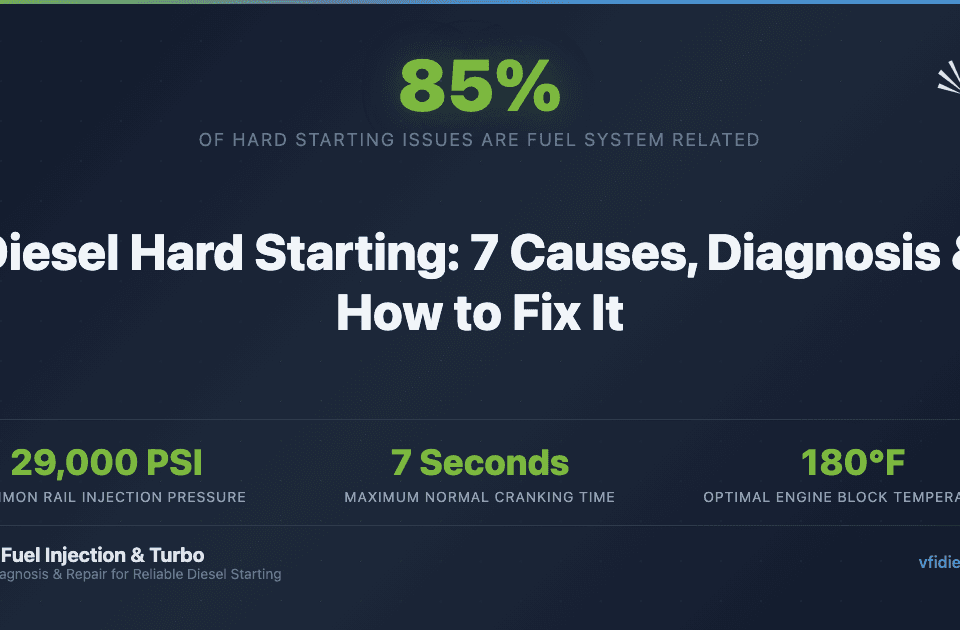
Diesel Hard Starting: 7 Causes, Diagnosis & How to Fix It
02/23/2026
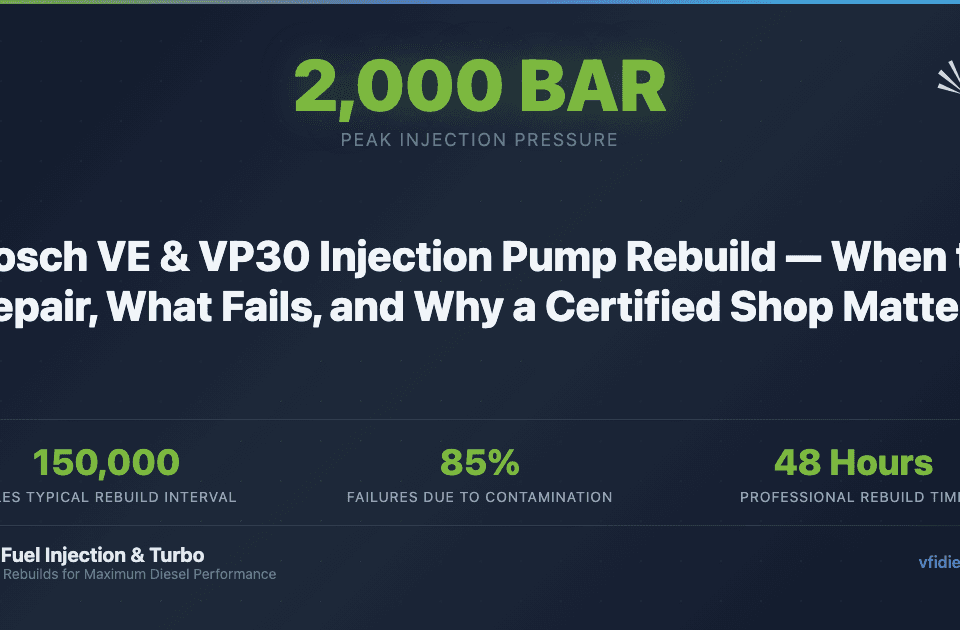
Bosch VE & VP30 Injection Pump Rebuild: When to Repair, What Fails, and Why a Certified Shop Matters
02/28/2026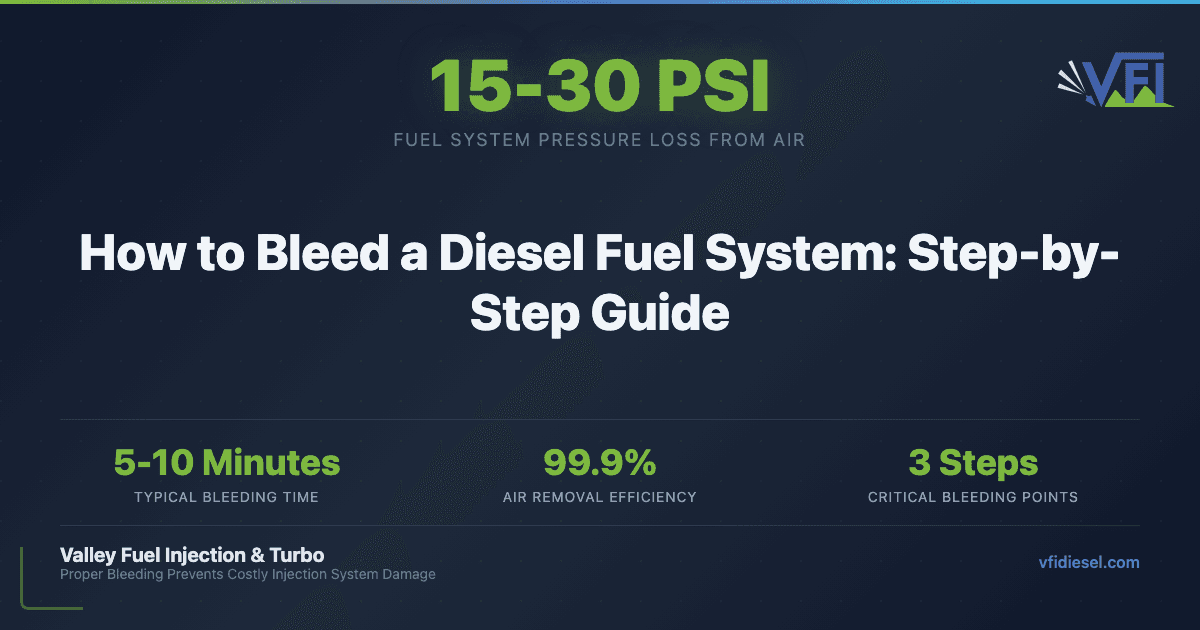
Published by Valley Fuel Injection & Turbo: Bosch-Certified Diesel Specialists, Woodland, CA
You changed a fuel filter, ran the tank dry, cracked a fuel line, or just came back to a diesel that sat for too long, and now it cranks and cranks but won’t fire. The problem is almost certainly air in the fuel system, and the fix is bleeding it out. Unlike gasoline engines that can tolerate small amounts of air, diesel fuel systems operate at extreme pressures and require a completely air-free fuel path from the tank to the injectors. Even a small air pocket can prevent the system from building enough pressure to atomize fuel and start the engine.
This guide covers why air gets into diesel fuel systems, how to recognize an airlock, and step-by-step bleeding procedures for trucks, tractors, generators, and equipment. If you’ve already been through our diesel hard starting guide or our cranks but won’t start guide and identified air in the fuel system as the culprit, this is your next step.
Why Air in a Diesel Fuel System Is a Problem
Diesel fuel systems are designed to be completely filled with liquid fuel at all times, from the tank pickup to the injector nozzle tips. Modern common rail systems operate at 25,000–30,000+ PSI, and even older mechanical systems run at several thousand PSI. These pressures are only achievable when the system is filled with incompressible liquid fuel.
Air is compressible. When air enters the fuel lines, the high-pressure pump compresses the air pocket instead of pressurizing fuel. The injectors never see adequate pressure, fuel doesn’t atomize, and the engine won’t start, or it starts briefly and stalls as the air pocket moves through the system.
The result is what’s commonly called an airlock: the engine cranks, the pump turns, but no fuel reaches the cylinders because the system can’t build pressure past the trapped air.
How Air Gets Into the Fuel System
Understanding how air entered the system is critical, because if you don’t fix the source, bleeding the lines is just a temporary fix. Air will re-enter the system and you’ll be back to the same problem.
Common Air Entry Points
- Running the tank dry: The most common cause. Once the fuel pickup sucks air instead of diesel, the entire system from tank to pump fills with air. Even adding fuel doesn’t fix it, the air is now trapped in the lines, filter housing, and pump.
- Fuel filter change: Every time a fuel filter is removed, the fuel column breaks and air enters. On some systems, prefilling the new filter with clean diesel before installation minimizes this. On others, especially canister-type filters, air entry is unavoidable and bleeding is part of the filter change procedure.
- Cracked or loose fuel lines: Even a hairline crack on the suction side of the fuel system (between the tank and the lift pump) can draw air in during operation. The leak might not drip fuel, suction-side leaks pull air in rather than push fuel out.
- O-ring failures: Fuel filter housing O-rings, fuel line connector seals, and fuel sensor O-rings all deteriorate over time. A worn O-ring on a filter housing is one of the most common recurring air leak sources.
- Lift pump or transfer pump failure: A weak or failed lift pump can’t maintain positive pressure in the fuel lines, allowing air to enter through minor seal imperfections that would be harmless with a functioning pump.
- Extended storage: Vehicles and equipment that sit for weeks or months can develop air pockets as fuel slowly evaporates or seeps past aging seals. If it needs bleeding after just an overnight sit, fuel is draining back somewhere; our guide to a diesel injection pump losing prime walks through finding the leak.
- Fuel system service: Any work that opens the fuel system, injector replacement, pump removal, line replacement, fuel tank work, introduces air that must be bled before the engine will start.
Signs of Air in the Fuel System
Before you start bleeding, confirm that air is actually the problem. These symptoms strongly point to an airlock:
- Engine cranks but won’t start: Especially after a filter change, running dry, or fuel system service.
- Engine starts briefly then dies: A small amount of residual fuel fires the engine for a second or two, but the air pocket behind it kills it.
- Rough idle that smooths out, then gets rough again: Intermittent air bubbles passing through the system.
- Visible bubbles in clear fuel lines: If your system has a clear fuel line section (common on many tractors and some trucks), air bubbles are visible proof.
- Sputtering and power loss under load: Air pockets cause momentary fuel starvation as they pass through the injectors.
- White smoke during cranking that clears, then returns: Fuel reaches cylinders intermittently as air pockets cycle through.
Tools and Supplies You’ll Need
Before starting, gather everything. Bleeding a fuel system can be messy, and you don’t want to stop mid-procedure to find a wrench.
- Wrenches or sockets to fit your bleed screws and injector line nuts (sizes vary by engine, typically 10mm, 12mm, 14mm, or 17mm)
- Clean rags or shop towels (you’ll use more than you think)
- Drain pan or container for catching fuel
- Clean diesel fuel for prefilling filters
- Safety glasses, fuel under pressure can spray
- The engine’s service manual or owner’s manual for system-specific bleed points
- A helper for cranking the engine (useful but not always required)
Step-by-Step: How to Bleed a Diesel Fuel System
The general principle is the same across all diesel engines: you work from the fuel tank toward the injectors, opening bleed points sequentially and pumping fuel through until air-free fuel flows from each point. The specifics vary by engine, so always reference your service manual, but this is the universal process.
Step 1: Identify Your Fuel System Layout
Before turning any wrench, trace the fuel path from tank to injectors and identify every bleed point. A typical diesel fuel system flows in this order:
- Fuel tank → pickup tube and supply line
- Primary fuel filter / water separator (may have a bleed screw or drain valve)
- Lift pump / transfer pump (mechanical lever or electric)
- Secondary fuel filter (usually has a bleed screw on top)
- High-pressure injection pump (may have a bleed screw: VP44, P7100, VE, common rail)
- High-pressure fuel lines → to individual injectors
Some engines have self-bleeding capability, particularly newer common rail systems with electric lift pumps. On these engines, cycling the ignition key to the “run” position multiple times (without cranking) activates the electric pump and can purge air automatically. Consult your manual.
Step 2: Bleed the Primary Filter / Water Separator
If your system has a primary fuel filter or water separator with a bleed screw, start here, it’s the first component downstream of the tank.
- Place rags under the bleed screw to catch fuel.
- Open the bleed screw (counterclockwise, usually 2-3 turns).
- Open the fuel supply valve (if equipped, some systems have a shutoff at the tank).
- If the engine has a manual lift pump lever or plunger, pump it repeatedly. Watch the bleed screw, you’ll see air bubbles in the fuel initially.
- Continue pumping until solid, bubble-free fuel flows steadily from the bleed screw.
- Tighten the bleed screw while still pumping to maintain pressure and prevent air from re-entering.
Step 3: Bleed the Secondary Fuel Filter
Repeat the same process at the secondary (on-engine) fuel filter. This filter sits between the lift pump and the injection pump, and air commonly gets trapped here, especially after a filter change.
- Locate the bleed screw on top of the secondary filter housing.
- Open the bleed screw 2-3 turns.
- Pump the lift pump lever until bubble-free fuel flows.
- Tighten the bleed screw while pumping.
Pro tip: When installing a new spin-on fuel filter, fill it with clean diesel fuel before threading it on. This dramatically reduces the amount of air that enters the system and makes bleeding faster. For canister-type filters, fill the housing before reinstalling the cap.
Step 4: Bleed the Injection Pump (If Equipped with a Bleed Screw)
Some injection pumps, particularly Bosch VE, VP44, and P7100 pumps, have a bleed screw on the pump body. If yours does, open it and pump until clear fuel flows, then tighten.
Many common rail high-pressure pumps (CP3, CP4, Denso HP3/HP4) do not have external bleed screws, they rely on the electric lift pump and the system’s self-purge capability. For these, cycling the key to “run” 8-10 times (30 seconds on, 5 seconds off) is often sufficient to prime the system.
Step 5: Bleed at the Injectors (If Necessary)
If the engine still won’t start after bleeding the filters and pump, you may need to bleed at the injector lines. This is common when the system was completely drained or when air is trapped in the high-pressure lines.
- Loosen the fuel line union nut at the first injector (closest to the pump), just one to two turns. Do not remove the line.
- Use two wrenches, one on the union nut and one on the injector body, to prevent twisting the steel line.
- Have a helper crank the engine for 10 seconds while you watch the loosened connection. You’ll see air and fuel sputtering out.
- When solid fuel appears without bubbles, tighten the union nut while the engine is still cranking.
- Move to the next injector and repeat.
- After bleeding all injectors, the engine should start. It may run rough for a minute as the last traces of air clear, this is normal.
Important: Don’t crank for more than 10–15 seconds at a time. Let the starter cool for 30–60 seconds between attempts. Overheating the starter motor is an expensive mistake on top of a fuel system problem.
Self-Bleeding Systems: Modern Common Rail Engines
Many newer diesel trucks, including late-model Cummins, Duramax, and Powerstroke engines, have electric lift pumps that can self-prime the system. The general procedure is:
- Turn the ignition key to the “run” position (not “start”) for 30 seconds. The electric lift pump will activate and push fuel through the system.
- Turn the key off for 5 seconds.
- Repeat this cycle 8-12 times.
- On the final cycle, turn the key to “start” and crank normally.
This key-cycling method works for most air intrusions from filter changes. For more severe airlocks (empty tank, line disconnect), you may still need to manually bleed at the filter housing bleed screw.
Some specific platform notes:
- 6.7 Cummins (Ram 2500/3500): Key cycle 10+ times. The electric lift pump is strong enough to self-purge in most cases. If it still won’t start, check the fuel filter housing for a bleed screw.
- Duramax (LML, L5P): Key cycle method works. If the primary fuel filter was changed, there may be an issue with the filter housing valve not reseating, a known issue on some models.
- 6.7 Powerstroke: Has an integrated fuel pump module. Key cycling usually works, but severely air-bound systems may require cracking injector lines.
- 5.9 Cummins (VP44 / P7100): No electric lift pump on most configurations. Manual lift pump lever on the engine block. Must manually bleed at filters, pump, and possibly injectors.
Tractors, Generators, and Equipment
Farm equipment, generators, and industrial diesel engines are actually where fuel system bleeding comes up most frequently, because these machines often sit for extended periods, run tanks dry during long work sessions, and get filter changes in the field.
Kubota, Yanmar, John Deere, and other compact diesel engines almost always have a manual lift pump lever and bleed screws on the filter housing. The procedure is the same as described above, bleed at the filter, then the pump, then the injectors if needed.
Key differences for equipment:
- Many tractors have inline fuel shutoff valves, make sure these are open before bleeding.
- Generator fuel systems often have a fuel-water separator as the primary filter, bleed here first.
- Some equipment uses a hand primer bulb (squeeze bulb) in the fuel line. Pump it until firm, this alone may be enough to clear a minor air pocket.
- Always carry a spare fuel filter and basic wrenches on equipment that runs in remote locations. A clogged filter plus an airlock in the field can turn a minor inconvenience into a full-day problem.
Preventing Air from Entering the Fuel System
Bleeding is a fix for air that’s already in the system. Preventing air entry in the first place saves time and frustration.
- Never run the tank dry. Refuel before the tank drops below 1/4. This also prevents the fuel pickup from sucking sediment and water from the bottom of the tank.
- Prefill new fuel filters. Fill spin-on filters with clean diesel before installation. For canister types, fill the housing. This minimizes the air volume that needs to be bled.
- Inspect O-rings during filter changes. Replace any O-ring that’s cracked, flattened, or hardened. A $2 O-ring prevents hours of troubleshooting recurring air leaks.
- Check suction-side lines and fittings. Any connection between the tank and the lift pump is a potential air entry point. Tighten fittings and replace deteriorated rubber hoses.
- Maintain the lift pump. A strong lift pump maintains positive pressure that keeps air out. A weak pump allows air to enter through marginal seals that would otherwise hold.
Bleeding a 6.7 Powerstroke Specifically
The 6.7 Powerstroke (2011 to present) does not have the manual bleed screws found on older mechanical diesels. Its CP4.2 high-pressure pump feeds a fully sealed common rail circuit, so there is no rail bleed screw and no factory hand primer. Everything depends on getting the low-pressure side fully primed first, and that side runs through the HFCM-style fuel filter housing where most 6.7 air problems start.
Start at the Filter Housing
The housing has a water-in-fuel (WIF) sensor and a drain valve at the bottom. The most common cause of post-filter-change air on this engine is a drain valve left a quarter turn loose, or a pinched cap O-ring. Reseat the drain, confirm the cap O-ring is clean and seated, and torque the cap to spec (commonly 18 to 22 ft-lb, verify your service manual). Pre-fill the new filter with clean diesel before installing it. The housing holds roughly 1.5 to 2 quarts, so a dry filter forces the lift pump to fill that whole volume before fuel reaches the pump.
Run the Key-Cycle Prime, Then Crank
Turn the key to ON (Run), not Start. The in-tank lift pump runs about 20 to 30 seconds. Turn off, wait 10 seconds, and repeat 5 to 7 times. A ForScan or Ford-capable scan tool can command the fuel pump prime output to run the pump continuously for 60 to 90 seconds, which purges the housing faster. Only then crank, in 15-second attempts with 30 to 60 seconds between tries, so you never dry-run the CP4.2.
Frequently Asked Questions
How long does it take to bleed a diesel fuel system?
For a straightforward airlock from a filter change on a system with bleed screws, the process takes 10–20 minutes. A complete bleed after running the tank dry, from primary filter through injector lines, can take 30–60 minutes, including multiple cranking cycles. Self-bleeding common rail systems with electric lift pumps are typically faster: 5–10 minutes of key cycling.
Can I damage my engine by cranking too long while bleeding?
You won’t damage the engine itself, but you can burn out the starter motor. Never crank for more than 10–15 seconds at a time, and allow 30–60 seconds of cool-down between attempts. On systems that require extended bleeding at the injectors, this adds up, plan for patience, not force.
My engine starts after bleeding but dies after a few minutes. What’s wrong?
There’s still air in the system, or air is continuing to enter. If bleeding solves the problem temporarily but it returns, you have an active air leak, likely a cracked suction line, a bad filter housing O-ring, or a failing check valve. Install a clear fuel line section between the filter and pump to visually confirm whether bubbles are present during operation.
Do I need to bleed the system every time I change the fuel filter?
On most diesels, yes, at least a partial bleed at the filter housing. Some modern systems with electric lift pumps can self-purge after a filter change with just a few key cycles. Older mechanical systems almost always require manual bleeding. Prefilling the new filter with diesel before installation minimizes the air volume and may eliminate the need for a full bleed on some platforms.
Can air in the fuel system cause injector or pump damage?
Extended operation with air in the fuel system can cause damage, yes. The high-pressure pump relies on fuel for lubrication, air provides no lubrication, and the pump can overheat and score internally. Injectors can also be affected by the pressure fluctuations caused by air pockets. If you suspect air in the system, address it promptly rather than trying to “drive through it.”
Need Help With a Stubborn Airlock?
Most air bleeds are straightforward, but some systems fight back, especially when there’s an underlying air leak that keeps re-introducing air after you’ve bled the system. At Valley Fuel Injection & Turbo, we diagnose and repair diesel fuel system air leaks, rebuild injection pumps, and test injectors on Bosch-certified test benches. If bleeding doesn’t solve your problem, the issue is deeper, and we can find it.
We service all major diesel platforms: Cummins, Duramax, Powerstroke, Kubota, Yanmar, and more, and ship parts nationwide. If you’re not near Woodland, you can send your injection pump or injectors to us through our mail-in rebuild service.
📞 Call us: (530) 668-0818
📧 Email: info@vfidiesel.com
📍 Visit: 1243 E Beamer St, Suite C, Woodland, CA 95776
🛒 Shop Parts: Diesel Injectors · Injection Pumps · Bosch Service
Talk to a Diesel Tech Bled it and the air keeps coming back? Air that returns after a good bleed points to a suction-side leak, a weak lift pump, or a pump that won’t hold prime. Tell us the engine and when it quits, and we will help you narrow it down. Two ways in: drive it into our Woodland shop near Sacramento, or ship it to us from anywhere in the country. ☎︎ Call 530-668-0818Out of the area? Start a mail-in rebuild → |
Valley Fuel Injection & Turbo, Inc. is an authorized dealer for Bosch, Kubota, Delphi, Yanmar, and Alliant Power. Located in Woodland, CA, we serve diesel owners and fleets throughout Northern California and nationwide via our mail-in repair and parts shipping services.