Diesel Engine Losing Oil Pressure: 7 Causes & Fixes
05/01/2026
7.3 Power Stroke HPOP Problems: Symptoms & Replacement Guide
05/06/2026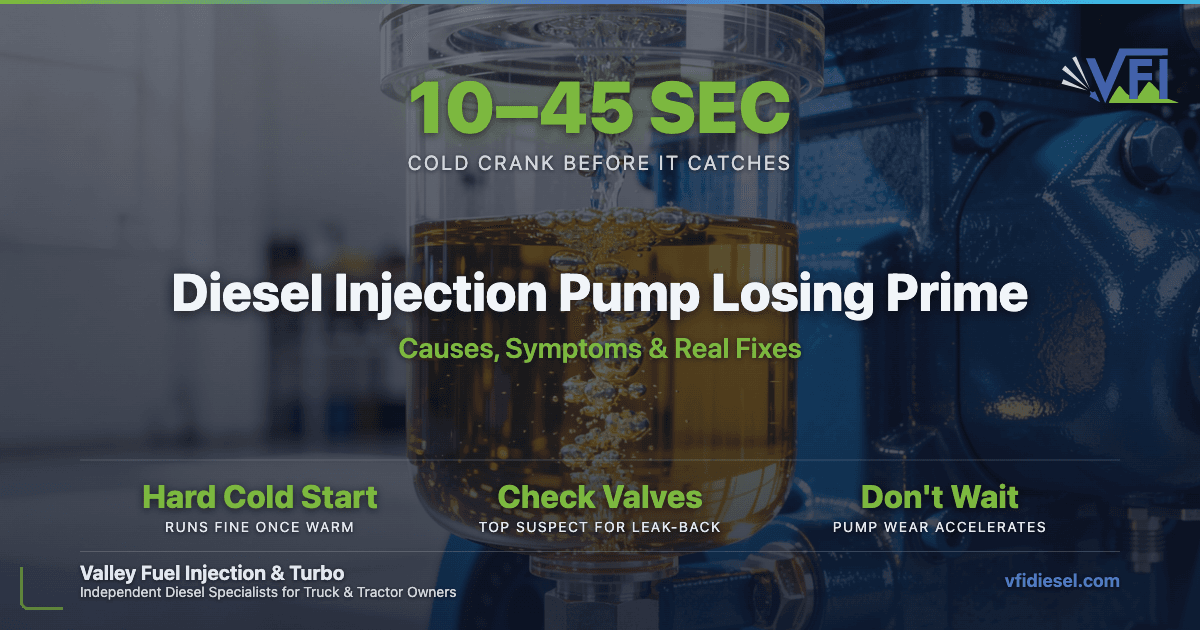
A diesel injection pump losing prime is one of the most frustrating problems a diesel owner can face, your engine cranks and cranks on a cold morning, finally catches after 15 to 30 seconds of grinding, then runs perfectly fine once it’s warm. By afternoon, you’ve almost forgotten it happened. But the next morning, same story. That pattern, hard cold start, long cranking, normal operation once running, is the classic fingerprint of a fuel system that won’t hold prime overnight. The fuel is draining back toward the tank while the engine sits, and on startup the injection pump has to work overtime to re-prime the system before combustion can happen.
When a diesel injection pump loses prime overnight, fuel is leaking back through a failed check valve, a weak lift pump, cracked fittings, or leaking injector return lines. The engine starts hard when cold but runs fine once the system re-pressurizes, and the problem will worsen over time until it leaves you stranded. Accurate diagnosis tells you whether the fix is a pump rebuild, a lift pump replacement, or a simple line repair.
What Does It Mean When a Diesel Injection Pump Loses Prime, and Why Does It Matter?
Losing prime means the fuel column between your tank and injection pump drains back when the engine is off, leaving air in the supply lines or pump housing. Diesel injection pumps, whether rotary distributor types like the Bosch VE, inline pumps, or VP44 units, are not self-priming in any meaningful sense. They depend on a pressurized, air-free fuel supply to begin injecting immediately on startup. When that fuel column collapses overnight, the pump spins dry for several seconds or more before it can draw fuel back up from the tank, build pressure, and fire the injectors.
This matters for two reasons. First, every second of dry or air-contaminated operation accelerates wear inside the pump, these components are lubricated by the diesel fuel itself. Second, extended cranking to re-prime puts extra load on your starter, batteries, and glow plug system. What starts as a nuisance becomes an accelerating mechanical problem. We’ve seen pumps come into our shop at Valley Fuel Injection in Woodland, CA that were prematurely worn out almost entirely because of a chronic prime-loss issue that the owner lived with for a year or two.
Diesel injection pumps rely on fuel as their primary lubricant and coolant. Running even briefly on air or a fuel-starved condition generates heat and metal-on-metal contact inside precision-machined components with tolerances measured in microns. Chronic prime loss is a slow death sentence for an otherwise healthy pump.
What Are the Symptoms of a Diesel Injection Pump Losing Prime?
The symptom pattern for a pump losing prime is distinct enough that an experienced diesel tech can often identify it from a description alone before touching the truck. Here’s what to look for:
- Hard start on cold mornings, normal operation once warm: The engine cranks for 10–45 seconds before catching. Once it starts, it runs fine. This is the defining symptom.
- Problem is worse after longer sits: An 8-hour overnight sit is worse than a 2-hour sit. A weekend sit may require multiple crank cycles. This tells you the leak-down rate, the longer the sit, the more fuel has drained back.
- White or grey smoke on startup: Air in the system causes incomplete combustion in the first few seconds, producing light smoke that clears once the engine is running cleanly.
- Air bubbles visible in the clear fuel filter or return line: If you have a clear primary filter bowl or can watch the return line, you may see air purging out during those first seconds of cranking.
- Engine stumbles or surges briefly before smoothing out: As the pump re-primes, fuel delivery is uneven for a moment, you’ll feel it as a rough idle that settles within 30 seconds.
- No hard start when the engine is still warm: If you shut it off, go inside for an hour, and it starts fine, but the next morning it’s hard again, that confirms the issue is time-dependent leak-down, not a mechanical starting problem.
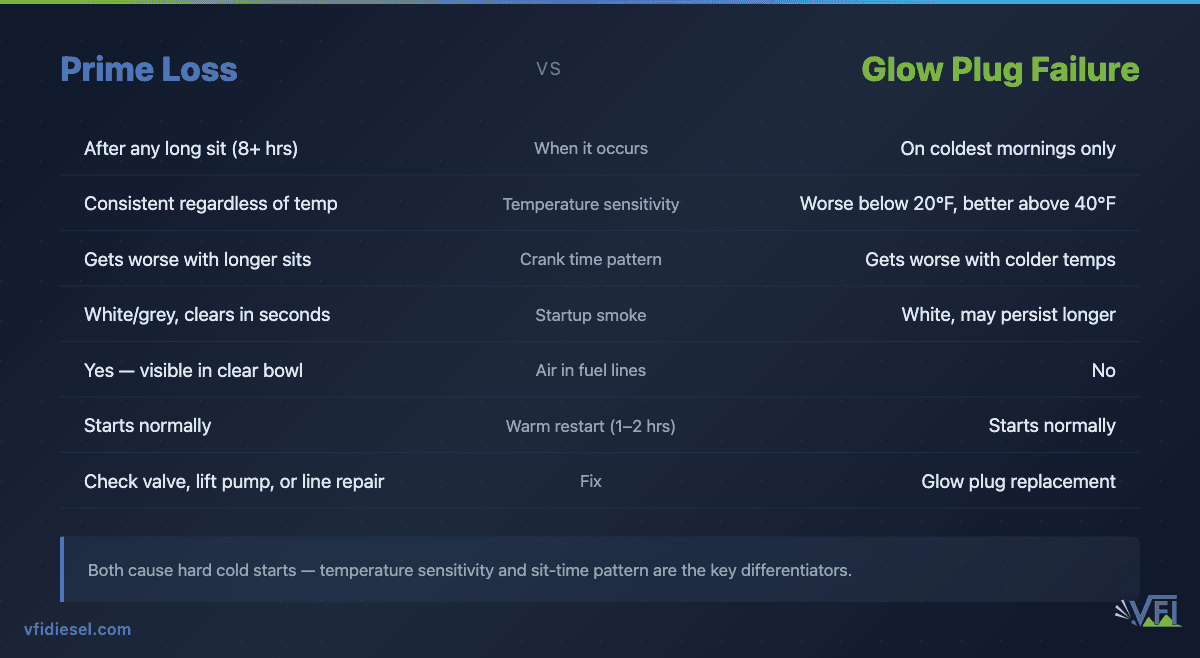
Don’t confuse prime loss with glow plug failure. Both cause hard cold starts, but glow plug issues are temperature-dependent, worse on the coldest mornings, better when it’s 60°F. Prime loss is consistent regardless of temperature and gets worse with longer sits. Misdiagnosis means replacing glow plugs when the real problem is a leaking check valve or lift pump.
What Are the Most Common Causes of a Diesel Pump Losing Prime?
There are four primary culprits, and in our experience at the shop they account for the vast majority of prime-loss cases. Understanding each one helps you narrow down where to look.
1. Failed Check Valve Inside the Injection Pump
Most rotary and inline injection pumps have an internal check valve, sometimes called an anti-drain-back valve, that holds fuel in the pump housing and supply gallery when the engine is off. On Bosch VE rotary pumps, this is a small spring-loaded ball valve at the fuel inlet. On inline pumps, check valves are built into the delivery valves above each plunger. When these valves wear, crack, or lose spring tension, fuel drains back through them by gravity and the pump housing empties overnight.
This is one of the most common causes we see, and it’s often repairable during a pump rebuild. The check valve itself is a small, inexpensive component, the labor to access it is where the cost comes in. Learn more about our Bosch injection pump testing and repair services.
2. Weak or Failing Lift Pump
The lift pump (also called a transfer pump or supply pump) is responsible for pulling fuel from the tank and delivering it to the injection pump at a specified pressure, typically 5 to 15 PSI depending on the application. A weak lift pump that can still move fuel when running may not generate enough suction to hold the fuel column in place when the engine is off. The result is the same: the supply side drains back toward the tank.
Lift pump diaphragms crack, check balls wear, and electric lift pumps lose voltage efficiency over time. We’ve written a detailed breakdown of how diesel lift pumps work, why they fail, and when to upgrade, worth reading if you suspect yours is marginal.
3. Injector Return-Line Leakage
On many diesel engines, particularly older mechanical systems and some common rail platforms, injectors have a leak-off or return circuit that routes excess fuel back to the tank. If the check ball or seal inside an injector fails, fuel can migrate backward through the return circuit when the engine is off, slowly draining the high-pressure side. This is more common on worn injectors with high mileage and is often accompanied by other symptoms like rough idle or uneven power delivery.
4. Cracked Fittings, Loose Connections, and Degraded Fuel Lines
Physical leaks in the supply side, a hairline crack in a banjo fitting, a loose compression fitting, a section of fuel hose that has hardened and is no longer sealing, allow air to enter the system as fuel drains. These are often the easiest fixes but also the easiest to miss because the leak may only be visible when the system is under suction, not pressure. Inspect every fitting between the tank and the injection pump, including the primary filter housing, any hand primer bulbs, and the lift pump inlet.
| Cause | Location | Typical Fix | DIY Friendly? |
|---|---|---|---|
| Internal check valve failure | Inside injection pump | Pump rebuild or valve replacement | No, requires pump disassembly |
| Weak lift pump | Supply side (tank to pump) | Lift pump replacement or upgrade | Yes, with basic tools |
| Injector return-line leak | Injectors / return circuit | Injector testing and rebuild | No, requires flow testing |
| Cracked fittings / loose lines | Supply lines and fittings | Fitting replacement / line repair | Often yes |
How Do You Diagnose Whether the Leak-Down Is at the Pump, Injectors, or Supply Side?
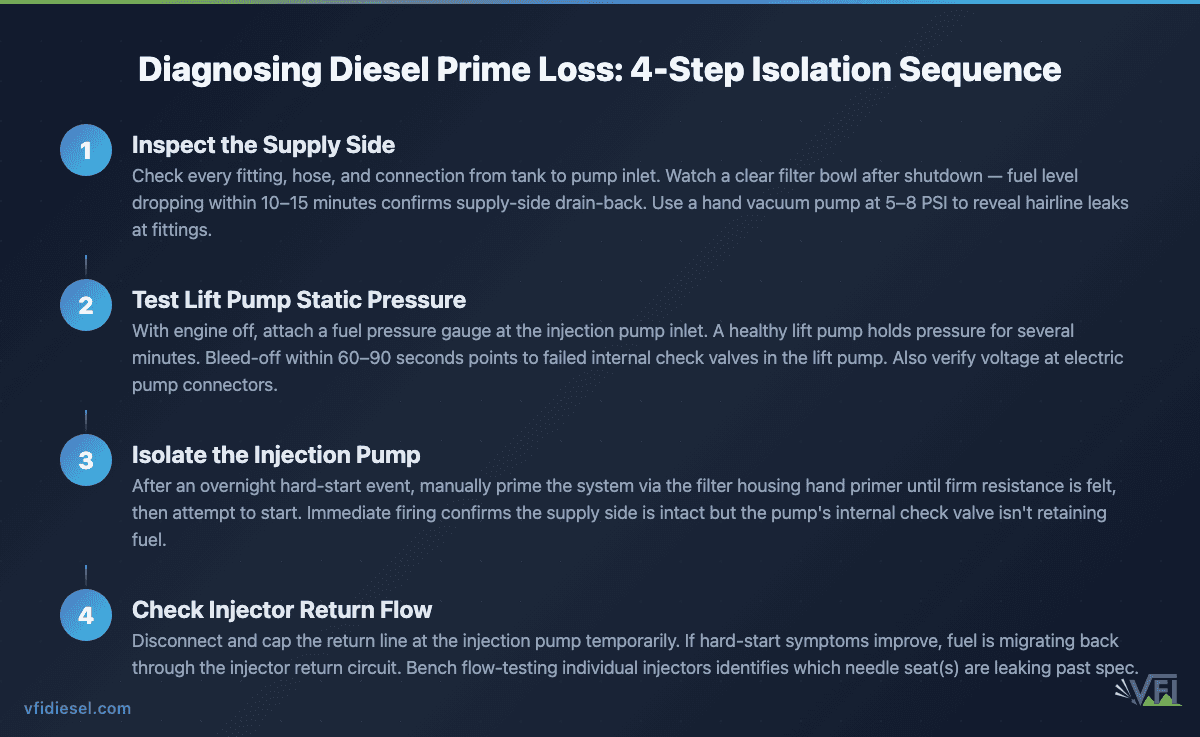
Systematic isolation is the key to diagnosing a diesel injection pump losing prime, guessing and replacing parts is expensive and often wrong. Here’s the diagnostic sequence we use:
Step 1: Check the Supply Side First
Inspect every fitting, hose, and connection between the tank and the injection pump inlet. Look for fuel staining, cracked rubber, or loose compression fittings. If you have a clear primary filter bowl, watch it after shutting the engine off, if the fuel level drops over 10–15 minutes, you have a supply-side drain-back. A hand-operated vacuum pump can be used to pressurize the supply lines (gently, 5–8 PSI) to check for leaks at fittings.
Step 2: Isolate the Lift Pump
A lift pump that won’t hold static pressure is a common culprit. With the engine off, use a fuel pressure gauge at the injection pump inlet. Pressure should hold for several minutes on a healthy system. If pressure bleeds off within 60–90 seconds, the lift pump’s internal check valves are leaking. On electric lift pumps, also check voltage at the pump connector, low voltage causes weak pumping even if the pump itself is intact.
Step 3: Isolate the Injection Pump
If the supply side checks out, the leak-down is likely internal to the injection pump. One field test: after the engine sits overnight and exhibits a hard start, manually prime the system using the hand primer on the filter housing (if equipped) until you feel firm resistance, then attempt to start. If it fires immediately after manual priming, the pump’s internal check valve is the problem; the supply side is fine, but the pump isn’t holding what was delivered to it.
Step 4: Check Injector Return Flow
On mechanical injection systems, disconnect the return line at the injection pump and cap it temporarily. If the hard-start problem improves, fuel was migrating back through the return circuit. Flow-testing individual injectors on a bench will identify which one, or ones, are leaking past their needle seats. This is shop work; accurate injector leak-off testing requires calibrated equipment and known flow rates.
A simple overnight test: after a hard start, open the bleed screw on your primary fuel filter (if accessible) immediately after cranking. If air purges out before fuel flows, your supply side has drain-back. If fuel flows immediately with no air, the prime loss is downstream, at the pump or injectors. This takes 30 seconds and tells you which half of the system to focus on.
If you’re in the Sacramento area and want a professional diagnostic before spending money on parts, our team serves Sacramento-area diesel owners and can perform a full fuel system pressure and leak-down test in the shop. Call us at 530-668-0818 to schedule a diagnostic appointment.
Can a Pump That Loses Prime Be Rebuilt, or Does It Need Replacement?
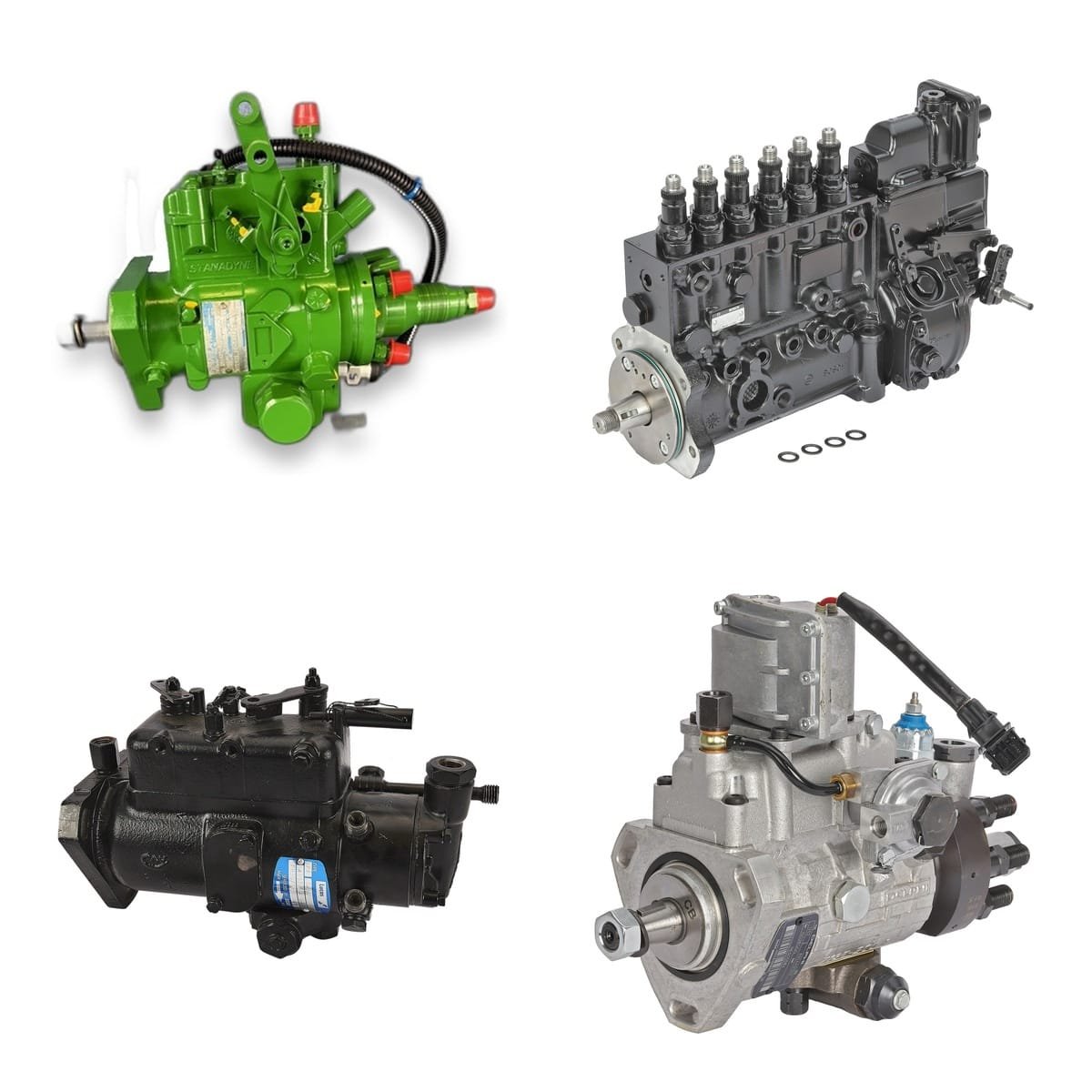
In most cases, a pump losing prime due to a failed internal check valve can be rebuilt, and rebuilding is often significantly more cost-effective than outright replacement, especially for Bosch VE pumps, inline pumps, and VP44 units where new OEM replacements are expensive or unavailable. The check valve components themselves are inexpensive; the value in a professional rebuild is the precision reassembly, calibration on a test bench, and verification that the pump holds prime after the repair.
That said, if the pump has been running with chronic prime loss for an extended period, the internal components may have accumulated wear from those dry-start cycles. A thorough inspection during disassembly will reveal whether the plungers, barrel, rotor, and delivery valves are within spec or need replacement. This is why we don’t quote pump repairs sight-unseen, the check valve might be a minor fix, or it might be the first domino in a larger rebuild.
For a detailed breakdown of what pump rebuilding costs versus replacement, including what’s actually done during a professional rebuild, see our Diesel Fuel Injection Pump Rebuild Cost vs Replace guide. And if you need a faster turnaround, our injection pump exchange program gets you a remanufactured unit while yours is being rebuilt, so your truck isn’t down for a week.
Check valve replacement as part of a pump rebuild typically adds $80–$200 in parts to the overall rebuild cost. A full pump rebuild including check valve service ranges from $800–$2,800+ depending on pump type, application, and internal condition. Compare this to new OEM pump prices of $1,500–$3,200+ for many applications. Rebuilding by a certified shop is almost always the better value, provided the pump’s core components are serviceable.
It’s also worth understanding the broader context of your injection system. If you’re running a VP44 pump and experiencing prime loss alongside other symptoms, read our comparison of Common Rail vs VP44 injection systems, it may inform your decision about whether to rebuild the existing system or consider an upgrade path.

When Is This a DIY Diagnosis Versus a Job for a Certified Injection Shop?
Some parts of this diagnosis are genuinely DIY-friendly. Inspecting supply lines and fittings, testing lift pump pressure with an inexpensive gauge, watching for air in a clear filter bowl, and manually priming the system to isolate the leak-down location, these are all things a mechanically capable diesel owner can do in the driveway. Replacing a lift pump on most applications is also within reach for someone comfortable with basic fuel system work.
Where it crosses into certified shop territory:
- Any internal pump work. Injection pumps operate at pressures up to 20,000+ PSI in some common rail systems, and even older mechanical pumps have tolerances in the single-digit micron range. Disassembly without the right tools, clean environment, and calibration equipment will cause more damage than it fixes.
- Injector leak-off testing. Quantifying how much fuel is bypassing each injector’s needle seat requires a calibrated flow bench, not something you can eyeball.
- Post-repair calibration. After any internal pump repair, the pump must be tested and calibrated on a test bench to verify correct fuel delivery across the RPM range. A pump that holds prime but delivers incorrect fuel quantities will cause poor performance, smoke, or engine damage.
We are one of the few Bosch-certified diesel fuel injection repair centers in Northern California, with the test bench equipment and factory training to properly diagnose, rebuild, and calibrate injection pumps. We accept mail-in pumps from customers across the country. If you’re not local to Northern California or Nevada, you can ship your pump to us for testing and rebuild through our nationwide mail-in rebuild service. Turnaround times and shipping instructions are available when you call.
Before shipping or bringing in a pump, document your symptoms in detail: how long the engine sits before the hard start occurs, how many seconds of cranking it takes, whether the problem is consistent or intermittent, and any recent work done on the fuel system. This information helps us identify the likely failure mode before we even open the pump, and saves you diagnostic time.
For context on how prime loss fits into the broader picture of diesel fuel system health, the diesel engine maintenance resources on our site cover preventive steps that can extend the life of your injection pump and keep the fuel system operating correctly between service intervals. According to Bosch Mobility’s diesel systems documentation, maintaining clean, air-free fuel delivery is one of the most critical factors in injection pump longevity, a principle we see validated daily in the pumps that come through our shop.
The Society of Automotive Engineers has published research on fuel system aeration and its effects on injection equipment wear, the findings consistently show that even brief air ingestion events accelerate component degradation in precision injection components. And for California operators, it’s worth noting that fuel system integrity is also a factor in CARB’s in-use diesel regulations, since a poorly running fuel system contributes to excess emissions. The EPA’s diesel fuel standards also underscore why maintaining a properly functioning injection system matters beyond just performance.
Talk to a Diesel Tech Hard start every morning after it sits? Call with how long it sits and how long it cranks, and we will help you pin down whether it is the pump check valve, the lift pump, or the injectors before you buy parts. Two ways in: drive it into our Woodland shop near Sacramento, or ship it to us from anywhere in the country. ☎︎ Call 530-668-0818Out of the area? Start a mail-in rebuild → |
Frequently Asked Questions
How long should a diesel injection pump hold prime after shutdown?
A healthy diesel fuel system should hold prime indefinitely, or at minimum for many hours. If your system loses enough prime to cause a hard start after an 8-hour overnight sit, that’s abnormal. Some minor pressure bleed-off over 24–48 hours can occur in older systems, but it should never be enough to cause extended cranking. If you’re cranking more than 5–7 seconds on a cold start after a normal overnight sit, the system is not holding prime properly.
Can bad diesel fuel cause a pump to lose prime?
Contaminated fuel, particularly fuel with water contamination or microbial growth, can damage internal pump components including check valves and seals, leading to prime loss. However, bad fuel alone doesn’t typically cause overnight drain-back; it causes the mechanical damage that then leads to prime loss. If you’ve recently run contaminated fuel and now have hard starts, have the pump inspected for internal damage alongside a fuel system flush.
Will adding a check valve to the fuel line fix a pump that loses prime?
An external inline check valve installed in the supply line can help in some cases, particularly when the drain-back is occurring through a weak lift pump or supply-side fittings. However, it won’t fix an internal pump check valve failure, because the pump itself is draining internally. Installing an external check valve without identifying the root cause is a band-aid, not a repair. It may reduce symptoms while the underlying problem continues to worsen.
Is a diesel injection pump losing prime covered under warranty?
If the pump was recently rebuilt or replaced, prime-loss failure is typically covered under the shop’s or remanufacturer’s warranty, provided it’s not caused by external factors like contaminated fuel or a lift pump issue that was left unaddressed. Always consult a qualified diesel technician to document the failure mode before pursuing a warranty claim, so the root cause can be clearly identified and attributed correctly.
Can I drive with a diesel injection pump that’s losing prime?
You can drive once the engine is running and the system has re-primed, the prime loss itself only affects startup, not operation. However, we strongly advise against continuing to drive without addressing the issue. Each hard-start event causes additional wear inside the pump from momentary dry or air-contaminated operation. The problem also tends to worsen progressively, what’s a 15-second crank today may become a no-start situation in a few months. Address it sooner rather than later.
Valley Fuel Injection & Turbo, Inc. has been diagnosing and repairing diesel fuel injection systems since 1993. We’re a Bosch-certified injection shop with the test bench equipment to properly identify and fix prime-loss issues, whether it’s an internal check valve, a lift pump, or injector leak-off. We serve diesel owners throughout Northern California and Nevada from our Woodland, CA shop, and we accept mail-in pumps for testing and rebuild from customers nationwide.
Call us at 530-668-0818 or schedule a diagnostic online. Don’t let a fixable prime-loss problem turn into a seized pump.