7.3 Power Stroke HPOP Problems: Symptoms & Replacement Guide
05/06/2026
Turbocharger Repair vs. Replacement: Diesel Guide
05/13/2026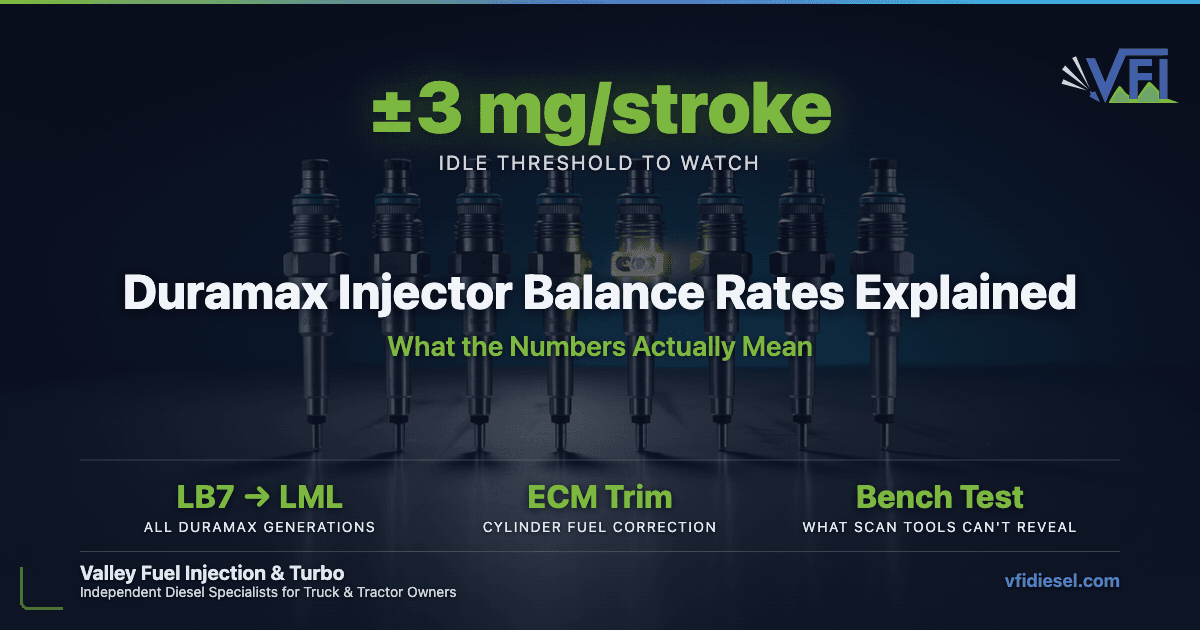
Duramax Injector Balance Rates Explained: What the Numbers Mean and When to Act
Duramax injector balance rates are real-time fuel delivery correction values the ECM calculates for each injector, and they’re one of the most actionable diagnostic data points available on any diesel platform. If you’ve plugged in a scan tool and seen numbers like +4.5 or -6.2 next to each cylinder and wondered what they actually mean, you’re in the right place. This guide breaks down exactly how to read those numbers on LB7, LLY, LBZ, LMM, and LML Duramax engines, what the thresholds are that should put you on alert, and what a professional test bench reveals that a scan tool alone cannot.
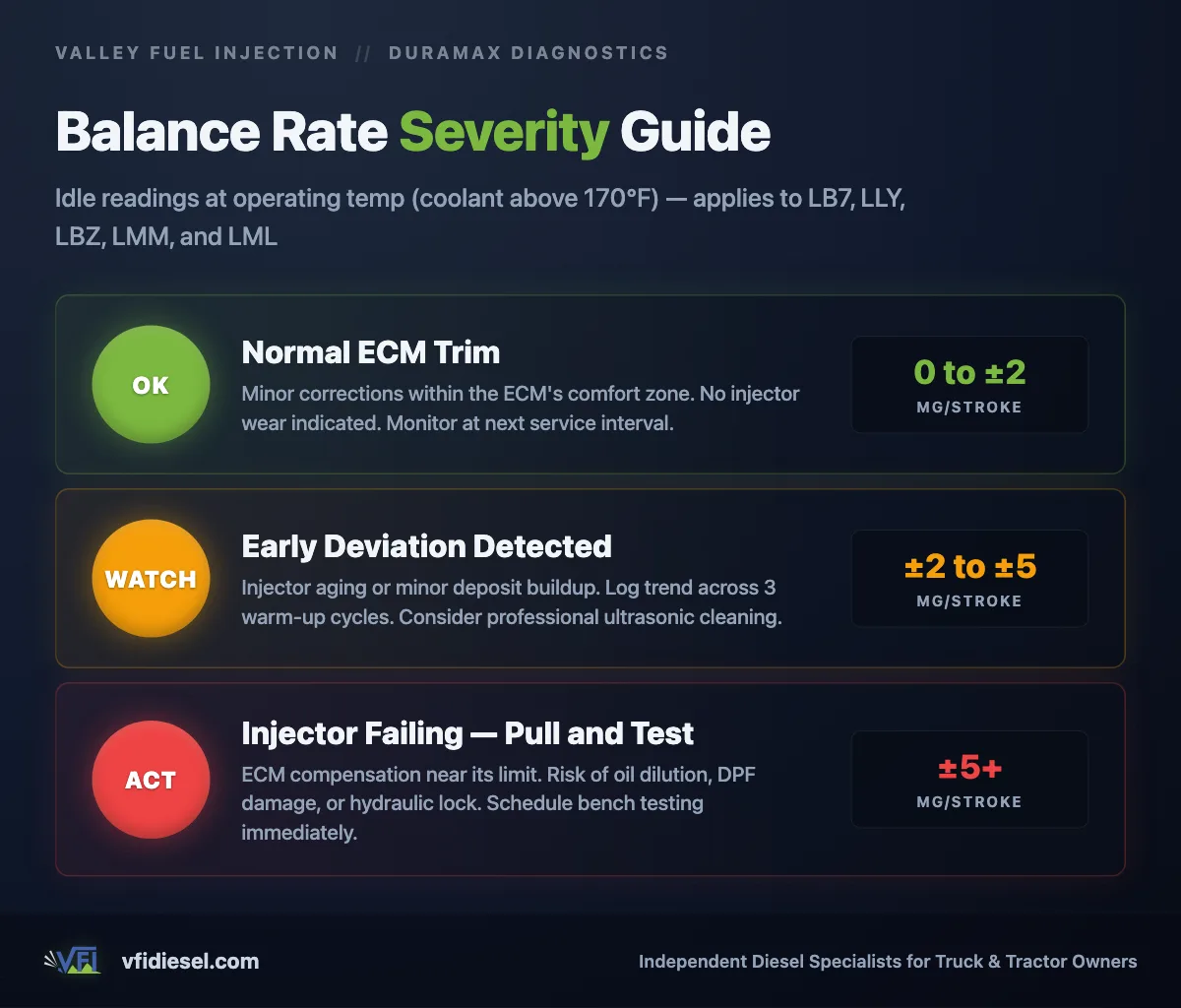
Injector balance rates tell you how hard the ECM is compensating for each cylinder’s fuel delivery. Numbers beyond ±3 mg/stroke at idle deserve attention; beyond ±5 mg/stroke typically means an injector is worn, fouled, or failing, and only a calibrated test bench can confirm whether cleaning, recalibration, or replacement is the right fix.
What Are Injector Balance Rates and How Does the Duramax ECM Use Them?
Balance rates are the ECM’s trim corrections, expressed in milligrams of fuel per stroke (mg/stroke), that keep each cylinder contributing equally to overall engine output. The Duramax ECM continuously monitors crankshaft acceleration after each injection event using the crank position sensor. If cylinder 4 fires but the crank doesn’t accelerate as much as expected, the ECM notes that cylinder is underperforming and increases its commanded fuel quantity. That correction value is the balance rate you see on the scan tool.
Think of it like a chef tasting a dish and adding salt to compensate for an ingredient that came up short. The ECM is always tasting, always adjusting. Balance rates are logged at idle because that’s when the contribution of each individual cylinder is most measurable, at high RPM and load, the corrections blur together and become less meaningful for diagnostic purposes.
The Duramax 6.6L uses a Bosch high-pressure common rail system operating at pressures up to 26,000 psi on later generations. Even microscopic wear inside an injector’s nozzle or control valve changes flow characteristics enough for the ECM to detect and flag it through balance rate deviation. Learn more about common rail system repair on our services page.
Balance rates are captured at idle (typically 600–800 RPM) with the engine fully warmed up, coolant temp above 170°F is the standard condition. Cold readings are unreliable because injector characteristics and fuel viscosity shift with temperature. Always warm the engine fully before logging balance rate data.
What Do Positive vs. Negative Balance Rate Readings Actually Tell You?
A positive balance rate means the ECM is adding fuel to that cylinder; a negative balance rate means it’s pulling fuel out, and the direction of the deviation tells you as much as the magnitude.
- Positive value (+mg/stroke): That injector is delivering less fuel than commanded. The ECM is compensating by increasing pulse width. Common causes: worn nozzle, restricted flow, deposits on the tip, or a leaking control valve that bleeds off rail pressure before injection.
- Negative value (−mg/stroke): That injector is delivering more fuel than commanded, it’s over-fueling. The ECM is pulling back. Common causes: a stuck-open or leaking nozzle, worn needle seat, or a return circuit that’s not bleeding off pressure correctly.
- Near-zero values (±1 mg/stroke): Normal. The ECM is making minor trims within its comfort zone.
A negative (over-fueling) injector is often more urgent than a positive one. An injector dumping excess fuel can wash cylinder walls, dilute engine oil, cause raw fuel to enter the exhaust, and damage the DPF on LMM and LML trucks. Don’t assume a negative balance rate is “less bad” because the number is smaller.
It’s also worth looking at the pattern across all eight cylinders, not just the worst offender. If six cylinders show +1 to +2 and two cylinders show +5 to +7, you likely have two specific injectors with problems. But if all eight cylinders are drifting positive together, that points toward a system-wide issue, low rail pressure, a failing CP3 pump, or fuel quality problems, rather than individual injector wear.
At What Balance Rate Threshold Should You Be Concerned, and What Do the Factory Specs Say?
General industry thresholds for Duramax balance rates are well-established, though GM’s factory service documentation and the Bosch calibration standards we work to on our test bench are the definitive references.
| Balance Rate Range | What It Means | Recommended Action |
|---|---|---|
| 0 to ±2 mg/stroke | Normal ECM trim, healthy injector | No action needed; monitor at next service |
| ±2 to ±3 mg/stroke | Early deviation, injector aging or minor deposits | Log trend over time; consider professional cleaning |
| ±3 to ±5 mg/stroke | Significant deviation, injector wear or fouling | Schedule professional testing; don’t ignore |
| ±5 mg/stroke or beyond | Injector failing: ECM compensation near limit | Pull and test immediately; replacement likely |
These thresholds apply broadly across LB7 through LML generations, though the LB7 is particularly notorious for injector problems, the original nozzle design had documented durability issues that GM addressed in later generations. If you own an LB7 and you’re seeing balance rates creeping toward ±4, read our detailed breakdown of 6.6 Duramax LB7 injector replacement costs and process so you know what you’re potentially facing.
Log balance rates at idle on three separate warm-up cycles before drawing conclusions. A single snapshot can be skewed by a recent cold start, a brief air bubble in the fuel system, or a scan tool communication glitch. Consistent readings across multiple sessions are what matter. If the same cylinder keeps showing the same deviation, that’s a real problem.
Can Bad Balance Rates Be Caused by Something Other Than the Injector Itself?
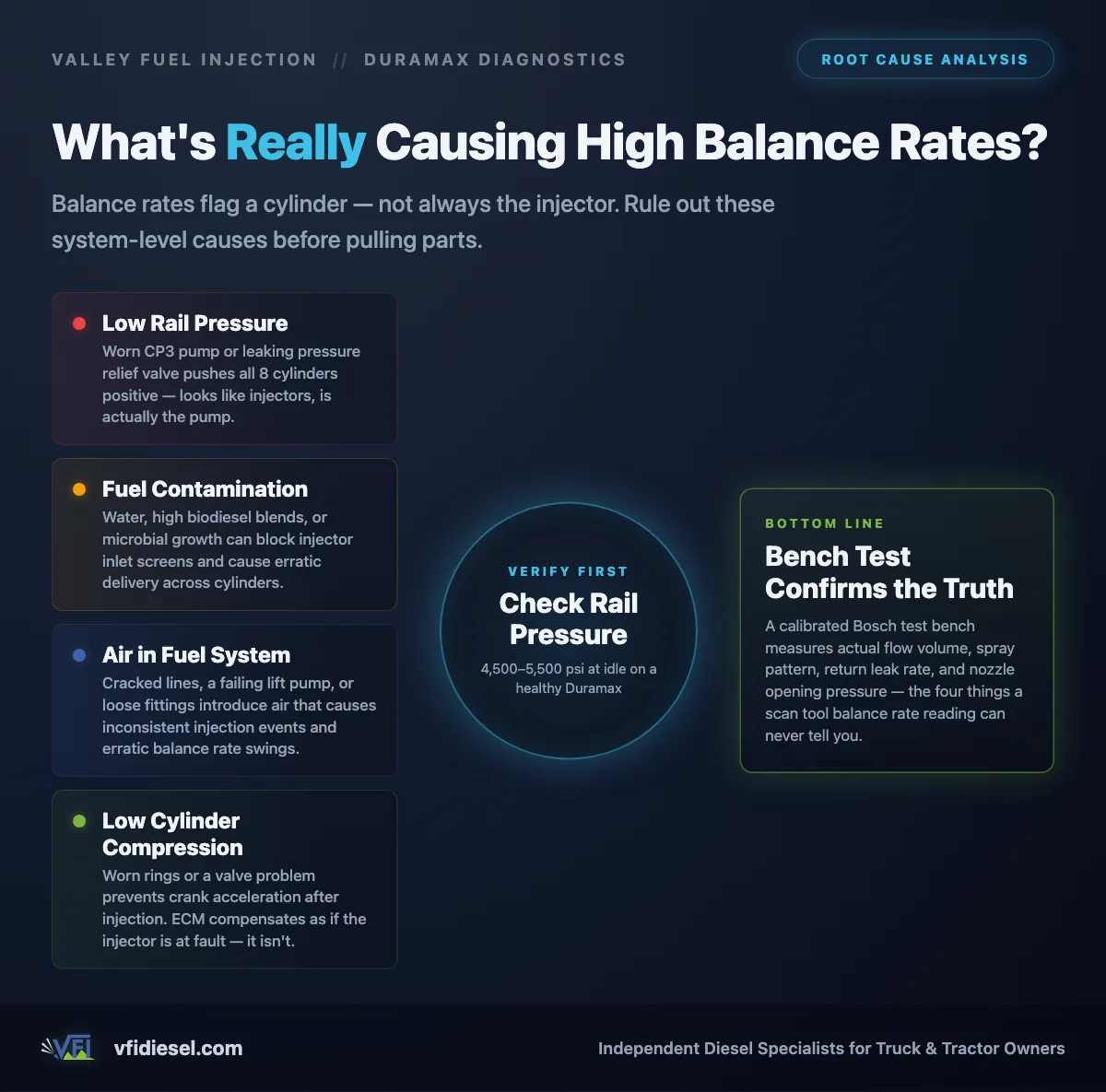
Yes, and this is where a lot of DIY diagnoses go sideways. Balance rates point to a cylinder that’s not delivering expected power, but the injector isn’t always the root cause. Before condemning an injector, a qualified diesel technician should rule out these contributing factors:
- Low rail pressure: If the CP3 high-pressure pump is worn or a pressure relief valve is leaking, rail pressure drops and all injectors deliver less fuel than commanded. The ECM compensates across the board, pushing all balance rates positive. This looks like a multi-injector problem but is actually a pump problem.
- Fuel quality and contamination: Water, biodiesel blends above B5, or microbial contamination can partially block injector filters (the small screen at the inlet of each injector) and cause erratic delivery. California diesel owners should be especially aware of this, we’ve written about biodiesel injector damage as a hidden fuel crisis in this region.
- Air in the fuel system: A cracked fuel line, failing lift pump, or loose fitting can introduce air that causes inconsistent injection events. Balance rates will be erratic rather than consistently offset.
- Cylinder compression issues: If a cylinder has low compression from a worn ring or a valve problem, the crank won’t accelerate properly after injection regardless of how much fuel is delivered. The ECM interprets this as an injector problem and compensates, but adding more fuel to a cylinder with low compression doesn’t fix anything.
- ICP/IPR sensor issues (on older platforms): While more relevant to Power Stroke owners, sensor drift on any platform can corrupt the feedback loop the ECM uses to calculate balance rates.
Before pulling injectors based on balance rate data alone, verify rail pressure with a known-good gauge or high-quality scan tool PID. On a healthy Duramax at idle, you should see approximately 4,500–5,500 psi. If rail pressure is low, fix the supply system first and recheck balance rates, you may find they normalize without touching a single injector. Our team at Bosch diesel fuel injection testing and repair runs this exact diagnostic sequence every time.
How Do Technicians Use Balance Rate Data to Decide Which Injectors to Pull and Test?
Experienced diesel technicians use balance rates as a ranking and prioritization tool, not a pass/fail verdict. Here’s the systematic approach we use at Valley Fuel Injection when a Duramax comes in with balance rate concerns:
Step 1: Baseline the system. Log balance rates at idle after a full warm-up. Record all eight cylinders. Note which are positive, which are negative, and the spread between the best and worst cylinder.
Step 2: Check rail pressure and fuel supply. Confirm the CP3 is building adequate pressure and holding it. A leaking injector return line or a failing pressure relief valve will skew the entire dataset.
Step 3: Cylinder contribution test. Some scan tools (EFI Live, HP Tuners, and the factory GM Tech2/MDI) allow you to disable individual injectors one at a time and measure the RPM drop. A healthy cylinder drops RPM significantly when its injector is cut. A cylinder with a bad injector, or one that was already being over-compensated, shows a smaller drop. This cross-references the balance rate data and helps confirm which cylinders are genuinely problematic.
Step 4: Pull and bench test the suspects. Once the field data points to specific injectors, those units come out and go on a calibrated test bench. This is where the scan tool data gets confirmed or contradicted. A Bosch-certified test bench measures actual flow volume at multiple pressure points and injection pulse widths, it tells you exactly how much fuel the injector is delivering versus what it should deliver, across the full operating range. Read more about how common rail injectors are tested on our Bosch-certified bench.
Professional injector bench testing typically runs $50–$100 per injector depending on the test protocol. For a full set of eight Duramax injectors, that’s $400–$800 for comprehensive flow testing, far less than replacing injectors that don’t need replacement. If testing reveals the injectors are within spec, you’ve confirmed the problem lies elsewhere and saved yourself a significant unnecessary repair bill.
The bench test also determines whether an injector can be professionally cleaned and recalibrated versus replaced outright. Many injectors showing moderate balance rate deviations, especially those in the ±3 to ±5 range, are candidates for professional ultrasonic cleaning and recalibration rather than replacement. Compare that to the DIY cleaning options covered in our post on diesel fuel injector cleaning: DIY vs. professional service, the difference in precision is significant.

If you’re in the Sacramento area or anywhere in Northern California and want a professional eye on your balance rate data, reach out to our team or call us at 530-668-0818. We also accept mail-in injectors from Duramax owners nationwide who want factory-level bench testing without a local shop that can match the capability. Pull the suspects and ship them in: our mail-in injector testing and rebuild service puts each one on the bench and quotes only the ones that fail.
What Happens If You Ignore High Balance Rates, and What Does Professional Testing Reveal?
Ignoring balance rates beyond ±5 mg/stroke is a gamble that almost always gets more expensive over time. Here’s what typically unfolds:
Short term: Rough idle, minor power loss, and slightly elevated fuel consumption. The ECM is compensating, but it can only do so within limits. Misfire codes (P0300-series) may begin to appear as the injector deviates further from spec.
Medium term: An over-fueling injector begins washing the cylinder walls with raw fuel, diluting the engine oil with diesel. Oil samples will show elevated fuel dilution. Piston rings and cylinder walls begin to wear prematurely. On LMM and LML trucks with a diesel particulate filter, excess unburned fuel accelerates DPF loading and can cause DPF damage, a repair that can run $3,000–$6,500 on its own.
Long term: A severely leaking injector can hydraulically lock a cylinder. Diesel fuel doesn’t compress. If enough fuel accumulates in the cylinder on a shutdown, the next cold start can bend a connecting rod. This is an engine-destroying failure mode that turns a $800–$1,200 injector problem into a $10,000–$18,000+ engine replacement.
Hydraulic lock from a leaking injector is one of the most catastrophic, and preventable, diesel engine failures. If you’re seeing balance rates beyond ±6 mg/stroke on any cylinder and the truck sits overnight, check the oil level before every cold start. A rising oil level with a fuel smell is a red flag that an injector is leaking down into the cylinder while the engine sits. Pull the injector before you start the engine again.
What professional bench testing reveals that a scan tool cannot: the exact flow rate deviation at idle, part load, and full load injection events; the spray pattern quality (a distorted pattern causes incomplete combustion even if flow volume is technically acceptable); the return leak rate (how much fuel bleeds back to the tank through the control valve); and the minimum opening pressure of the nozzle. Bosch’s common rail injection standards define acceptable tolerances for all of these parameters, and a certified test bench is the only way to measure them accurately.
The SAE’s technical research on diesel injector degradation consistently shows that flow deviation and spray pattern degradation often occur together, meaning an injector that’s only slightly out of spec on flow volume can still have a severely compromised spray pattern that a scan tool balance rate reading will never catch.
For Duramax owners in the Sacramento area or as far out as Reno, Nevada, our Woodland shop is one of the few facilities in Northern California running a full Bosch-certified common rail test bench with the tooling and factory training to properly evaluate Duramax injectors at this level. Our full diesel fuel injection services page covers everything we do in detail.
The EPA’s emission standards for heavy-duty diesel vehicles also underscore why proper injector function matters beyond just performance, misfiring or over-fueling injectors directly impact NOx and particulate emissions, which affects compliance for commercial operators.
Frequently Asked Questions About Duramax Injector Balance Rates
No. Balance rates are calculated live by the ECM based on real crankshaft behavior, they’re not stored values that reset with a code clear. If an injector is delivering too much or too little fuel, the ECM will calculate the same correction the next time you idle the engine at operating temperature. Clearing codes removes DTCs but doesn’t change the underlying injector performance. The balance rates will return to the same values within a few minutes of idle.
Not necessarily, but it depends on mileage and the condition of the others. On a high-mileage LB7 or LLY, replacing only the two worst injectors often means the others start showing similar deviations within 20,000–30,000 miles, requiring another labor-intensive pull. Many experienced Duramax technicians recommend replacing all eight on high-mileage engines to avoid a second round of the same labor. Bench testing the remaining injectors first gives you the data to make that decision intelligently rather than guessing.
The GM factory Tech2 and MDI/GDS2 tools read balance rates natively. Aftermarket options that work well include EFI Live (the most popular with Duramax tuners), HP Tuners, and Autoenginuity. Basic OBD-II readers and most generic code scanners cannot access balance rate data, it’s an enhanced parameter that requires a GM-specific or professional-grade scan tool. If you don’t have access to one, a Bosch-certified diesel shop will have the tools to pull the data properly.
Yes, aftermarket tunes that increase fueling can shift baseline balance rates and make interpretation more complex. An injector that looks marginal on a stock tune may appear worse on an aggressive tune because the ECM is commanding more fuel and the deviation becomes proportionally larger. Always note whether the truck is running stock or tuned calibration when logging balance rate data, and ideally compare against known-good data from a similar tune level.
For high-mileage Duramax trucks (over 100,000 miles), logging balance rates once a year or every 15,000 miles is a reasonable preventive practice. Catching injector deviation early, before it reaches the ±5 threshold, gives you the option of professional cleaning and recalibration rather than outright replacement. It also helps you catch fuel system issues like CP3 wear before they become catastrophic. Think of it as a blood pressure check for your fuel system.
Ready to Get Definitive Answers on Your Duramax Injectors?
Balance rate data is a powerful starting point, but it’s a symptom report, not a diagnosis. The only way to know exactly what’s happening inside each injector is to pull it and put it on a calibrated test bench. At Valley Fuel Injection in Woodland, CA, we run a full Bosch-certified common rail test bench and have been diagnosing and remanufacturing diesel fuel injection systems for over 30 years. We work on LB7, LLY, LBZ, LMM, and LML Duramax injectors regularly and can tell you definitively whether your injectors need cleaning, recalibration, or replacement, and back that up with actual flow data, not guesswork.
Call us at 530-668-0818 or schedule a diagnostic online. We’re located in Woodland, CA, convenient to Sacramento, Davis, Chico, and the greater Northern California region. Not local? We accept mail-in injectors and ship remanufactured Duramax injectors nationwide. Our LB7 through LMM injectors are Bosch Authorized Remanufactured, rebuilt by Valley Fuel Injection & Turbo; the LML injector is a Bosch factory reman. Learn more about our Bosch injector testing and repair services and find out why Duramax owners across the country trust us with their fuel systems.