Killer Dowel Pin (KDP): The 5.9 Cummins Problem That Can Destroy Your Engine
02/23/2026
How to Bleed a Diesel Fuel System: Step-by-Step Guide
02/23/2026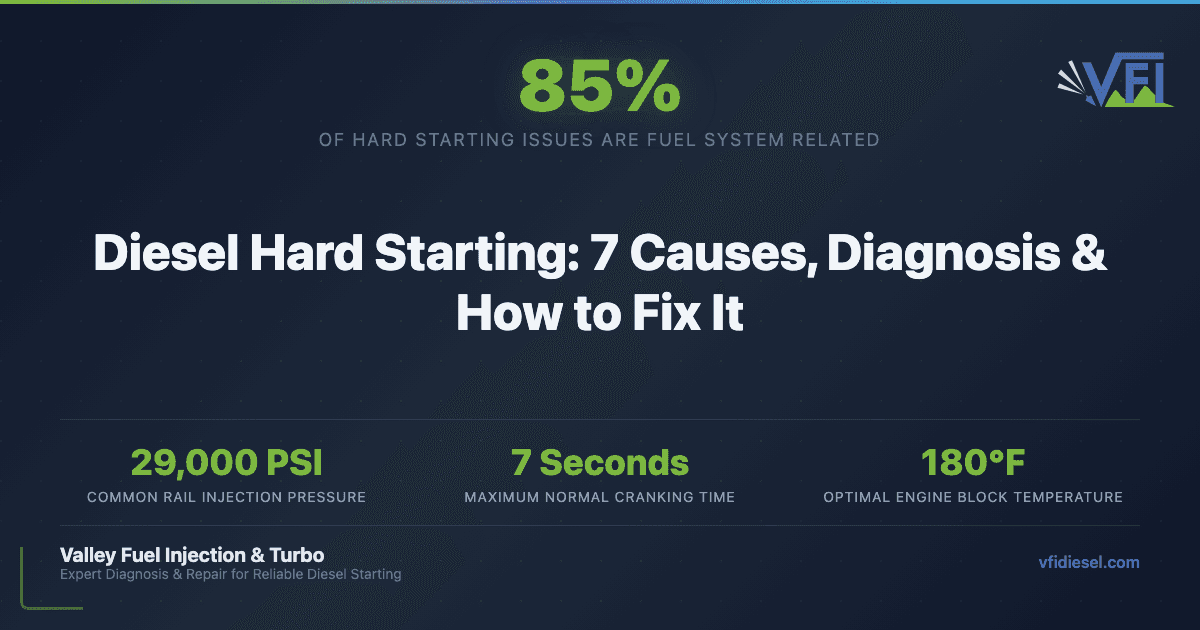
Published by Valley Fuel Injection & Turbo: Bosch-Certified Diesel Specialists, Woodland, CA
Your diesel cranks and cranks, maybe it eventually fires after 10 or 15 seconds of grinding, maybe it sputters to life and almost dies before catching, or maybe it starts fine when warm but takes forever when cold. This isn’t a complete no-start (we cover that in our cranks but won’t start guide). This is hard starting, the engine eventually runs, but getting there is a battle.
Hard starting is one of the most common diesel complaints, and it’s also one of the trickiest to diagnose because the root cause can be in the fuel system, the air system, the cold-start system, or the engine’s internal mechanical condition. At Valley Fuel Injection & Turbo, we see hard-starting diesels every week, from Cummins and Duramax pickups to Kubota tractors and industrial generators. The causes follow predictable patterns, and this guide walks through every one of them.
Before you test fuel parts, check the battery and cranking speed. It is the cheapest check.
Hard Starting vs. No Start: What’s the Difference?
The distinction matters because the diagnostic path is different. A complete no-start typically points to a total failure, no fuel delivery, no compression, no crank signal. Hard starting is subtler: fuel is getting there, compression exists, the engine wants to run, but something is marginal. You’re dealing with a system that’s partially degraded rather than completely failed.
Hard starting often gets worse gradually. What starts as an extra second or two of cranking in cold weather slowly progresses to five seconds, then ten, then fifteen. By the time most owners seek help, the problem has been building for months. That gradual progression is actually a diagnostic clue, it points to wear-related causes rather than sudden failures.
Cause #1: Fuel Drainback and Loss of Prime
This is a classic cause of hard starting after the engine has been sitting, especially overnight or over a weekend. The engine fires quickly when warm or recently run, but takes extended cranking after sitting for hours.
What’s Happening
Diesel fuel systems are designed to stay full of fuel (hold their prime) when the engine is off. Check valves in the injection pump, anti-drainback valves in the fuel supply system, and tight-sealing injectors all work together to keep the lines full of fuel and ready to fire on the first crank.
When any of these components leak, even slightly, fuel drains back to the tank while the engine sits. The next time you crank, the fuel pump has to refill the lines and build pressure from scratch before any fuel reaches the injectors. That’s what causes the extended crank time.
Common Drainback Sources
- Leaking injectors: Worn injector nozzle seats or internal seals allow fuel to drain back through the injector. This is one of the most common causes on high-mileage engines. An injector leak-back test, measuring how much fuel returns to the tank through each injector, is the standard diagnostic method.
- Failed check valve in the injection pump: The pump’s internal check valve prevents fuel from flowing backward when the engine stops. If it leaks, fuel drains back and the pump loses prime. Common on VP44 and older Bosch VE pumps.
- Fuel supply line leaks: Any crack, loose fitting, or deteriorated O-ring on the suction side of the fuel system can allow air to enter while the engine sits. When you crank, the pump has to purge that air before it can deliver fuel. You’ll often see bubbles in a clear return line during cranking.
- Failed anti-drainback valve: Many diesel fuel systems include a check valve near the fuel filter or transfer pump that prevents gravity drainback. A failed valve lets the fuel column fall back to the tank.
Diagnostic Test
On trucks with an electric lift pump, if your engine starts quickly when you cycle the key 3-4 times (allowing the lift pump to build pressure without cranking), but takes extended cranking with a single key turn after sitting, that points to a drainback issue. The repeated key cycles let the lift pump refill the lines before you ask the engine to fire.
Cause #2: Glow Plug or Intake Heater Failure
If hard starting is primarily a cold-weather problem, the engine fires quickly at 70°F but struggles at 40°F or below, the cold-start system is the first suspect.
Diesel engines rely on compression heat to ignite fuel. At cold ambient temperatures, the cylinder walls, piston, and incoming air are all cold, which absorbs heat from the compression stroke and can prevent the air from reaching ignition temperature. Glow plugs (or intake air heaters on some platforms) compensate by adding heat to the combustion chamber before and during cranking.
How Glow Plugs Fail
Glow plugs are resistive heating elements that eventually burn out. One failed glow plug on a 6- or 8-cylinder engine might not be noticeable in mild weather, the other cylinders fire and carry the dead one. But as temperatures drop, or as additional plugs fail, the engine needs more and more cranking to generate enough heat for ignition. Common failure progression:
- A few failed plugs: Noticeable hard starting in cool weather. White smoke during cranking as unburned fuel exits the exhaust from the dead cylinders.
- More failed plugs: Hard or impossible starting in cold weather. Extended cranking, excessive white smoke, rough running for the first minute or two after starting.
The glow plug relay and timer module can also fail. If the relay doesn’t energize the plugs at all, you’ll have a cold-start problem even with brand-new plugs. Check for voltage at the glow plug bus bar during the preheat cycle. DTCs P0380, P0670–P0683 indicate glow plug circuit faults.
Cause #3: Low Fuel Pressure
Diesel engines need adequate fuel pressure to atomize fuel properly in the combustion chamber. If pressure is low, whether from a weak lift pump, restricted filter, or air leak, the injectors can’t produce the fine spray pattern needed for quick ignition.
Common Low-Pressure Causes
- Clogged fuel filter: The most common and cheapest fix. A restricted fuel filter can drop supply pressure significantly, enough to cause hard starting even if the engine runs acceptably once it’s going. If you can’t remember when the fuel filter was last changed, change it now.
- Weak or failing lift pump: The lift pump (or transfer pump) moves fuel from the tank to the injection pump. A weak lift pump produces enough flow to keep a running engine fed, but can’t build enough pressure fast enough during cranking to get fuel to the injectors quickly. This is an extremely common cause on VP44 Cummins trucks, the VP44 injection pump relies on the lift pump for adequate supply pressure, and a weak lift pump kills the VP44.
- Air in the fuel system: Even a small air leak on the suction side of the fuel system reduces the lift pump’s ability to pull fuel from the tank. The pump cavitates (pumps air instead of fuel), and fuel delivery drops. Common leak points include filter housing O-rings, fuel line connections, and cracked pickup tubes in the tank.
- Fuel quality: Water contamination, low cetane rating, or gelled fuel (in cold weather) all make starting harder. Water in fuel is especially problematic because it does not burn, it takes the place of fuel, and it rusts and wears injection parts.

Cause #4: Worn Injectors
As diesel injectors wear, their spray patterns degrade. Instead of producing a fine, atomized mist that ignites quickly, worn nozzles produce streams or large droplets that take longer to vaporize and ignite. The engine will eventually start, there’s enough fuel and enough heat, but it takes more cranking revolutions to get combustion going.
Injector-related hard starting is typically consistent across all temperatures (not just cold) and gets progressively worse over time. You may also notice white smoke or black smoke during and immediately after starting, rough idle for the first 30-60 seconds, and slightly elevated fuel consumption.
On common rail systems like the 6.7 Cummins or LB7 Duramax, professional flow testing on calibrated equipment is the definitive diagnostic. On older mechanical systems, a pop test checks nozzle opening pressure and spray pattern. If there’s no injection shop near you, you can pull the injectors and ship them to us for bench testing through our mail-in injector and pump rebuild service.
Cause #5: Low Compression
Diesel engines ignite fuel through compression alone, there’s no spark plug. If cylinder compression drops below the minimum threshold needed to generate ignition temperature, the engine will be hard to start or won’t start at all.
Low compression develops gradually from worn piston rings, scored cylinder walls, valve seating problems, or head gasket leaks. Because it’s gradual, you’ll notice hard starting getting progressively worse over tens of thousands of miles.
Compression-Related Symptoms
- Hard starting that’s worse when cold (cold cylinder walls absorb more heat, making marginal compression even less effective).
- Improvement as the engine warms up, the thermal expansion of rings and pistons temporarily improves the seal.
- White smoke during cranking that clears once the engine reaches operating temperature.
- Rough idle, especially when cold.
- Gradual loss of power over time.
A compression test confirms the diagnosis. If one or more cylinders read well below the others or below the maker’s spec, the engine has internal mechanical issues that need to be addressed.
Cause #6: Injection Timing Issues
If fuel is injected at the wrong point in the compression stroke, it won’t ignite efficiently, or at all. Timing that’s slightly retarded (fuel injected too late) is a common cause of hard starting because the piston is already on the way down when fuel arrives, reducing the effective compression ratio.
On pump-timed systems (P7100 and Bosch VE mechanically, VP44 through its electronically controlled timing piston), timing can drift from wear, improper pump installation, or a slipped timing gear. On electronically controlled common rail systems, timing is managed by the ECM, but faulty cam or crank sensors can cause the ECM to calculate timing incorrectly.
Key DTCs related to timing and sensor issues: P0335/P0336 (crankshaft position sensor), P0340/P0341 (camshaft position sensor), P0016 (cam/crank correlation). If the ECM can’t determine piston position accurately, it can’t time fuel delivery correctly.
Cause #7: Battery and Cranking Speed
This one gets overlooked because it seems too simple, but cranking speed matters enormously for diesel starting. Diesel engines need a minimum RPM during cranking to build enough compression for ignition. If the battery is weak, the cables are corroded, or the starter is dragging, cranking speed drops and the engine won’t generate enough heat to ignite fuel.
If the starter cannot spin the engine fast enough, it will not build the heat it needs to start. This is especially problematic in cold weather when oil viscosity is higher and the battery’s output is reduced.
Check battery voltage under load, inspect cable connections for corrosion, and verify the starter’s amp draw is within spec. If the engine is using 15W-40 oil and struggling in cold weather, switching to a 5W-40 synthetic that your engine maker lists for cold weather can noticeably improve cold cranking speed.
Hard Starting Diagnostic Flowchart
- When is starting difficult? Cold only → glow plugs, battery, oil viscosity. After sitting → fuel drainback. All conditions → injectors, compression, timing.
- Electric lift pump: does cycling the key 3-4 times before cranking help? Yes → points to drainback or loss of prime.
- Any smoke during cranking? White smoke → fuel reaching cylinders but not igniting (glow plugs, compression, timing). No smoke → fuel not reaching cylinders (drainback, low pressure, air leak).
- Check the basics. Fuel filter age, battery voltage, glow plug operation.
- Measure fuel pressure. Low supply pressure → lift pump, filter, air leak. Low rail pressure → injection pump or high-pressure leak.
- Test injector leak-back. Excessive return → worn injectors causing drainback and poor atomization.
- Compression test. Below spec → internal engine wear (rings, valves, head gasket).
Frequently Asked Questions
Why does my diesel start fine when warm but hard when cold?
Cold-start difficulty that disappears once the engine is warm points to the cold-start aid system (glow plugs or intake heater), marginal compression, or oil viscosity. When the engine is warm, residual heat in the block and cylinders compensates for failed glow plugs or slightly low compression. Once the engine cools completely, that thermal assistance is gone and the marginal condition becomes a starting problem.
My diesel takes longer to start after sitting overnight. What’s wrong?
This is classic fuel drainback. While the engine sits, fuel drains back to the tank through leaking injectors, a failed check valve in the injection pump, or a compromised anti-drainback valve. On trucks with an electric lift pump, try cycling the key to the “run” position 3-4 times without cranking, if it then starts quickly, that points to drainback. An injector leak-back (return flow) test shows whether worn injectors are bleeding off the pressure the engine needs to start.
Can a bad fuel filter cause hard starting?
Absolutely. A restricted fuel filter reduces supply pressure to the injection pump, which reduces fuel volume and pressure at the injectors. The engine may start eventually because there’s enough fuel to sustain combustion once things get moving, but the initial fuel delivery is too slow to fire the engine quickly. If you can’t remember when the fuel filter was last changed, replace it, it’s the cheapest diagnostic step you can take.
How do I know if my glow plugs are bad?
Test each glow plug with a multimeter set to resistance (ohms). A good glow plug reads low, often under 2 ohms, but the right number depends on the plug. Check the spec for your exact plug. An open circuit (infinite resistance) means the plug is burned out. You can also check for voltage at the glow plug connector during the preheat cycle, each plug should see the voltage the maker specifies. If one or more plugs aren’t heating, you’ll have hard starting in cold weather and white smoke during cranking from those cylinders.
Is hard starting a sign of a serious engine problem?
It depends on the cause. A clogged fuel filter or dead glow plug is a simple, inexpensive fix. Fuel drainback from worn injectors is moderate, injectors need to be rebuilt or replaced but the engine itself is fine. Low compression from worn rings or a head gasket leak is more serious and indicates the engine is approaching a major service interval. The diagnostic flowchart above helps narrow down which category your problem falls into.
Expert Diesel Hard Starting Diagnosis at Valley Fuel Injection
Hard starting is frustrating because the engine almost works, it just takes too long. At Valley Fuel Injection & Turbo, we have the Bosch-certified diagnostic tools to quickly identify whether the problem is fuel drainback, injector wear, pump timing, glow plugs, compression, or something else entirely. We test and rebuild injectors and pumps in-house to OEM specifications, no guessing, no parts-swapping.
We service all major diesel platforms: Cummins, Duramax, Powerstroke, Kubota, Yanmar, and more, and ship remanufactured injectors and injection pumps nationwide.
📞 Call us: (530) 668-0818
📧 Email: info@vfidiesel.com
📍 Visit: 1243 E Beamer St, Suite C, Woodland, CA 95776
🛒 Shop Parts: Diesel Injectors · Injection Pumps · Bosch Service
Valley Fuel Injection & Turbo, Inc. is an authorized dealer for Bosch, Kubota, Delphi, Yanmar, and Alliant Power. Located in Woodland, CA, we serve diesel owners and fleets throughout Northern California and nationwide via our mail-in repair and parts shipping services.