Diesel Injection Pump Exchange Program: Save Money & Time
03/09/2026
Agricultural Diesel Parts: Why Farms Choose Authorized Sources
03/11/2026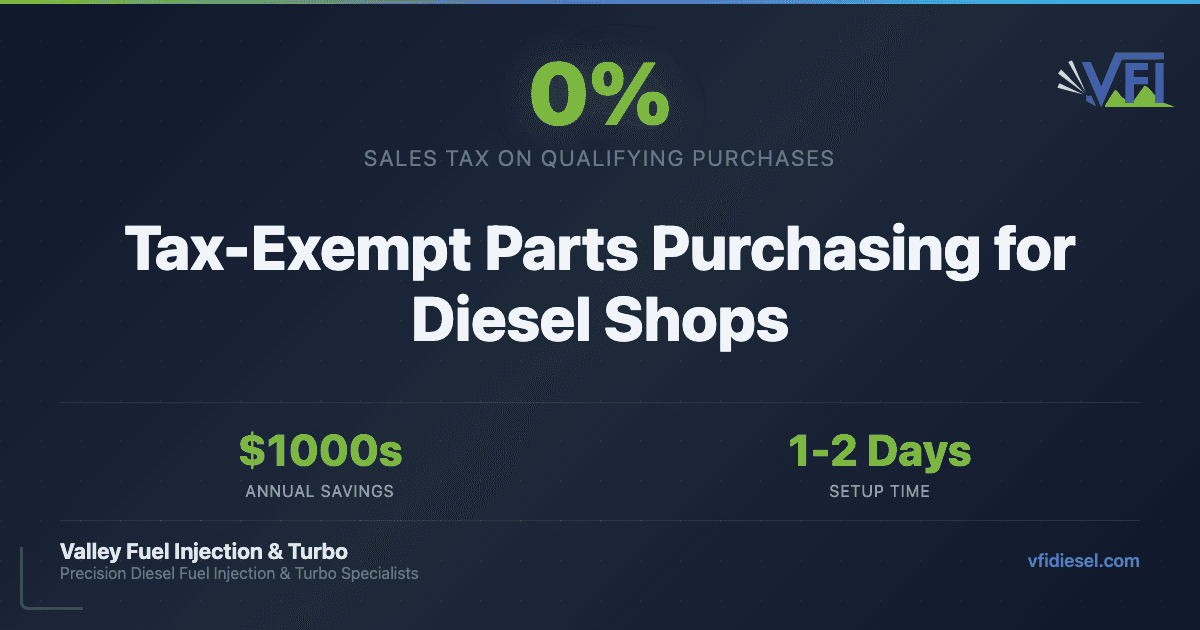
If your diesel repair shop is paying sales tax on parts you’re reselling to customers, you’re paying tax at the purchase stage that resale purchasing avoids. Tax exempt diesel parts purchasing isn’t just for the big fleet operations, it’s a fundamental business practice that can significantly improve your shop’s profitability and cash flow.
Purchases for resale avoid tax at the wholesale purchase stage; tax generally remains due on the taxable retail sale.
What Types of Tax Exemptions Apply to Diesel Repair Shops?
Two kinds of exemptions come up most for diesel repair shops: resale (parts you resell to customers) and agricultural (in California a partial exemption, claimed by a qualifying farm customer on qualifying farm equipment and parts).
Resale exemptions are the most universally applicable. When you purchase a fuel injector, turbocharger, or engine part that you’ll install and charge the customer for, you shouldn’t pay sales tax on that purchase, you collect it from your end customer instead. This prevents double taxation and is recognized in all states with sales tax.
How Do You Obtain a Resale Certificate?
The process starts with your state’s department of revenue or taxation. You’ll need your business license, federal EIN, and proof of your repair shop operations. In California, the purchaser supplies a resale certificate containing the required information, generally including its seller’s permit number. CDTFA does not issue the completed resale certificate.
In California the resale certificate you give each supplier must show your name and address, your seller’s permit number, a description of what you are buying for resale, a statement that it is for resale, and the date and your signature. Your trade account documentation with parts suppliers can serve as supporting evidence.
Once approved, you’ll receive a seller’s permit number, which goes on the resale certificate you give to suppliers. The certificate allows them to sell to you without charging sales tax, provided the items qualify for resale exemption.
Misusing resale certificates can result in significant penalties and back-tax assessments. Only use exemptions for items you’re actually reselling or that qualify under specific exemption categories.
Which Diesel Parts Qualify for Tax-Exempt Purchasing?
Understanding what qualifies is crucial for maximizing your savings while staying compliant. Generally, any part that becomes part of the customer’s equipment qualifies for resale exemption, fuel injectors, injection pumps, turbochargers, engine components, filters, and gaskets.
Shop supplies present a gray area. Items like shop rags, cleaning solvents, and general tools typically don’t qualify for resale exemption. However, consumables directly used in repair work (such as gaskets, O-rings, or fluids that transfer to the customer) often do qualify.
Resale and farm relief are decided per sale, not per shop.
The specific rules vary significantly by state, so consult with a qualified tax professional familiar with your local regulations.
How Do You Set Up Tax-Exempt Accounts with Parts Suppliers?
Most major diesel parts suppliers have established processes for tax-exempt accounts. You’ll typically need to provide your resale certificate, business license, and complete a supplier-specific tax exemption form. Many suppliers require annual renewal of exemption documentation.
When setting up accounts with suppliers like Bosch, Delphi, or Alliant Power distributors, emphasize your professional repair shop status and provide comprehensive documentation upfront. This prevents delays and ensures your tax-exempt purchasing status is properly configured from day one.
For online ordering systems, most suppliers have a checkbox or field for tax-exempt status. However, phone orders often require you to remind the sales rep about your exempt status, make it part of your standard ordering process.
What Records Do You Need to Maintain?
Proper documentation is essential for audit protection. Maintain copies of all resale certificates, supplier tax-exempt account confirmations, and invoices showing tax-exempt purchases. Your accounting system should clearly identify which purchases used tax exemptions and why they qualified.
Create a simple tracking system that links exempt purchases to customer jobs. When you buy an injector tax-exempt and install it for a customer, your records should show that connection. This demonstrates the legitimate resale nature of the transaction.
California requires you to keep these records at least four years, longer if an audit or appeal is open.
Many shops use job folders or digital work order systems that include parts purchasing documentation. This creates a natural audit trail and helps identify any compliance issues before they become problems.
Some states offer voluntary disclosure programs that allow shops to correct past tax issues with reduced penalties. California voluntary disclosure addresses previously unreported use-tax liabilities; overpayment recovery is a separate process.
Tax you paid on parts you later resold is taken as a “tax-paid purchases resold” deduction on your sales tax return.
How Do Agricultural and Other Exemptions Work?
California’s farm-equipment exemption is partial and requires a qualified purchaser, qualifying equipment or parts, and qualifying agricultural use. If you service tractors, combines, irrigation equipment, or other farm machinery, check each job against those requirements. The key requirement is that the equipment being serviced must be used in agricultural production.
Some states also offer manufacturing exemptions for shops that rebuild components like fuel injection pumps or turbochargers. If you’re doing significant remanufacturing work, investigate whether these exemptions apply to your operations.
What Are Common Mistakes to Avoid?
The biggest mistake is using exemptions for items that don’t qualify. Personal use items, general shop supplies, and equipment that doesn’t transfer to customers typically don’t qualify for resale exemption. When in doubt, pay the tax rather than risk audit penalties.
Another common error is failing to collect sales tax from customers when you’ve purchased parts tax-exempt. If you buy a common rail injector without paying tax, you must collect appropriate tax from your customer (unless they also qualify for exemption).
Poor record-keeping creates audit risks even when you’re following the rules correctly. Maintain clear documentation that shows the business purpose and resale nature of exempt purchases.
How Does This Apply to Online Parts Purchasing?
Many suppliers now offer online ordering with integrated tax-exempt processing. However, you’ll still need to set up your exempt status with each supplier individually. Don’t assume your exemption with one distributor automatically applies to others.
When ordering from our online shop or other parts suppliers, verify that your tax-exempt status is properly applied before completing each order. Most systems will show “Tax: $0.00” or similar indication when exemptions are active.
For out-of-state purchases, use tax obligations may apply even when the supplier doesn’t charge sales tax. Consult with your tax advisor about use tax requirements in your state.
FAQ Section
Can I get a refund for sales tax I paid before getting my resale certificate?
It depends on your state. In California, tax you paid on parts you later resold is taken as a “tax-paid purchases resold” deduction on your sales tax return. In other states, ask your bookkeeper or tax advisor how to handle it.
Do I need separate exemption certificates for each state where I buy parts?
Not always. Many states accept an out-of-state resale certificate or a multistate form, but some require their own. Ask each out-of-state supplier which form it accepts.
What happens if I use my resale certificate for personal purchases?
This is considered fraud and can result in certificate revocation, back taxes, penalties, and interest charges. Only use exemptions for legitimate business purchases that qualify under the specific exemption category.
How often do I need to renew my resale certificate?
Requirements vary by state. Some certificates are permanent until revoked, while others require periodic renewal (typically every 1-4 years). Check with your state’s department of revenue for specific requirements.
Can I use agricultural exemptions for all diesel equipment repairs?
No. Agricultural exemptions typically only apply to equipment actually used in farming, ranching, or agricultural production. Commercial trucks, construction equipment, and other non-agricultural diesel equipment usually don’t qualify.
Tax exempt diesel parts purchasing represents one of the most straightforward ways to improve your shop’s profitability. The setup process requires some initial effort; after that, parts you buy for resale are not taxed at the purchase stage. For shops in the Sacramento area, our team at Valley Fuel Injection has helped numerous repair facilities optimize their purchasing processes and maximize tax savings.
Ready to stop overpaying for diesel parts? Call us at 530-668-0818 to discuss trade account setup and tax-exempt purchasing options. We serve diesel repair shops nationwide with competitive pricing and proper tax-exempt processing. Our Woodland, CA facility ships parts across the country, helping shops like yours maximize profitability through smart purchasing practices.