
OEM vs Reman Diesel Injectors: Worth the Price?
05/20/2026
Diesel Turbo Surging at Cruise: Causes & Fixes
05/29/2026
If your diesel truck feels noticeably weaker on a 105°F August afternoon than it does on a cool spring morning, you’re not imagining it, and you’re not alone. A diesel engine losing power in hot weather is one of the most common complaints we hear from owners across the Central Valley and Nevada, and it has real, diagnosable causes rooted in thermodynamics, fuel system physics, and component wear that heat accelerates. This post breaks down exactly why it happens, how to pinpoint the cause, and what to do about it before summer turns a manageable problem into a catastrophic repair bill.
Heat attacks diesel performance from multiple directions simultaneously, thinner air reduces combustion efficiency, fuel temperatures rise and reduce energy density, and marginal components that hold together in cool weather fail outright when temps spike. In Central Valley and Nevada summers that routinely exceed 100°F, diagnosing heat-related power loss means checking both the air side and the fuel side before drawing conclusions.
Is Heat-Related Diesel Power Loss Real, or Just Perception?
It’s absolutely real, and it’s measurable. On a 105°F day in Woodland or Reno, the air entering your intake is significantly less dense than it is at 55°F. Less dense air means less oxygen per unit volume, which means your engine cannot burn as much fuel per combustion cycle without producing excessive smoke. The ECM in modern diesels actually detects this and pulls fueling to protect the engine and stay within emissions parameters. You feel that as a power reduction. On a turbocharged diesel, the turbo is also working harder to compress thinner, hotter air, and if the intercooler can’t cool that charge air adequately, intake temps climb further, compounding the problem.
On top of the physics, heat accelerates wear and causes marginal components to fail. A fuel injector that’s borderline on spray pattern at 60°F may cross the threshold into actual misfiring at 100°F. A boost pipe with a hairline crack that seals under moderate thermal expansion may open up at peak summer temps. So the power loss you feel in summer is partly a normal thermodynamic effect, and partly your truck telling you something is about to break.
Air density drops roughly 3% for every 10°F rise in ambient temperature. On a 105°F day versus a 65°F day, you’re starting with about 12% less oxygen in every intake stroke, before the turbo even enters the equation. That’s a meaningful reduction in potential power output, and it’s why diesel performance tuners often reference SAE-corrected horsepower numbers. Learn more about how air density affects engine output at SAE International.
How Does High Ambient Temperature Affect Turbo Performance and Fuel Delivery?
The turbocharger is your first line of defense against thin hot air, and also one of the first components to struggle in extreme heat. Here’s what happens in sequence on a hot summer day:
1. Turbo inlet temperature rises. Your turbo is spinning up to 150,000 RPM and sitting inches from an exhaust manifold that’s already glowing. When ambient air is 105°F instead of 65°F, the turbo is starting with warmer air, compressing it further, and generating even more heat of compression. Compressor outlet temperatures can exceed 300°F on a hard pull in summer heat.
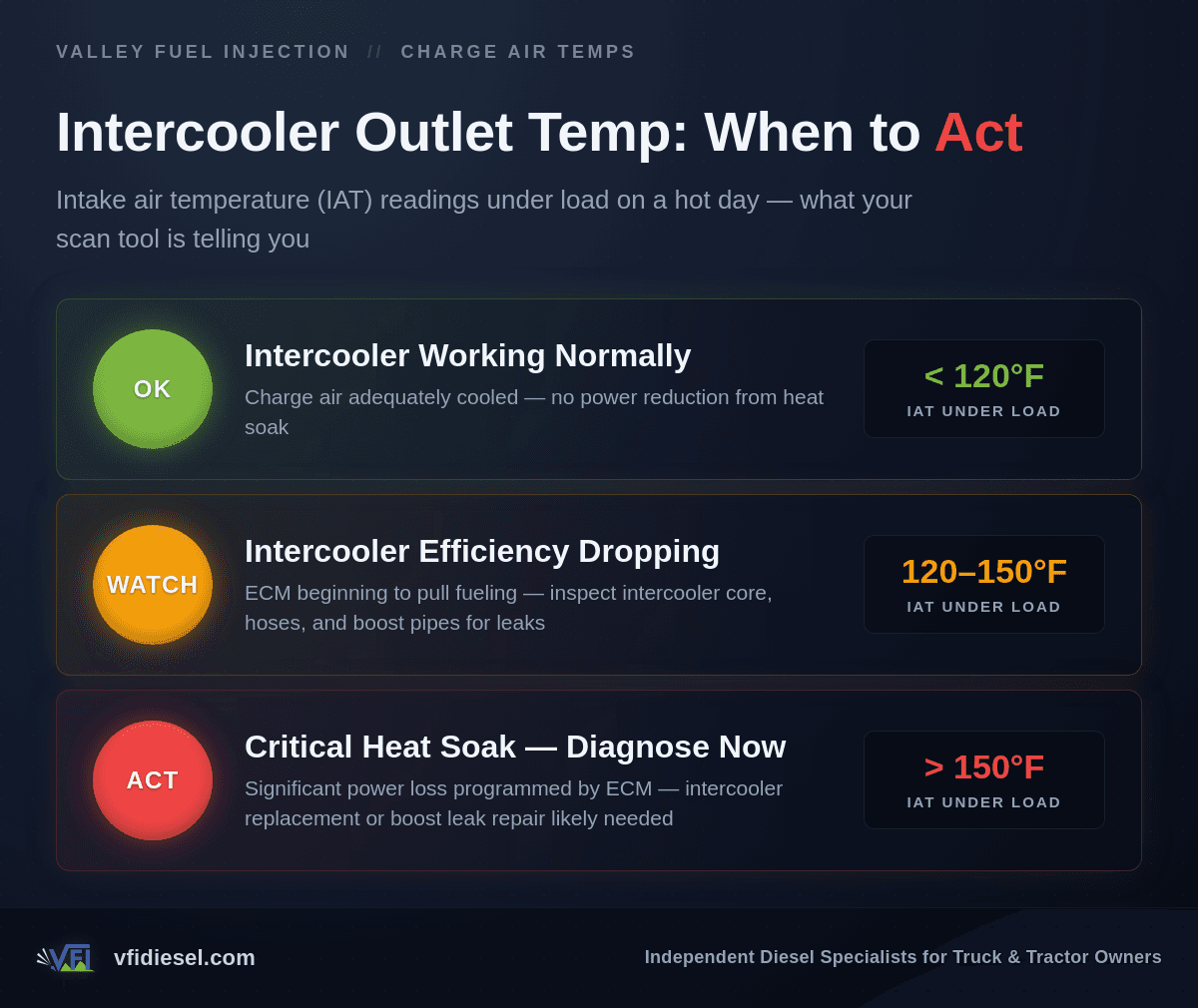
2. Intercooler efficiency drops. The intercooler (charge air cooler) is supposed to strip that heat out of the compressed air before it enters the engine. But the intercooler is cooled by ambient air, and when ambient air is 105°F, the temperature differential across the intercooler core shrinks dramatically. A stock intercooler that works adequately at 65°F may allow intake charge temps of 160°F+ in midsummer, which directly reduces air density entering the cylinders and can cause detonation in performance applications.
3. Fuel temperature climbs. Hot fuel is less dense, so each injection carries less energy and you feel it as lost power under load; our summer guide explains what happens to diesel fuel when it gets hot.
4. The ECM compensates, sometimes too aggressively. Modern diesel ECMs monitor intake air temperature (IAT), coolant temperature, fuel temperature (on equipped platforms), and rail pressure. When these readings climb, the ECM dials back fueling and boost targets to protect the engine. On a stock tune this is appropriate, but it means you feel the power reduction as a real, programmed response to heat stress.
If your diesel feels weak only after 20–30 minutes of highway driving on a hot day but runs fine when cold, that’s a classic heat-soak signature. The engine is fine at startup because everything is still at ambient temp. As components heat up, especially the intercooler, fuel lines, and injection pump, performance degrades. Log your IAT sensor and fuel rail pressure with a scan tool on a hot afternoon pull and compare to a cold morning run. The data will tell you exactly where the bottleneck is.
What Fuel System Problems Get Dramatically Worse in Hot Weather?
Heat is the accelerant that turns a developing fuel system problem into an urgent one. These are the issues we see most often at our shop during summer months:
Failing Lift Pump / Transfer Pump
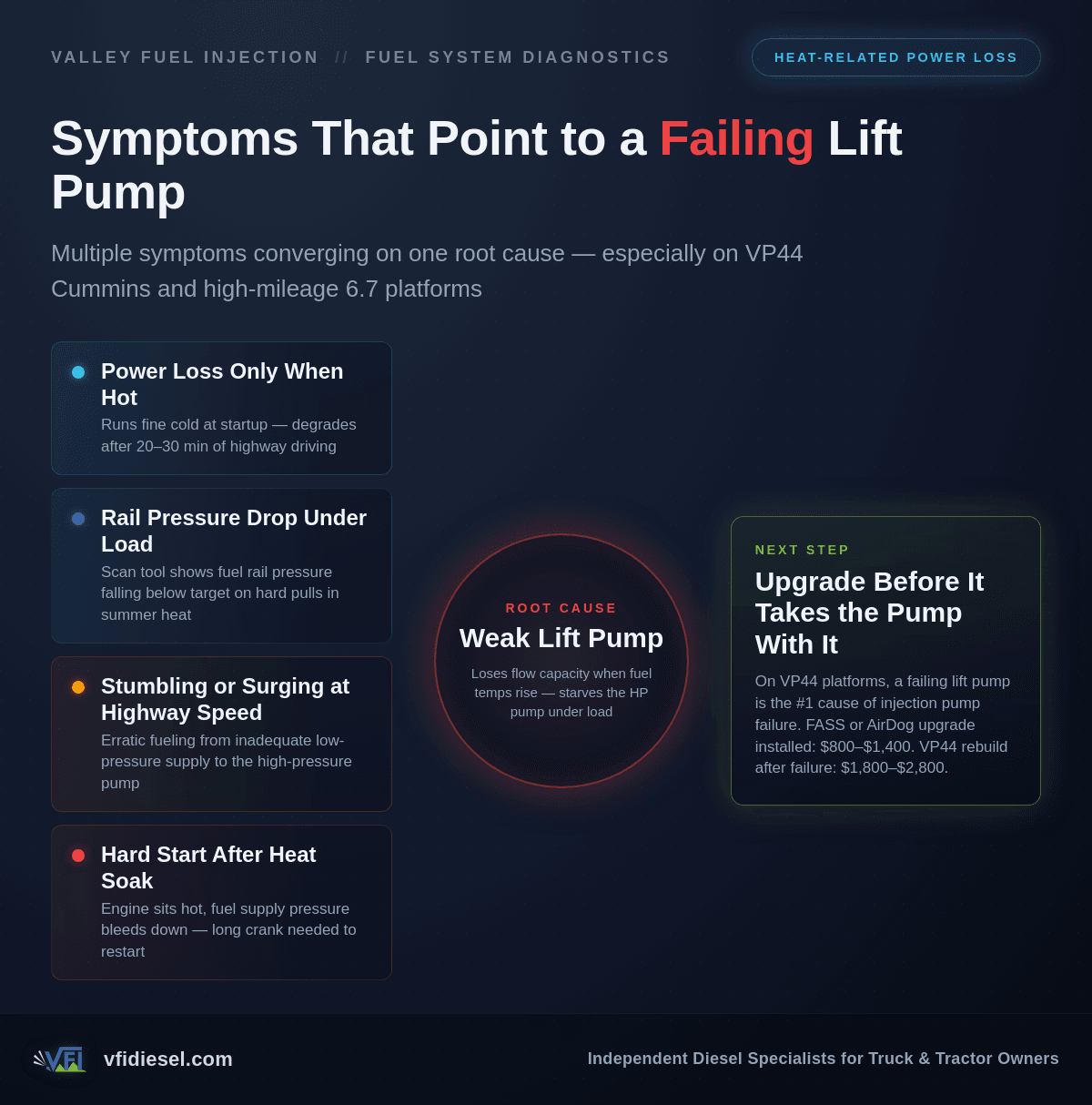
The lift pump is responsible for supplying low-pressure fuel to the injection pump or high-pressure pump. Lift pump motors generate heat during operation, and they rely partly on cool fuel flow for self-cooling. In summer, fuel temps are already elevated, and if the lift pump is worn, it loses flow capacity faster when hot. The result: inadequate fuel supply to the high-pressure side under load, causing rail pressure drop, stumbling, and power loss, symptoms that may not appear at all on a cool morning. On Cummins 5.9 and 6.7 platforms, a weak OEM lift pump is one of the most common causes of summer power loss we diagnose.
Restricted Fuel Filters
A partially clogged fuel filter creates a restriction that the lift pump has to overcome. In cool weather, fuel flows more easily and the pump can compensate. In hot weather, thinner (lower-viscosity) fuel actually flows somewhat more easily, but a severely clogged filter combined with heat-stressed pump performance creates a scenario where fuel delivery falls short under high-load, high-temperature conditions. Change your fuel filter before summer if you’re anywhere near the service interval.
Marginal Injectors
Worn injectors that are borderline on spray pattern, opening pressure, or return flow often reveal themselves in heat. The injector’s internal clearances change with temperature. An injector that’s leaking internally (excessive return flow) wastes high-pressure fuel as heat, and that heat compounds injector wear. On common rail systems, excessive injector return flow bleeds down rail pressure, and the high-pressure pump has to work harder to maintain target pressure, generating more heat in the process. It’s a feedback loop that gets worse as temperatures rise. If you’re seeing black smoke on hard pulls in summer but not in spring, worn injectors are high on the suspect list.
VP44 Pump Heat Sensitivity
The Bosch VP44 injection pump used in 1998.5–2002 Dodge 5.9 Cummins trucks is notorious for heat sensitivity. The VP44’s internal electronics, specifically the module that controls injection timing, are vulnerable to heat damage. The pump relies on fuel flowing through it for cooling, which is why a weak lift pump is often the direct cause of VP44 failure. In summer, with higher fuel temps and a struggling lift pump, VP44 failures spike dramatically. We rebuild VP44 pumps regularly, and summer is always our busiest season for them. You can read more about our Bosch injection pump repair services if you’re dealing with VP44 issues.
CP4 High-Pressure Pump Stress (LML Duramax / 6.7 Powerstroke)
The CP4.2 pump used in the LML Duramax (2011–2016) and 2011–2019 6.7 Powerstroke is a known weak point in any condition, but heat stress accelerates its failure mode. The CP4 relies on diesel fuel for lubrication, and as fuel temperatures rise and fuel quality degrades (thin summer fuel, ethanol-blended diesel), lubrication film thickness drops. A CP4 that’s already showing early wear signs can go catastrophic on a hot summer tow. When a CP4 fails catastrophically, metal debris contaminates the entire fuel system, injectors, fuel lines, rails, and tank. That repair typically runs $10,000–$18,000+ at California specialty-shop rates. Prevention is far cheaper than the cure.
If your LML Duramax or 2011–2019 6.7 Powerstroke suddenly loses power, stumbles, or dies on a hot day, do NOT keep running it. A failing CP4 pump can send metal shrapnel through your entire fuel system within minutes of initial failure. Shut it down, have it towed, and have the fuel system inspected before attempting to restart. Continuing to run a CP4-equipped truck through a failure event can turn a $4,000–$6,000 pump replacement into a $12,000–$18,000+ fuel system replacement. See our related post on diesel engines that won’t stay running for more on sudden power loss events.
Fuel Return Line Restrictions and Heat Soak
On common rail systems, injectors return unused high-pressure fuel back to the tank through return lines. If these return lines are kinked, restricted, or routed near heat sources, return fuel temperature climbs, and that hot fuel goes back into the tank and recirculates through the system. Over time, this raises the entire fuel system temperature. In extreme cases, fuel temps can reach 140–160°F, well above the threshold where vapor formation and reduced energy density become significant problems.
How Do You Diagnose Heat-Related Power Loss: Fuel Side vs. Air Side?
The key to diagnosing a diesel engine losing power in hot weather is separating air-side problems from fuel-side problems, and ruling out the simple stuff first. Here’s the diagnostic sequence we follow at Valley Fuel Injection:
| Check | What It Tells You | Side |
|---|---|---|
| Scan tool IAT reading (hot vs. cold) | Intercooler efficiency, air filter restriction | Air |
| Boost pressure log under load | Turbo output, boost leaks, VGT vane sticking | Air |
| Boost leak test (pressurize charge pipes) | Heat-expanded cracks in intercooler hoses/pipes | Air |
| Fuel rail pressure log (hot idle + load) | Lift pump output, injector return flow, HP pump wear | Fuel |
| Fuel temperature sensor reading | Fuel heat soak, return line restriction | Fuel |
| Injector return flow test (balance rates) | Worn injectors bleeding down rail pressure | Fuel |
| Fuel filter restriction / differential pressure | Filter clog starving the HP pump | Fuel |
| EGR cooler / oil cooler inspection | Internal coolant leaks raising combustion temps | Cooling |
The diagnostic fee for a heat-stress inspection, including a scan, boost leak test, fuel rail pressure log, and coolant temp review, typically runs $175–$350 at our shop. That’s almost always credited toward the repair when we find something. Compared to the cost of guessing wrong on a summer tow failure, it’s money well spent.
For a deeper look at boost leak symptoms specifically, see our detailed post on turbo boost leak symptoms and diagnosis, many of the heat-related air-side problems we see manifest as boost leaks that only open up under thermal expansion.
Here’s what common heat-related diesel repairs typically cost at a California specialty shop in 2026:
- Diagnostic / heat-stress inspection: typically $175–$350
- Intercooler replacement (light-duty diesel truck): typically $1,400–$2,200
- Fuel temperature sensor replacement: typically $250–$550
- IAT sensor replacement: typically $175–$400
- Lift pump replacement (FASS/AirDog upgrade, installed): typically $800–$1,400
- VP44 injection pump rebuild: typically $1,800–$2,800
- CP4.2 replacement (pump only): typically $3,500–$6,000+
- Diesel injector set replacement (6.7 Cummins, installed): typically $3,500–$5,500
- Turbocharger replacement (VGT, installed): typically $2,800–$4,500
- EGR cooler replacement: typically $1,800–$3,800
Prices reflect typical California specialty-shop ranges as of 2026. Your actual quote depends on the condition of your specific components, parts availability, and current labor rates. Call VFI at 530-668-0818 for an accurate quote on your job.
Which Diesel Platforms Are Most Vulnerable to Heat-Related Fuel System Issues?
Not all diesel trucks handle heat equally. Here’s how the major platforms stack up based on what we see in the shop:
Dodge/Ram 5.9 Cummins (1998.5–2002: VP44)
The most heat-sensitive platform we work on. The VP44 pump’s internal module is directly cooled by fuel flow, and a stock lift pump that’s even slightly worn will cause the VP44 to overheat under summer load. Symptoms: stumbling at highway speed on hot days, hard starts after heat soak, sudden loss of power. If you own one of these trucks and haven’t upgraded to an aftermarket lift pump (FASS, AirDog), do it before summer. VP44 rebuilds run $1,800–$2,800, and that’s if the pump is the only casualty.
Dodge/Ram 6.7 Cummins (2007.5–Present)
The 6.7 Cummins uses a CP3 high-pressure pump, which is considerably more durable than the CP4. However, the stock lift pump is a known weak point, especially on high-mileage trucks used for towing in heat. Rail pressure drop on hot summer pulls is a common complaint, and worn injectors compound it. The 6.7 is also sensitive to intake air temperature through its VGT turbo, sticky VGT vanes (from EGR soot buildup) reduce boost at high temps. Our common rail service covers the full fuel system on these trucks.
GM 6.6 Duramax LML (2011–2016)
The LML Duramax’s CP4.2 pump is the single biggest heat-related vulnerability in the modern diesel truck market. California’s summer diesel fuel, which often contains biodiesel blends that reduce lubricity, combined with high fuel temperatures creates the worst possible environment for a CP4. We’ve written about how California’s biodiesel blends damage injection systems, it’s directly relevant to CP4 survival in summer. LML owners towing in the Central Valley or Nevada in summer should seriously consider a CP4-to-CP3 conversion before a failure event forces the decision.

Ford 6.7 Powerstroke (2011–2019)
Like the LML, the 2011–2019 6.7 Powerstroke uses a CP4.2 pump and carries the same catastrophic failure risk in heat. Ford addressed this in the 2020 redesign, but if you’re running a first- or second-gen 6.7, the CP4 risk is real. The 6.7 PS also runs a twin-turbo setup on some years, and the small turbo in the compound arrangement is particularly sensitive to heat soak. Boost response on hot days can feel noticeably sluggish if the small turbo’s VGT vanes are sticking.
Ford 7.3 and 6.0 Powerstroke (HEUI)
The HEUI injection system used in the 7.3 and 6.0 Powerstroke uses engine oil pressure to actuate injectors. In hot weather, oil viscosity drops, which affects HPOP output and injection pressure. On a 6.0 with a failing oil cooler, a very common failure mode, coolant mixes with oil, which further degrades oil viscosity and HPOP performance in heat. If your 6.0 Powerstroke loses power on hot days and you haven’t replaced the oil cooler, that’s the first place to look. See our post on diesel engine oil pressure loss for more on how oil system health affects injection on HEUI platforms. If the oil side checks out on a 6.0, our 6.0 Powerstroke injector problems guide covers the FICM voltage and injector tests that come next.
If you’re comparing heat-related power loss to mechanical or load-related causes, our post on diesel engine losing power under load covers the non-thermal side of the same symptom. Many owners deal with both simultaneously, a mechanically worn injector that causes power loss under load AND heat-related rail pressure drop that makes the same symptom worse in summer.
What Maintenance Steps Reduce Heat-Related Power Loss in Northern California and Nevada Summers?
Prevention is always cheaper than repair. Here’s what we recommend to diesel owners in the Central Valley, Sacramento area, and Nevada before summer heat arrives:
1. Upgrade your lift pump before summer. If you’re on a VP44 platform (98.5–02 Cummins), this is non-negotiable. FASS and AirDog systems provide consistent fuel pressure, filter water and air from the fuel supply, and dramatically extend VP44 and injector life. Installed cost typically runs $800–$1,400, a fraction of a VP44 rebuild.
2. Replace fuel and air filters at the start of the hot season. A clean fuel filter and air filter reduce the workload on both the lift pump and the turbocharger. In dusty Central Valley conditions, air filters clog faster than the service interval suggests, inspect yours visually every spring.
3. Inspect intercooler hoses and charge pipes. Heat cycling causes rubber boost pipes to harden and crack. A boost leak test before summer will catch hairline cracks that only open up under full thermal expansion. This is a $175–$350 diagnostic that has saved many customers from a summer tow-in.
4. Use a quality diesel fuel additive with lubricity improver. California’s CARB-compliant diesel and biodiesel blends can have marginal lubricity, especially in summer. A lubricity additive (Stanadyne Performance Formula, Power Service, Hot Shot’s Secret) costs pennies per gallon and measurably reduces injection system wear. The California Air Resources Board (CARB) sets strict fuel composition standards that affect lubricity, supplementing with an additive is a reasonable precaution in this state.
5. Check coolant system health. An EGR cooler or engine oil cooler that’s beginning to fail will cause coolant temps to rise in hot weather, which compounds every other heat-related issue. Pressure-test your cooling system and inspect coolant condition before summer. The EPA’s emissions regulations require functioning EGR systems on modern diesels, a failing EGR cooler affects both performance and compliance.
6. Have injectors tested if they’re high-mileage. Common rail injectors on 6.7 Cummins, Duramax, and Powerstroke platforms typically show measurable wear by 150,000–200,000 miles. A bench test, running $50–$100 per injector, tells you exactly where each injector stands before summer towing season. Catching a marginal injector before it fails completely is far cheaper than dealing with the downstream damage. Learn more about our injector testing and repair services.
7. Address VGT turbo vane sticking proactively. On 6.7 Cummins and 6.6 Duramax trucks, EGR soot buildup causes VGT vanes to stick, reducing boost response and making heat-related power loss significantly worse. A turbo inspection and cleaning can restore boost response before summer. See our turbocharger service page for what’s involved. For more on Bosch-certified turbo service, Bosch Mobility publishes technical resources on variable geometry turbocharger maintenance.
Diesel owners in the Sacramento and Davis areas can bring their trucks into our Woodland shop for a pre-summer fuel system inspection. We’re also a resource for diesel fuel injection service in Sacramento and diesel service for Reno and northern Nevada customers, and we accept mail-in injectors and pumps for testing and rebuilding from customers across the country.
Don’t wait until your diesel loses power on a 108°F afternoon on I-5 with a load behind you. Call Valley Fuel Injection at 530-668-0818 or schedule a diagnostic online. We’re located at 1243 E Beamer St, Suite C, Woodland, CA 95776, serving the Central Valley, Sacramento region, and Nevada since 1993. We also ship remanufactured injectors and pumps nationwide and accept mail-in units for bench testing and rebuilding.
Frequently Asked Questions
Why does my diesel truck feel weaker in summer but run fine in cool weather?
This is a real, measurable effect, not just perception. Hot ambient air is less dense, meaning less oxygen per intake stroke, which reduces combustion efficiency and causes the ECM to pull fueling. On top of that, heat causes marginal components (worn injectors, weak lift pumps, cracked boost pipes) to fail outright when they might hold together at cooler temperatures. If the power loss is dramatic or sudden, have the truck inspected, it may be signaling a developing failure rather than just normal thermal behavior.
Can hot diesel fuel cause power loss, and what helps?
Yes. Hot fuel is less dense, so it carries less energy per injection and power drops under load. It is also thinner, so it lubricates the pump and injectors less and they wear faster. A quality fuel cooler or an upgraded lift pump system helps manage fuel temperatures in hot climates. Our summer guide covers diesel fuel temperature limits and heat damage.
Is a CP4-to-CP3 conversion worth it for towing in California summers?
For LML Duramax and 2011–2019 6.7 Powerstroke owners who tow regularly in hot weather, a CP4-to-CP3 conversion is one of the best investments you can make. The CP3 is a far more robust pump that tolerates heat, marginal fuel quality, and high-demand towing conditions far better than the CP4. A full conversion typically runs $4,500–$8,500 installed, compared to $10,000–$18,000+ if a CP4 fails catastrophically and contaminates the entire fuel system. We perform this conversion at our Woodland shop and can discuss the options for your specific truck.
Can a stuck VGT turbo cause heat-related power loss?
Yes, and it’s one of the most common air-side causes of summer power loss on 6.7 Cummins and 6.6 Duramax trucks. EGR soot accumulates on VGT vane rings over time, and heat can cause the soot to harden and stick the vanes in a partially closed position. This reduces boost output and response, especially at highway speeds. Symptoms include sluggish acceleration, lower-than-normal boost pressure readings, and occasionally a check engine light for turbo underboost. A turbo inspection and cleaning often resolves this without full turbo replacement.
How do I know if my intercooler is causing heat-related power loss?
The clearest indicator is a high IAT (intake air temperature) reading on a scan tool during a hot-day pull. If your IAT is climbing above 140–150°F under load, the intercooler is not adequately cooling the charge air. A boost leak test will also reveal cracked intercooler hoses or a damaged core that’s leaking boost pressure. Visually inspect the intercooler core for bent fins, oil contamination (which indicates a boost leak from the engine side), and cracked end tanks. An intercooler replacement on a light-duty diesel truck typically runs $1,400–$2,200 at a California specialty shop.
Whether you’re dealing with heat-related power loss right now or want to get ahead of summer before it causes a roadside failure, our team has the diagnostic equipment, factory training, and 30+ years of hands-on experience to find the problem fast. We’re a Bosch-authorized diesel fuel injection testing and remanufacturing center serving Northern California and Nevada. Call us at 530-668-0818, schedule a diagnostic, or visit us at 1243 E Beamer St, Suite C, Woodland, CA 95776. We ship remanufactured injectors, pumps, and parts nationwide, contact us about our mail-in testing and rebuild service.