DPF Effect on Diesel Injectors: Fleet Guide
06/28/2026
How Long Do Diesel Injectors Last? What Kills Them
07/16/2026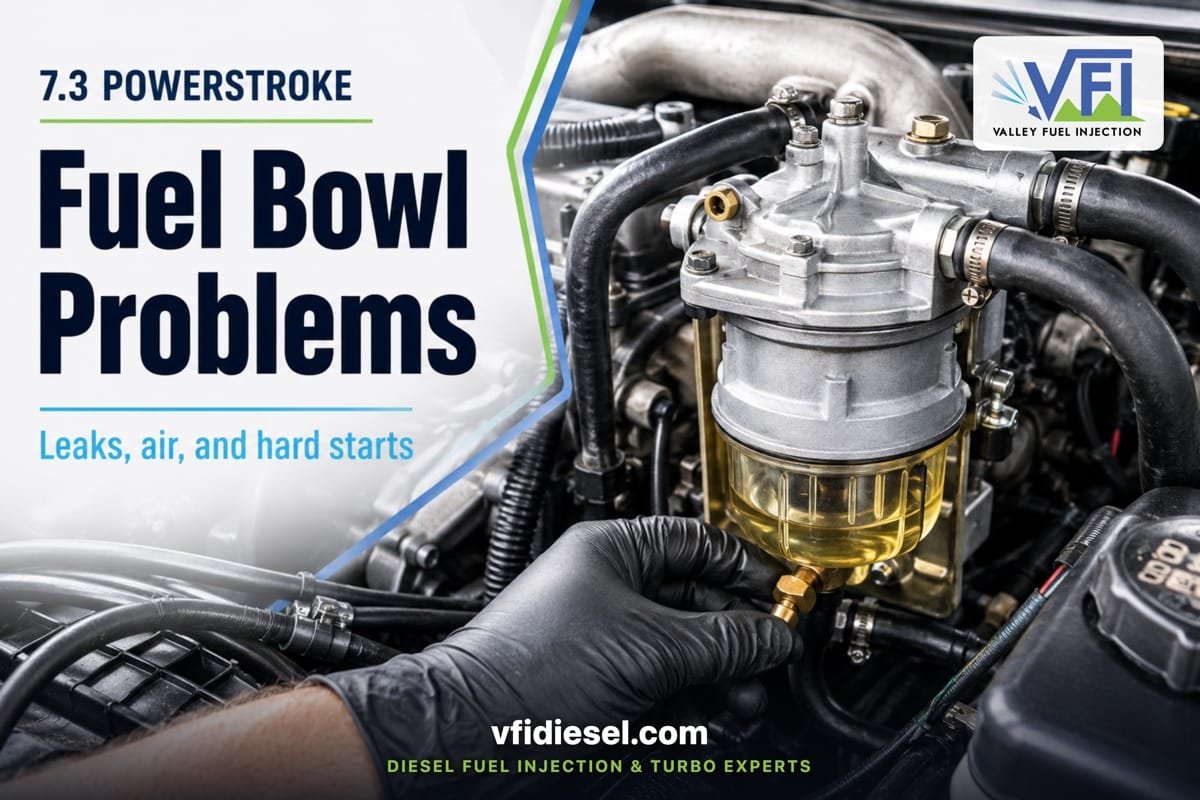
7.3 Power Stroke Fuel Bowl Problems: Leaks, O-Rings, and What Actually Fails
The 7.3 Power Stroke fuel bowl is one of the most overlooked failure points on an otherwise bulletproof engine. If your 7.3 is hard to start when cold, losing fuel pressure overnight, or leaving a diesel smell under the hood, there is a good chance the fuel bowl is involved. This component sits inline between the lift pump and the HEUI injection system, and when it starts leaking or its internal regulator fails, the entire fuel system pays the price. Here is what actually fails, how to diagnose it, and what a proper rebuild involves.
The 7.3 Power Stroke fuel bowl is a wear item, not a lifetime part. O-rings harden and crack, the fuel pressure regulator loses its spring tension, and the drain valve seeps fuel. A complete reseal and FPR rebuild is a straightforward job that prevents hard starts, rough running, and long-term damage to your HPOP and injectors.
What Is the Fuel Bowl on a 7.3 Power Stroke and What Does It Do?
The fuel bowl is a small aluminum housing mounted on the driver-side valve cover area of the 7.3 Power Stroke, and it serves as the central hub of the low-pressure fuel system. It holds a replaceable spin-on fuel filter, houses the fuel pressure regulator (FPR), integrates a water separator with a drain valve at the bottom, and routes fuel from the lift pump to the injection system. On 1994.5 through 2003 model-year trucks, this assembly is a shared design with minor revisions across the OBS (1994.5–1997) and Super Duty (1999–2003) generations.
Before fuel ever reaches your high-pressure oil pump (HPOP) or injectors, it passes through the fuel bowl. The FPR inside the bowl controls fuel pressure, typically targeting around 45–65 PSI depending on demand. A small poppet valve and spring regulate that pressure, and when those parts wear out, fuel pressure drops, fuel delivery suffers, and the engine starts behaving erratically.
Ford revised the fuel bowl design several times across the 7.3’s production run. The OBS (1994.5–1997) bowl has slightly different fitting locations than the Super Duty (1999–2003) bowl. Parts kits are not always interchangeable, so confirm your model year before ordering a rebuild kit.
What Are the Most Common Fuel Bowl Failure Points, and What Causes Them?
There are four distinct failure points in the 7.3 Power Stroke fuel bowl, and most trucks will experience at least two of them by the time they reach 150,000 miles.
1. O-Ring Seals (External Leaks)
The fuel bowl uses multiple rubber O-rings to seal fittings, the filter housing interface, and the drain valve assembly. These O-rings are made from standard rubber compounds that harden, crack, and shrink over time, especially in the heat cycles common to a diesel engine bay. California heat makes this worse. Once an O-ring fails, you get an external fuel leak that ranges from a slow seep to an active drip. The fuel smell is usually the first thing owners notice, followed by a visible wet spot on the bowl housing or on the valley below it.
2. Fuel Pressure Regulator (FPR) Wear
The FPR inside the bowl uses a poppet valve, a poppet seat, and a spring to hold system pressure. Over time, the spring loses tension and the poppet seat wears or erodes. When this happens, the regulator cannot hold adequate fuel pressure, especially after the truck sits overnight. The result is extended cranking on cold starts because the system has to build pressure from scratch rather than maintaining residual pressure. This is the single most common complaint we hear from 7.3 owners, and the FPR is almost always the cause.
3. Drain Valve Assembly (Seeping or Stuck)
The drain valve at the bottom of the bowl allows you to drain accumulated water from the separator. These valves develop two problems. First, the valve seat wears and allows a slow fuel seep even when closed. Second, the valve body itself corrodes or seizes, making it impossible to drain the bowl during filter changes. A seeping drain valve is a fire hazard and a DEQ concern, and a seized one means water accumulates in the bowl until it gets pushed into the injection system.
4. Housing Cracks and Fitting Damage
The aluminum bowl housing itself can crack at the fitting bosses, particularly on high-mileage trucks where fittings have been removed and reinstalled multiple times. Overtightened fuel line fittings are the most common cause. A cracked housing cannot be reliably resealed with O-rings alone and typically requires a replacement assembly.
A fuel leak at the bowl is not just a nuisance. Diesel fuel dripping onto hot exhaust components or the engine block is a fire risk. If you see active dripping or smell fuel strongly in the cab, address this before driving the truck. Do not assume a slow seep will stay slow.
How Do You Know If a Fuel Bowl Leak Is Causing Your Starting or Running Problems?
Fuel bowl problems produce a recognizable symptom pattern, and once you know what to look for, diagnosis is straightforward.
Extended cold starts (5+ seconds of cranking): This is the hallmark symptom of a failed FPR. When the regulator cannot hold residual pressure overnight, the fuel system bleeds down. The next morning, the lift pump has to refill and pressurize the entire system before the engine will fire. On a healthy 7.3, cold starts should take 2–4 seconds of glow plug wait time and then fire quickly. Anything longer points to a pressure retention problem, and the fuel bowl FPR is the first place to check before condemning the lift pump or injection pump.
Rough idle after sitting: If the truck starts rough and smooths out after 30–60 seconds, that is consistent with air intrusion from a leaking seal. Air gets pulled into the low-pressure side of the system through a failing O-ring or drain valve, and the engine runs rough until the lift pump purges it.
Fuel smell under the hood: Diesel has a distinctive smell, and even a minor seep at the bowl is noticeable. If you can smell fuel but cannot see an obvious leak, wipe the bowl housing dry with a rag, run the engine for five minutes, and inspect again. Wet spots will reappear quickly if there is an active leak.
Visible fuel at the bottom of the bowl: The drain valve is at the lowest point of the assembly. Wet residue here that is not from a recent intentional drain is a clear sign the drain valve is seeping.
Low fuel pressure at the rail: If you have a fuel pressure gauge (or can borrow a mechanical gauge), fuel pressure at idle should be in the 45–65 PSI range on a healthy 7.3. Pressure below 40 PSI at idle, or pressure that drops rapidly when you shut the engine off, points directly at the FPR.
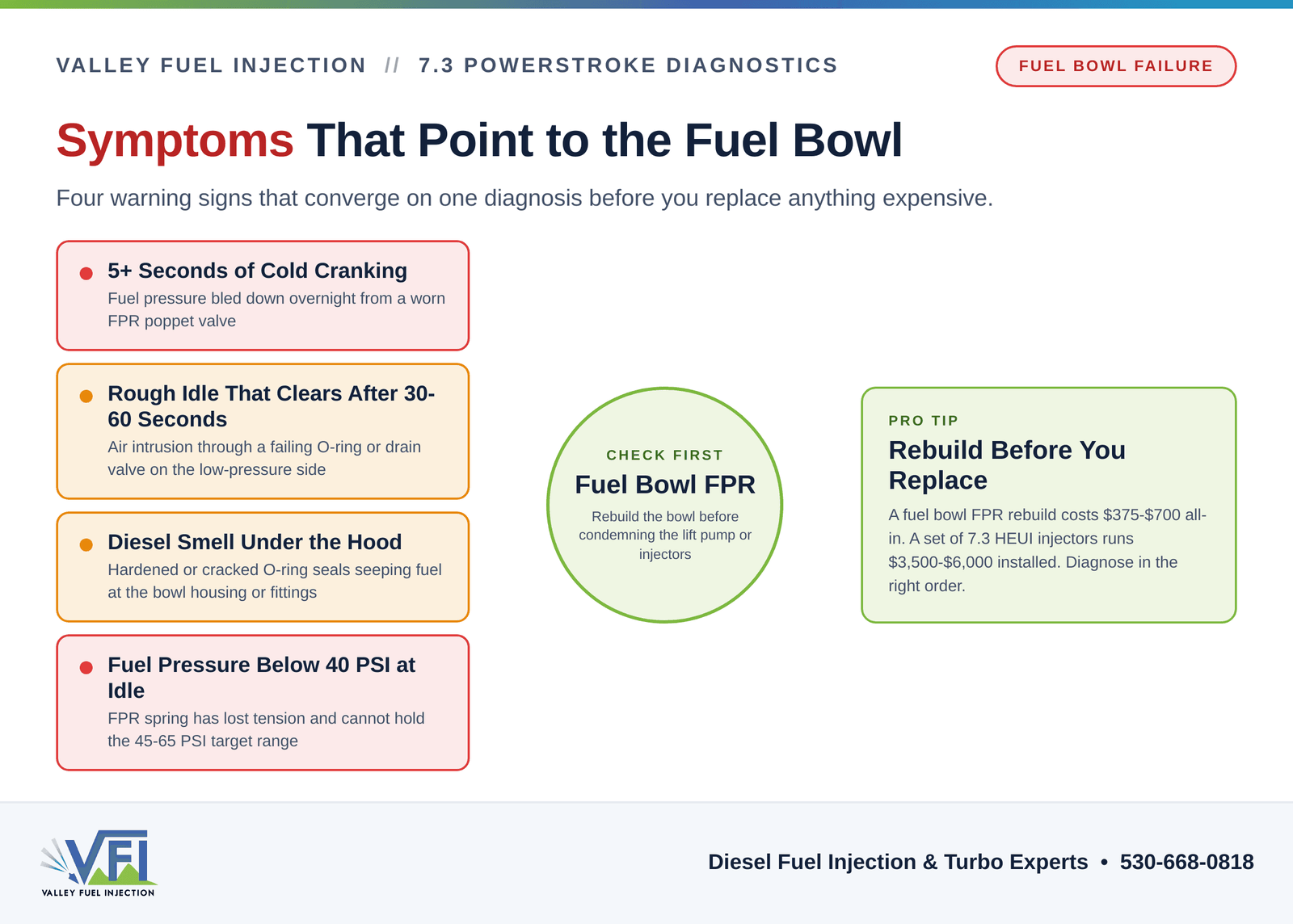
Before you replace the lift pump on a 7.3 with hard-start complaints, rebuild the fuel bowl FPR first. A new lift pump costs significantly more and will not fix a pressure-retention problem caused by a worn poppet valve. We see this misdiagnosis regularly at our shop. Rebuild the bowl, verify fuel pressure, and then evaluate the lift pump if the problem persists. If you need help sorting it out, schedule a diagnostic with our team.
What Is Involved in a Proper Fuel Bowl Rebuild: Parts, Process, and Difficulty Level?
A complete fuel bowl rebuild addresses all four failure points at once. Doing it piecemeal is a false economy because the labor to access the bowl is the same whether you replace one O-ring or all of them.
Parts You Need for a Complete Rebuild
| Component | What It Does | Parts Cost (Typical) |
|---|---|---|
| O-Ring Reseal Kit | Seals all external fittings and interfaces | $50–$85 (after shop markup) |
| FPR Rebuild Kit | Poppet valve, seat, spring, guide, hardware | $90–$160 (after shop markup) |
| Drain Valve Assembly | Replaces seeping or seized drain valve | $60–$100 (after shop markup) |
| Blue Spring Upgrade Kit | Raises FPR pressure slightly for better cold starts | $30–$65 (after shop markup) |
| Billet Cap (optional upgrade) | Replaces plastic cap, eliminates a common leak point | $65–$110 installed |
| Fuel Filter | Replace any time the bowl is opened | Included in most service visits |
Parts and labor vary by region, engine condition, and current pricing. Call us at 530-668-0818 for an accurate quote.
OEM-spec parts from suppliers like Alliant Power are worth the premium over generic aftermarket kits. The poppet valve and seat are precision components, and cheap replacements often fail prematurely or do not seal correctly. Our Alliant Power parts and service page covers what we stock for 7.3 fuel system components.
The Rebuild Process
The basic procedure involves removing the fuel lines from the bowl, draining the filter housing, disassembling the FPR cavity, cleaning all mating surfaces, installing new O-rings with clean diesel fuel as lubricant, pressing in the new poppet seat, installing the new poppet valve and spring, reassembling the drain valve, and reinstalling the bowl. Some shops prefer to remove the bowl from the truck entirely for bench work, which adds time but allows for a more thorough inspection and cleaning. Either way, the job is not technically difficult, but it does require attention to detail. One cross-threaded fitting or a pinched O-ring puts you right back to a leak.
The Bosch diesel fuel injection engineering standards that govern precision fuel system components apply here too: cleanliness and correct torque are non-negotiable. Contamination introduced during a rebuild is just as damaging as the original failure.
The “blue spring” upgrade is a popular modification on 7.3 builds. The stock FPR spring is calibrated conservatively, and installing a slightly stiffer spring raises fuel pressure a few PSI, which improves cold-start fuel delivery and can sharpen throttle response. It is a low-cost addition to a rebuild that most experienced 7.3 owners consider standard. Ask about it when you bring your truck in.
Can a Leaking Fuel Bowl Damage Your HPOP or Injectors If Ignored?
Yes, and this is where a fuel bowl problem that seems minor becomes expensive if you wait too long.
The 7.3 Power Stroke uses a HEUI (Hydraulically actuated Electronically controlled Unit Injector) system. The injectors are fired by high-pressure engine oil, but they still require adequate fuel pressure on the low-pressure side to deliver a proper fuel charge. When the FPR fails and fuel pressure drops, the injectors do not receive enough fuel volume at the right pressure, and they begin to cavitate. Over time, cavitation erodes the precision internal components of the injector body. This is slow damage, but it accumulates.
The connection to the HPOP is indirect but real. When an engine cranks excessively to start because of low fuel pressure, the HPOP is cycling under load repeatedly without the engine firing. Extended cranking also stresses the oil system because the HPOP depends on adequate oil pressure to build injection pressure. More importantly, water intrusion through a neglected drain valve can eventually reach the injection system. Water in diesel fuel is corrosive to injector tips, check valves, and the precision bore of the HPOP itself. Our post on 7.3 Power Stroke HPOP problems covers what happens when the high-pressure side of this system fails, and the repair costs are significantly higher than a fuel bowl rebuild.
If you are also dealing with injector wear on your 7.3, our Bosch diesel injector testing and repair service can evaluate what you are actually working with before you commit to replacement costs.
Water contamination in diesel is one of the fastest ways to destroy precision injection components. The 7.3’s fuel bowl drain valve exists specifically to prevent water accumulation from reaching the injectors. If you cannot remember the last time you drained the bowl separator, do it now. A stuck or seeping drain valve should be replaced immediately, not deferred.
For context on how fuel system neglect compounds across components, our post on summer diesel fuel system problems covers how heat accelerates seal degradation and contamination issues across the entire fuel circuit.
When Does a Fuel Bowl Rebuild Make Sense vs. Replacement, and What Does It Cost?
For most 7.3 Power Stroke owners, a rebuild is the right call. The aluminum bowl housing is durable and, as long as it is not cracked or has stripped fittings, it can be resealed and rebuilt indefinitely. Replacement assemblies are available when the housing itself is compromised, but they are not cheap and the labor to swap them is the same as a rebuild anyway.
Rebuild vs. Replace Decision Guide
| Condition | Recommendation |
|---|---|
| O-ring leaks, FPR wear, seeping drain valve, housing intact | Rebuild (reseal + FPR + drain valve) |
| Cracked housing at fitting boss | Replace housing assembly |
| Stripped or cross-threaded fuel line fittings | Replace housing assembly |
| Severe corrosion or internal contamination | Replace housing, inspect downstream components |
| Preventive maintenance on high-mileage truck | Rebuild (proactive, before failure) |
What Does a Fuel Bowl Service Cost at a California Diesel Shop?
O-Ring Reseal Kit (parts, after markup): typically $50–$85
FPR Rebuild Kit (parts, after markup): typically $90–$160
Drain Valve Replacement (parts, after markup): typically $60–$100
Blue Spring Upgrade (parts, after markup): typically $30–$65
Rebuild Labor (R&R + full reseal + FPR rebuild): typically $155–$310
Full Fuel Bowl Service (all-in, parts + labor): typically $375–$700
Replacement Bowl Assembly (if housing is damaged): typically $250–$450 for the part
Upper end of ranges reflect bowl-off bench service, OEM parts, billet cap upgrade, and contamination cleaning. Prices reflect California specialty-shop rates as of 2026. Call 530-668-0818 for an accurate quote on your specific truck.
For comparison, a set of 7.3 HEUI injectors runs typically $3,500–$6,000 installed at a California specialty shop. A fuel bowl rebuild at $375–$700 is one of the best-value preventive services you can do on a high-mileage 7.3. It protects significantly more expensive downstream components and resolves the most common drivability complaints owners report.
The EPA’s diesel fuel standards have tightened over the years, and ultra-low sulfur diesel (ULSD) has less natural lubricity than older diesel formulations. This accelerates wear on precision fuel system components, including the FPR poppet valve and seat. If your 7.3 has lived its whole life on ULSD (post-2006), the FPR wear timeline is shorter than older trucks that ran higher-sulfur fuel. It is worth keeping this in mind when planning maintenance intervals.
Diesel truck owners across Northern California and Nevada bring their 7.3s to us for exactly this kind of work. Whether you are in Sacramento, Chico, or coming in from the Reno area, we have the parts and experience to do this job correctly. Our Sacramento-area diesel customers appreciate that we are close enough for a same-day drop-off and that we work exclusively on diesel fuel injection systems, not everything from oil changes to brakes.
For more context on how the 7.3’s fuel system fits together and what else to watch on this engine, our complete guide to 7.3 Power Stroke injection pump problems covers the mechanical and electronic pump failures that show up alongside fuel bowl issues on high-mileage trucks.
The SAE technical literature on HEUI fuel system performance confirms that low-pressure fuel delivery quality directly affects injector performance and longevity. The fuel bowl is not a glamorous component, but it is foundational to everything the 7.3’s injection system does.
Valley Fuel Injection has been diagnosing and rebuilding 7.3 Power Stroke fuel systems since 1993. We carry OEM-spec rebuild kits, Alliant Power components, and have the bench equipment to verify fuel pressure before and after the service. Call us at 530-668-0818 or schedule a diagnostic online. We ship parts nationwide and accept mail-in components for bench testing. Visit us at 1243 E Beamer St, Suite C, Woodland, CA 95776.
Prices reflect typical California specialty-shop ranges as of 2026. Your actual quote depends on the condition of your specific components, parts availability, and current labor rates. Call VFI at 530-668-0818 for an accurate quote on your job.
Frequently Asked Questions: 7.3 Power Stroke Fuel Bowl Problems
How often should I rebuild the fuel bowl on my 7.3 Power Stroke?
Most experienced 7.3 owners recommend a full fuel bowl reseal and FPR rebuild every 100,000–150,000 miles as preventive maintenance, or immediately when symptoms appear. If you have never done it and your truck has over 150,000 miles, it is overdue. The cost of a proactive rebuild is far lower than diagnosing and repairing the downstream damage from a neglected bowl.
Can I rebuild the 7.3 fuel bowl myself, or does it need a shop?
A mechanically capable owner with basic hand tools can complete this job. The process is not complicated, but it requires cleanliness, correct torque on all fittings, and careful O-ring installation. The most common DIY mistake is pinching an O-ring during reassembly, which creates a new leak immediately. If you are not comfortable with precision fuel system work, a qualified diesel technician should handle it. Contamination introduced during a sloppy rebuild can damage injectors that cost thousands to replace.
Will a fuel bowl rebuild fix my 7.3’s hard cold-start problem?
In most cases, yes. Extended cold cranking on a 7.3 is almost always a fuel pressure retention issue, and the FPR inside the bowl is the most common cause. Rebuild the bowl FPR first, verify fuel pressure with a mechanical gauge after the repair, and then evaluate the lift pump if the problem persists. Replacing the lift pump before rebuilding the FPR is a common and expensive misdiagnosis.
What is the blue spring upgrade for the 7.3 fuel bowl, and is it worth it?
The blue spring (and similar color-coded variants) replaces the stock FPR spring with a slightly stiffer one, raising fuel pressure a few PSI above the factory spec. The result is better cold-start fuel delivery and marginally sharper throttle response. It is a low-cost addition to any fuel bowl rebuild and is widely considered a worthwhile upgrade on the 7.3. It is not a performance modification in the traditional sense, but it does optimize the fuel system to work closer to its potential.
Can water in the fuel bowl damage my 7.3 injectors?
Yes. The water separator in the fuel bowl is designed to collect water before it reaches the injection system. If the drain valve is seized and water accumulates, or if the bowl is never drained, that water eventually gets pushed downstream. Water is corrosive to injector tips, check valves, and the precision bore surfaces inside the HEUI injectors. Even small amounts of water contamination accelerate injector wear significantly. Check and drain the water separator at every fuel filter change.
Related 7.3 Power Stroke guides
- 7.3 Power Stroke Injection Pump Problems: Complete Guide
- 7.3 Power Stroke HPOP Problems: Symptoms & Replacement Guide
Chasing air, leaks, or a hard-starting 7.3? Valley Fuel Injection tests and rebuilds 7.3 Power Stroke fuel systems, injection pumps, and HPOPs. Call 530-668-0818.