
Yanmar Diesel Injection Pump Problems & Fixes
06/08/2026
Diesel Injector Return Flow Test: What It Reveals
06/12/2026
Summer Diesel Fuel System Problems: Heat, Vapor Lock, and Injector Damage Prevention
Diesel fuel system problems in hot weather are more common than most truck owners realize, and the Central Valley is one of the harshest environments in the country for diesel injection equipment. When ambient temperatures push past 105°F in Woodland, Sacramento, and the surrounding region, the fuel system takes on stress that simply doesn’t exist in cooler climates. Fuel temperature rises, pressure stability drops, return-line heat builds, and injectors that were running fine in April start misfiring by July. This post covers exactly what’s happening inside your injection system during a Central Valley summer, and what you can do to prevent a breakdown before it happens.
Extreme heat doesn’t just stress your engine, it directly degrades diesel fuel quality, destabilizes injection system pressure, and accelerates wear on injectors and high-pressure pumps. Proactive summer maintenance and early warning sign recognition can prevent repair bills that run well into the thousands.
How Does Extreme Summer Heat Affect Diesel Fuel Quality and Injection System Pressure?
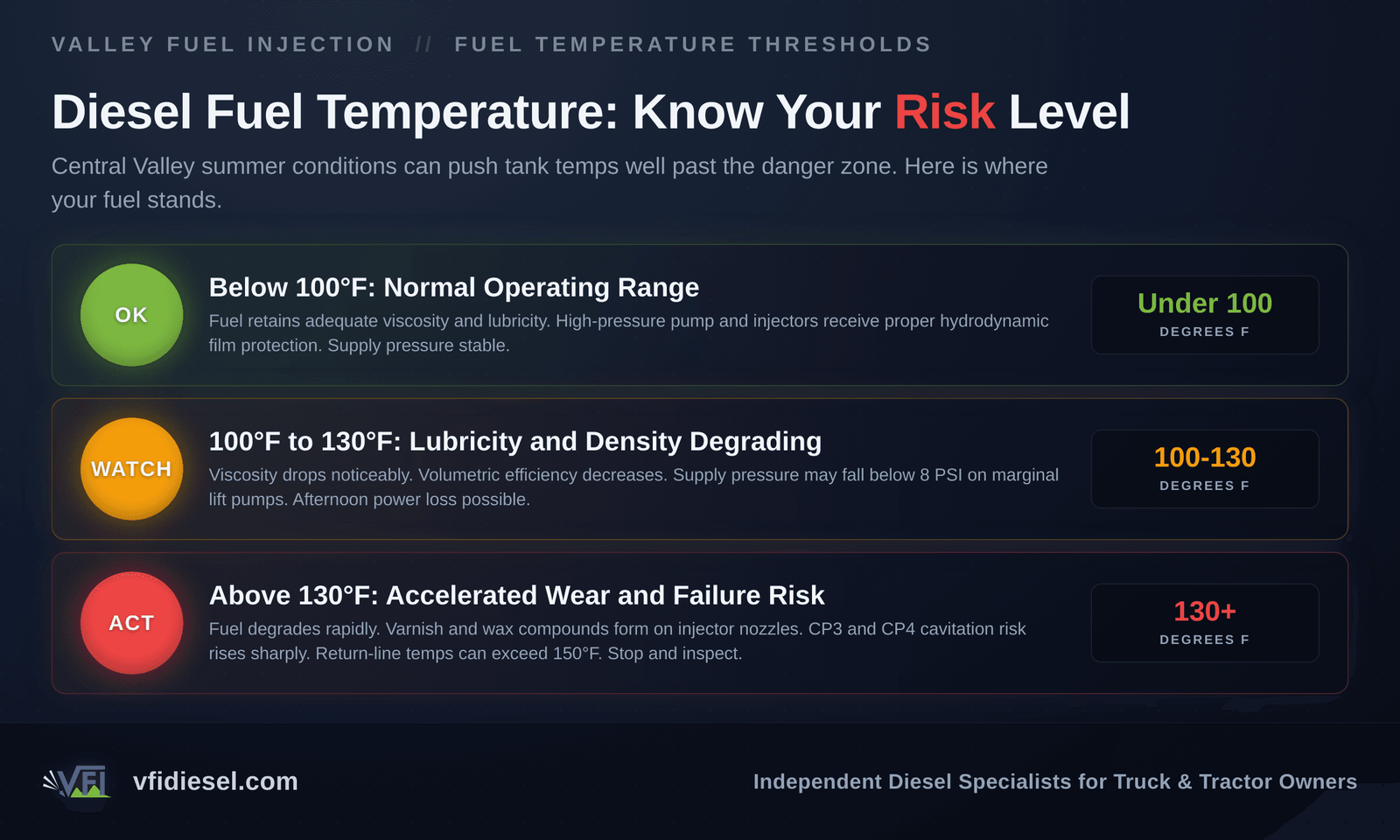
Heat reduces diesel fuel’s lubricity and density, which directly affects how the injection system performs. Diesel is a lubricant as much as it is a fuel. The high-pressure pump and injectors rely on fuel to keep their precision internal components from wearing against each other. When fuel temperature rises above 100°F, its viscosity drops, meaning it becomes thinner and less able to carry the hydrodynamic film that separates metal surfaces inside the pump and injectors.
Beyond lubricity, hot fuel is less dense, which means less energy per gallon and reduced volumetric efficiency through the injection system. The ECU on a modern common rail engine compensates for some of this, but there are limits. High fuel temperature also causes pressure instability in the low-pressure supply circuit. A fuel system that holds 10–15 PSI at the lift pump on a cool morning may struggle to maintain 8 PSI when the engine bay is soaking in 110°F heat and the fuel tank has been sitting in direct sun all day.
Pressure instability in the supply side starves the high-pressure pump. On common rail systems, a CP3 or CP4 pump that isn’t receiving adequate supply pressure will cavitate, pulling air or vapor through its internals, and that cavitation is one of the fastest ways to destroy a high-pressure pump. Our diesel fuel system pressure loss guide covers the nine causes of pressure loss in detail, and heat-related supply pressure drop is one of the most underdiagnosed of the group.
If you’re running a Dodge 5.9L 24-valve Cummins with the VP44 injection pump, summer is the season where lift pump failures become catastrophic. The VP44 has almost no tolerance for low supply pressure, and a lift pump that’s marginal in cool weather will fail outright when fuel temperatures climb. Check supply pressure before summer, not after the pump dies.
What Is Vapor Lock in a Diesel Fuel System and Can It Happen in Modern Common Rail Engines?
Vapor lock in a diesel system happens when fuel temperature rises high enough that light hydrocarbon fractions vaporize inside the fuel lines, creating gas bubbles that interrupt the flow of liquid fuel to the injection pump. It’s more commonly associated with gasoline engines, but diesel systems are not immune, especially older mechanical systems with low-pressure supply circuits routed near exhaust components.
In a traditional mechanical injection system, the consequences of vapor lock are straightforward: the engine stumbles, loses power, or refuses to restart after a hot soak. You shut down a hot engine, park in direct sun, and come back 20 minutes later to a no-start condition. The fuel in the lines has partially vaporized, and the mechanical lift pump can’t pull enough liquid fuel to prime the system. If you’ve ever had to bleed a diesel after a hot-soak no-start, you’ve experienced a mild form of this, our step-by-step diesel fuel system bleeding guide walks through the procedure.
Modern common rail engines are better protected against classic vapor lock because the high-pressure pump operates at pressures that keep fuel in liquid form through most of the circuit. However, common rail systems have their own heat-related vulnerability: the low-pressure supply circuit between the tank and the high-pressure pump still operates at relatively low pressure, and if fuel in that section gets hot enough, you can develop aeration and cavitation at the pump inlet. The result isn’t a textbook vapor lock, but the damage to the CP3 or CP4 pump is just as real.
CP4 pumps (found in the 6.7L Power Stroke and LML Duramax) are particularly vulnerable to cavitation damage from hot, aerated fuel. When a CP4 fails catastrophically, metal debris contaminates the entire fuel system including the injectors. Full fuel system replacement on these platforms typically runs $10,000–$18,000+. Preventing supply-side heat stress is far cheaper than that repair.
California’s summer fuel blend also plays a role here. The state’s reformulated diesel, which often contains biodiesel blends, has different volatility characteristics than conventional diesel.

Higher biodiesel content can affect how fuel behaves at elevated temperatures. Our post on biodiesel injector damage covers the specific ways California’s fuel blend creates problems that operators in other states don’t see.
Why Do Diesel Injectors and High-Pressure Pumps Fail More Often in Summer Months?
Summer failure rates for injectors and high-pressure pumps are higher because heat attacks the fuel system from multiple directions simultaneously. It’s not one problem, it’s several compounding problems hitting at the same time.
First, hot fuel has reduced lubricity, increasing wear on the tight-tolerance components inside the injection pump and injector bodies. Second, heat degrades fuel faster, allowing oxidation and varnish formation that deposits on injector nozzles and needle seats. Third, fuel return temperatures climb, which means the fuel returning to the tank is already hot, and the tank temperature rises throughout the day. By late afternoon on a 108°F day in Sacramento, your fuel tank may contain diesel that’s sitting at 130°F or higher before it even reaches the engine.
Fourth, and critically for the VP44 platform, summer is when lift pumps fail. The lift pump on a 1998–2002 Dodge 5.9L Cummins is a low-cost component that sits in the fuel stream and relies on that fuel for cooling.
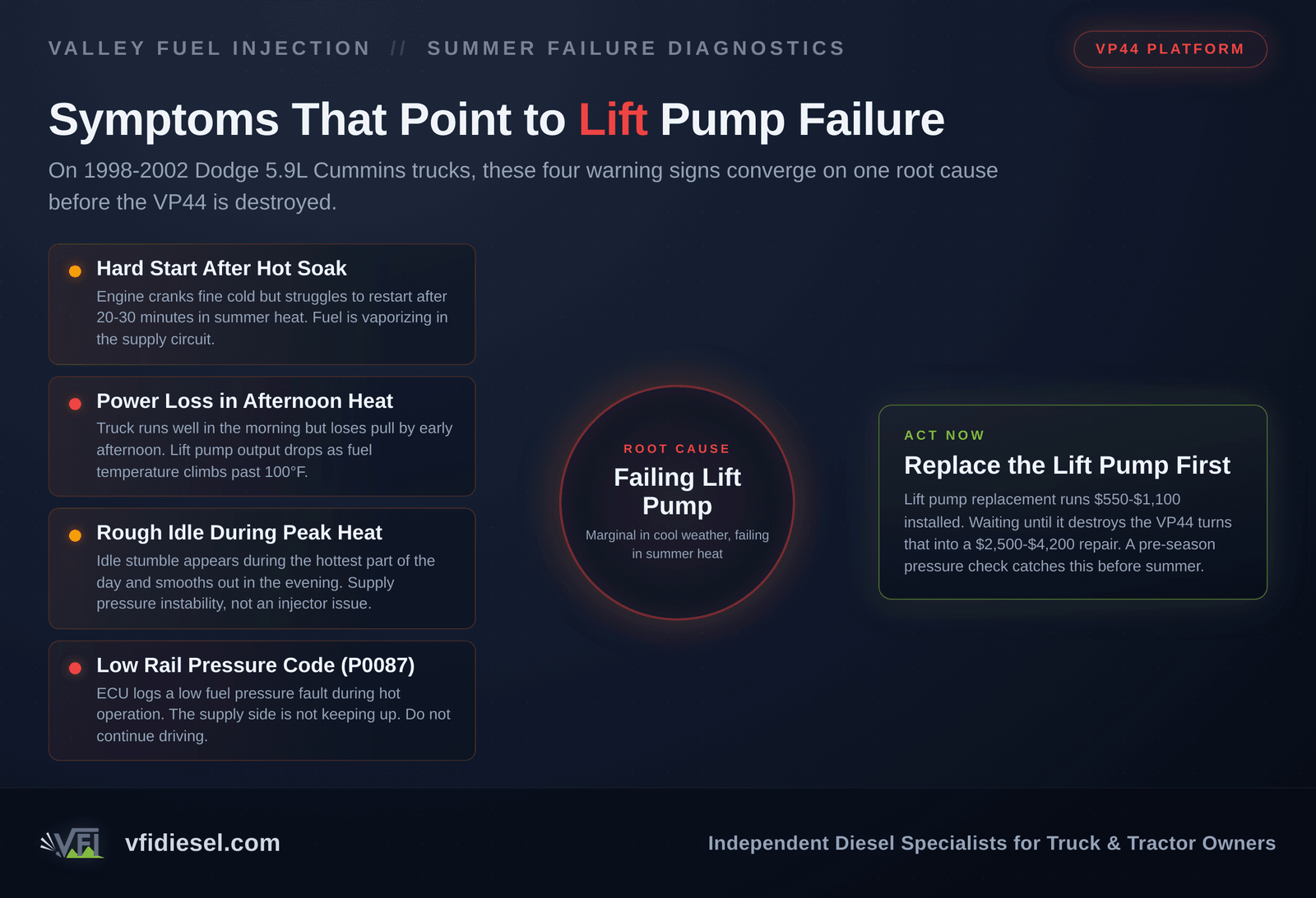
When ambient temperatures are high and the truck is working hard, the lift pump runs hot. A lift pump that’s already worn or marginal will fail under summer heat loads, and when it does, the VP44 starves for supply pressure and fails shortly after. Lift pump replacement on these trucks typically runs $550–$1,100 all-in. A VP44 rebuild at a Bosch-certified shop runs $2,500–$4,200 all-in. Replacing the lift pump first is not optional, it’s the root cause that has to be addressed, or a new VP44 will fail the same way.
For modern common rail trucks, summer heat accelerates injector tip coking. Injector nozzles that are partially coked spray fuel in a distorted pattern, causing incomplete combustion, elevated exhaust temperatures, and carbon buildup that worsens the coking problem. A professional injector cleaning service, typically $250–$550, can address early-stage coking before it progresses to mechanical nozzle damage that requires full injector replacement. Our injector cleaning comparison guide explains when cleaning is appropriate and when you need to go further.
| Component | Summer Heat Risk | Typical Repair Cost (CA) |
|---|---|---|
| Diesel lift pump (VP44 era) | Thermal overload, starvation failure | $550–$1,100 installed |
| VP44 injection pump | Supply starvation from lift pump failure | $2,500–$4,200 all-in |
| CP3 high-pressure pump | Cavitation from hot/aerated fuel | $2,800–$5,500 installed |
| CP4 high-pressure pump | Catastrophic cavitation failure, system contamination | $10,000–$18,000+ all-in |
| Common rail injector set (6.7L Cummins) | Nozzle coking, tip erosion from hot fuel | $3,500–$6,500 installed |
| Fuel filter service (dual-filter) | Accelerated plugging from heat-degraded fuel | $95–$220 |
Prices reflect typical California specialty-shop ranges as of 2026. Call us at 530-668-0818 for an accurate quote on your specific job.
What Role Does Fuel Return Temperature Play in Hot-Weather Injection System Health?
Fuel return temperature is one of the most overlooked factors in hot-weather injection system health, and it matters more than most operators realize. In a diesel injection system, the injectors and high-pressure pump don’t consume all the fuel that’s delivered to them. A significant portion returns to the fuel tank through return lines. That returned fuel carries heat from the injection system back to the tank, gradually raising tank temperature throughout the day.
On a common rail system, the fuel that returns from the injectors has been pressurized to 20,000–30,000 PSI and then depressurized rapidly. That pressure drop generates heat. The fuel returning from a common rail system can be 40–60°F hotter than the fuel leaving the tank. On a hot summer day when the tank is already warm, return temperatures can push well past 150°F in the return line. At those temperatures, fuel degrades faster, wax and varnish compounds form more readily, and the supply fuel entering the high-pressure pump is already hot before it’s ever pressurized.
Some performance and heavy-duty diesel applications use a fuel cooler in the return line to reduce tank temperature rise. For agricultural equipment and heavy trucks that run long hours in Central Valley heat, a fuel cooler can meaningfully extend injection system service life. Ask our team whether your application would benefit from one.
For Kubota and Yanmar compact equipment operators working in the field during summer, return temperature is an especially relevant concern. These smaller engines have less thermal mass and smaller fuel tanks, meaning the tank temperature equilibrates faster. Equipment running continuous cycles in 105°F field conditions can develop return-temperature-related fuel quality issues within a single work shift. Our Kubota engine service and Yanmar engine service teams see this pattern every summer. If you’re operating compact equipment in the Central Valley and noticing afternoon power loss that wasn’t present in the morning, fuel temperature is one of the first things to investigate.
Keeping the tank as full as practical during summer operations helps. More fuel volume means more thermal mass, which slows the rate of temperature rise. Parking in shade when possible, and avoiding long hot-soak periods in direct sun before restarting, also reduces the thermal load on the fuel system.
How Should You Adjust Diesel Maintenance Intervals During Central Valley Summer Heat?
Standard OEM maintenance intervals are written for average operating conditions. Central Valley summer heat is not average operating conditions, and treating it as such will cost you more in repairs than the shortened service intervals ever would.
Fuel filters are the most important item to address. Heat-degraded fuel deposits particulates and varnish compounds faster than cool-weather fuel. If your OEM interval calls for fuel filter replacement every 15,000 miles or once a year, consider moving to every 10,000 miles or every six months during summer-heavy operation. Dual-filter systems (primary and secondary/water separator) should both be serviced together. Filter service at a shop typically runs $95–$220 for a dual-filter setup, which is a fraction of what a plugged filter that starves your injection pump will cost to repair.
Water separator bowls should be checked and drained more frequently during summer. Heat causes condensation cycles inside the fuel tank, and summer fuel blends can carry more water contamination than winter blends. Water in diesel fuel is corrosive to injector internals and will accelerate wear on needle seats and nozzle tips.
A quality diesel fuel additive with lubricity improver and fuel stabilizer is worth running through summer. Stanadyne Performance Formula, Power Service, and Hot Shot’s Secret are all reasonable choices. The cost per gallon treated runs $0.03–$0.12 depending on the product, which is negligible compared to the protection they provide to injection system components. This is especially relevant for California’s reformulated diesel blends, which have lower lubricity than conventional diesel.
For operators in the Sacramento area and surrounding Central Valley who run their trucks hard through summer, we also recommend having your injection system pressure tested and your lift pump output checked before the hottest months arrive. Catching a marginal lift pump in May is a $550–$1,100 repair. Catching it in August after it’s taken out the VP44 or starved a CP3 is a $2,500–$5,500 repair. Our diesel engine maintenance services include pre-summer fuel system inspections that can identify these issues before they become failures.
For Kubota equipment operators, our Kubota fuel system bleeding guide is a useful reference if you’re dealing with hot-soak no-starts or air introduction issues during summer field operations.
The Bosch Mobility diesel systems documentation provides technical background on common rail system operating parameters that’s useful context for understanding why temperature tolerances matter so much in precision injection equipment.
What Are the Warning Signs That Summer Heat Is Already Damaging Your Fuel Injection System?
Several warning signs indicate that heat stress is already affecting your diesel fuel injection system. Recognizing them early is the difference between a service call and a major rebuild.
Hard starts after hot soak. If your diesel starts fine in the morning but struggles to restart after sitting for 20–30 minutes in the heat, you’re likely dealing with fuel vaporization or aeration in the supply circuit. This is a classic sign of a marginal lift pump or a fuel system with supply-side heat problems.
Power loss that develops through the day. An engine that runs well in the morning but loses noticeable power by early afternoon is often dealing with rising fuel temperature reducing volumetric efficiency and injection pressure stability. This is different from turbo-related heat soak, which typically recovers faster after a rest period.
Rough idle or misfires during high-heat periods. If rough idle appears specifically during the hottest part of the day and improves in the evening, heat-related fuel system pressure instability is a strong candidate. Individual injector misfires from coking will be more consistent regardless of time of day, but heat can exacerbate borderline injectors that were otherwise masking their symptoms.
Excessive black or white smoke during summer operation. Black smoke from incomplete combustion can indicate coked injector nozzles spraying poor patterns. White smoke, particularly during hot-soak restarts, can indicate aeration in the fuel system allowing air into the combustion event.
Fuel pressure warning lights or low rail pressure codes. On modern common rail systems, the ECU monitors rail pressure continuously. Low rail pressure codes (typically P0087 or similar) during hot weather operation are a direct indicator that the supply side is not keeping up with demand, which in summer often means a failing lift pump, a clogged filter, or the early stages of high-pressure pump wear.
Do not ignore low rail pressure codes during summer. On CP4-equipped trucks (2011–2016 LML Duramax, 2011–2019 6.7L Power Stroke), a failing supply side that causes the CP4 to cavitate can lead to catastrophic pump failure and full fuel system contamination within a short period of continued operation. If you pull a P0087 or similar code in summer, stop driving and get it diagnosed before the repair bill grows by an order of magnitude.
Fuel in the return line running visibly hot. If you have access to a temp gun and can check return line temperature, readings above 160°F at the return fitting are a concern. This is more practical for fleet mechanics doing pre-season inspections than for individual truck owners, but it’s a useful data point.
If you’re seeing any of these symptoms, bring the truck in before the problem compounds. Our diesel fuel injection services include full diagnostic and bench testing to identify exactly what’s failing and what’s still serviceable. A computer diagnostic scan runs $150–$300, and a full diagnostic with bench testing runs $300–$700, both far less than the cost of guessing wrong and replacing parts that weren’t the root cause.
The SAE International research on diesel fuel temperature effects on injection system performance provides peer-reviewed technical context for why these temperature thresholds matter in precision common rail systems. The EPA diesel fuel standards page is a useful reference for understanding how fuel specification requirements vary by season and region, including the California-specific variations that affect lubricity and volatility. For California operators specifically, CARB’s diesel fuel program page covers the state’s unique diesel fuel requirements that distinguish California fuel from what operators in other states are running.
Prices reflect typical California specialty-shop ranges as of 2026. Your actual quote depends on the condition of your specific components, parts availability, and current labor rates. Call VFI at 530-668-0818 for an accurate quote on your job.
If you’re in the Woodland area or anywhere in Northern California or Nevada, our shop at 1243 E Beamer St, Suite C, Woodland, CA 95776 has been diagnosing and repairing diesel fuel injection systems since 1993. We’re a Bosch-certified testing and remanufacturing center, which means we have the equipment and the training to test your components to factory specification rather than guessing. If you’re outside our area, we also accept mail-in injectors and pumps for bench testing and rebuilding, call us at 530-668-0818 to discuss your situation, or schedule a diagnostic online.
Frequently Asked Questions: Diesel Fuel System Problems in Hot Weather
Can vapor lock damage a modern diesel engine?
Classic vapor lock, where fuel vaporizes in the supply lines and prevents the engine from running, is less common in modern common rail diesels than in older mechanical systems. However, modern common rail engines can still experience aeration and cavitation in the low-pressure supply circuit when fuel temperatures are high. This cavitation can damage the high-pressure pump (CP3 or CP4) and, in severe cases on CP4-equipped trucks, trigger catastrophic pump failure that contaminates the entire fuel system. So while the symptom presentation is different from classic vapor lock, the underlying heat-related fuel supply problem is just as real and potentially more expensive to repair.
How hot is too hot for diesel fuel in the tank?
Diesel fuel begins to lose meaningful lubricity and stability above approximately 100°F, and degradation accelerates above 130°F. In Central Valley summer conditions, fuel in a tank sitting in direct sun can reach 130–150°F by mid-afternoon, especially in smaller tanks with high return-line heat load.
Keeping the tank full, parking in shade when possible, and using a fuel additive with lubricity improver and stabilizer can help manage fuel temperature effects. If your fuel system shows symptoms of heat stress, a pre-season inspection and fuel filter service are the most cost-effective preventive steps.
Why does my diesel lose power in the afternoon but not in the morning?
Power loss that develops through the day and improves in the evening is a classic pattern for heat-related fuel system pressure instability. As ambient temperatures climb and the fuel tank heats up from return-line heat and solar exposure, supply pressure to the injection pump drops and fuel density decreases. Both factors reduce the effective injection quantity per cycle, which the driver experiences as power loss. A marginal lift pump that holds adequate pressure in cool morning conditions may not be able to maintain pressure when fuel is hot and the engine is working hard in afternoon heat. Diagnosing this requires checking supply pressure and lift pump output under hot operating conditions, not just a cold-start check.
Should I change my diesel fuel filter more often in summer?
Yes, shortening fuel filter intervals during summer is a sound practice for Central Valley operators. Heat accelerates fuel degradation, which increases the rate at which particulates and varnish compounds accumulate on filter media. If your OEM interval is 15,000 miles or annual, consider moving to 10,000 miles or every six months during periods of sustained high-temperature operation. Dual-filter setups (primary and secondary/water separator) should both be serviced at the same time. Filter service typically runs $95–$220 at a California specialty shop, which is a small investment compared to the cost of a plugged filter that starves your injection pump.
What is the most heat-vulnerable diesel injection system in common use?
The VP44 injection pump used in 1998–2002 Dodge 5.9L 24-valve Cummins trucks is widely considered the most heat-vulnerable common diesel injection system still in widespread use. The VP44 has very tight supply pressure tolerances and relies almost entirely on the lift pump for adequate fuel supply. When the lift pump fails, which happens more frequently in summer heat, the VP44 is destroyed quickly. The fix is always to replace the lift pump first (typically $550–$1,100 installed) and then rebuild or replace the VP44 ($2,500–$4,200 all-in). On modern platforms, CP4-equipped trucks (LML Duramax, 2011–2019 6.7L Power Stroke) carry the highest catastrophic failure risk from heat-related supply-side problems, with full system replacement costs reaching $10,000–$18,000+.