
Summer Diesel Fuel System Problems: Heat & Prevention
06/10/2026
5.9 Cummins P7100 vs VP44: Which Is More Reliable?
06/22/2026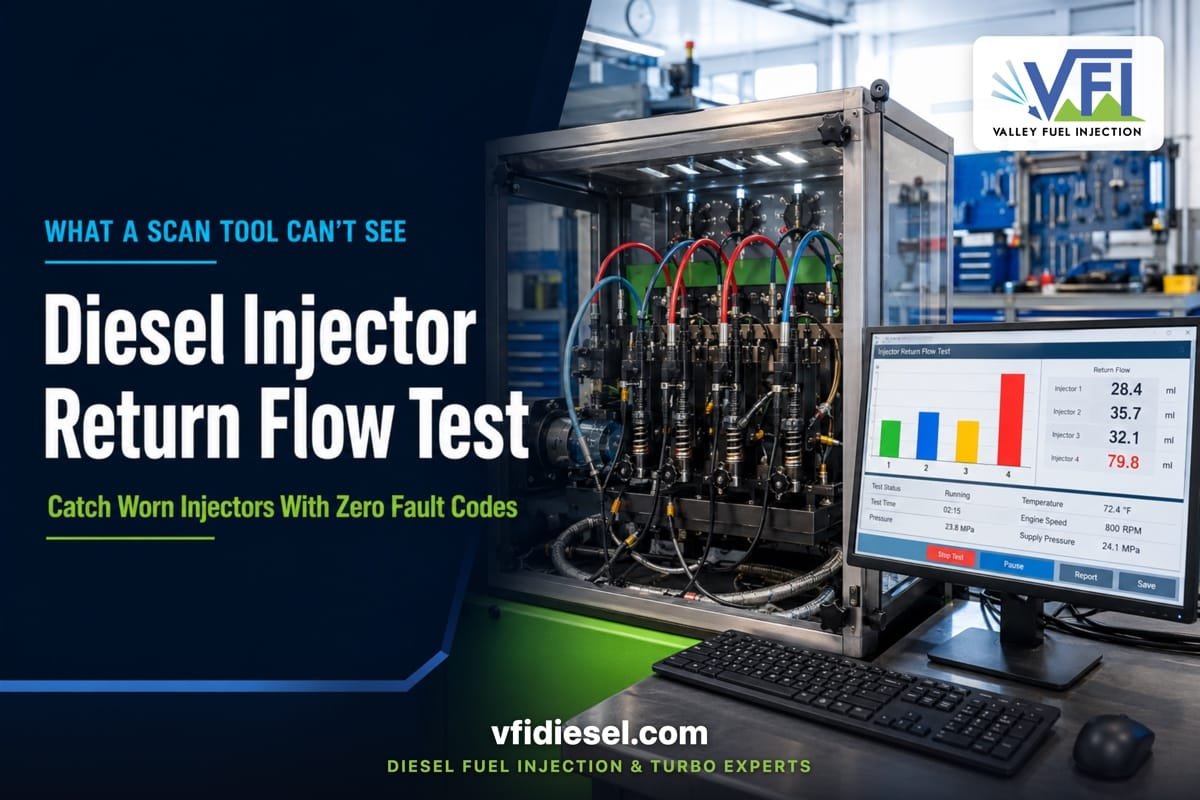
Diesel Injector Return Flow Testing: What It Reveals That a Scan Tool Can’t
A diesel injector return flow test measures how much fuel leaks back past an injector’s internal control valve instead of being delivered to the combustion chamber. It’s one of the most precise diagnostic tools available for common rail fuel systems, and it routinely catches worn or failing injectors that produce zero fault codes and look completely normal on a scan tool. If your truck is losing power, running rough, or burning more fuel than it used to, and your shop says “the codes are clean,” a return flow test may be exactly what you need next.
A return flow test measures internal injector leakage that scan tools and balance rate checks simply cannot detect. It’s a core part of professional common rail diagnostics and often the definitive step between “something’s wrong” and “here’s exactly which injector is the problem.”
What Is a Return Flow Test and Why Do Diesel Specialists Use It?
A return flow test quantifies the volume of fuel that returns from each injector to the tank or low-pressure circuit during a defined operating condition, typically at idle and at a specified RPM load point. In a healthy common rail injector, only a small, predictable amount of fuel returns through the back-leak circuit. When an injector’s internal components wear, that return volume climbs, and the high-pressure pump has to work harder to compensate.
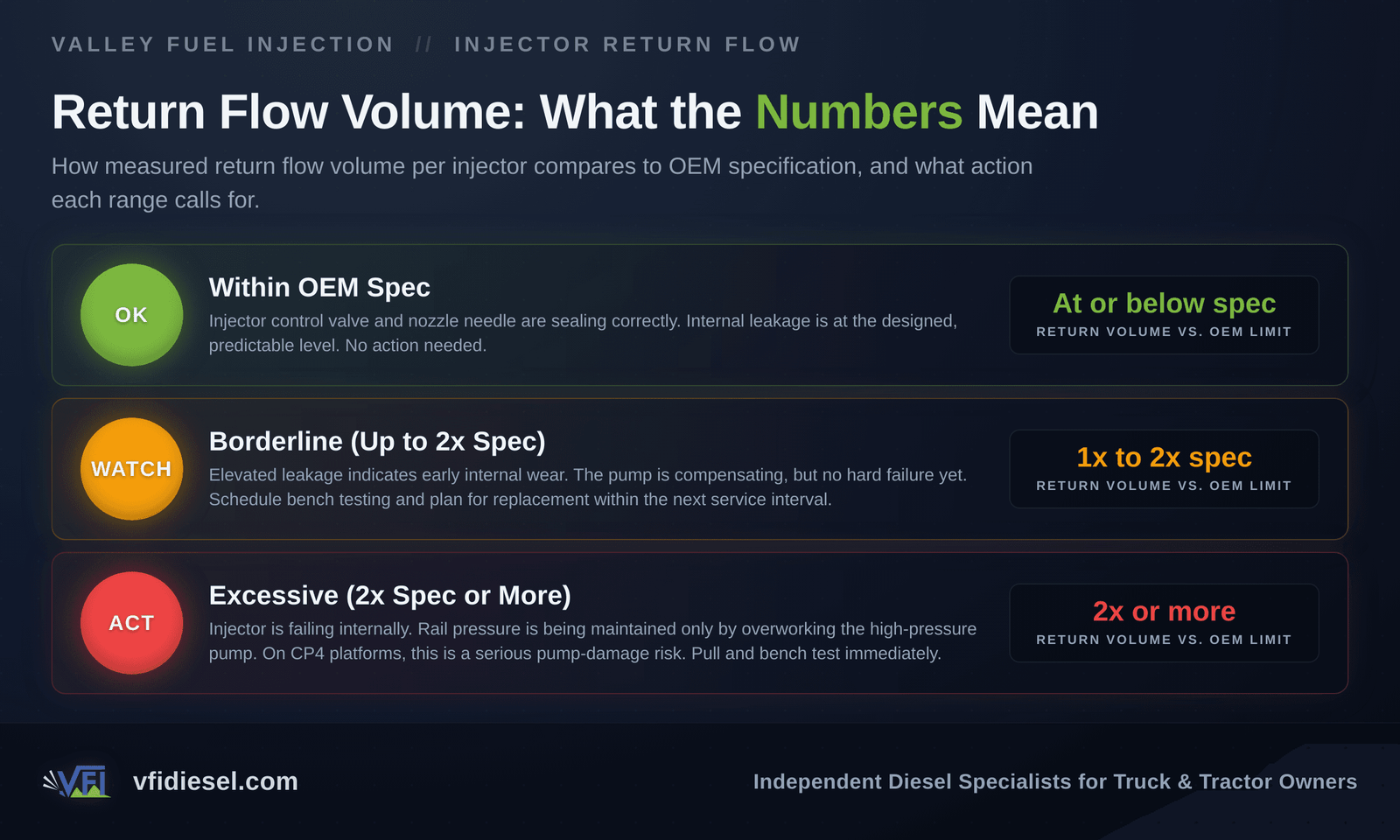
The test is straightforward in concept: you isolate the return line from each injector, run the engine under controlled conditions, and measure the volume of fuel collected from each cylinder’s return port over a set time period, usually 30–60 seconds. The results are compared against OEM specifications. An injector that returns two or three times the allowable volume is flagged as worn, even if it’s still technically firing and producing no fault code.
We use this test regularly here at Valley Fuel Injection because it gives us hard data. Not a scan tool’s interpretation of what the ECU is compensating for, but actual fuel volume numbers. When you’re dealing with a $5,000–$9,000 injector replacement job, you want certainty before you start pulling hardware.
Return flow testing is especially valuable before purchasing a used diesel truck. A set of injectors can look fine on a scan tool and still be internally worn enough to need replacement within 20,000 miles. A pre-purchase return flow test can save you thousands.
How Excessive Return Flow Points to Worn or Failing Injectors
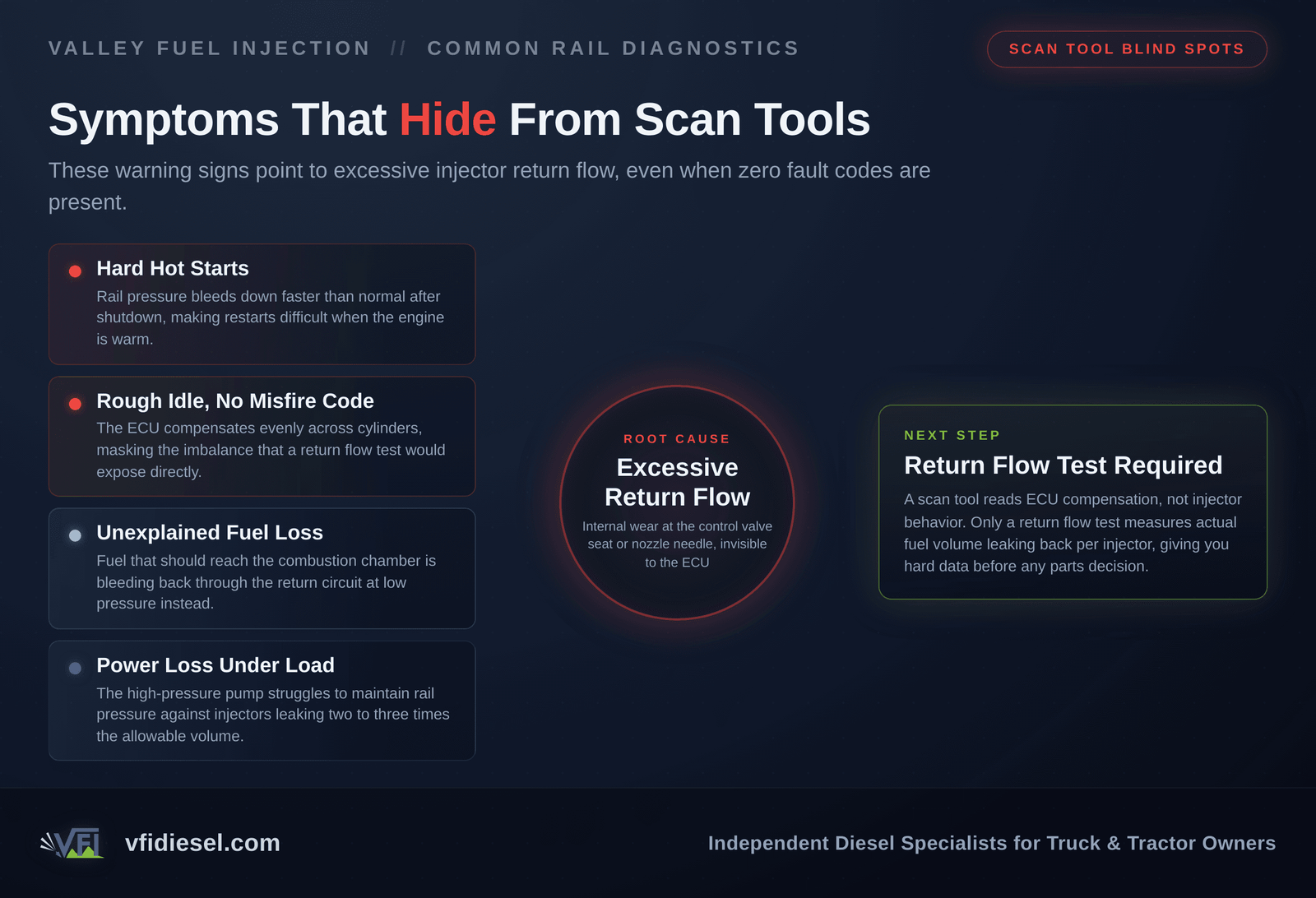
Excessive return flow is a direct indicator of internal injector wear, specifically at the control valve seat, the nozzle needle, or the pressure-balancing orifices inside the injector body. As these components wear, they lose their ability to hold high-pressure fuel in the injection circuit. Fuel that should be delivered as a precisely metered, high-pressure spray instead bleeds back through the return circuit at low pressure.
Here’s why that matters beyond just wasted fuel. The high-pressure pump (your CP3, CP4, or equivalent) must maintain rail pressure by continuously compensating for whatever the injectors are leaking. An injector that’s leaking excessively forces the pump to work harder, which accelerates pump wear. On CP4-equipped platforms, this is a serious concern because the CP4 already has a reputation for catastrophic failure, and a set of leaking injectors puts additional strain on a pump that has limited tolerance for it.
The symptoms of excessive return flow overlap heavily with other diesel problems, which is exactly why the test is so useful. You might see:
- Hard starting, especially when hot
- Rough idle or cylinder misfire without a misfire code
- Reduced power under load
- Increased fuel consumption with no obvious cause
- Excessive black or white smoke at idle
- Rail pressure that drops faster than expected at key-off
None of those symptoms will reliably point to return flow as the cause without testing. That’s the whole point. The ECU sees a rail pressure drop and compensates by commanding more fuel from the pump. The truck keeps running. No code sets. But the injectors are quietly failing, and the pump is being worked harder than it should be.
On CP4-equipped trucks (2011–2016 LML Duramax, 2011–2019 6.7 Powerstroke), severely worn injectors accelerating pump wear can lead to CP4 catastrophic failure. Full fuel-system contamination from a CP4 failure typically runs $10,000–$18,000 to correct. Catching worn injectors early via return flow testing is far cheaper than the alternative.
Return Flow Testing vs. Balance Rates vs. Bench Testing: What Each Method Tells You
These three diagnostic approaches are complementary, not interchangeable. Each one reveals something different, and understanding the distinction helps you know when each is appropriate.
| Method | What It Measures | What It Misses | Best Used For |
|---|---|---|---|
| Balance Rates (scan tool) | ECU fuel trim corrections per cylinder | Injectors that are uniformly worn; internal leakage not affecting trim | Quick screening; identifying obviously misfiring cylinders |
| Return Flow Test (on-vehicle) | Actual fuel volume leaking back per injector | Spray pattern quality; atomization; electrical response | Confirming internal wear; identifying which injectors to pull |
| Bench Flow Test (off-vehicle) | Delivery volume, return volume, spray pattern, response time, leak-down at multiple pressure and RPM points | Nothing significant, this is the most complete picture available | Definitive pre-rebuild evaluation; verifying remanufactured injectors before reinstallation |
Balance rates are what most shops check first because it takes about two minutes with a scan tool. The problem is that balance rates reflect what the ECU is doing in response to injector behavior, not what the injectors are actually doing. If all six injectors on a Cummins are worn by roughly the same amount, balance rates may look acceptable because the ECU has compensated evenly. Return flow testing catches that scenario directly.
Bench testing is the gold standard. When injectors come off the engine and go onto a Bosch-certified test bench, we can test them across the full operating range, measure delivery volume and return volume simultaneously, evaluate spray pattern quality, and check response time on solenoid or piezo actuation. A bench test gives you a complete data report on every injector, which is what you need before deciding whether to rebuild, replace, or reinstall.
Bosch’s diesel injection test specifications define acceptable return flow volumes at multiple operating points. An injector that passes at idle but fails at high-load RPM is still a failing injector. A proper bench test covers all those points, not just one.
Which Engines Benefit Most From Return Flow Diagnostics?
Any common rail diesel engine can benefit from return flow testing, but certain platforms see this diagnostic used most frequently because of their design characteristics or known wear patterns.
6.7L Cummins (2007–present): The Cummins inline-six common rail system is well-suited to return flow testing because the injectors are relatively accessible and the system runs at high rail pressures where internal leakage becomes significant quickly. Worn Bosch injectors on this platform often show excessive return flow before they produce any drivability codes. A full set of six installed injectors at a California specialty shop typically runs $4,500–$7,500 depending on parts specification and engine condition.
6.6L Duramax (LB7 through L5P): LB7 owners know the injector story well. But even later Duramax generations develop return flow issues, particularly after high mileage or exposure to degraded fuel. The LML’s CP4 pump makes catching leaking injectors especially important, as noted above. A full set of eight installed injectors on a Duramax typically runs $5,500–$9,500 at California specialty-shop rates.
6.7L and 6.4L Powerstroke: Both platforms run Bosch common rail systems with high operating pressures. The 6.7 in particular benefits from return flow testing because injector wear on this platform often presents as rough idle and hard starts long before codes appear. A full set of eight installed injectors typically runs $5,500–$8,500.
Agricultural and industrial equipment: Kubota, Yanmar, and similar equipment running Tier 4 common rail systems benefit significantly from return flow diagnostics because these engines often run for thousands of hours between scheduled service intervals. Catching a worn injector before it affects pump life is especially valuable when the equipment is in the middle of a season. Our Kubota service and Yanmar service teams handle this regularly.
Older mechanical injection systems (rotary pumps, inline P-pumps) don’t use a return flow circuit in the same way, so this test is specific to common rail architecture. If you’re running a pre-common-rail diesel, the diagnostic path is different.
Fuel quality plays a major role in how quickly injectors develop excessive return flow. California’s B20 biodiesel blends can accelerate internal seal and nozzle wear in injectors not designed for high-blend biodiesel. Read more about biodiesel injector damage in California if you’re running higher-blend fuel.
Can You Perform a Return Flow Test Yourself, or Does It Require a Shop?
A basic return flow test can be performed by a knowledgeable DIYer with the right equipment, but there are real limitations to what a home-shop test will tell you compared to a professional bench evaluation.
The on-vehicle version of the test requires a return flow test kit specific to your injector platform. These kits use calibrated graduated tubes or cylinders that connect to each injector’s return port. You run the engine at a specified idle RPM for a set time, collect the fuel from each cylinder’s return port separately, and compare the volumes. The test gives you a relative comparison between cylinders and a rough pass/fail against OEM specs.
Where the DIY approach falls short:
- You need accurate OEM return flow specifications for your specific injector part number, and those specs vary by engine variant, not just engine family.
- An on-vehicle test only evaluates one operating condition. A worn injector may pass at idle and fail significantly at high load.
- You’re measuring return flow only. You’re not evaluating spray pattern, delivery volume, atomization quality, or electrical response time.
- Contaminated or degraded fuel in the system can affect results without indicating injector wear.
For a truck owner trying to decide whether to pull injectors for professional testing, an on-vehicle return flow test is a reasonable screening step. For anyone making a repair decision, especially on a high-mileage engine or before spending several thousand dollars on new injectors, professional bench testing is the right call. You can also ship your injectors to us for a full Bosch-certified bench evaluation if you’re not local to Northern California.

Professional diagnostic fees for an initial scan and cylinder contribution check typically run $175–$350 at a California specialty shop. A bench flow test (return flow, leak-down, and spray pattern) per injector runs typically $75–$120 for diagnostic-only testing, or $80–$160 per injector when combined with ultrasonic cleaning. Injector removal labor for a full set ranges from $600–$1,400 depending on platform. Parts and labor vary by engine condition and current pricing. Call us at 530-668-0818 for an accurate quote on your specific engine.
If you’re in the Sacramento area or anywhere in Northern California, bring your truck to our Woodland shop for a proper evaluation. If you’re further out, in the Reno area or beyond, our mail-in testing service handles the bench work and ships results back to you with a full data report.
What to Expect After a Return Flow Test Confirms Injector Wear
Once a return flow test identifies one or more injectors with excessive leakage, you have a clear decision tree to work through. Here’s how we typically walk through it with customers.
Step 1: Determine how many injectors are affected. If one injector is failing and the rest are within spec, a single-injector replacement is a reasonable option. If two or more are out of spec, or if the passing injectors are borderline, replacing the full set makes more economic sense. Installing one new injector alongside five worn ones means you’ll be back in a few months for the others, and you’ll pay the removal labor twice.
Step 2: Decide between remanufactured and new OEM injectors. Remanufactured common rail injectors from a reputable source, tested to OEM spec on a Bosch bench, perform as well as new in most applications and cost significantly less. Individual reman common rail injectors typically run $300–$550 each, compared to $500–$900 for new OEM units. For Bosch injector service, we can often rebuild your cores to OEM specification rather than replacing them outright.
Step 3: Address ancillary components. When injectors come out, it’s the right time to inspect and replace copper sealing washers, return line fittings, and any connector tubes or high-pressure fuel lines that show wear. Skipping this step and reusing old sealing hardware is a common cause of post-repair fuel leaks. Parts for a full set of connector tubes and seals typically run $150–$400 depending on platform.
Step 4: Evaluate the high-pressure pump. If your injectors show significant wear, your pump has been working harder than designed to maintain rail pressure. A pump pressure and volume test is worth doing before reinstalling new injectors. Putting a fresh set of injectors on a marginal pump is a setup for premature injector failure. See our common rail system repair page for more on what a full system evaluation covers.
Step 5: Verify the repair with a post-installation bench check. Any injector that’s been rebuilt or replaced should be bench-tested before going back in the engine. This is standard practice at a certified shop and the step that separates a professional repair from a parts-swap. Our process is detailed on our Bosch-certified test bench overview.
For ongoing injector health after the repair, proper fuel filtration and fuel quality matter more than most diesel owners realize. A quality lift pump system, regular filter changes, and clean diesel go a long way toward protecting a new set of injectors. Our diesel maintenance page covers the service intervals we recommend, and our guide on professional injector cleaning vs. DIY methods is worth reading if you’re trying to extend injector life between major services.
Injector refurbishment (nozzle and internal components, flow-tested to OEM spec) typically runs $200–$400 per injector at a California specialty shop. Full set replacement costs vary significantly by platform: 6.7 Cummins (6 injectors installed) typically runs $4,500–$7,500; Duramax or Powerstroke (8 injectors installed) typically runs $5,500–$9,500. Prices reflect typical California specialty-shop ranges as of 2026. Your actual quote depends on the condition of your specific components, parts availability, and current labor rates. Call VFI at 530-668-0818 for an accurate quote on your job.
Frequently Asked Questions: Diesel Injector Return Flow Testing
How long does a return flow test take?
An on-vehicle return flow test typically takes 30–90 minutes depending on engine accessibility and how many data points are collected. A full bench test after injector removal takes longer because it includes multiple pressure and RPM test points, spray pattern evaluation, and a printed data report. Factor in injector removal and reinstallation labor when estimating total shop time.
Can an injector fail a return flow test and still run the engine?
Yes, and this is one of the most important things to understand about this test. A common rail injector can have two to three times the allowable return flow volume and still fire on every cycle. The engine runs because the ECU compensates by commanding more fuel delivery and the high-pressure pump works harder to maintain rail pressure. The injector is failing, but it hasn’t failed completely yet. Catching it at this stage is far less expensive than waiting for a hard failure or pump damage.
Does a return flow test damage the injectors?
No. A return flow test is a passive measurement. You’re collecting fuel that already exits through the return circuit during normal engine operation. Nothing about the test procedure adds stress to the injector. The test simply quantifies what’s already happening inside the injection system.
Is a return flow test the same as a leak-down test?
They’re related but not identical. A leak-down test typically measures how quickly rail pressure drops when the engine is shut off, which gives a combined picture of injector leakage across the whole system. A return flow test measures leakage per individual injector during engine operation. The return flow test is more specific and more useful for identifying which injector is the problem. On a Bosch-certified test bench, both measurements are taken as part of a complete injector evaluation, along with delivery volume and spray pattern data.
Should I test all injectors or just the one I suspect?
Test all of them. Injectors on the same engine have the same age, mileage, and fuel exposure. If one is worn enough to show excessive return flow, the others are typically not far behind. Pulling and testing only the suspected injector, then reinstalling it alongside five worn units, means you’ll likely be back in the shop soon for the rest. A full set evaluation costs more upfront but gives you a complete picture and helps you make a smarter repair decision.
Valley Fuel Injection has been testing and rebuilding diesel fuel injection systems since 1993. Our Bosch-certified test bench gives you real data on every injector, not guesswork. Whether you’re a diesel truck owner in Sacramento, a fleet manager, or an equipment operator anywhere in Northern California or Nevada, we can help you get to the right answer before you spend money on parts you may not need.
Call us at 530-668-0818 or schedule a diagnostic. We’re located at 1243 E Beamer St, Suite C, Woodland, CA 95776. We also accept mail-in injectors for bench testing and ship results and rebuilt components nationwide.
How to Read Return Flow Numbers: When Cleaning Works and When an Injector Is Scrap
Knowing the test exists is one thing. Knowing what the numbers mean is what actually drives the repair decision. Return flow is measured in milliliters per 1,000 injection strokes, and every Bosch common rail injector has a factory specification for its exact part number. A healthy injector at idle simulation typically returns roughly 2 to 8 mL per 1,000 strokes depending on the platform, and that figure climbs in a tight, predictable band as load increases. The diagnostic value comes from how far the measured number sits above that specification.
| Return Flow vs. Spec | Condition | Recommended Action |
|---|---|---|
| 20 to 40% over | Early wear | Ultrasonic cleaning may restore spec. Retest to confirm. |
| 40 to 80% over | Moderate wear | Replacement candidate. Cleaning only buys time. |
| Over 80%, or return exceeding delivery | Beyond serviceable limit | Replace. No cleaning will restore it. |
One nuance matters: return flow has to be read alongside delivery volume. An injector that both leaks back heavily and under-delivers fuel to the cylinder has a double failure, usually needle seat erosion or severe control valve wear, and that combination always means replacement. For where cleaning is a legitimate fix versus a false economy, see our guide on professional injector cleaning vs. DIY.