Diesel Injector Return Flow Test: What It Reveals
06/12/2026
6.7 Cummins vs 6.6 Duramax: Injection Reliability
06/23/2026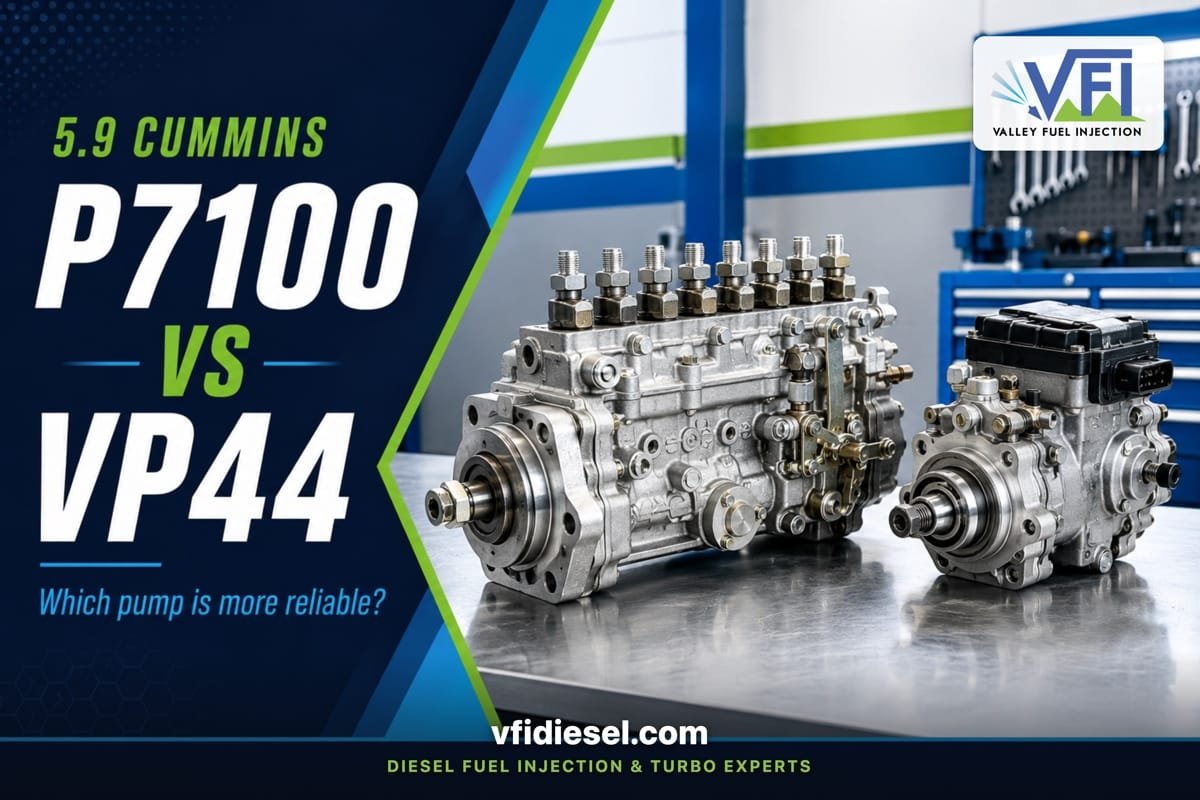
5.9 Cummins Injection Pump: Mechanical P7100 vs VP44: Which Is More Reliable?
If you own a second-gen Cummins, you already know the debate. The P7100 mechanical injection pump on the 12-valve 5.9 has a reputation for near-indestructible reliability and massive power potential, while the VP44 electronic pump that replaced it on the 24-valve has a well-documented failure history that still frustrates owners today. But the real story is more nuanced than “mechanical good, electronic bad.” Both pumps have genuine strengths, both have real weaknesses, and knowing the difference matters whether you’re rebuilding a failed pump, considering a swap, or just trying to keep your truck on the road. We’ve bench-tested and rebuilt hundreds of both units here at Valley Fuel Injection, and this guide gives you the straight comparison.
The P7100 wins on raw reliability and repairability. The VP44 wins on factory drivability and emissions compliance. For most owners, rebuilding the pump you have with quality parts is the right call. A P7100 swap is mechanically possible on a 24-valve truck but requires significant supporting work and may not be street-legal in California. Whichever pump you run, professional bench calibration is the difference between a pump that lasts and one that fails again in 30,000 miles.
What Years Did Cummins Use the P7100 and VP44, and Why Did They Switch?
Cummins used the Bosch P7100 inline injection pump on the 5.9 from 1994 through 1998, paired with the 12-valve cylinder head. The VP44 rotary electronic pump replaced it for the 1998.5 model year and ran through 2002, paired with the 24-valve head. The transition wasn’t driven by reliability, it was driven by emissions regulations and the need for more precise fuel delivery control that a mechanical pump simply couldn’t provide at the time.
The P7100 (often called the “P-pump”) is a Bosch inline six-plunger pump. Each cylinder gets its own dedicated pumping element, and fuel delivery is controlled mechanically through a governor and a rack-and-pinion system. There are no electronics involved in the injection event itself. The VP44 is a radial-piston distributor pump with an integrated electronic control module (ECM) that communicates with the truck’s engine management system to control injection timing and quantity. The added precision allowed Cummins to meet tightening NOx and particulate standards while improving cold-start behavior and part-throttle drivability.
The switch made engineering sense for 1998. What Cummins and Bosch didn’t fully anticipate was how sensitive the VP44’s electronics and high-pressure components would be to the fuel quality and lift pump conditions that real-world truck owners would throw at them.
The P7100 was already a mature, proven design when Cummins adopted it. Bosch had been refining inline P-series pumps for decades across European truck and industrial applications before they ever appeared under the hood of a Dodge Ram. That engineering depth is a big part of why the pump holds up so well even 30 years later.

How Does the P7100 Work and Why Do Diesel Enthusiasts Still Love It?
The P7100 earns its reputation because the core design is elegant in its simplicity. Six individual plunger-and-barrel assemblies, one per cylinder, are driven by a camshaft inside the pump housing. Fuel delivery quantity is controlled by rotating the plungers via a rack, which changes the effective stroke of each plunger. Timing is controlled by advancing or retarding the pump relative to the engine’s camshaft. The entire system runs on mechanical feedback with no sensors, no solenoids in the injection path, and no ECU dependency.
What this means in practice: the pump can be adjusted, tuned, and modified with hand tools and a calibration stand. Want more fuel? Turn the star-wheel. Want more timing advance? Loosen the pump mounting and rotate it. Experienced diesel tuners have been extracting 400, 500, and even 600-plus horsepower from P7100-equipped 12-valves using nothing more than pump modifications, bigger injectors, and a good intercooler. The platform responds to tuning in a way that electronic systems simply don’t allow without reflashing the ECU.
Reliability-wise, the P7100 is lubricated by the diesel fuel it pumps, just like the VP44. But the mechanical components are heavier-duty, the tolerances are less extreme, and there are no electronics to fail. A worn P7100 typically announces itself gradually through reduced power and increased smoke rather than a sudden catastrophic failure. When it does need service, a competent injection shop can rebuild it to factory spec using available parts. Bosch still supports the P7100 platform with service components, and the aftermarket has filled in any gaps.
The AFC (Air Fuel Control) housing on the P7100 is one of the most important and most overlooked tuning points on the 12-valve. A properly adjusted AFC prevents black smoke under boost and protects the engine from over-fueling at low RPM. If you’re buying a used 12-valve that has been “turned up,” have the AFC setting verified by a shop with a calibration stand before you drive it hard.
VP44 Strengths and Weaknesses: What Makes It Fail and How Often?
The VP44 is a genuinely capable pump when it’s running correctly and receiving the fuel supply it needs. The 24-valve head it pairs with flows significantly better than the 12-valve, and the electronic control allows for injection timing maps that optimize power, fuel economy, and emissions across the entire RPM range. Stock, the 24-valve 5.9 with a VP44 makes more horsepower and torque than the 12-valve P7100 truck, and it’s smoother and quieter at part throttle.
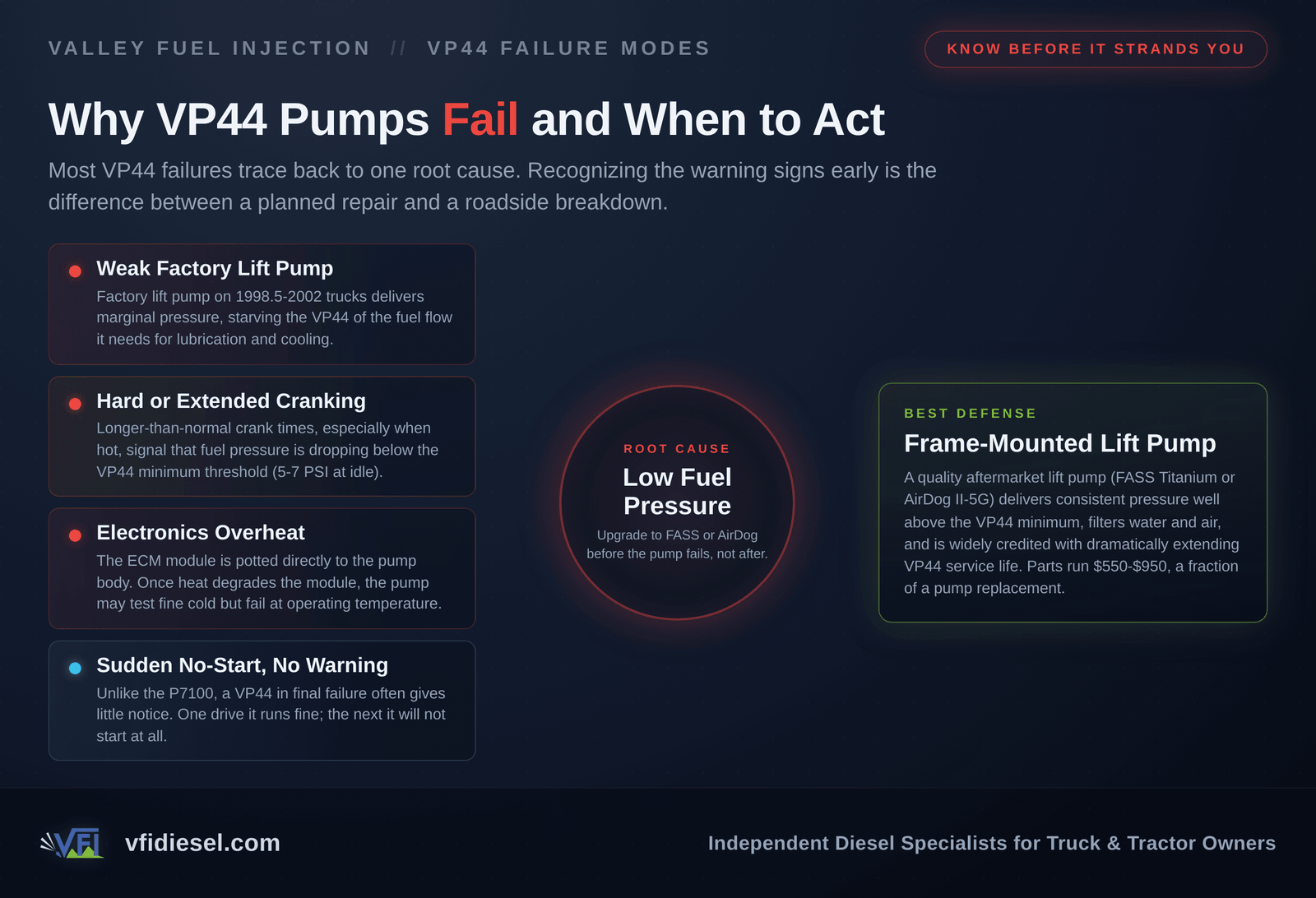
The problem is the VP44’s Achilles heel: it relies on fuel pressure from the lift pump for both lubrication and cooling of its internal components, including the electronic control module that’s mounted directly to the pump body. The factory lift pump on 1998.5–2002 trucks is notoriously weak, and when it starts to fail, it starves the VP44 of fuel pressure. The pump runs hot, the electronics cook, and the high-pressure components wear at an accelerated rate. By the time you notice symptoms, the damage is often already done.
For a detailed breakdown of how VP44 failure progresses and how to diagnose it, our post on 5.9 Cummins VP44 injection pump failure covers the full picture. The short version: low fuel pressure is the number-one killer, and installing a quality aftermarket lift pump (FASS or AirDog) is the single most important thing you can do to protect a VP44.
The other VP44 vulnerability is its electronics. The module is potted in epoxy and not user-serviceable. When it fails, the pump fails. Early VP44 failures were common enough that Bosch and Cummins issued technical service bulletins, and there was a period when remanufactured VP44s were in short supply because cores were failing faster than they could be rebuilt. That situation has stabilized, but VP44 electronics remain a known weak point.
Not all VP44 remanufactured pumps are equal. Budget reman units often reuse the original electronics module and simply replace mechanical wear components. When the electronics were already marginal, you’re buying a short-term fix. Bosch-certified reman VP44s use new or fully tested electronics and steel-sleeved housings that address the original failure modes. The price difference is real, but so is the difference in service life. Also be aware of biodiesel contamination: VP44 internal components are especially sensitive. See our post on biodiesel injector damage for why this matters in California.
Talk to a Diesel Tech VP44 dying or P7100 tired? Get it on the bench Tell us the year, the symptoms and your lift pump pressure. We bench-test VP44 and P7100 pumps, tell you what failed, and quote the rebuild or a reman exchange before any work starts. Two ways in: drive it into our Woodland shop near Sacramento, or ship it to us from anywhere in the country. ☎︎ Call 530-668-0818Out of the area? Start a mail-in rebuild → |
P7100 vs VP44: Power Potential, Reliability, Repairability, and Parts Availability
Here’s a direct side-by-side comparison across the categories that matter most to 5.9 Cummins owners:
| Category | P7100 (12-Valve, 1994–1998) | VP44 (24-Valve, 1998.5–2002) |
|---|---|---|
| Stock Power | 215 hp / 440 lb-ft (late P7100) | 235–245 hp / 460–505 lb-ft |
| Tuning Ceiling | Very high, 500+ hp with pump mods, injectors, turbo | Moderate, limited by electronics and housing strength |
| Reliability | Excellent, gradual wear, forgiving of fuel pressure variations | Moderate, highly sensitive to lift pump condition and fuel quality |
| Failure Mode | Gradual power loss, increased smoke, rarely sudden | Can be sudden and complete, no-start with little warning |
| Repairability | Excellent, all-mechanical, fully rebuildable by a qualified shop | Good, but electronics module requires specialized tooling |
| Parts Availability | Good: Bosch still supports; strong aftermarket | Good, reman supply has stabilized; quality varies widely |
| Drivability | Good, mechanical character, some smoke on tip-in | Excellent, smooth, precise, better cold-start behavior |
| Emissions Compliance | Pre-OBD2, simpler compliance picture on 1994–1997 | OBD2-compliant, required for CA smog on applicable years |
The power potential gap between the two platforms is significant for performance builds. The P7100 responds to mechanical tuning in ways that diesel enthusiasts have been exploiting for decades. Cummins forum lore is full of “five-minute” pump adjustments that add 50–80 horsepower, though we’d caution that any pump modification should be done on a calibration stand with proper fueling verification, not in a parking lot with a screwdriver. The VP44 can be tuned through ECU programming, but the pump housing and electronics set a ceiling that the P7100 simply doesn’t have. For a broader look at how these electronic systems compare to the next generation, see our post on VP44 vs common rail injection.
Should You Swap a Failed VP44 for a P7100: Is It Practical in 2026?
A P7100 swap on a 24-valve 5.9 is mechanically possible, but it’s not a bolt-on job and it comes with real trade-offs that make it the right choice for a narrow subset of owners.
The 24-valve head and the 12-valve head use different injection timing relationships, and the VP44 and P7100 have different mounting configurations and drive interfaces. A proper swap requires a conversion kit, a different injection timing cover, re-clocking the fuel lines to match P7100 outlet spacing, and recalibrating the pump on a bench for the 24-valve’s fuel delivery requirements. You also lose the ECU-controlled injection timing, which means cold starts may be harder and part-throttle drivability will be more “mechanical” in character.
The bigger issue for California owners: a P7100 swap on a 1998.5–2002 24-valve truck almost certainly won’t pass a California smog inspection. The VP44 is part of the OBD2 system on these trucks. Removing it changes the engine management in ways that will trigger failure codes and visible smoke. California’s Air Resources Board treats any modification that increases emissions or removes certified emissions equipment as a violation, regardless of how old the truck is. If your 24-valve is smog-exempt (pre-1976 registration or certain off-highway applications), this is less of a concern, but most street-registered trucks in California will have a compliance problem.
For owners outside California, or for off-highway and competition builds, a P7100 swap can make a lot of sense if you’re building for maximum power and long-term mechanical simplicity. For a daily driver in California that needs to pass smog, rebuilding the VP44 with a quality Bosch-certified reman unit and upgrading the lift pump is almost always the better path.
If you’re on a VP44 truck and want P7100-level reliability without the swap complexity, the single best investment you can make is a quality frame-mounted lift pump (FASS Titanium or AirDog II-5G). These systems deliver consistent fuel pressure well above the VP44’s minimum requirement, filter water and air from the fuel supply, and are widely credited with dramatically extending VP44 service life. A lift pump system typically runs $550–$950 for parts, plus $250–$500 for installation at a California specialty shop. That’s a fraction of a pump replacement and can add years to the VP44’s life.
We also want to be honest about P7100 parts availability in 2026. New OEM P7100 cores are essentially exhausted. Most P7100 rebuilds today are done on exchange cores, and the quality of what you get back depends heavily on the condition of the core and the capabilities of the shop doing the rebuild. A Bosch-certified facility with a calibration stand and access to genuine Bosch service components will produce a very different result than a generic rebuild using aftermarket kit parts. The same is true for the VP44, the reman market has a wide quality range, and the cheapest option is rarely the best value when you’re factoring in labor for a second replacement.
When Either Pump Fails: What Professional Rebuild and Testing Looks Like
Whether you’re dealing with a worn P7100 or a failed VP44, professional bench testing and calibration is what separates a pump that performs correctly from one that just bolts on and runs. This is where we spend a significant part of our day here at Valley Fuel Injection.
For the P7100, bench testing verifies delivery volume from each of the six plungers across the full RPM range, checks governor response, verifies timing advance function, and confirms AFC behavior under simulated boost pressure. A pump that passes visual inspection can still fail bench calibration, plunger wear, barrel scoring, or a governor spring that’s lost tension will show up on the stand in ways you’d never catch by just looking at the pump. Calibration involves adjusting delivery to spec and verifying that all six cylinders are balanced within tolerance. An out-of-balance pump causes rough running, uneven cylinder temperatures, and accelerated injector wear. For more on what proper professional service looks like versus a DIY approach, see our post on diesel fuel injector cleaning: DIY vs professional service.
For the VP44, bench testing is more complex because the pump’s electronic module must communicate correctly with test equipment that simulates the truck’s ECU signals. We verify injection timing response across the commanded range, check high-pressure output, confirm solenoid response times, and test the electronics under thermal load. A VP44 that tests fine cold and fails warm is a common presentation, the electronics are marginal and only show their weakness when the module reaches operating temperature. Bosch’s own diagnostic protocols for VP44 testing are detailed in their service documentation, and following them is what distinguishes a thorough rebuild from a parts swap. You can review Bosch’s diesel injection service standards at Bosch Mobility.
For cost context, here’s what you’re typically looking at in 2026 at a California specialty shop:
| Service | Typical Cost Range (CA, 2026) |
|---|---|
| P7100 reman/rebuild pump (part only) | Typically $1,200–$1,800 |
| P7100 R&R labor (install only) | Typically $300–$550 |
| P7100 full replacement job (part + labor) | Typically $1,600–$2,500 |
| VP44 reman pump (Bosch-certified, part only) | Typically $1,650–$2,200 (plus core charge $200–$400 if applicable) |
| VP44 R&R labor (install only) | Typically $450–$750 |
| VP44 full replacement job (part + labor) | Typically $2,200–$3,200 |
| Injector set (6, stock reman, VP44-era 24V) | Typically $900–$1,800 parts only |
| FASS/AirDog lift pump (part only) | Typically $550–$950 |
| Lift pump installation labor | Typically $250–$500 |
Prices reflect typical California specialty-shop ranges as of 2026. Your actual quote depends on the condition of your specific components, core condition, parts availability, and current labor rates. A biodiesel-contaminated or previously modified pump core can significantly affect rebuild cost. Call VFI at 530-668-0818 for an accurate quote on your specific job.
One important note on injectors: when a VP44 fails catastrophically, it’s worth having the injectors bench-tested before reinstalling them. A pump that ran low on pressure for an extended period can allow debris into the injection lines, and injectors that have been running lean or with contaminated fuel may have accelerated wear on the nozzle seats. Replacing the pump without addressing marginal injectors is a common reason trucks come back with ongoing performance issues. Our Bosch injector testing and repair service covers exactly this kind of system-level evaluation. For a full breakdown of what pump rebuilds cost compared to replacement across diesel platforms, see our diesel injection pump rebuild cost guide.
We serve diesel truck owners, fleet operators, and agricultural equipment owners across Northern California and Nevada from our shop in Woodland, CA. If you’re in the Sacramento area or anywhere in the Central Valley, we’re a short drive from most of the region. We also accept mail-in pumps and injectors for bench testing and rebuild from owners nationwide, you don’t have to be local to get Bosch-certified work done on your 5.9 Cummins injection pump.
The SAE has published extensive research on diesel injection system reliability and failure modes that supports much of what we see in the shop, you can explore their technical library at SAE International if you want to go deep on the engineering side.
Whether you have a P7100 that needs calibration, a VP44 that left you stranded, or you’re weighing your options on a rebuild vs. replacement, we can help. Call us at 530-668-0818 or schedule a diagnostic. Visit our shop at 1243 E Beamer St, Suite C, Woodland, CA 95776. We ship remanufactured pumps and injectors nationwide, call or visit our diesel fuel injection services page to learn more.
Shipping from out of state is routine for this work. If you are in Utah or the surrounding Mountain West, our Utah VP44 rebuild page covers transit times and the mail-in process.
Frequently Asked Questions: P7100 vs VP44 on the 5.9 Cummins
Can you put a P7100 on a 24-valve 5.9 Cummins?
Yes, it is mechanically possible using a conversion kit, but it requires significant supporting work including a different timing cover, re-clocked fuel lines, and bench calibration of the pump for the 24-valve application. On California-registered trucks, a P7100 swap on a 1998.5–2002 24-valve will almost certainly fail a smog inspection because it removes OBD2-required emissions equipment. For off-highway, competition, or out-of-state builds, the swap can make sense. For California street trucks, rebuilding the VP44 with a quality Bosch-certified reman unit and upgrading the lift pump is the better path for most owners.
What kills VP44 injection pumps?
Low fuel pressure from a weak or failing lift pump is the primary cause of VP44 failure. The VP44 relies on fuel pressure for both lubrication and cooling of its internal components and electronics module. When lift pump pressure drops below the minimum threshold (around 5–7 PSI at idle, higher under load), the pump runs hot, the electronics degrade, and high-pressure components wear prematurely. The factory lift pump on 1998.5–2002 trucks is undersized for this job. Installing a quality aftermarket frame-mounted lift pump (FASS or AirDog) is the single most effective preventive measure. Fuel contamination, biodiesel blends above B5, and extended service intervals on fuel filters also contribute to VP44 failures.
How much does it cost to replace a VP44 injection pump in California?
At a California specialty diesel shop in 2026, a complete VP44 replacement (Bosch-certified reman pump plus installation labor) typically runs $2,200–$3,200. The pump itself ranges from $1,650–$2,200 depending on the reman tier, with a core charge of $200–$400 added if your core is non-rebuildable. Labor for the install typically runs $450–$750. Budget reman units cost less up front but carry a higher re-failure risk, especially if they reuse the original electronics module. Always ask whether the reman unit includes new or fully tested electronics before you commit to a price.
Is the P7100 really more reliable than the VP44?
In terms of real-world durability under varying fuel quality and maintenance conditions, yes. The P7100’s all-mechanical design is more forgiving of fuel pressure variations, less sensitive to fuel contamination, and fails gradually rather than suddenly. A well-maintained P7100 can last 400,000–500,000 miles or more. The VP44 is capable of similar longevity when the lift pump is upgraded and fuel quality is maintained, but it has more failure modes and fails more abruptly when those conditions aren’t met. For a stock daily driver with good maintenance habits and an upgraded lift pump, the gap narrows considerably. For a high-mileage truck with deferred maintenance, the P7100 has a clear reliability advantage.
Does Valley Fuel Injection rebuild P7100 and VP44 pumps?
Yes. Valley Fuel Injection in Woodland, CA is a Bosch-authorized diesel fuel injection testing and remanufacturing center with over 30 years of experience on both platforms. We bench-test, rebuild, and calibrate P7100 and VP44 pumps to factory specifications using genuine Bosch service components. We serve customers locally in Northern California and Nevada, and we also accept mail-in pumps from owners nationwide. Call us at 530-668-0818 or visit our shop at 1243 E Beamer St, Suite C, Woodland, CA 95776 to discuss your specific situation.
Related guides from Valley Fuel Injection
- 5.9 Cummins VP44 Injection Pump Failure: Diagnosis & Repair Guide
- Common Rail vs VP44: Which Injection System Is Better?
- Killer Dowel Pin: The 5.9 Cummins P7100 Risk to Know
Need a P7100 or VP44 rebuilt or tested? Valley Fuel Injection is a Bosch-authorized diesel injection shop in Woodland, CA serving Northern California and nationwide mail-in. Shop VP44 pumps or call 530-668-0818.