
Diesel Technician Shortage: Repair Wait Times & Fleets
08/09/2026
6.7 Cummins Grid Heater Problems: Symptoms & Fixes
08/27/2026
EPA 2027 Diesel Engine Rules: What Truck Owners and Fleets Need to Know
The EPA 2027 diesel engine regulations represent the most significant overhaul of heavy-duty emission standards in over two decades. Starting with model year 2027, new Class 8 trucks must meet NOx limits roughly 80% tighter than the current 2010 standards, a target that is forcing engine manufacturers to fundamentally redesign their fuel injection, EGR, and aftertreatment systems. If you run a diesel fleet in Northern California or Nevada, or if you’re an owner-operator planning your next truck purchase, these rules will directly affect what you buy, how you maintain it, and what it costs when something goes wrong.
EPA 2027 slashes heavy-duty NOx limits from 0.2 g/bhp-hr to 0.035 g/bhp-hr. Meeting that target requires more precise fuel injection, more robust aftertreatment, and much tighter maintenance tolerances, which means fuel injection system health becomes even more critical for compliance and uptime.
What Are the EPA 2027 Heavy-Duty Diesel Engine Emission Standards, and When Do They Take Effect?
The EPA’s Clean Trucks Plan finalizes a phased NOx reduction schedule. The most demanding phase, often called the “Phase 3” or “2027 standard”, requires new heavy-duty diesel engines to emit no more than 0.035 grams of NOx per brake horsepower-hour, down from the 0.20 g/bhp-hr limit that has been in place since 2010. That is an 82.5% reduction in allowable NOx output. The rules also tighten particulate matter limits and extend the useful life and warranty periods over which engines must remain in compliance, from 110,000 miles to 435,000 miles for the most demanding Category 3 engines.
The phase-in begins with model year 2027 for the heaviest on-highway trucks and expands through 2031. Engine manufacturers had to submit certification applications well ahead of the 2027 production date, which is why we are already seeing announcements from Volvo and Mack about compliant powertrains. For fleets buying or spec’ing trucks in 2025 and 2026, understanding what is coming is not academic, it directly affects resale value, parts availability, and total cost of ownership on trucks purchased right now.
You can read the full rule summary directly from the EPA’s Clean Trucks Plan page.
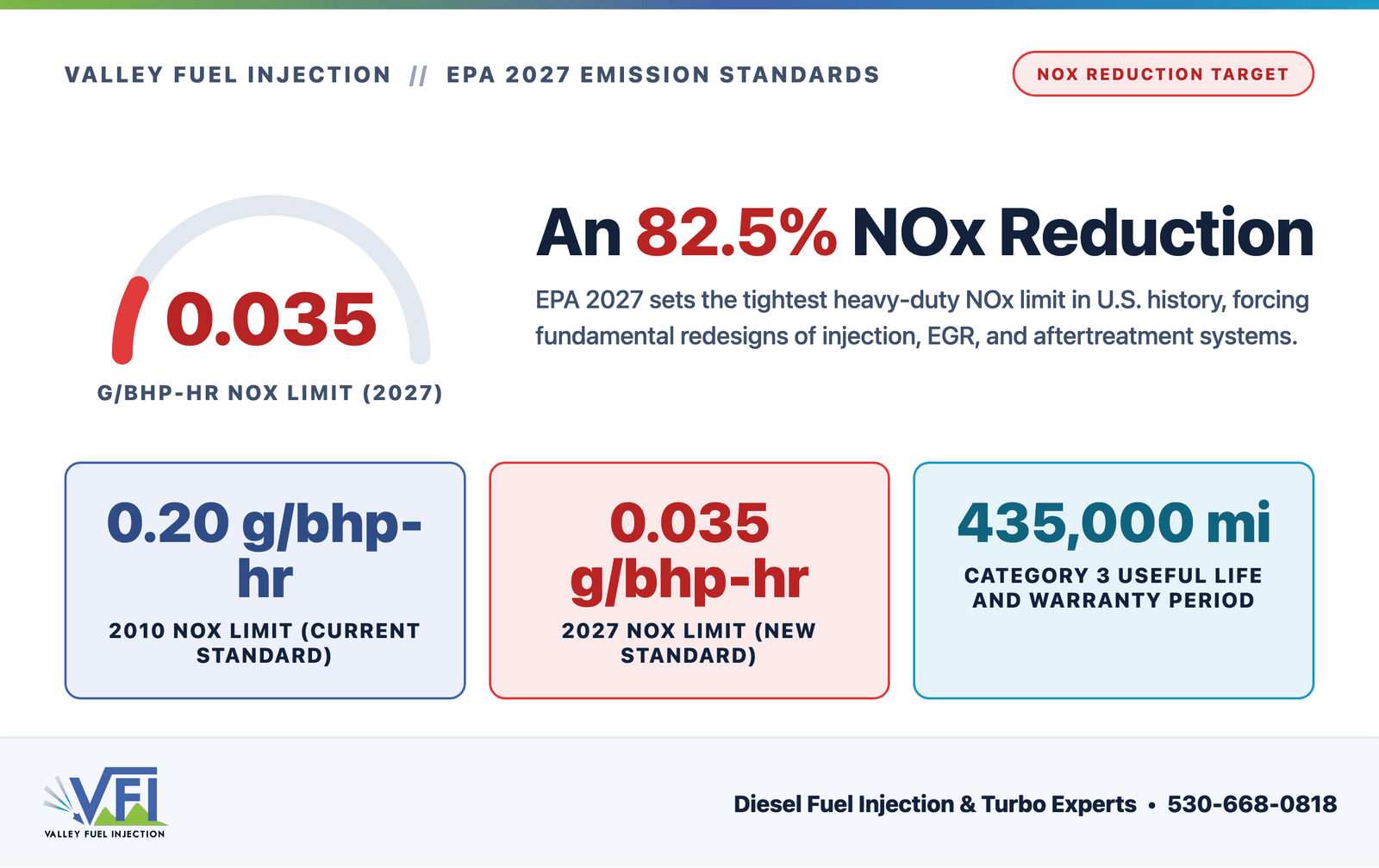
The extended useful life requirement under EPA 2027 means engine manufacturers must warrant emissions-related components for up to 435,000 miles on Category 3 engines. That is nearly four times the previous requirement, and it is pushing OEMs toward more durable injection and aftertreatment hardware from the factory.
How Do the New Volvo D13 and Mack MP13 Engines Meet EPA 2027 Requirements?
Volvo Trucks and Mack Trucks, both part of the Volvo Group, have announced their EPA 2027-compliant powertrains: an updated Volvo D13 and the new Mack MP13. Both engines are designed around a strategy of dramatically improved aftertreatment efficiency combined with tighter fuel combustion control.
The core architecture relies on what engineers call “cold-start SCR” performance. Older SCR (selective catalytic reduction) systems only reached peak NOx conversion efficiency after the exhaust system warmed up, typically several miles into a trip. The new systems use electrically heated catalysts, close-coupled SCR positioning, and advanced DEF dosing algorithms to hit high conversion rates within seconds of startup. This matters because a significant portion of real-world NOx emissions occur during cold starts and low-load urban operation, exactly the conditions that older aftertreatment systems handled poorly.
On the fuel injection side, both the D13 and MP13 lean on high-pressure common rail systems with tighter injection timing control and multiple injection events per combustion cycle. Precise injection allows combustion temperatures and pressures to be optimized for lower NOx formation at the source, reducing the burden on aftertreatment to clean up what the combustion process creates. The EGR systems are also more sophisticated, with cooled EGR rates and valve response times tuned more precisely than previous generations.
The Volvo Group’s compliance strategy is worth watching closely in California. Volvo reached a $197 million settlement with the EPA and CARB in 2024 over emissions certification violations on earlier engine families. That settlement underscores how seriously regulators are treating NOx compliance, and why OEMs are investing heavily in getting the 2027 architecture right from day one.
The $197M Volvo/CARB settlement was not just a fine, it included mandatory in-use testing, recall provisions, and enhanced compliance monitoring. California regulators have demonstrated they will pursue enforcement aggressively. Fleets operating non-compliant or tampered equipment in Northern California face significant financial exposure.
What Do Tighter NOx Limits Mean for Diesel Fuel Injection and Aftertreatment Systems?
Tighter NOx limits mean that every link in the fuel combustion and exhaust chain must perform closer to its design specification, all the time, not just when the truck is new. This is where fuel injection system health becomes a compliance issue, not just a performance issue.
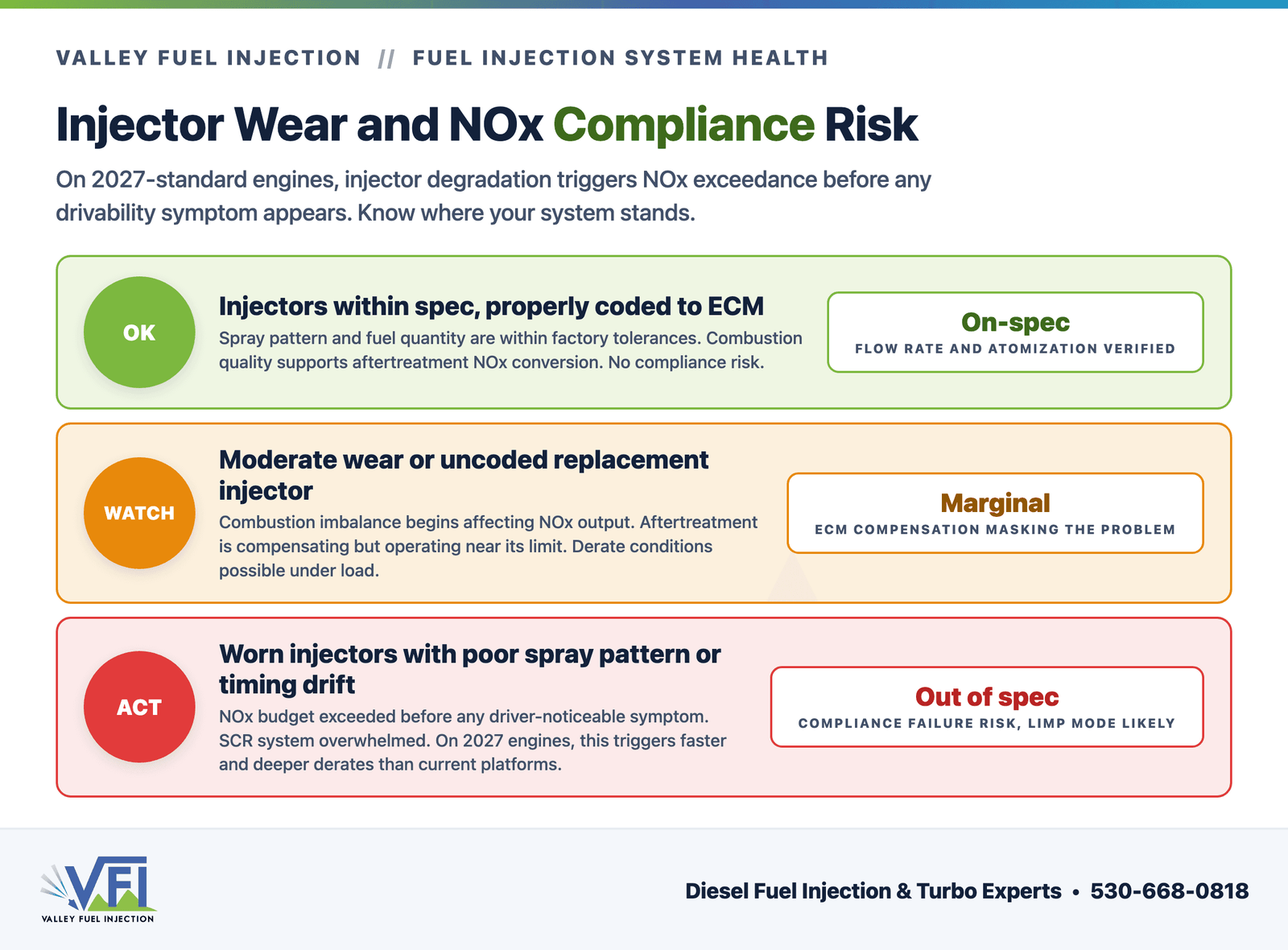
Here is why: NOx formation is directly tied to combustion temperature and the completeness of the burn. A worn or dirty injector that delivers fuel in a poor spray pattern, or at incorrect timing, raises peak combustion temperatures and creates localized rich zones, both of which increase NOx output. On a 2010-standard engine, that degradation might go unnoticed by the aftertreatment system. On a 2027-standard engine with a much tighter NOx budget, the same injector wear can push the engine out of compliance before any obvious drivability symptom appears.
The aftertreatment side is equally demanding. SCR systems on 2027 engines will rely on NOx sensors, DEF dosing injectors, and catalyst beds performing at a higher level than current-generation systems. A failing NOx sensor, a partially clogged DEF injector, or a degraded SCR catalyst will trigger derates faster and more aggressively on these new platforms. The extended warranty periods also mean manufacturers will be scrutinizing in-use performance data, telematics-connected trucks will flag injection and aftertreatment anomalies automatically.
For fleets running current-generation trucks, this is a preview of where maintenance standards are heading. Shops like ours at Valley Fuel Injection are already seeing the pattern on 2017-and-newer common rail platforms: injection system precision directly affects whether the aftertreatment can do its job. That relationship only tightens under 2027 rules.
| System | 2010 Standard Tolerance | 2027 Standard Implication |
|---|---|---|
| Fuel injectors | Moderate wear tolerated before drivability impact | Wear triggers NOx exceedance before driver notices |
| NOx sensors | Sensor drift causes derate warnings | Sensor drift triggers faster, deeper derates |
| EGR system | Carbon buildup reduces flow, increases NOx gradually | Same buildup exceeds tighter NOx budget sooner |
| SCR / DEF system | Degraded catalyst still meets standard at moderate load | Degraded catalyst fails compliance at lower NOx budget |
| DPF | Extended cleaning intervals common in practice | Tighter regen management required; soot load affects NOx strategy |
Will EPA 2027 Engines Require Changes to How Fleets Maintain Fuel Injection and Turbos?
Yes, and the changes are more about discipline and intervals than entirely new procedures. The fuel injection systems on 2027-compliant engines will still be high-pressure common rail architecture, and the turbochargers will still be variable geometry units. But the tolerances are tighter, the ECM calibration is more sensitive to component variation, and the consequences of deferred maintenance are steeper.
A few specific areas where maintenance practices will need to sharpen:
Injector coding and calibration. Every time an injector is replaced on a modern common rail engine, the replacement unit must be coded to the ECM with its individual trim values. On 2027 platforms, this step is not optional, skipping it causes combustion imbalance that pushes NOx output up and triggers derate conditions. We already see this on current platforms, and it will only become more critical. ECM/injector calibration on these engines typically runs $250–$600 as a standalone service line item.
High-pressure fuel pump condition. The HPFP on Volvo D13 and Mack MP8/MP13 platforms (Bosch CP-spec units) must maintain rail pressure within tight tolerances to support the multi-event injection strategies these engines use for NOx control. A pump that is losing pressure at the margins will cause the ECM to compensate in ways that affect combustion quality and aftertreatment load. HPFP replacement on these platforms typically runs $2,800–$5,500 parts and labor, and if the pump has shed metal debris into the fuel rail, injector replacement is often triggered at the same time.
VGT turbocharger response. Variable geometry turbos on 2027 engines are tied into the engine’s NOx management strategy, vane position affects EGR flow and exhaust temperature, both of which the aftertreatment system depends on. A sticky VGT actuator or carboned-up vane assembly does not just hurt power; it disrupts the thermal management the SCR system needs to stay in its conversion window. Our turbocharger service team sees this regularly on current-generation trucks, and 2027 engines will be no different.
NOx sensor replacement intervals. These sensors wear out, and on 2027 platforms they will be monitored more aggressively by the ECM. A single bad NOx sensor, upstream or downstream of the SCR, can put a truck in limp mode. Replacing both sensors in a single visit typically runs $1,100–$2,500 at a California specialty shop. Doing them one at a time on a high-mileage truck usually costs more in total labor.
If you are running a current-generation Volvo D13 or Mack MP8 and planning to keep the truck past 400,000 miles, get a full fuel injection system diagnostic now, before 2027 trucks arrive and parts demand spikes. Reman injectors and HPFP cores for these platforms are already on allocation at some distributors. Our common rail service team can bench-test your injectors and pressure-test your pump before problems become roadside events.
If you’ve noticed your current truck losing power under load or in hot weather, that’s worth investigating now. Read our breakdown of why diesel engines lose power in hot weather, many of those causes tie directly to fuel injection and turbo health.
How Does California’s CARB Standard Interact with EPA 2027 for Northern California Fleets?
California does not simply adopt the federal EPA standard, it sets its own, and historically CARB’s rules are stricter and enforced more aggressively. For Northern California fleets, the interaction between EPA 2027 and CARB regulations creates a compliance layer that is more demanding than what fleets in other states face.
CARB’s Advanced Clean Trucks (ACT) regulation and the Heavy-Duty Omnibus Rule already require that new trucks sold in California meet low-NOx standards that in some cases anticipate the EPA 2027 thresholds. CARB’s Omnibus regulation effectively requires 2027-level NOx performance from model year 2024 trucks sold in California, which means some fleets in our region are already operating under 2027-equivalent emission constraints, whether they realize it or not.
The practical implication: if you are a fleet manager based in Sacramento, Stockton, or Redding, your trucks may already need to comply with standards that the rest of the country won’t face until 2027. CARB’s in-use compliance testing program means that trucks operating in California can be pulled over and tested for emissions performance in the real world, not just on a dynamometer during certification. A truck that passes federal certification but underperforms in real-world operation is still a CARB enforcement risk.
You can review CARB’s current heavy-duty truck requirements directly at the CARB Heavy-Duty Vehicle Inspection Program page.
The biodiesel mandate in California also intersects with injection system health in ways that are underappreciated. Higher B20 blends, increasingly common at California truck stops, can accelerate injector wear and deposit formation on common rail systems not designed for those blends. We covered this in detail in our post on biodiesel injector damage and California’s fuel quality issues. On a 2027-standard engine where injection precision is critical to NOx compliance, that wear mechanism matters more than ever.
CARB’s Heavy-Duty Inspection Program can conduct roadside emissions tests on trucks operating in California. A truck with a degraded SCR catalyst or malfunctioning DEF system is not just a maintenance problem, it is a potential citation and out-of-service order. Fleets based near Sacramento, Stockton, or along I-5 corridors see these inspections regularly.
What Should Diesel Fleet Managers Be Planning for Right Now, and What Can Wait?
Not everything needs to happen immediately, but some decisions made in 2026 will have significant cost implications by 2028. Here is a practical framework for prioritizing.

Do now:
- Audit the aftertreatment health of every truck in your fleet. DPF condition, SCR catalyst efficiency, and NOx sensor function should be documented. An aftertreatment diagnostic and forced regen service typically runs $350–$700, far less than replacing a DPF ($3,500–$8,500) that was allowed to fail because no one checked it.
- Establish a relationship with a qualified diesel fuel injection specialist who can bench-test injectors and pressure-test pumps. As 2027 trucks enter the market, shops with common rail expertise will be in high demand. Fleet accounts with established relationships get prioritized scheduling.
- Review your fuel sourcing. If your trucks are running California B20 blends heavily, assess whether your injector maintenance intervals are adjusted accordingly. The wear mechanisms are real and documented.
- Check whether any trucks in your fleet have aftertreatment tampering or delete devices. CARB enforcement is active, and the Volvo settlement demonstrates that regulators are willing to pursue significant penalties. Bringing tampered trucks back into compliance before an inspection is far less expensive than the alternative.
Plan for 2027 and beyond:
- Budget for higher per-event repair costs on 2027-compliant trucks. The systems are more sophisticated, parts are more expensive, and calibration requirements add labor time to every injection system repair. A single injector swap on a Volvo D13 or Mack MP13 will likely run $900–$1,800 all-in; a full set of six runs $6,500–$10,500 depending on OEM vs. reman choice and engine access time.
- Evaluate whether your current maintenance provider has the equipment and training to work on 2027-architecture engines. These trucks require advanced scan tools, injector coding capability, and familiarity with the specific aftertreatment control strategies each OEM uses.
- Consider extended parts inventory for your current pre-2027 fleet. As production shifts toward 2027 architecture, parts availability for 2020-2026 trucks may tighten. Stocking critical wear items: NOx sensors, DEF injectors, EGR valves, for your highest-mileage units is a reasonable hedge.
If your trucks are showing any symptoms of fuel system stress right now, hard starts, rough idle, unexplained derates, or engines that won’t stay running, those are signals worth investigating before the problem compounds. Deferred injection system maintenance on a high-mileage truck rarely gets cheaper with time.
Key EPA 2027-related service cost ranges (California specialty shop, 2026):
Aftertreatment diagnostic / forced regen: typically $350–$700
NOx sensor replacement (both, one visit): typically $1,100–$2,500
EGR valve replacement (Class 8): typically $2,200–$4,500
DPF cleaning (professional): typically $500–$950
DPF replacement (Class 8): typically $3,500–$8,500
HPFP replacement (Volvo D13 / Mack MP8): typically $2,800–$5,500
Full injector set (Class 8, 6 injectors, installed): typically $6,500–$10,500
ECM / injector coding post-replacement: typically $250–$600
Prices reflect typical California specialty-shop ranges as of 2026. Your actual quote depends on the condition of your specific components, parts availability, and current labor rates. Call VFI at 530-668-0818 for an accurate quote on your job.
For technical background on how modern common rail injection systems are engineered to meet increasingly tight emission targets, the Bosch Mobility diesel systems overview is a useful reference: Bosch supplies the high-pressure injection components used in many of the engines affected by EPA 2027.
Fleet managers and owner-operators in the Sacramento region can also review our Sacramento diesel fuel injection service page for information on what we offer locally, and those running routes through the Central Valley can find us at our Woodland diesel fuel injection shop, centrally located for I-5 and Highway 113 corridor operators.
Our team has been working on diesel fuel injection systems since 1993, and we are already tracking how 2027 engine architecture is changing what fleet maintenance looks like in practice. If you want to talk through what these regulations mean for your specific trucks, reach out to our team or call us at 530-668-0818. We are happy to walk through your fleet’s situation without a sales pitch attached.
Frequently Asked Questions About EPA 2027 Diesel Engine Regulations
When exactly do EPA 2027 diesel engine regulations take effect?
The most stringent NOx limits apply to model year 2027 engines, with full phase-in continuing through 2031. Trucks manufactured before model year 2027 are not required to be retrofitted to meet the new standard, but California’s CARB regulations may impose additional requirements on older trucks operating in the state through separate programs such as the Truck and Bus Regulation.
Do EPA 2027 rules apply to trucks already in service, or only new purchases?
The certification standards apply to new engines at the point of manufacture. However, California’s in-use compliance programs mean that older trucks operating in the state must still meet the emission standards they were certified to when new. Tampering with aftertreatment systems on any truck, regardless of model year, is a CARB violation with significant financial penalties.
Will reman injectors and pumps be available for 2027-architecture engines?
Yes, but it will take time for the remanufacturing supply chain to develop around new platforms. For the first several years after 2027 engines enter the market, OEM replacement parts will be the primary option, which means higher parts costs compared to what fleets currently pay for reman units on established platforms. Shops with strong OEM distributor relationships, like our Bosch and Delphi authorized accounts, will have better parts access during that transition period.
How does the Volvo $197M EPA settlement affect warranty coverage on current Volvo trucks?
The settlement included provisions for extended emissions warranty coverage and in-use testing on affected engine families. If you operate Volvo trucks in the affected model year range, you should verify your specific VIN against the settlement terms. Your Volvo dealer or a qualified diesel specialist can help you understand what coverage applies to your equipment. The EPA’s settlement page has the official documentation.
What is the most important fuel injection maintenance step for staying compliant under tighter NOx rules?
Keeping injectors delivering the correct spray pattern and fuel quantity is the foundation. On common rail engines, that means periodic bench testing to verify flow rate and atomization, and replacing injectors before they degrade to the point where combustion quality suffers. It also means ensuring that every injector replacement is followed by proper ECM coding, an uncoded injector causes combustion imbalance that increases NOx output and can trigger derate conditions on modern engines. Our Bosch-certified injection testing and repair service covers both the bench testing and the calibration side of that equation.
Whether you’re managing a fleet of Class 8 trucks or running a single owner-operator rig, now is the time to assess your fuel injection and aftertreatment health. Call us at 530-668-0818 or schedule a diagnostic at our shop at 1243 E Beamer St, Suite C, Woodland, CA 95776. We also ship remanufactured injectors and pumps nationwide and accept mail-in units for bench testing and rebuilding, so distance is not a barrier to getting the right service.