
EPA 2027 Diesel Engine Regulations: Fleet Guide
08/12/2026
Kubota V2203 Engine Guide: Variants, Fitment & Fixes
10/06/2026
6.7 Cummins Grid Heater Problems: Symptoms, Diagnosis, and What It Means for Cold Starting
6.7 Cummins grid heater problems are one of the most common cold-start complaints we see from Ram 2500 and 3500 owners, and they are also one of the most misdiagnosed. The grid heater is not a glow plug system. It works completely differently, and when it fails, the symptoms overlap with fuel injection problems in ways that send a lot of trucks down the wrong repair path. This guide walks through exactly what the grid heater does, how to tell when it is failing, why the bolt failure issue is so notorious on this engine, and when the hard-start problem you are chasing is actually coming from the injection system instead.
A failed 6.7 Cummins grid heater causes hard cold starts and white smoke, but the same symptoms can come from worn injectors. Diagnosing which system is actually at fault before you start replacing parts saves hundreds of dollars and prevents repeat comebacks.
What the Grid Heater Actually Does in the 6.7 Cummins Cold-Start Sequence
The grid heater is an electrically heated resistive element mounted in the intake air stream, upstream of the intake manifold. When coolant temperature is below a threshold (roughly 50°F on most calibrations), the ECM commands the grid heater relay to energize the element before and during cranking. The element heats incoming air so that compression temperatures during cranking are high enough to ignite diesel fuel reliably.
This is fundamentally different from a glow plug system. Glow plugs heat the combustion chamber directly, one per cylinder. The grid heater heats all the intake air at once, acting as a single centralized heat source for the entire engine. The 6.7 Cummins uses this approach because it is fast, effective, and compatible with the high-pressure common rail system’s tight injection timing requirements. The ECM runs the heater in a pre-heat cycle (typically 5–15 seconds depending on ambient temperature), then holds it on during cranking and for a post-start warm-up period to reduce white smoke.
When that element or its control circuit fails, the engine is cranking cold air instead of pre-heated air. On a warm day that might not matter much. At 20°F, it can mean the difference between a one-second start and a 30-second crank that still results in a rough, smoking idle.
The 6.7 Cummins grid heater draws a massive amount of current when it energizes, typically 100–150 amps. A weak battery or corroded battery cable can prevent the element from reaching full temperature even when the heater itself is perfectly good. Always load-test your batteries before condemning the grid heater assembly.
Symptoms of a Failing Grid Heater on the 6.7 Cummins
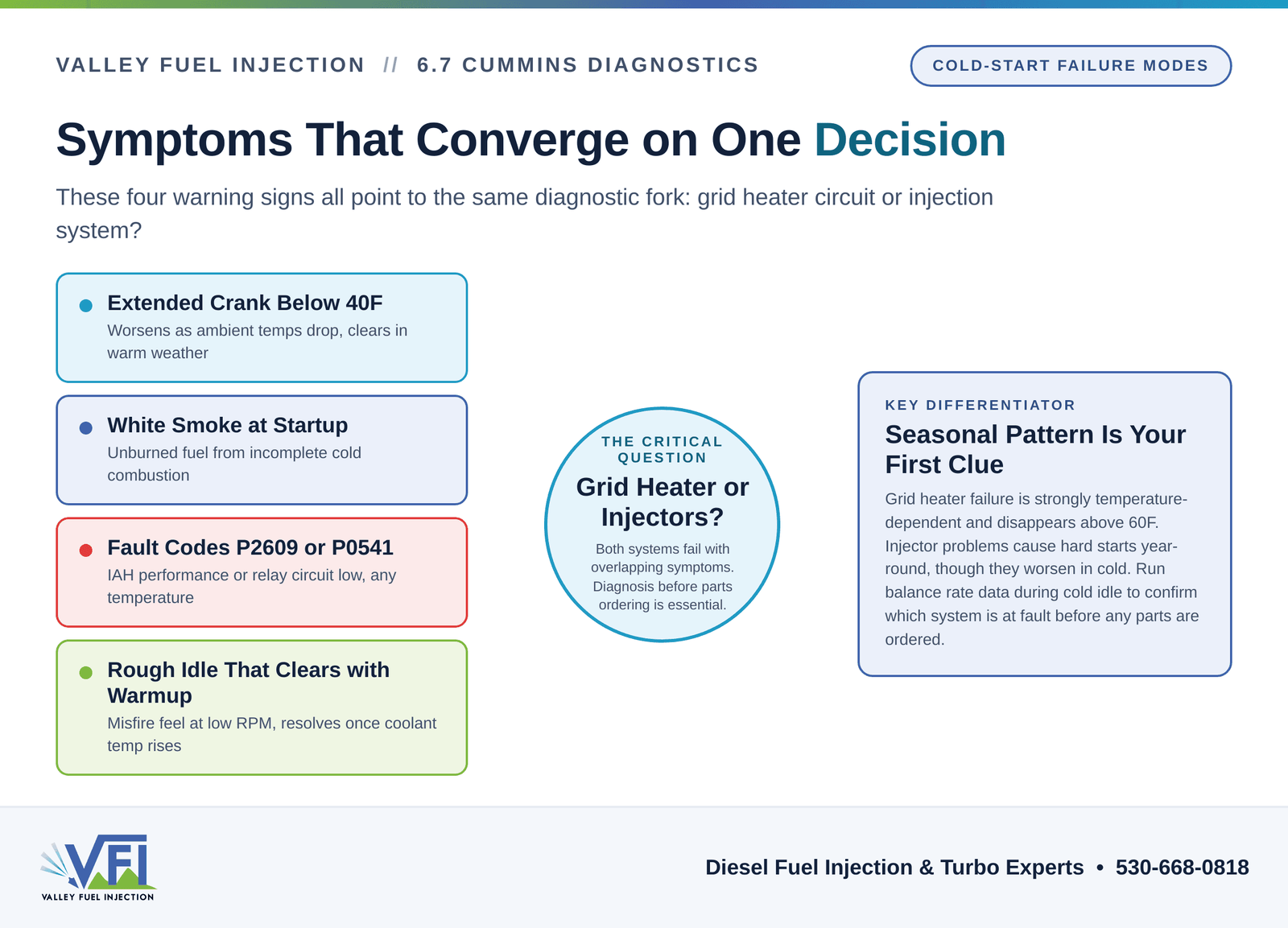
The most obvious symptom is extended cranking time in cold weather, but there are several others that point specifically toward the grid heater rather than other systems.
| Symptom | When It Appears | Notes |
|---|---|---|
| Extended crank time in cold weather | Below 40°F ambient | Worsens as temps drop further |
| White smoke at startup | First few minutes of operation | Unburned fuel from incomplete combustion |
| Rough idle after cold start | Clears once coolant temp rises | Engine misfire feel at low RPM |
| Fault codes P2609 or P0541 | Check Engine light, any temp | P2609 = IAH performance; P0541 = relay circuit low |
| No “Wait to Start” light | Cold start sequence | ECM may not be commanding the heater at all |
| Symptoms disappear in warm weather | Above 60°F ambient | Strong indicator the heater is the cause, not injectors |
The seasonal pattern is the biggest clue. If your 6.7 Cummins starts and runs perfectly fine from April through October and becomes a problem every November, the grid heater is almost always involved. Injector problems, by contrast, tend to show up year-round, though they get worse in cold weather too. We cover the overlap between these two systems in more detail below.
Why the Grid Heater Bolt Is Such a Notorious Failure Point
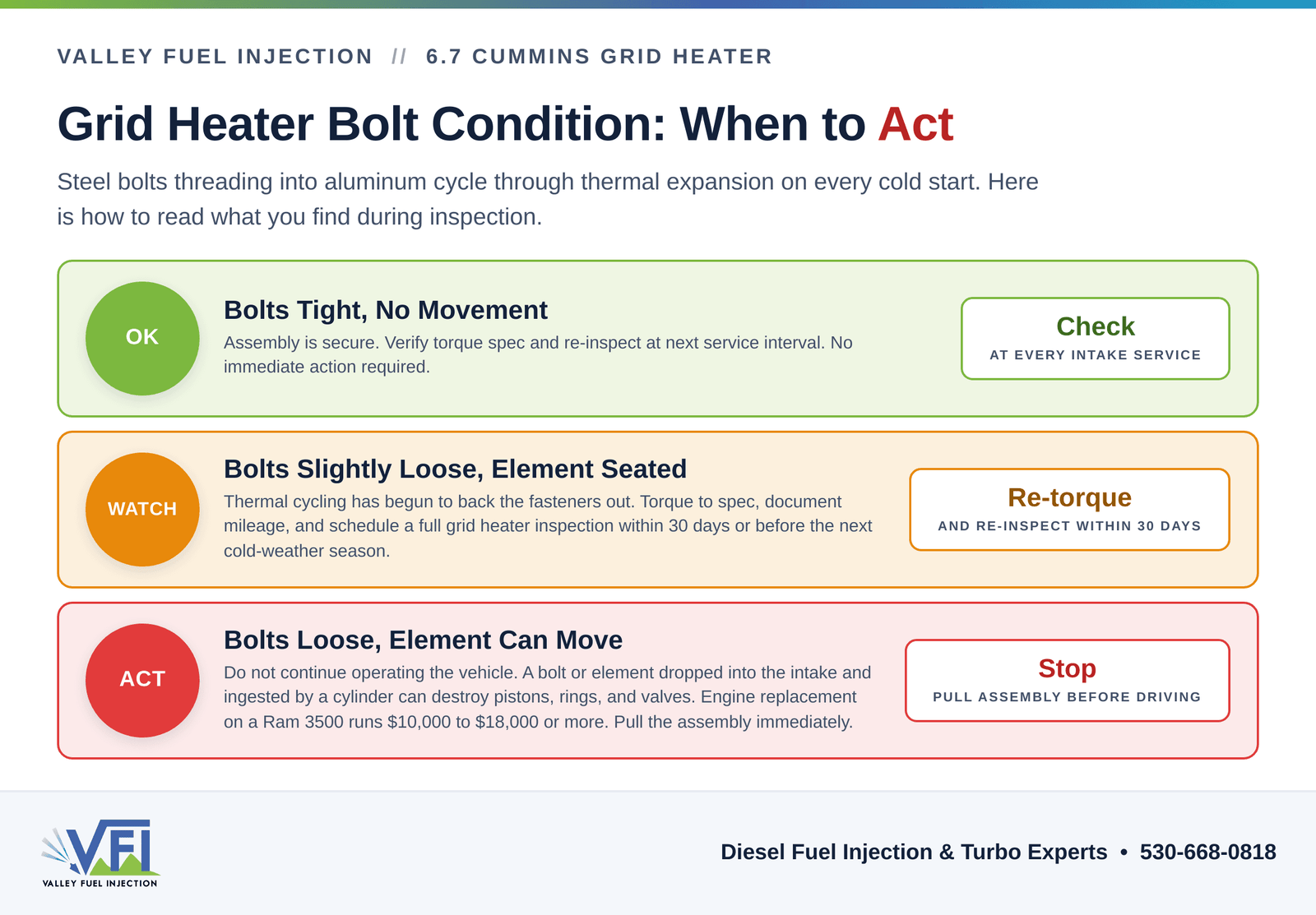
The grid heater assembly on the 6.7 Cummins is mounted to the intake horn with bolts that thread into aluminum. This is where things get ugly. The element itself runs at very high temperatures every cold start, and the intake horn cycles through significant thermal expansion and contraction over time. The bolts are steel threading into aluminum, which means different expansion rates every single time the engine heats up and cools down.
Over thousands of cold-start cycles, those bolts work loose. When they work loose, the element can drop into the intake manifold. If that bolt makes it into a cylinder, you are looking at catastrophic engine damage. This is not a hypothetical worst-case scenario. It happens regularly enough that the aftermarket has developed specific solutions to address it, and shops like ours see the aftermath firsthand.
A loose grid heater bolt on the 6.7 Cummins is not a “monitor it” situation. If you find a loose bolt during inspection, the assembly should come out immediately for evaluation. A bolt dropped into the intake and ingested into a cylinder can destroy pistons, rings, and valves. Engine replacement on a Ram 3500 runs from $10,000 to $18,000 or more. The grid heater fix costs a fraction of that.
Fleece Performance and BD Diesel have both developed upgraded grid heater kits specifically to address this failure mode. These kits use better fastener materials, thread-locking provisions, and in some cases a redesigned mounting approach that eliminates the loose-bolt failure mode entirely. The Diesel World coverage of Fleece’s solution brought this issue to wider attention, but the problem has been documented in 6.7 Cummins forums for years. Any shop working on high-mileage 6.7 Cummins trucks should be checking that grid heater mounting at every opportunity.
Cummins has issued service information on this failure, and Cummins Engine owners are encouraged to check their engine serial number against current service bulletins for the 6.7 ISB platform.
How Grid Heater Failure Interacts with Fuel Injection and Hard Starting
Here is where the diagnosis gets complicated. A failed grid heater and worn 6.7 Cummins injectors produce overlapping symptoms, and many trucks have both problems at the same time. Understanding how they interact helps you prioritize the repair correctly.
When the grid heater fails, the engine cranks cold air. The ECM compensates by commanding extended injection duration and pilot injection events to get combustion started. This puts extra demand on the injectors during every cold start. If your injectors are already showing wear, reduced spray pattern quality, or internal leakage, that extra demand exposes the weakness. The result is a hard start that does not fully resolve even after you replace the grid heater, because the injectors were marginal before and the grid heater failure was masking how marginal they really were.
The reverse is also true. A truck with a perfectly good grid heater but injectors that are leaking internally will still hard-start in cold weather because the combustion event is weak even with properly heated intake air. Replacing the grid heater on that truck accomplishes nothing.
This is why diagnosis matters before parts get ordered. Our post on 6.7 Cummins injector problems covers the injection-side symptoms in detail, and it is worth reading alongside this one if your truck is hard-starting. The two issues are related, and the fix for one does not automatically fix the other.
Common rail injector wear on the 6.7 Cummins shows up as balance rate deviations in INSITE or dealer-level scan data. A cylinder contributing significantly less fuel than its neighbors during cold idle is telling you the injector on that cylinder is not delivering correctly. That is an injection problem, not a grid heater problem, and no intake air heater will fix it. For a broader look at common rail symptoms and failure patterns, see our guide on common rail injector problems.
The 6.7 Cummins common rail system operates at injection pressures up to 29,000 PSI at full load. Even minor internal injector wear that allows small amounts of return flow leakage can drop effective injection pressure enough to cause cold-start misfires, because compression temperatures during cold cranking are already marginal without the grid heater working.
Diagnostic Steps: Grid Heater vs. Glow Plug vs. Injection Issue
Confirming the cause of a 6.7 Cummins hard cold start requires a methodical approach. Guessing costs money. Here is the sequence we use.
Step 1: Pull fault codes. Connect a quality scan tool capable of reading Cummins-specific codes, not just generic OBD-II. P2609 (Intake Air Heater System Performance) and P0541 (Intake Air Heater Relay Circuit Low) both point directly at the grid heater circuit. If you have neither of these codes but you do have misfire-related or fuel system codes, the investigation shifts toward injection.
Step 2: Verify the relay is commanding the heater. With a scan tool that can monitor IAH relay status, watch whether the ECM is actually commanding the heater on during cold start. If it is commanding it and the heater is not drawing current, you have an element failure. If it is not commanding it at all, the issue may be the coolant temperature sensor sending incorrect data to the ECM.
Step 3: Load-test the batteries. The 6.7 Cummins runs dual batteries. Both need to be load-tested under actual cranking conditions. A battery that reads 12.6 volts at rest but collapses under load will starve the grid heater of the current it needs to reach operating temperature. This is an extremely common finding on trucks with 4–5 year old batteries.
Step 4: Check the element resistance. With the heater relay disconnected, measure resistance across the element terminals. A good element reads in the range of 0.5–1.5 ohms. An open circuit (infinite resistance) means the element is burned out. A short to ground means the element has failed internally. Either way, the assembly needs replacement.
Step 5: Inspect the mounting bolts. While you have access to the intake area, physically check the grid heater mounting bolts for tightness. This takes 30 seconds and could prevent an engine-destroying failure. If the bolts are loose, the assembly needs to come out for a full inspection before it goes back in.
Step 6: Run injector balance rate data. If steps 1 through 5 do not fully explain the hard-start severity, connect INSITE or an equivalent Cummins-capable tool and capture balance rate data during a cold idle. Cylinders deviating more than a few mm³ from the average are telling you the injector on that cylinder is contributing to the problem. This step is what separates a grid heater repair from a grid heater plus injector repair, and it matters because the labor to access the injectors overlaps with some of the grid heater work.
The grid heater circuit on this engine already has a documented safety history. In 2023, Stellantis recalled roughly 306,000 Ram 2500, 3500, 4500, and 5500 trucks from the 2021 to 2023 model years because the intake heater grid relay could overheat and, in rare cases, create a fire risk (NHTSA recall 23V-060). If your truck falls in that range, check whether the recall was performed before you spend money chasing a cold-start complaint. Note that the relay recall is a separate issue from the grid heater bolt failure discussed above, which has no recall.
Cold-start behavior comes down to two things happening correctly at once: intake air warm enough to support combustion, and injectors delivering a clean, correctly timed spray. The short version: both have to be right for a reliable cold start, and fixing only one when both are marginal leads to a comeback.
If you are near our shop, we serve diesel truck owners throughout the Sacramento region. Our Sacramento diesel fuel injection customers and those coming from Woodland and the surrounding valley can bring their Ram in for a full cold-start diagnostic. We run the complete sequence above rather than guessing at parts.
Repair Options and What to Address at the Same Time
Once you have confirmed the grid heater is the problem, you have two main repair paths.
OEM replacement: A factory Mopar/Cummins grid heater assembly addresses the immediate failure. The part runs typically $450–$750, and labor for the R&R is typically $400–$550 at a California specialty shop, for an all-in range of roughly $900–$1,300. This is the straightforward fix, but it does not address the underlying bolt retention issue that caused the failure in the first place.
Upgraded aftermarket kit: BD Diesel’s 1041520 kit and Fleece Performance’s equivalent use improved fastener design and materials to prevent the bolt loosening failure mode. The kit itself runs typically $350–$550, with all-in installation cost of roughly $800–$1,200. The slightly lower total cost compared to OEM replacement reflects the fact that these kits are engineered to be a permanent fix rather than a repeat repair. For trucks that will see regular cold-weather operation, the upgrade kit is worth the conversation.
OEM grid heater assembly (part only): typically $450–$750
OEM replacement, all-in (parts + labor): typically $900–$1,300
Aftermarket upgrade kit (part only): typically $350–$550
Upgrade kit installed, all-in: typically $800–$1,200
Cold-start injector diagnostic / balance rate test: typically $200–$400
Single 6.7 Cummins injector replaced (parts + labor): typically $700–$1,400
Full set of six injectors replaced (parts + labor): typically $4,500–$7,500
Prices reflect typical California specialty-shop ranges as of 2026. Your actual quote depends on the condition of your specific components, parts availability, and current labor rates. Call VFI at 530-668-0818 for an accurate quote on your job.
What to address at the same time: Because accessing the grid heater requires removing the intake horn, this is a natural opportunity to inspect components that are otherwise difficult to reach. A qualified diesel technician should check the intake manifold for signs of oil accumulation from EGR, inspect the intake temperature and pressure sensors, and run the injector balance rate diagnostic while the engine is cold. If balance rates reveal a marginal injector, addressing it now avoids a second teardown later.
A failed grid heater that causes heavy white smoke at startup is worth fixing on its own terms, not just for how the truck drives. Persistent startup smoke draws attention, annoys neighbors and jobsite crews, and on a truck that ever gets inspected it is the kind of visible symptom that invites a closer look. This is an additional reason California truck owners should not defer this repair.
Our diesel fuel injection services page covers the full scope of what we do on 6.7 Cummins fuel systems, from bench testing individual injectors to full common rail system diagnostics. If your grid heater repair reveals injection problems underneath, we have the equipment and the experience to address both in the same visit.
We also work with fleet managers and owner-operators who ship injectors and pumps to us for bench testing and remanufacturing. If you are not local to Northern California, you can contact us about our mail-in injector testing and rebuild service. We ship remanufactured 6.7 Cummins injectors nationwide.
For more on fuel system maintenance practices that extend injector and pump life, our summer diesel fuel system guide covers fuel quality and heat-related degradation that affects injection components year-round, not just in cold weather.
For background on why cold-start injection quality is so sensitive to component condition, Bosch documents the injection pressure and timing tolerances these systems run to on its solenoid-injector common-rail system page. Those tolerances are why a worn injector shows up first on a cold start, when everything is working hardest.
Frequently Asked Questions
Can I drive my 6.7 Cummins with a failed grid heater?
In warm weather, yes, with reduced cold-start performance. In cold weather, you risk hard starts, excessive white smoke, and additional stress on the injectors from prolonged cranking. The more serious concern is the bolt failure risk. If the grid heater mounting bolts are loose, driving the truck at all risks dropping the element or a bolt into the intake. Have it inspected before continuing to operate the vehicle in that condition.
Will a grid heater fault code always trigger the Check Engine light?
Not always. Some grid heater faults store as pending codes without illuminating the MIL, particularly on early 6.7 Cummins calibrations. A truck can have a non-functional grid heater and no visible warning light. If you are experiencing hard cold starts and the light is not on, pull codes anyway with a Cummins-capable scan tool rather than relying on the dashboard alone.
How do I know if my hard cold start is the grid heater or the injectors?
The clearest indicator is the seasonal pattern. Grid heater failure produces symptoms that are strongly temperature-dependent and disappear in warm weather. Injector problems cause hard starts and rough idle across a wider temperature range, though they are worse in the cold. Running injector balance rate data during a cold idle is the definitive test. Cylinders with poor balance rates point to injection, not intake heating. A qualified diesel technician can run this test and give you a clear answer before any parts are ordered.
Is the Fleece Performance grid heater upgrade worth it over OEM replacement?
For trucks that see regular cold-weather use, yes. The OEM design has a documented bolt retention weakness that the aftermarket kits specifically address. If you are already pulling the intake horn to replace a failed heater, spending a modest amount more for a kit engineered to prevent the same failure from recurring is a reasonable decision. Ask your shop which kit they recommend for your specific model year, as fitment details vary across the 2007.5–2024 production run.
Whether the problem is the grid heater, the injectors, or both, we have the equipment and the experience to find it. Our team has been diagnosing and repairing 6.7 Cummins fuel systems for years, and we do not guess at parts. Call us at 530-668-0818 or schedule a diagnostic at our shop.
Visit us at 1243 E Beamer St, Suite C, Woodland, CA 95776. We also ship remanufactured injectors and accept mail-in pump and injector service nationwide.