
How Long Do Diesel Injectors Last? What Kills Them
07/16/2026
Kubota V3800 Fuel System Problems: SVL90-2, SVL95-2s, M-Series and CAT C3.8 Guide
07/19/2026
Diesel Cold Start Problems: Why Your Engine Struggles in Winter and How to Fix It
Diesel cold start problems are one of the most common complaints we hear from truck owners, equipment operators, and fleet managers every winter. If your diesel cranks longer than usual, blows white smoke on startup, stumbles at idle, or flat-out refuses to fire on a cold morning, you are not imagining things.
Cold weather puts every part of your fuel system under stress at once, and a system that runs fine at 60°F can reveal hidden weaknesses the moment temperatures drop below freezing. This guide breaks down exactly what is happening inside your fuel system when it is cold, what you can do to prevent it, and when the problem goes beyond a can of additive and needs a qualified diesel technician.
Cold-weather diesel hard starts usually come from weak batteries and slow cranking, gelled fuel, tired glow plugs or cold-soaked injectors, often several at once. Treat your fuel, maintain your glow plugs, and watch for symptoms that point to a deeper injection system problem before the cold season starts.
Why Do Diesel Engines Have a Harder Time Starting in Cold Weather Than Gasoline Engines?
Diesel engines rely entirely on compression ignition, which means there is no spark plug to light the fuel. Instead, the engine compresses air so tightly that it heats up to well over 1,000°F, and that heat ignites the fuel as it is injected. In cold weather, two things work against this process simultaneously.
First, cold metal absorbs heat. When your engine block, cylinder head, and pistons are cold-soaked overnight, the compressed air loses heat to the surrounding metal before it reaches ignition temperature. A healthy engine with good compression can still overcome this, but any engine with worn rings or slightly low compression will struggle badly. Second, cold diesel fuel does not atomize well. Injection systems are engineered to spray fuel as a fine mist, but cold, thickened fuel resists atomization and burns poorly even when the air is hot enough to ignite it.
Gasoline engines sidestep most of this because they use a spark to ignite a pre-mixed air-fuel charge. Cold weather still affects them, but the ignition mechanism itself is not temperature-dependent the way compression ignition is.
The compression ratio in a modern diesel engine is typically 16:1 to 23:1, compared to 9:1 to 12:1 in most gasoline engines. That higher compression is what generates ignition heat, and it is also what makes cold-weather heat loss so critical to starting reliability.
What Fuel System Components Are Most Affected by Cold Temperatures?
Nearly every component in your diesel fuel system is affected by cold, but some are far more vulnerable than others. Understanding which parts fail first helps you prioritize maintenance and diagnose problems faster.
For truck owners in the Sierra Nevada foothills, the Cascades, or high-elevation Nevada communities, all of these components can be stressed simultaneously during a single cold night. If your fuel system is already marginal, winter is when it breaks. Our diesel fuel injection services team sees a sharp spike in cold-start diagnosis calls every November through February for exactly this reason.
How Does Gelled Fuel, Wax Formation, and Cold-Soaked Injectors Cause Hard Starts?
Diesel fuel contains paraffin wax, and that wax begins to crystallize as temperatures drop. This process happens in two stages that every diesel owner should understand.
The first stage is the cloud point, which is the temperature at which wax crystals begin to form and the fuel turns cloudy. The cloud point of #2 diesel depends on the blend, the season and the supplier. At this stage, fuel still flows but filter plugging becomes possible.
The second stage is the cold filter plugging point (CFPP), a lab test of the temperature where wax starts to plug a standard test filter. Once your filter is plugged, your lift pump cannot pull enough fuel to supply the injection pump, and the engine either cranks without starting or starts briefly and dies.
Cold-soaked injectors add another layer to the problem. Common rail injectors operate at extremely tight tolerances, often within a few microns. Cold, thickened fuel gives a poorly atomized spray that burns incompletely, producing the characteristic white smoke you see on cold mornings. That white smoke is largely unburned fuel vapor, not coolant.
Extended cold cranking without a start forces raw fuel past cold injectors and into the cylinder. This fuel can wash the oil film off cylinder walls, accelerating wear. If a few short cranking tries do not start it (your owner’s manual gives the limit, often about 10 seconds a try with a rest between), stop and diagnose the root cause. You may be making a wear problem worse with every attempt.
Biodiesel blends can make cold-weather gelling worse. B20 and higher blends usually have higher cloud points than straight #2 diesel, depending on the biodiesel used, meaning wax formation starts sooner. If you are running a biodiesel blend in a mountain climate, this matters. We covered the broader risks of biodiesel in our post on biodiesel injector damage and California’s fuel quality issues, and cold-weather gelling is one more reason to be cautious with high-blend fuels in winter.
What Role Do Glow Plugs, Grid Heaters, and Fuel Heaters Play in Cold-Weather Starting?
Glow plugs, grid heaters, and fuel heaters are your engine’s first line of defense against cold-start problems, and each one addresses a different part of the problem.
Glow plugs are installed in each cylinder (one per cylinder on most engines) and preheat the combustion chamber before cranking begins. A healthy glow plug reaches 1,800°F or more within a few seconds. When one or more glow plugs fail, the affected cylinders rely entirely on compression heat, which is often not enough on a cold morning. A single failed glow plug on a 6-cylinder engine can make cold starts noticeably harder. A set with multiple failures can make the engine nearly impossible to start below 25°F.
Glow plug replacement typically runs $300–$700 installed for a full set, depending on engine and access. The glow plug control module (GPCM) that fires them is another common failure point, running $200–$450. If your glow plug light flashes an error code or your wait-to-start time seems unusually short, test the system before winter arrives.
Grid heaters are used on many Cummins and some Caterpillar engines instead of individual glow plugs. A grid heater is a resistive element mounted in the intake manifold that heats incoming air before it enters the cylinders. When a grid heater does fail, every cylinder is affected at once.
Fuel heaters address the fuel side of the problem rather than the air side. An electric or coolant-based fuel heater warms the fuel before it reaches the filter, preventing wax crystals from plugging the media. Many modern diesel trucks include a factory electric fuel heater at the fuel filter. Check that it works before winter. Aftermarket electric fuel heaters that run off battery power before cranking are a worthwhile upgrade for anyone who regularly parks in sub-freezing conditions.
A block heater is one of the most effective cold-start tools for any diesel. Plugging in for 2–4 hours before startup warms the coolant, which warms the block, the heads, and the fuel in the filter housing. It reduces wear, speeds up warm-up, and makes every other cold-start system work better. If you are in a mountain community and not using your block heater, you are making things harder than they need to be.
Which Diesel Additives and Fuel Treatments Actually Help Cold-Weather Performance?
The diesel additive market is full of products that make big claims. Some of them genuinely work. Here is what the science supports and what we have seen perform consistently in real-world use.
The most important class of cold-weather additive is the anti-gel / wax crystal modifier. These products work by coating wax crystals as they form and preventing them from agglomerating into larger structures that plug filters. Products like Stanadyne Performance Formula, Power Service Diesel 911 (for emergency re-liquefaction) and Power Service White Bottle (for prevention), and Hot Shot’s Secret Diesel Winter Anti-Gel are all well-regarded. Stanadyne Performance Formula runs roughly $0.04–$0.06 per gallon treated, Power Service around $0.03–$0.05, and Hot Shot’s Secret around $0.08–$0.12.
A few important rules about using these products:
- Add the treatment to the tank before filling with diesel so it mixes thoroughly as fuel flows in.
- Anti-gel additives must be added before gelling occurs. They cannot reliquefy already-gelled fuel. For that, you need a product specifically labeled as a re-liquefier, used in conjunction with warming the fuel.
- Do not use cetane boosters as a substitute for anti-gel. Cetane improvers help combustion quality but do not address wax formation.
- Avoid mystery-brand additives that claim to do everything. Stick to products with documented CFPP test data on the label.
Use additives that are tested for diesel injection equipment, especially on common rail systems. The wrong additive chemistry can damage injector seals and nozzle coatings. When in doubt, use products specifically labeled as safe for high-pressure common rail systems.
For a broader look at how fuel quality affects your injection system year-round, our post on summer diesel fuel system problems covers the flip side of seasonal fuel stress.
When Do Cold-Start Symptoms Point to a Deeper Injection System Problem?
This is the question that matters most, because treating a fuel system problem with additives and hoping it goes away is a path to expensive repairs. Some cold-start symptoms are environmental and go away as temperatures rise. Others are warning signs of a failing injection component that cold weather is exposing, not causing.
Here is how to tell the difference:
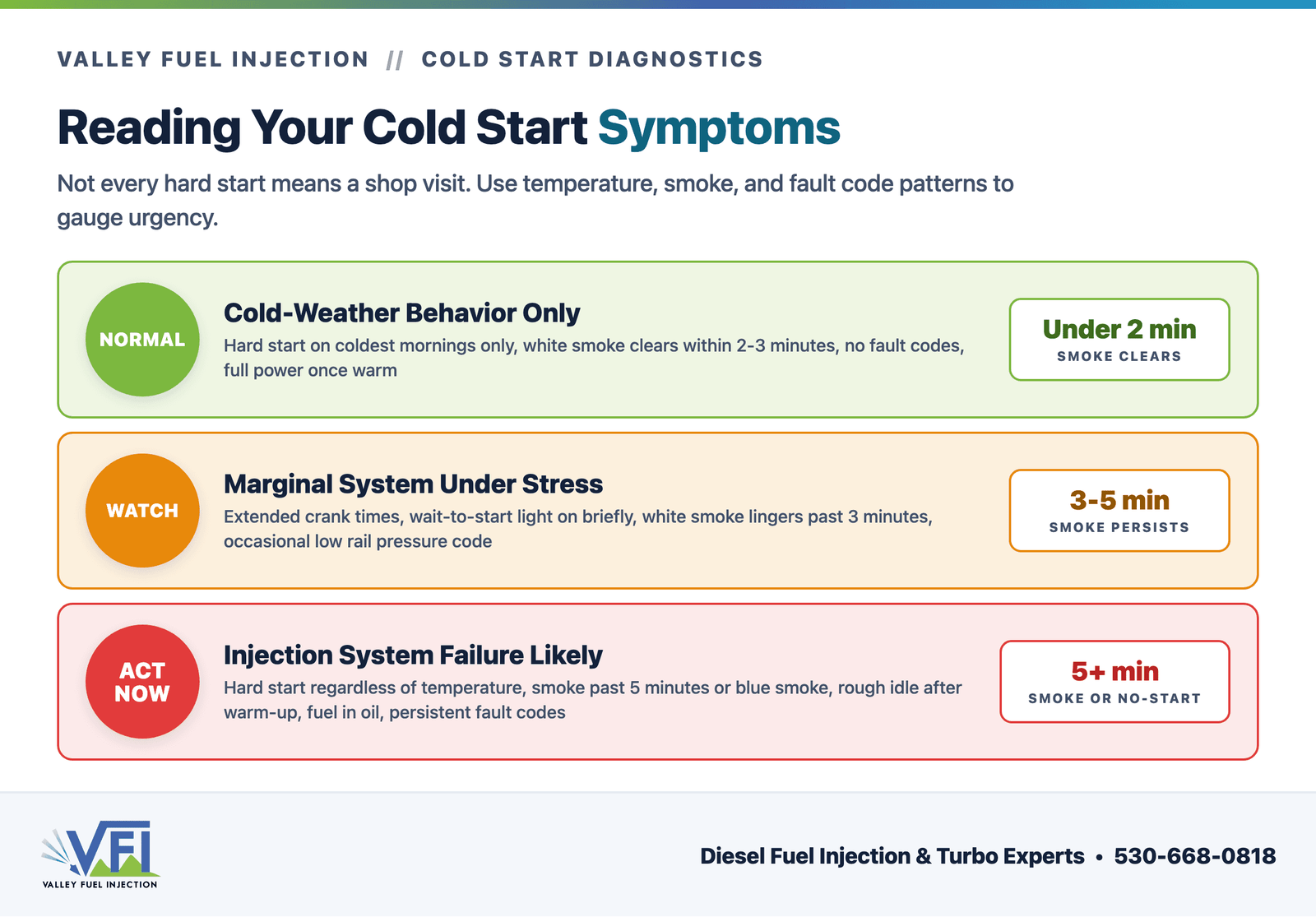
Likely environmental (cold-weather specific): Hard start only on the coldest mornings, clears up once engine warms, no fault codes, white smoke disappears within 2–3 minutes of running, normal power once warm.
Likely a deeper problem: Hard start regardless of temperature but worse in cold, fault codes for low rail pressure or injector circuit faults, rough idle that persists after warm-up, white or blue smoke that continues past 5 minutes of running, loss of power at operating temperature, fuel in the oil.
Common injection system failures that cold weather exposes include:
- Worn or sticking injectors: An injector that is partially stuck closed or has a worn nozzle may pass a warm-weather test but fail when cold-soaked. Bench testing at our Bosch-certified injector testing facility can identify injectors that are marginal under cold conditions.
- Low injection pump output: A VP44, CP3, or mechanical injection pump that is worn will produce less pressure than spec, and cold, thick fuel makes that deficiency worse. If rail pressure codes (common rail) or slow, smoky cold starts (VP44 and mechanical pumps) show up mostly cold and clear as the engine warms, have the pump and fuel supply tested. Our team specializes in common rail system diagnosis and repair, and we can bench-test your pump to confirm.
- Failing lift pump: A weak lift pump that is barely keeping up with demand in warm weather will starve the injection pump in cold weather. FASS and AirDog lift pump systems, installed in the $800–$1,400 range, are a reliable upgrade over the factory unit on high-mileage trucks.
- Leaking injector return lines: Leaking return lines, or worn injectors with high return flow, make it hard for the pump to build rail pressure while cranking. This creates long crank times that look exactly like a glow plug problem.
Before winter hits, have your injectors bench-tested if your truck has more than 150,000 miles on the original set and already starts slow or smokes when cold. A professional bench test, typically $50–$100 per injector, measures spray pattern, return flow, and opening pressure under controlled conditions. It is far cheaper than diagnosing a no-start on the side of a mountain highway in January. Read more about what that process involves in our post on diesel fuel injector cleaning: DIY vs professional service.
Yanmar and Kubota compact diesel owners face the same cold-start challenges, often amplified by the smaller displacement and tighter tolerances in those engines. If you operate a compact tractor or utility vehicle in a mountain or high-desert climate, pre-winter injection system service is especially important. Our Kubota service and Yanmar service teams handle cold-start diagnosis on small diesels regularly.
For a deeper look at pump-specific failure modes that cold weather can trigger, our post on Yanmar diesel injection pump problems covers several patterns that apply broadly across small diesel platforms. And if you are weighing a pump rebuild versus replacement after a cold-season failure, our injection pump rebuild cost guide breaks down the numbers in detail.
The EPA’s diesel fuel standards and the California Air Resources Board diesel fuel program both set specifications for diesel fuel quality, but neither standard guarantees cold-weather performance at the pump. The CFPP of the fuel you buy varies by region, season, and supplier. In Northern California and Nevada, winter-blend diesel is generally available at major truck stops from October through March, but rural and agricultural fuel suppliers may not switch blends as reliably. Always confirm with your supplier.
ASTM D2500 (cloud point) and ASTM D6371 (cold filter plugging point) are the standard tests for these two ratings, and understanding them helps you evaluate whether the fuel you are buying is appropriate for your operating conditions.
Cold-start diagnosis and repair costs vary widely depending on root cause. A full diagnostic and bench test typically runs $300–$700. Glow plug replacement (full set, installed) runs $300–$700. A glow plug control module adds $200–$450. If the problem traces back to worn injectors, individual common rail injector remanufacturing runs $300–$550 each, and a full set installed is typically $3,200–$9,500 depending on engine. A failing injection pump rebuild ranges from $1,200–$2,800 depending on pump type. Prices reflect typical California specialty-shop ranges as of 2026. Your actual quote depends on the condition of your specific components, parts availability, and current labor rates. Call VFI at 530-668-0818 for an accurate quote on your job.
Get Your Diesel Ready Before Winter Hits
Diesel cold start problems are almost always preventable with the right combination of fuel treatment, maintained heating systems, and a pre-season injection system inspection. The engines that end up on the side of the road in January are usually the ones that had marginal injectors, a weak lift pump, or failing glow plugs that were never addressed in the fall.
At Valley Fuel Injection and Turbo, we have been diagnosing and repairing diesel fuel injection systems since 1993. Our team includes Bosch-certified technicians who specialize in common rail systems, VP44 pumps, and mechanical injection equipment across every major diesel platform. Whether you are dealing with a hard-starting pickup, a fleet vehicle that is struggling in cold weather, or a piece of agricultural equipment that needs to be reliable at first light on a cold morning, we can help.
Call us at 530-668-0818 or schedule a diagnostic before the cold season catches you off guard. We are located at 1243 E Beamer St, Suite C, Woodland, CA 95776, serving diesel owners throughout Northern California and Nevada. We also ship remanufactured injectors and pumps nationwide and accept mail-in units for bench testing and rebuilding.
Diesel owners in the Sacramento area and across the Reno and Northern Nevada region can reach us for remote consultation or mail-in service. Do not wait until a no-start on a cold morning forces the decision.
Frequently Asked Questions About Diesel Cold Start Problems
Why does my diesel blow white smoke on cold starts but clear up after a few minutes?
White smoke on a cold start is usually unburned fuel vapor caused by incomplete combustion in cold cylinders. When injectors are cold-soaked, they atomize fuel less effectively, and when combustion chamber temperatures are low, some of that fuel does not burn completely. As the engine warms up, atomization improves and combustion temperatures rise, which is why the smoke clears. If white smoke persists beyond 5 minutes of warm running, that points to a failing injector, a glow plug problem, low compression or coolant getting into a cylinder rather than a normal cold-start condition.
At what temperature does diesel fuel start to gel?
Diesel begins forming wax crystals at its cloud point. The cloud point of #2 diesel depends on the blend, the season and the supplier. The cold filter plugging point, a lab test of the temperature where wax starts to plug a standard test filter, is typically a few degrees lower. Winter-blend diesel sold at major truck stops is formulated for lower temperatures, often down to -10°F or colder in northern climates. Biodiesel blends usually have higher cloud points, depending on the biodiesel used, meaning gelling starts sooner.
How do I know if my glow plugs are causing my hard cold starts?
The most reliable way is to have the glow plug system tested with a scan tool that can read glow plug circuit status and GPCM output. A basic test is to measure resistance at each glow plug with a multimeter: a healthy plug reads a low resistance within the maker’s spec for that plug; an open circuit (infinite resistance) means the element has burned out.
If your wait-to-start light comes on for less than 2 seconds on a very cold morning, or if you have a fault code for a glow plug circuit, have the system tested before assuming the problem is fuel-related.
Can I use starting fluid (ether) to help my diesel start in cold weather?
We strongly advise against it, especially on modern common rail diesels and any engine equipped with glow plugs or a grid heater. Ether ignites far more rapidly than diesel fuel and can cause severe detonation that cracks pistons, blows head gaskets, or damages injectors. Some older mechanical engines have a small ether port designed for controlled use, but even then, it is a last resort. The right answer is to address the underlying cause: treat your fuel, maintain your glow plugs, use a block heater, and have a marginal injection system serviced before winter.
How much does it cost to diagnose diesel cold start problems professionally?
A full diagnostic including computer scan and bench testing typically runs $300–$700 at a specialty diesel shop. That cost is almost always worth it because cold-start symptoms can point to several different root causes, and replacing parts without a proper diagnosis often means replacing the wrong thing first. A qualified diesel technician can isolate whether the problem is fuel quality, glow plugs, a weak lift pump, worn injectors, or low injection pump output, saving you from unnecessary parts expense.