
Diesel Cold Start Problems: Causes & Fixes
07/19/2026
Kubota V3307 Fuel System Guide: SVL75-2, KX080-4 and CAT C3.3B Injector and Pump Problems
07/20/2026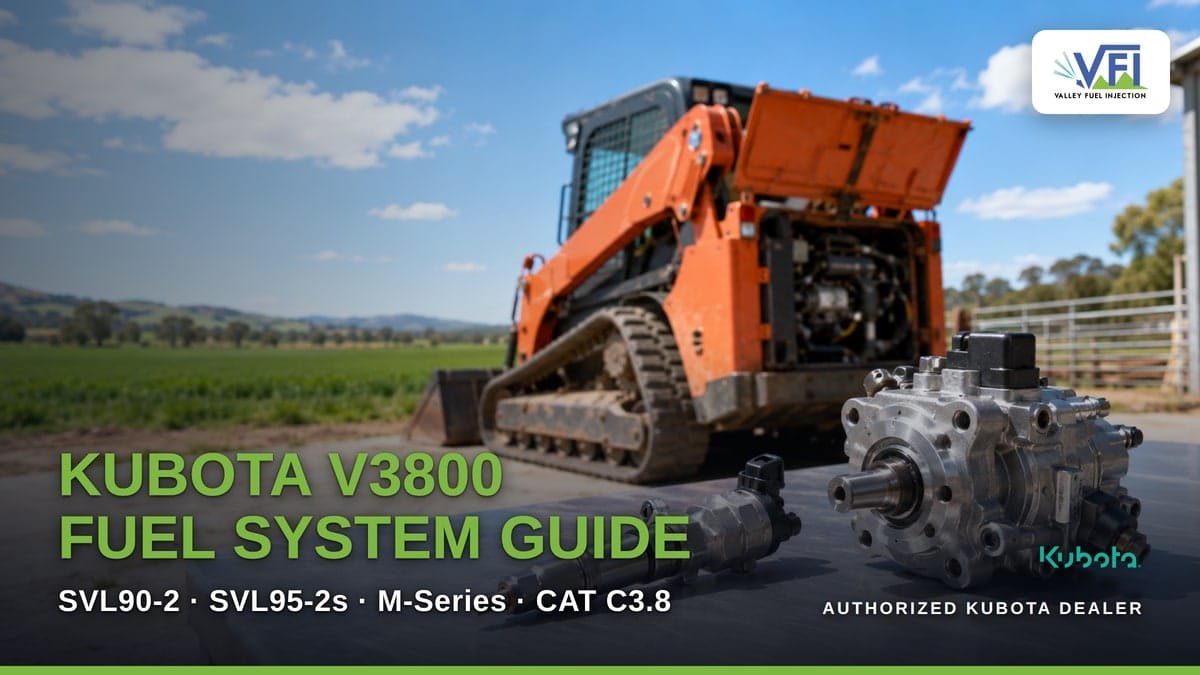
Kubota V3800 fuel system problems generate more confusion per machine than almost any other compact diesel platform we service, and it is not because the engine is bad. The V3800-CR is a stout 3.8 liter common rail diesel that Kubota installs in the SVL90-2, SVL95-2s, and SVL97-2 track loaders and in M-series tractors like the M9960 and M5-111. Kubota also builds the same engine for Caterpillar as the C3.8 in the 272D2, 299D2, and 299D3, and supplies V3800 power for earlier Bobcat T750, T770, and S850 loaders.
One Denso fuel system design and one set of failure modes across four paint colors. This guide maps each failure mode to the actual component, the fault codes owners report, and realistic California repair costs, so you stop paying dealer money for parts you do not need.
How Does the Kubota V3800 Fuel System Actually Work?
The V3800-CR-TE4 and TIE4 use a Denso common rail system built around three stages. A low-pressure circuit pulls fuel from the tank through the water separator and main filter to a Denso HP3 supply pump. On the back of that pump sits the SCV, the suction control valve, a duty-cycle solenoid that meters how much fuel the pump is allowed to compress.
The HP3 feeds the rail. Kubota’s common rail diagnosis manual lists 95 to 130 MPa (about 13,800 to 18,800 psi) during acceleration for the engines it covers, and Kubota’s later V3 fault list sets its over-pressure limit near 191 MPa. From the rail, Denso solenoid injectors fire on commands from the ECM, which watches the rail pressure sensor and corrects fueling in real time.
Two design details drive most of the confusion. First, the SCV is not a simple on-off valve: the ECM pulses it constantly, and it needs a calibration learn through Kubota’s Diagmaster dealer software after replacement.
Second, the injectors carry QR and ID codes on their tops and are registered to the ECM by cylinder. Swap two between holes, or install one without coding it, and the ECM applies wrong correction values: over-fueling, rough running, and eventually a plugged DPF. Our Kubota injector maintenance guide covers brand-wide prevention; this article stays specific to the V3800.
Why Does a Kubota V3800 Crank but Not Start?
A V3800 needs the rail above a minimum pressure threshold before the ECM will fire the injectors, so a crank-no-start with no smoke usually points to rail pressure, though Kubota’s procedure also checks the starting aids and air intake. Work from the tank forward.
Start with the electric feed pump and its power supply. Key on, you should hear the lift pump run. One M9960 owner on OrangeTractorTalks chased a dead fuel pump after washing the tractor and found a hidden 20 amp mini fuse taped against the engine harness near the ECM. It was corroded, not blown, so it looked fine while the pump had no clean power.
If your V3800 died after a wash or a wet week, check the fuel pump fuse and its wiring for corrosion before touching the high-pressure side.
Next, rule out air and supply restriction. A filter change or a run-dry tank can leave enough air in the low-pressure circuit that the HP3 never builds rail pressure. Our Kubota fuel system bleeding guide covers the procedure, so we will not repeat it here.
Then look at the SCV, and do not test it with battery voltage. The SCV is a pulse-width controlled solenoid, and applying 12 volts straight from the battery to see if it clicks will destroy it. An SVL95-2s crank-no-fuel case on OrangeTractorTalks after an engine rebuild traced back to exactly this: good pump, good fuel, and an SCV killed by a DIY voltage test. A new SCV also needs its Diagmaster learn to run right, one of several reasons generic scanners fall short on these engines.

What Causes Kubota V3800 Fuel System Problems Under Load with No Codes?
The classic complaint: an SVL90-2 that idles fine, then chugs, sputters, or falls on its face when you load the bucket or climb a trailer, with a clean code list. The ECM only sets a fault when rail pressure deviates far enough for long enough, so a marginal restriction can make the machine miserable without tripping a code.
A TractorByNet thread tells the whole story. An SVL90-2 owner paid his dealer to replace the flow control valve, the SCV, chasing what the dealer called erratic fuel flow. The chugging came back. The actual fix was the main fuel filter, a part that typically runs $30 to $60. His comment afterward, wondering how many other needless parts he had paid for, is the reason this section exists. On a V3800 that runs clean at idle but starves under load, the order forums learned the hard way is:
- Fuel filters and water separator first. Both elements, and drain the separator. A clogged element flows enough for idle demand but not full-load demand.
- Tank and pickup second. SVL95-2s owners have documented tank contamination that intermittently blankets the pickup screen. If filters keep plugging early, the tank needs a cleanout, not another filter.
- SCV third. A lazy SCV causes hunting rail pressure and surging under load. Verify with live rail pressure data against commanded pressure, not by ear and not with jumper wires.
- Injectors last. Worn or contaminated injectors leak excess fuel to the return circuit, robbing the rail under high demand. A return flow test identifies the leaking cylinder without pulling all four on a guess.
Water in the fuel deserves its own warning. At V3800 rail pressures, a slug of water past the separator can blow an injector tip outright, so if you find water in the separator, treat the injectors as suspects. If rail pressure itself collapses or spikes, the rail, its sensor, and the pressure limiter come into play; our guide to high-pressure fuel rail failure symptoms covers how those present.
Why Won’t an SVL90-2 or SVL95-2 Complete a Regen?
Regen problems are where V3800 owners lose the most money to misdiagnosis, because the DPF is usually the victim, not the cause.
The most expensive pattern: one over-fueling injector. A single injector flowing far past its rated output dumps unburned fuel into the exhaust continuously. The DPF loads faster than any regen can clean it, so the machine falls into back-to-back regens, then failed forced regens, then derate.
California owners report plugged-DPF quotes typically in the $4,500 to $5,900 range for parts and labor. Pay that without fixing the injector and the new DPF plugs too. If an SVL regens constantly or cannot complete a forced regen, check the DPF sensor wiring and have the injectors flow tested before condemning the filter. We explain the two-way relationship in our guide to DPF and injector interaction.
The cheapest pattern: chafed DPF temperature sensor wiring. SVL90-2 machines are known on OrangeTractorTalks for throwing codes 9204 and 9214 from the DPF temp sensor circuit. The harness chafes through its insulation sleeve, creating partial shorts and phantom readings that abort regens. Owners have fixed it with a careful splice and RTV sealant after dealers quoted sensors and filters. Before buying any exhaust temperature sensor for an SVL90-2, strip back the sleeve and inspect the wires.
The frustrating pattern: derate that survives the repair. Once the countdown runs out and the ECM derates power, fixing the root cause is often not enough. Clearing the derate typically requires a factory reset or software update through dealer Diagmaster, so budget that visit into the repair plan. If the dependency bothers you, you are not alone; see our right to repair guide for diesel equipment.
What Do V3800 Fault Codes Like E9302, 9204, and P206A Actually Mean?
Kubota shows fault codes on the SVL dash as E-prefixed numbers, and owners report the same handful again and again.
The SVL95-2s DEF injector story deserves emphasis because it compounds. HeavyEquipmentForums members have replaced two and three DEF injectors in a row, typically $600 to $1,800 each installed, and the failed injectors leak DEF onto the downstream NOx sensor, which then fails too, typically $1,200 to $1,500 replaced. If you are on your second DEF injector, inspect the NOx sensor for crystallized DEF now rather than waiting for the next limp mode.
How Much Do Kubota V3800 Fuel System Problems Cost to Fix?
Forum threads bury real numbers pages deep, so here they are in one place: typical ranges reported by California owners and specialty shops.
Two cost-control moves matter here. First, test before you buy: flow testing all four injectors identifies the one bad unit instead of guessing at a full set, and our mail-in injector testing service handles that from anywhere in the country. Second, remember the coding requirement. Injectors installed without ECM registration can create the exact over-fueling condition you were trying to fix, so budget for the coding step whoever turns the wrenches. Our article on how common rail injectors are tested shows how we verify them on the bench.
Which Other Machines Share V3800 Injectors? The CAT C3.8 and Bobcat Cross-Reference
Here is the fact almost nobody publishes: the Denso injector fitted to many of these engines, part number 095000-9690, Kubota number 1J500-53051, crosses several brands because the engine underneath is the same Kubota V3800. A CAT 299D2 losing rail pressure and an SVL95-2 flagging E9302 are frequently the same failure wearing different decals.
Fitment still depends on engine serial and emissions tier, because Kubota revised injector part numbers between Tier 4 interim and final production. Confirm against your engine plate, or call us with the serial and we will look it up. The diagnostic logic transfers wholesale either way: SCV testing rules, injector coding, and the over-fueling-to-plugged-DPF chain apply to the CAT and Bobcat installations exactly as they do to the SVL.
Should You Check Kubota Warranty and Campaigns Before Paying?
Yes, and this is the step forum members most often discover after they have already paid. Tier 4 Kubota engines carry an emissions warranty on major aftertreatment components of 5 years or 3,000 hours, whichever comes first, separate from the base machine warranty, and Kubota has run service campaigns that many owners only learn about from other owners:
- M5-111 DEF header campaign. The DEF tank header sensor fails from heat soak, triggering P206A, the dash countdown clock, and a derate to roughly 10 percent power. It is subject to a Kubota emissions campaign, so have the dealer check your serial before quoting a header out of pocket.
- SVL95-2s turbo boost hose clamp campaign. Clamp replacement to prevent charge-air leaks that hurt fueling and regen behavior.
- SVL95-2s air filter assembly campaign. Complete air filter assembly replacement paired with an ECU reflash.
Before authorizing any DPF, DEF, or injector repair on a V3800 machine, have the dealer run the serial number for open campaigns and confirm emissions warranty status in writing.
As for the delete kits marketed to frustrated owners, we understand the desperation, but they are illegal on emissions-controlled equipment, they give Kubota grounds to deny warranty and campaign claims, and a machine deleted because one injector was over-fueling still has an over-fueling injector. Prevention beats all of it; our Kubota injector maintenance tips cover the fuel-quality and filter discipline that keeps this system out of trouble.
Frequently Asked Questions
Why won’t my Kubota SVL90-2 complete a regen even when forced?
The two most common causes are an over-fueling injector loading the DPF faster than the regen can clean it, and a faulted DPF temperature sensor circuit, often chafed wiring behind the insulation sleeve. Flow test the injectors and inspect the sensor harness before buying a DPF.
Are Kubota V3800 injectors cylinder-specific, and do new ones need to be coded to the ECM?
Yes on both counts. Each injector carries QR and ID codes on its top and is registered to a specific cylinder through Diagmaster. Swapping positions or skipping the coding step makes the ECM apply wrong correction values, which produces over-fueling and can plug the DPF.
Can I test the SCV by applying battery voltage to it?
No. The suction control valve is a duty-cycle solenoid, and direct battery voltage destroys it. Owners have turned running machines into crank-no-fuel machines this way. Test it with live rail pressure data, and expect a Diagmaster calibration after any replacement.
What does fuel error code E9302 mean on an SVL95-2?
E9302 is a fuel system fault indicating rail pressure is not tracking the ECM’s command. Check the fuel filters and water separator, verify feed pump supply, then evaluate the SCV before condemning injectors or the HP3 pump.
My machine derated after the DPF or DEF countdown. Does a dealer have to reset it?
Usually yes. Even after the fault is repaired, clearing the derate typically requires a factory reset or software update through Kubota’s Diagmaster dealer software, so plan that visit into the repair.
My Kubota M9960 died after washing and the fuel pump won’t run. What should I check?
Check the fuel pump fuse and its wiring for corrosion before touching the high-pressure side, then confirm the pump primes at key-on. A corroded fuse can cut fuel pump power while it looks fine at a glance.
Can I delete the DEF and DPF on an SVL95-2s to stop the problems?
Delete kits exist, but they are illegal on emissions-controlled diesel equipment, they give Kubota grounds to deny warranty and campaign claims, and they leave the actual fault, frequently an over-fueling injector or failing DEF injector, unrepaired. Diagnosing the root cause is almost always cheaper long term.
Is my DPF or DEF repair covered under Kubota’s emissions warranty?
It may be. Tier 4 Kubota engines carry emissions warranty coverage on major aftertreatment components for 5 years or 3,000 hours, whichever comes first, and several V3800 machines are subject to campaigns, including the M5-111 DEF header and the SVL95-2s boost hose clamp and air filter assembly campaigns. Have a dealer run your serial number before paying out of pocket.
Get V3800 Help from an Authorized Kubota Dealer and Injection Shop
Valley Fuel Injection has been rebuilding and testing diesel injection systems since 1993, and we are an authorized Kubota engine dealer, which means we handle the V3800 from both sides: genuine parts with correct serial-based fitment, plus the flow testing that tells you which injector is actually at fault before you spend DPF money. Browse our Kubota engine sales, parts, and service page, or talk to us about your SVL, M-series, CAT C3.8, or Bobcat machine.
Call us in Woodland, California at 530-668-0818, or contact us online. Out of the area? Our mail-in service lets you ship injectors or a pump from anywhere in the country and get test results before you buy a single part.
- Kubota V3307 Fuel System Guide: SVL75-2, KX080-4 and CAT C3.3B Injector and Pump Problems
- Kubota V2403 Engine Guide: Problems, Cat C2.4 Crossover, and Replacement Options
- 5.9 Cummins VP44 Injection Pump Failure: Complete Diagnosis & Repair Guide
- 6.7 Cummins Injector Problems: Symptoms, Diagnosis & Repair Options