

Kubota V3800 Fuel System Problems: SVL90-2, SVL95-2s, M-Series and CAT C3.8 Guide
07/19/2026
7.3 Powerstroke Injector Symptoms & Replacement: HEUI Buyer’s Guide (1994–2003)
07/20/2026
The Kubota V3307 fuel system has earned its reputation the hard way. The V3307-CR-TE4 powers some of the most popular compact machines in North America: the SVL75 and SVL75-2 track loaders, the SSV75 skid steer, the KX080-4 excavator, and the M6060 and M7060 tractors. Caterpillar buys the same engine from Kubota and badges it the C3.3B for its D-series skid steers and track loaders, M-series compact wheel loaders, and the 308 mini excavator. Across all of those machines, the same Denso common rail system produces the same complaints: power loss after warm-up, cryptic E-codes, limp mode, and dealer quotes that stop conversations. This guide covers the whole system, symptom by symptom, with the service bulletin and part numbers usually buried deep in forum threads.
How Does the Kubota V3307 Fuel System Work?
The V3307-CR-TE4 is a 3.3 liter, four cylinder, turbocharged Tier 4 Final diesel with a Denso common rail system and a diesel particulate filter. Fuel flows in a simple chain, and knowing that chain is half of every diagnosis:
- Tank and pickup: fuel leaves through a screened inlet, exactly where rust flakes and gummed diesel collect.
- Feed pump and water separator: a low pressure lift pump pushes fuel through the separator and filter to the high pressure side.
- Supply pump with SCV: the gear driven Denso supply pump builds rail pressure. Its suction control valve (SCV) is an ECU controlled solenoid metering how much fuel enters the pumping chambers.
- Common rail and injectors: the rail feeds four electronically fired Denso injectors, each carrying a factory calibration code the ECU must know.
- Return circuit: excess fuel flows back to the tank. Excessive return flow is a classic sign of internally leaking injectors.
Almost every V3307 fuel complaint traces back to one of three things: fuel not reaching the supply pump (restriction or air), the pump and SCV not building pressure, or the injectors not using that pressure correctly. Our common rail repair page covers the architecture in more depth.
Why Does My SVL75-2 Lose Power After It Warms Up?
This is the signature V3307 failure, and it is remarkably consistent from machine to machine. The loader starts fine and works at full power while cold. Roughly 10 minutes after reaching operating temperature, the engine begins to miss and chug, and the machine can barely lift a loaded bucket. Let it idle a minute and power briefly returns. Owners have replaced fuel filters, water separators, and lift pumps chasing this exact behavior with zero improvement.
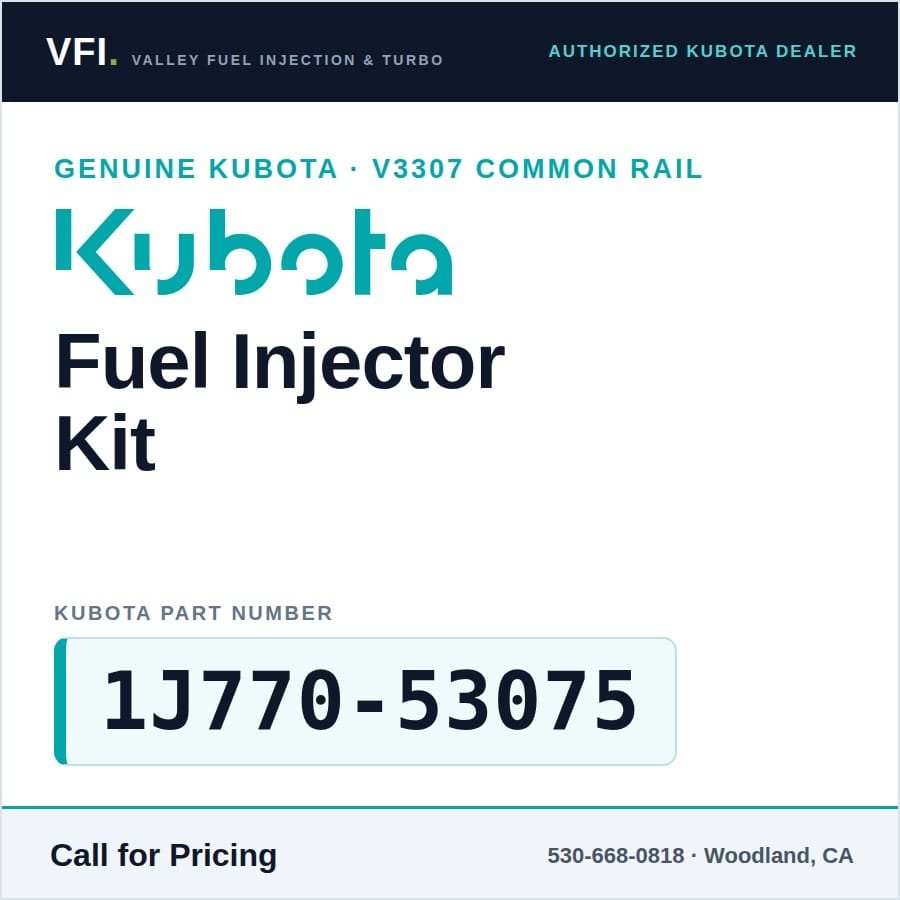
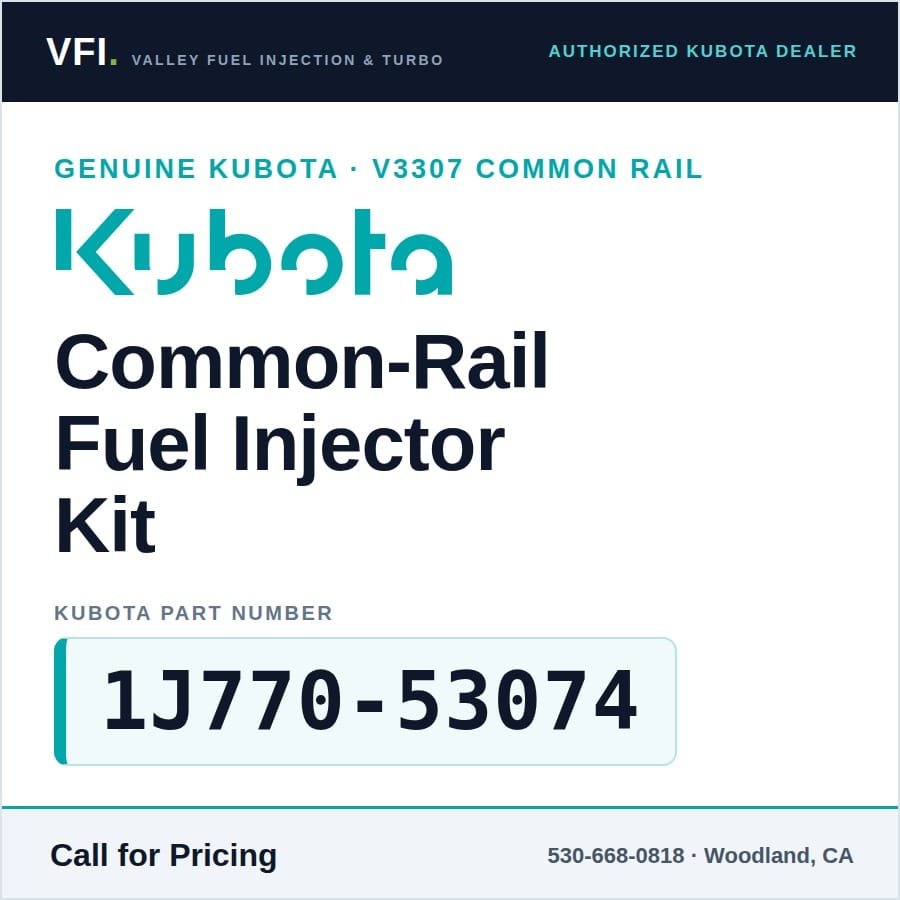
The root cause on affected machines is defective fuel injectors, and Kubota has acknowledged it in writing. Product Support Bulletins PSB-2019-053 and PSB-2021-008-E-R1 cover defective injectors on specific SVL serial number ranges, and PSB-2021-007-E-R1 covers the same problem on M6060, M7060, and M4 tractors. The prescribed repair is replacing all four injectors with an improved design, not just the weakest one. The updated injector part number is 1J770-53075, which supersedes the original 1J770-53050 and 1J770-53053.
The confirming test is an injector balance test run through Kubota’s Diagmaster software, once below and once above 140 degrees F coolant temperature. A failing injector on these engines often balances acceptably cold and falls apart hot, which is why the machine feels fine for the first 10 minutes. The pattern fills the long running SVL75-2 losing power thread on OrangeTractorTalks, where the fix that finally worked was the bulletin injector replacement.

What Do SVL75-2 Error Codes E9106, E9109, E9113 and E9214 Mean?
Kubota’s SVL and SSV machines report faults as E-codes on the dash, and four of them dominate fuel system complaints:
| Code | What It Points To | Dealer Tool Needed? |
|---|---|---|
| E9106 | Injector fault. Frequently logged on machines showing the hot power loss pattern above. | Yes. Diagmaster identifies the cylinder and runs the balance test. |
| E9109 | Fuel system fault reported on SSV65 and SVL machines that drops the machine into limp mode, sometimes for weeks when misdiagnosed. | Yes, for both diagnosis and clearing. |
| E9113 | Logged on SVL75-2s alongside fuel delivery complaints. Compare actual versus commanded rail pressure before condemning any part. | Yes, to view live rail pressure data. |
| E9214 | DPF regeneration demanded too frequently. Triggers limp mode. Causes include failing injectors, T0/T1/T2 or differential pressure sensor faults, and chafed wiring at the DPF sleeve. | Yes. The derate persists until the root fault is fixed and cleared. |
Here is the part owners hate: there is no owner accessible code clearing on SVL loaders. No key dance, no battery disconnect trick. Codes and derates clear only through Diagmaster after the fault is repaired, which is one reason generic scanners get you nowhere on this equipment and why these machines feature in the right to repair debate. E9214 deserves special respect: failing injectors over-fuel and load the DPF with soot, so a regen code is often an injector code wearing a disguise. Our guide on the DPF and injector feedback loop explains why.
What Is the Right Order to Diagnose Kubota V3307 Fuel System Problems?
Forum threads are full of owners who spent hundreds on parts in the wrong order. Filters are cheap, so they get replaced first even when symptoms clearly point elsewhere. Let the symptom pick your starting point:
| Symptom | Most Likely Cause | Test First |
|---|---|---|
| Full power cold, misses and loses power about 10 minutes after warm-up, idling briefly restores it | Defective injectors (PSB-2019-053 / PSB-2021-008-E-R1) | Diagmaster injector balance test below and above 140 degrees F coolant |
| Long cranking, starts then stalls minutes later | Suction side restriction: rust flakes at the tank inlet screen, gummed diesel after storage | Inspect the tank inlet and cap, blow back the tank-to-separator line, cut open the old filter |
| Hard starting with fluctuating rail pressure readings | Air entering the low pressure side | Check every suction side fitting and O-ring, then bleed the system properly |
| Power fades under sustained heavy load or PTO work | Weak lift pump or blocked supply line (common on M7060) | Measure fuel supply pressure under load; negative pressure means restriction |
| Surging, limp mode, rail pressure codes with clean fuel supply | SCV or supply pump wear, or internally leaking injectors bleeding down the rail | Compare actual versus commanded rail pressure, then run an injector return flow test |
Two notes on that table. First, if the machine sat over winter, pull the suction line before anything else: black gummed residue and rust flakes from the tank inlet clog the line to the separator and starve the engine exactly as described in the stall-after-start threads. Second, after any fuel side work, follow our Kubota fuel system bleeding guide rather than cracking injector lines at random; a bad bleed causes its own no-start.
How Much Does SVL75-2 Injector Replacement Cost?
The number that shocks everyone first: one owner of a 2014 SVL75-2 reported a dealer quote approaching $8,000 to replace the injectors. That quote is real, but it is also the top of the market. Here is how the job typically breaks down at California specialty shop rates:
| Item | Typical Range | Notes |
|---|---|---|
| Genuine injector, each | Typically $200-$600 | Updated part 1J770-53075; buy from an authorized Kubota source to keep warranty intact |
| Set of four, parts only | Typically $900-$2,800+ | Bulletins call for replacing all four, not just the failed cylinder |
| Labor, removal and installation plus ECU coding | Typically $600-$1,400 | Access is tight on compact equipment, and Diagmaster time is part of the job |
| Bench testing suspect injectors, each | Typically $50-$100 | The cheap way to confirm the diagnosis before buying a full set |
In other words, a careful shop can often do the whole job for roughly half of the worst dealer quotes, and testing first can save you from buying injectors you did not need. We bench test common rail injectors in-house and accept mail-in injectors from anywhere in the country. Staring at a big quote? Call us at 530-668-0818 for a second opinion first.
How Do You Remove a Stuck Injector on a V3307?
V3307 injectors seize in their bores from carbon buildup. The safe sequence: clean the area thoroughly so debris cannot fall into open ports, remove the high pressure and return lines, unbolt the hold-down clamps, then work the injector loose by rotating it in the bore. Penetrating oil and patience beat force. If it will not rotate, use a proper injector puller or slide hammer adapter on the injector body. Never lever against the solenoid on top; that ruins an injector that might have been rebuildable. Install new copper sealing washers, and never reuse over-torqued or kinked high pressure lines.
Do New Kubota Injectors Have to Be Programmed Into the ECU?
Yes, and skipping this step is the single most common DIY failure on this engine. Each Denso injector carries a compensation code (an alphanumeric calibration string) that must be entered into the ECU for its cylinder through Diagmaster. Owners have replaced the injection pump and all four injectors and still had a no-start or a miserable rough run, purely because the coding was never done. There is no workaround through the dash, so budget for programming time as part of any injector job.
Are SVL75-2 Injectors Covered Under Kubota Warranty?
More often than owners think. Original injectors carry a 5 year federal emissions warranty, provided the failure was not caused by fuel contamination, and the bulletin repairs on affected serial ranges were covered work. Before paying out of pocket, have your dealer check your serial number against the bulletins above and ask specifically about emissions warranty coverage on the injectors.
Two caveats. Kubota will not warranty aftermarket injectors, so discount listings making bold warranty claims deserve skepticism. And contamination voids everything: if the tank is shedding rust, document the cleanup before the warranty conversation. For the bigger picture on why Tier 4 Kubota injectors fail, see our Kubota Tier 4 injector problems guide.
What Goes Wrong With the Kubota V3307 Supply Pump and SCV?
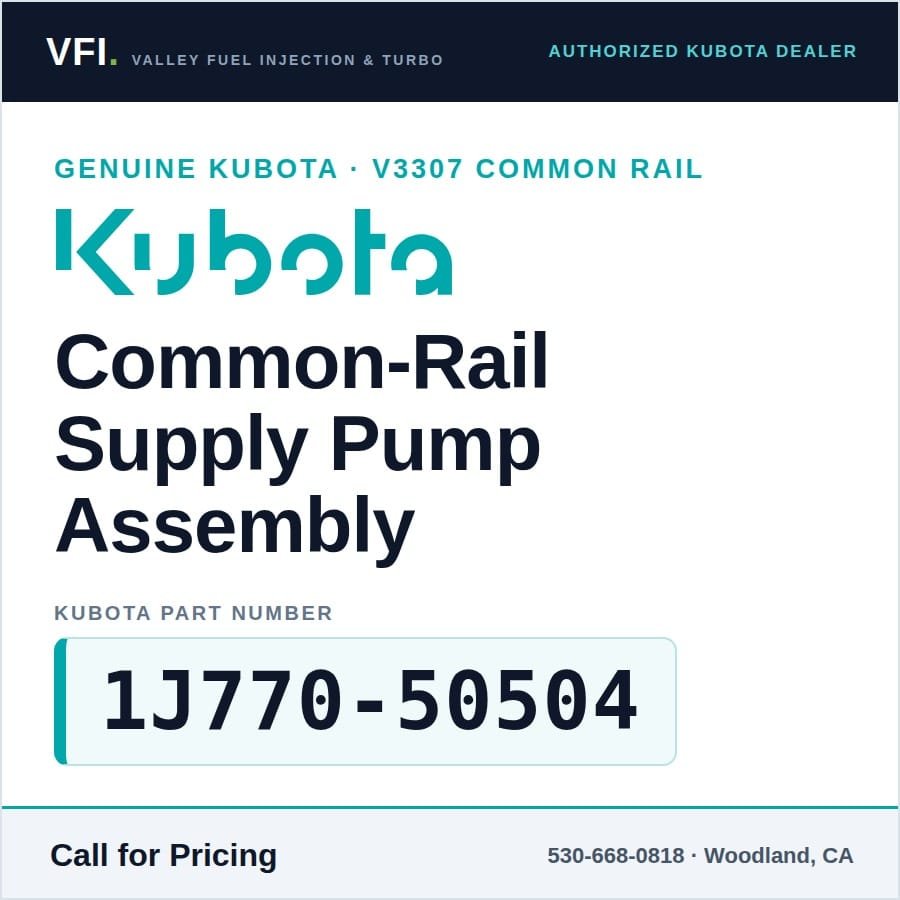
When the injectors check out, attention turns to the Denso supply pump (original part 1J770-50503, since superseded). The pump itself is durable, but the SCV is a precision solenoid and does not tolerate debris. A sticking or worn SCV causes rail pressure that wanders instead of tracking the commanded value, which the operator feels as surging, hunting idle, hard hot starts, and random limp mode events.
Before condemning a supply pump, rule out the cheap stuff: suction side air leaks cause the same fluctuating rail pressure, and internally leaking injectors can bleed off pressure the pump is building just fine. A return flow test separates those cases quickly. Also protect the electronics: V3307 ECU failures from water intrusion and improper jump starting are well documented, so keep connectors sealed and jump start with care.
Is the CAT C3.3B the Same Engine as the Kubota V3307?
Yes. Caterpillar’s C3.3B is a Kubota built V3307 variant, and the fuel systems share the same Denso hardware. The injector CAT sells as 436-1096 is the same unit as the Kubota 1J770-53050 family, which means C3.3B owners can cross-reference Kubota part numbers and vice versa. Machines affected include the 236D, 242D, 246D, 257D, 259D, 262D, 277D, 279D, 287D and 289D skid steers and track loaders, the 906M, 907M and 908M wheel loaders, and the 308 mini excavator.
The CAT side failure patterns rhyme with the Kubota side but skew toward no-start complaints: internally leaking injectors that keep the rail from building cranking pressure, injector seal leaks, cracked high pressure lines, dead cylinders and misfires, and in one memorable 259D case, chunks of rubber found inside the tank-to-filter tube. Two CAT specific notes: after a tip-over, the standard guidance is to pull the injectors before cranking so oil that migrated into the cylinders cannot hydrolock the engine, and owners report dealer no-start diagnostics stretching past a week. A common rail specialist who can bench test the injectors will usually get there much faster.
What About the KX080-4 Excavator and the M6060/M7060 Tractors?
KX080-4
The KX080-4 runs the identical V3307-CR-TE4 fuel system, so everything above applies: same injectors, same supply pump, same Diagmaster requirement. The symptoms just wear excavator clothes: low engine power during digging, derates mid-cycle, and hard starts after jobsite refueling from questionable transfer tanks. Because almost no KX080-4 specific troubleshooting exists anywhere, diagnose it exactly like an SVL75-2: balance test the injectors hot and cold before replacing parts on speculation.
M6060 and M7060
The tractor twins have their own bulletin, PSB-2021-007-E-R1, for the same defective injector problem. The classic M7060 complaint is losing power anywhere from 10 minutes to 2 hours into PTO work such as mowing or baling. Beyond the injectors, M7060 threads add two supply side culprits: a weak lift pump that pulls fuel supply pressure negative under load, and blocked lines between the tank and separator. Air intrusion on the suction side shows up repeatedly too. If the tractor recovers after a short rest and the filters are fresh, run the supply pressure test before buying anything.
Whichever machine you run, prevention comes down to clean fuel, sealed caps, and filters changed on schedule. Our Kubota injector maintenance guide covers those habits in detail.
Frequently Asked Questions
Why does my SVL75-2 lose power after it warms up?
The most common cause is the documented V3307 injector defect covered by Kubota bulletins PSB-2019-053 and PSB-2021-008-E-R1. Affected machines run at full power cold, then miss and lose power about 10 minutes after warm-up. A Diagmaster injector balance test above and below 140 degrees F coolant temperature confirms it, and the fix is a set of four updated injectors (1J770-53075) with ECU compensation coding.
Do new Kubota injectors have to be programmed into the ECU?
Yes. Every Denso injector on the V3307 carries a compensation code that must be entered per cylinder using Kubota Diagmaster software. Installing new injectors without coding them causes rough running or a no-start even when the parts are perfect. There is no owner accessible way to do this on SVL machines, so include programming in the cost of any injector job.
How do you clear error codes on a Kubota SVL75-2?
You cannot clear them from the operator’s seat. SVL codes and derates clear only through Kubota’s Diagmaster software after the underlying fault is repaired. Battery disconnects and key cycling do not work, and a code like E9214 keeps the machine in limp mode until the root cause is actually fixed.
Is the CAT C3.3B the same engine as the Kubota V3307?
Yes. Kubota builds the C3.3B for Caterpillar, and the Denso fuel system components interchange. The CAT injector 436-1096 is the same unit as the Kubota 1J770-53050 family, so D-series skid steer and compact track loader owners can use Kubota sourcing and diagnostic knowledge for their fuel systems.
Why is my SVL75-2 stalling a few minutes after starting?
Stalling shortly after a start usually points to fuel starvation rather than injectors: rust flakes from the tank inlet clogging the suction line, gummed diesel after storage, or air entering the low pressure side. Inspect the tank inlet screen, blow back the tank-to-separator line, and check every suction fitting before replacing hard parts.
Are SVL75-2 injectors covered under Kubota warranty?
Often, yes. Original injectors carry a 5 year emissions warranty as long as the failure was not caused by fuel contamination, and the service bulletin repairs were covered on affected serial ranges. Have your dealer run your serial number against the bulletins before paying out of pocket, and stick with genuine parts, because Kubota will not warranty aftermarket injectors.
Get Expert Help With Your V3307 or C3.3B Fuel System
Valley Fuel Injection is an authorized Kubota dealer and has specialized in diesel fuel injection since 1993. From our Woodland, CA shop we diagnose, test, and repair Denso common rail systems for SVL75-2, SSV75, KX080-4, M6060/M7060 and CAT C3.3B machines across the Sacramento Valley, and we supply genuine Kubota parts and engines nationwide. Not local? Our mail-in service lets you ship injectors or a supply pump to us from anywhere in the country. Call 530-668-0818 or contact us online before you sign off on a five figure dealer estimate. A one hour test is a lot cheaper than the wrong repair.