7.3 Powerstroke Injector Symptoms & Replacement: HEUI Buyer’s Guide (1994–2003)
07/20/2026
6.0 Powerstroke Injector Symptoms (G2.8) + HPOP Failure: Buyer’s Guide
07/21/2026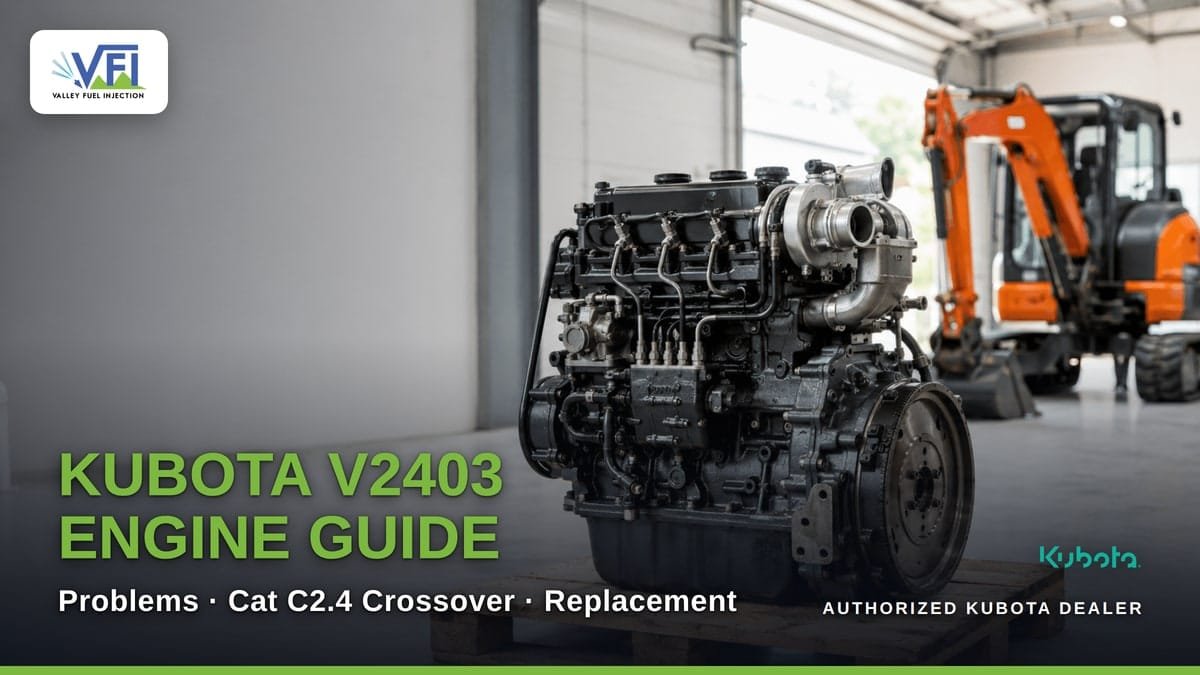
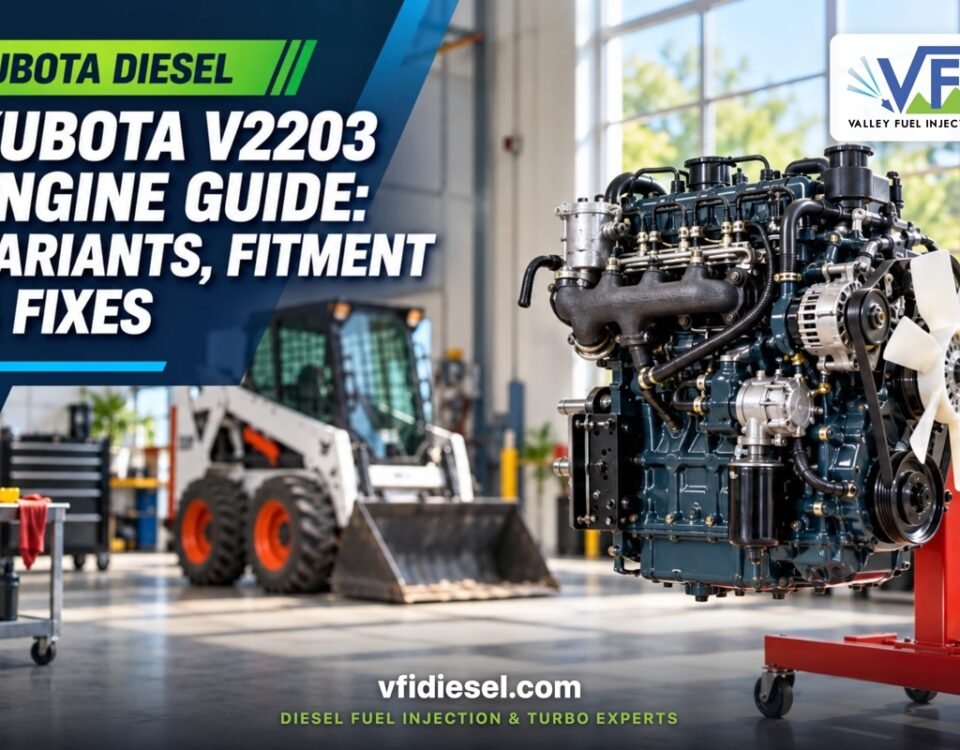
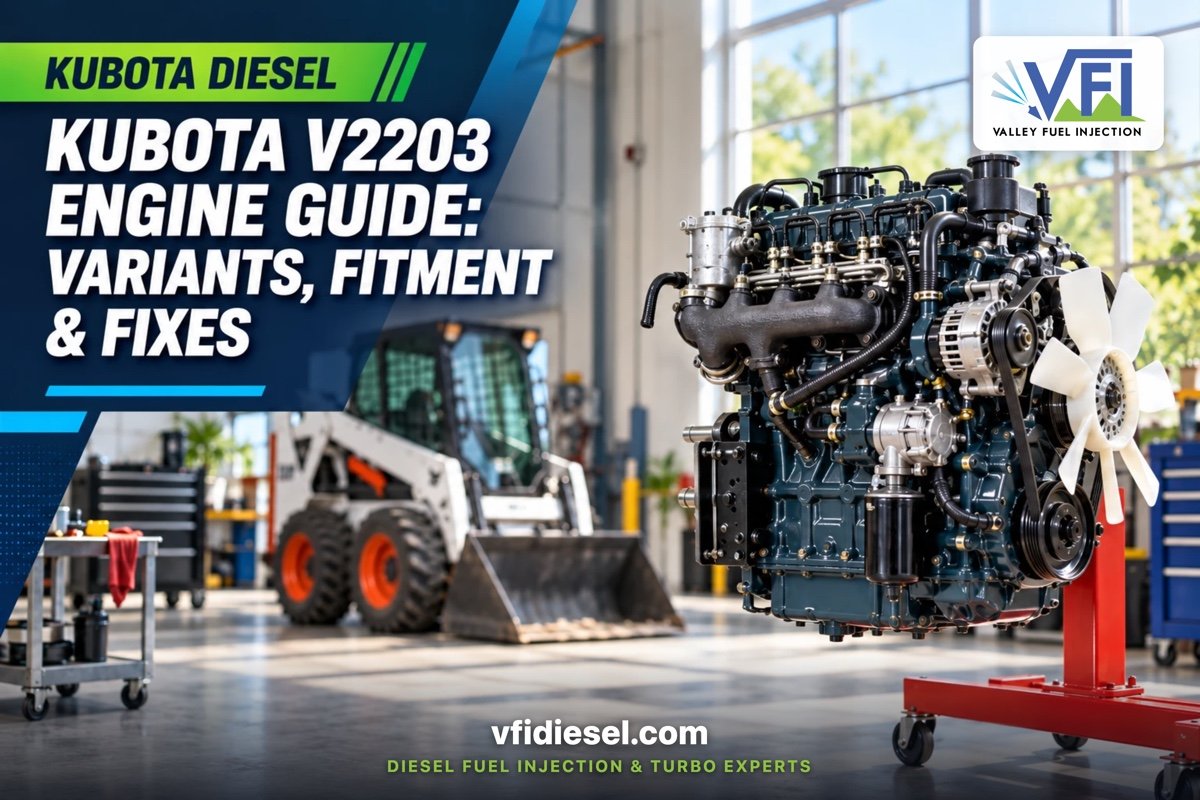
The Kubota V2403 engine is one of the most widely installed 2.4 liter diesels in compact equipment, and one of the most confusing to buy parts for. The same basic block shows up as an indirect-injection tractor engine, a direct-injection Bobcat engine, a Tier 4 common-rail engine with a DPF, and, wearing yellow paint, as the Cat C2.4 in mini excavators.
Forum threads are full of owners chasing the wrong part number, misdiagnosing a $40 solenoid as a worn-out engine, or asking whether a rebuild is even worth it. This guide sorts all of it out: how to identify your exact V2403 variant, which machines use it, how the Cat C2.4 crossover works, the failure patterns we actually see, and honest numbers on rebuild versus reman versus new.
Already decided on a new engine? We supply new genuine Kubota V2403 engines, matched to your engine plate before we quote, and can source other Kubota diesels too.
New Kubota V2403 engine →Kubota engine sourcing →What Is the Kubota V2403 Engine and Which Variant Do You Have?
The V2403 is a four-cylinder, liquid-cooled, 2,434 cc (2.4 liter) diesel from Kubota’s 03 series, an evolution of the smaller V2203. Depending on variant and rating, output runs from roughly 45 to 49 horsepower for the naturally aspirated mechanical versions up to the high 60s and low 70s for the turbocharged common-rail versions. All variants share the same basic architecture, but injection systems, emissions hardware, and parts books differ enormously.
Here is the decoder most parts listings never give you:
The model code alone is not enough. Kubota builds each variant in machine-specific spec codes (you will see designations like V2403-CR-T-EF04 and V2403-CR-EF02 in parts listings), and the differences are real: different injection calibrations, different accessory layouts, different ECU maps on common-rail engines. The engine plate carries the model, the spec code, and the serial number. Photograph all three before ordering anything. Two engines that look identical on the stand can take different injection pumps, and this single mistake causes more wasted money on V2403 parts than any actual failure.
What Equipment Uses the Kubota V2403?
The V2403 family spans three brands of equipment that commonly come through California shops:
If your machine is on this list and the engine is tired, you have more sourcing options than the OEM dealer will tell you about, because every one of these engines leads back to the same Kubota family.
Is the Cat C2.4 a Kubota Engine?
Yes. The Cat C2.4 is a Kubota V2403 built for Caterpillar. The mechanical C2.4 in the E2-series mini excavators is based on the V2403-M-DI-E3B, and the common-rail C2.4-CR in machines like the 307E2 and the 903C and 903D wheel loaders is based on the V2403-CR family. Caterpillar specs its own calibrations and accessories, but the block, head, rotating assembly, and much of the fuel system come from the same production line as the orange-branded engine.
One correction worth making, because it circulates constantly in listings and forum posts: the C2.4 does not power the Cat 302.7, 303, or 303.5. Those smaller Next-Gen machines use the Cat C1.1 and C1.7, and the early 2000s 303.5 ran a three-cylinder Perkins. The C2.4 lives in the 304 through 307 E-series and the earlier Next-Gen 304 and 305 CR; current 304 and 305 CR machines use the Cat C1.7 Turbo. If a seller tells you a “C2.4 from a 303.5” will fit your 305E2, walk away.
Why does the crossover matter? Money and availability. Cat C2.4 complete engines are genuinely scarce on the open market, while the equivalent Kubota V2403 is a stocked, supported engine with a full aftermarket. Filters, gaskets, water pumps, injectors, and injection pumps frequently cross directly to Kubota part numbers at a fraction of dealer pricing.
On common-rail versions you still need the correct Cat-spec calibration for injection components, which is where a shop that can test and match components matters. As an authorized Kubota dealer, we cross-reference C2.4 parts to Kubota numbers routinely through our Kubota engine sales, parts and service program.
What Are the Most Common Kubota V2403 Engine Problems?
The V2403 has an excellent reputation for longevity, and most of the complaints that fill forums are support-system failures rather than hard engine failures. These are the patterns, in the order we actually see them.
1. Cranks but will not start: check the fuel shutoff solenoid first
On mechanical V2403s, a failed fuel shutoff solenoid, a failed relay feeding it, or corroded and loose pins in the solenoid connector are among the most common no-start causes we see. Techs who work these engines daily call bad solenoids and relays routine, and corroded connector pins (on the solenoid, and on the fuel pressure sensor on later engines) mimic much bigger failures.
Before you suspect the injection pump, verify the solenoid gets battery voltage in the run position, pulls in and stays in; a click alone does not prove it holds. Owners have replaced pumps and injectors chasing what turned out to be a $10 relay. If the electrical side checks out, work through our guide to why a diesel cranks but will not start, and remember that any time the fuel system has been opened it must be properly bled (our Kubota fuel system bleeding guide covers the procedure for all models).
2. Engine runaway after injection pump work
This one is dangerous. The mechanical pump’s rack engages a pin on the governor linkage inside the crankcase, and if the pump is reinstalled with the rack pin on the wrong side of the governor arm, the governor cannot pull fuel back. One documented case describes revs climbing “to some crazy level” with no throttle response and no shutdown from the key, because the key kills the solenoid but a mispositioned rack can hold itself at full fuel.
The same incident bent the governor pin, compounding the repair. If a V2403 runs away, blocking the intake air is the only reliable way to stop it. The lesson: never crank a V2403 after pump removal until rack engagement is positively verified. This is exactly the kind of job where sending the pump and letting a shop verify the setup pays for itself.
3. Hard cold starts and white smoke
In our experience, cold-start complaints on the V2403 usually trace to the glow plug circuit: failed plugs, a broken feed wire to the plug rail, or a bad controller. Two less obvious causes show up repeatedly: valve clearance that has tightened up and bleeds off compression at cranking speed, and sticking injector nozzles that dribble instead of atomize.
White smoke at startup that clears as the engine warms is the classic signature of unburned fuel from any of these. Our guides to diesel cold start problems and diesel white smoke diagnosis walk through the universal checks; on the V2403 specifically, test the glow plugs and inspect that feed wire before anything else.
4. Black smoke and power loss
Black or gray smoke under load usually means clogged or worn injector nozzles causing incomplete combustion. A point worth stressing: the V2403’s injection pump is gear-driven and its timing rarely drifts on its own, so do not start a black smoke diagnosis by re-timing the pump. Misdiagnosed “timing problems” that were actually injector problems are a recurring forum theme. Compare your symptoms against our breakdowns of diesel black smoke causes and injection pump timing symptoms before touching pump shims.
5. V2403-T turbo and cooling issues
Turbocharged variants add the usual turbo wear items: shaft play, oil leaks past the seals with gradual power loss, and oil consumption. Coolant leaks and overheating complaints also cluster on the turbo engines, which run harder in skid steer duty. If boost feels soft or you find oil in the intake tract, check the turbo before blaming the fuel system; our guide to diesel turbocharger failure signs covers the inspection.
6. V2403-CR: DPF regeneration is the number one complaint
On Tier 4 Final common-rail versions, the loudest owner complaint is not the engine at all, it is the DPF. Light-duty use (short runs, long idling, low load) does not get the filter hot enough to clean itself, which triggers warning lights, forced regens, and derates. The fix is operational: work the machine under load, let active regens complete, and do not shut down mid-regen.
Delete kits are marketed for these engines, but they are not emissions-legal, and in California they can make the machine unsellable. The common-rail system also raises the stakes on fuel quality, since these engines share the injector wear patterns we cover in our Kubota injector maintenance tips and the regen-related injector stress explained in our DPF effect on diesel injectors guide.

How Do You Identify the Right V2403 Injection Pump?
“Kubota V2403 injection pump” is one of the most searched phrases for this engine, and also the easiest place to buy the wrong part. Fitment is by part number and engine serial, not by engine model. The families you will encounter:
Mechanical engines: pump part numbers beginning 1G762-, 1G852-, and 1G628- cover the mechanical V2403 range across KX excavators, L-series and MX tractors, and Bobcat applications. The castings look nearly identical, but delivery valve settings and calibration differ, and they are not interchangeable. Aftermarket and reman pricing spans roughly $200 to $750 depending on the part number and whether it is new, reman, or used takeoff, which is exactly why verifying the number stamped on your old pump matters before you spend anything.
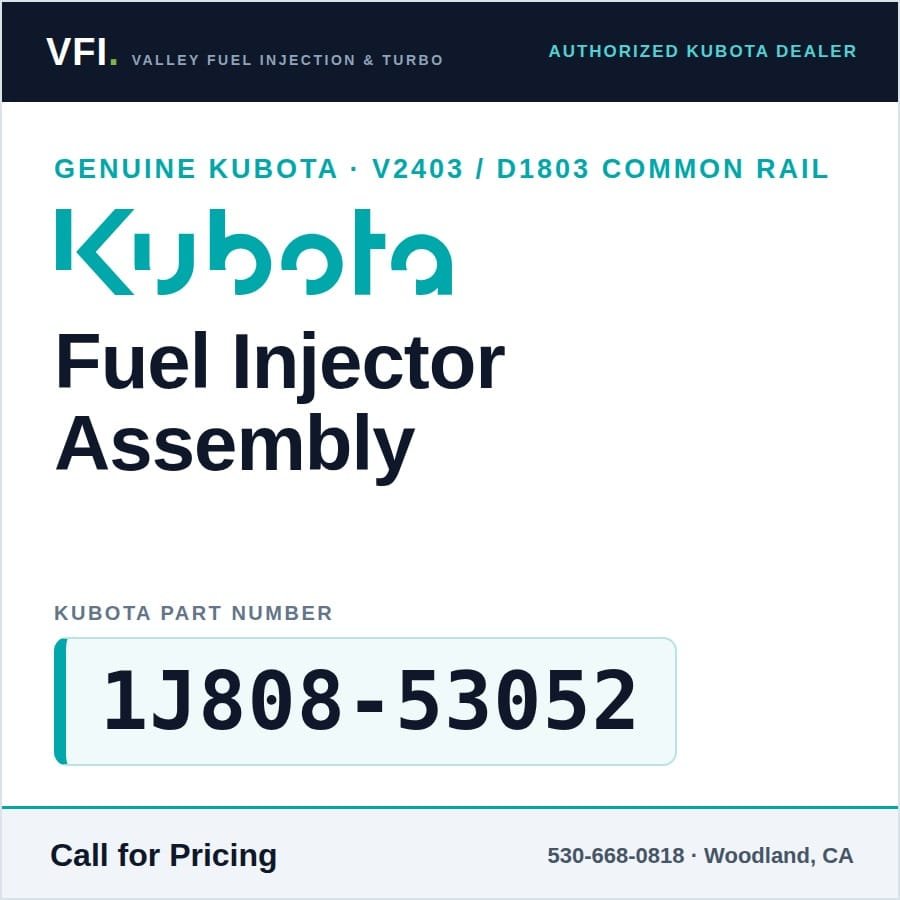
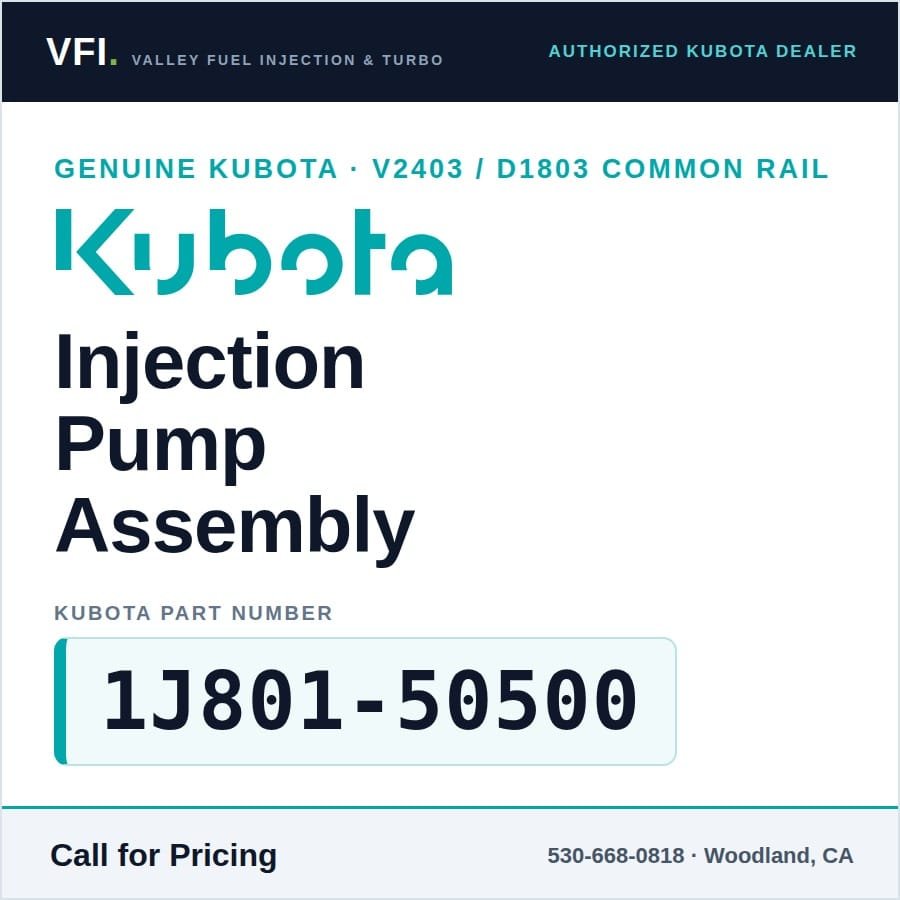
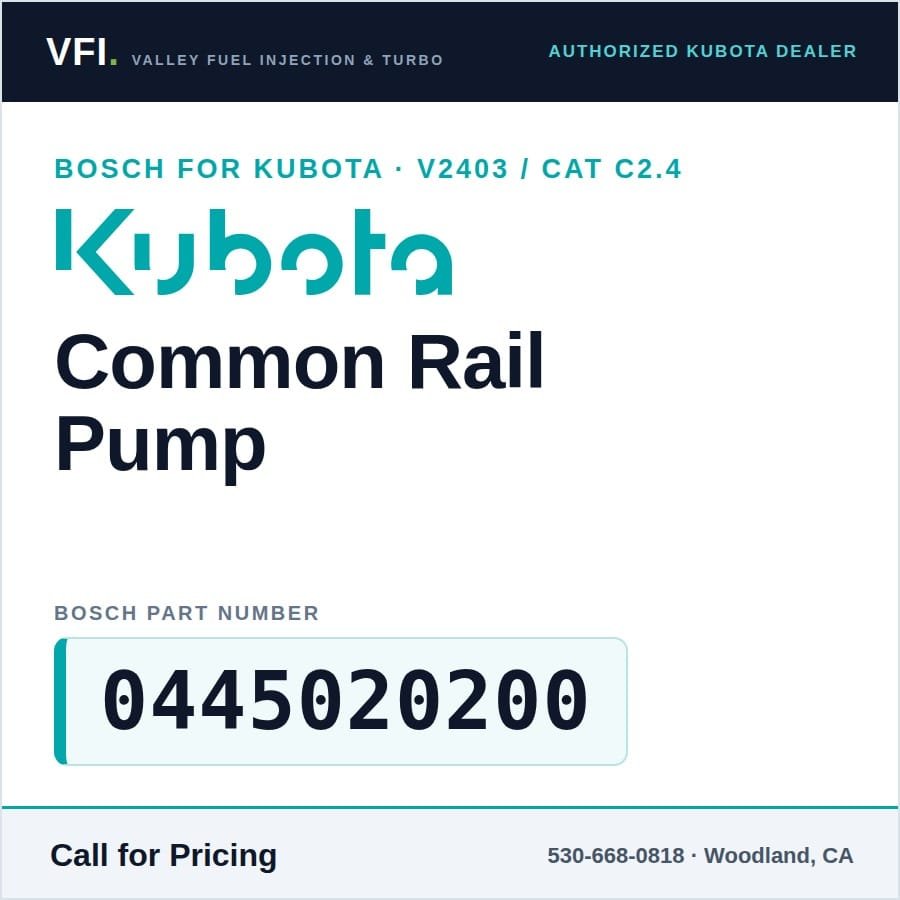
Common-rail engines: the V2403-CR uses a Bosch high-pressure supply pump under Kubota 1J801- family numbers, paired with Bosch common-rail injectors. These are precision components that should be tested and coded, not swapped blind.
On mechanical engines, injection timing is set with shims under the pump flange using the spill-cut method. The exact figure depends on your spec code, so verify it against the workshop manual for your serial number rather than a generic table. And plan ahead on parts: some Kubota internal components still ship from Japan, and owners have reported two-week waits for governor and pump parts. If your machine earns its keep, downtime math often favors a tested exchange pump over waiting on piece parts.
Talk to a Diesel Tech Not sure which V2403 pump fits your engine? Call with the number stamped on your old pump and your engine serial. We will confirm the right part, or bench test and rebuild your pump and injectors. Two ways in: drive it into our Woodland shop near Sacramento, or ship it to us from anywhere in the country. ☎︎ Call 530-668-0818Out of the area? Start a mail-in rebuild → |
Should You Rebuild Your Kubota V2403 Engine or Replace It?
This is the question forum threads circle endlessly without ever putting numbers in one place. Here is the honest comparison for a worn-out V2403:
The decision logic we give customers: if you can do the labor yourself and the block checks out, a careful rebuild is the value play. If the machine makes you money, a reman drop-in wins on downtime. A new engine makes sense on late-model machines with a lot of chassis life left, but factor the core charge and note that emissions rules lead some suppliers to restrict complete-engine sales by region, which surprises online buyers at checkout.
Whatever you choose, buy against your serial number, and remember that on a mechanical engine the injection pump and injectors should be tested or rebuilt during the overhaul, because a fresh bottom end fed by 6,000-hour injectors will smoke and disappoint. Our Kubota injector maintenance guide covers keeping the new fuel system healthy afterward.
One more V2203 note, since the interchange question comes up constantly: the V2403 shares its 87 mm bore with the V2203 but uses a longer stroke, so certain external and accessory parts cross over while the rotating assembly and many gaskets do not. Never assume interchange; check both part numbers.
Frequently Asked Questions
How many hours will a Kubota V2403 last?
With clean fuel, regular oil changes, and a healthy cooling system, the V2403 has a long service life. Most engines that die early are killed by overheating, dirty fuel, or extended low-load idling on DPF-equipped versions, not by inherent weakness.
What is the oil capacity of a Kubota V2403?
Kubota’s 03-M workshop manual lists 9.5 L (2.5 US gal) with the 124 mm deep oil pan and 7.6 L (2.0 US gal) with the 90 mm pan. Its oil chart calls for API CF or later, SAE 10W-30 or 10W-40 at any temperature, or SAE 30 above 77°F. Always confirm against the manual for your machine, since sump and cooler configurations vary by application.
How much horsepower does a Kubota V2403 have?
Roughly 45 to 49 horsepower for naturally aspirated mechanical versions, more for the turbocharged M-DI-T used in Bobcat loaders, and up to the low 70s for turbocharged common-rail versions. The exact rating depends on the spec code and the machine’s governed speed.
Are V2203 and V2403 parts interchangeable?
Partially. They share the same family architecture and bore, but the V2403’s longer stroke means pistons, crankshaft, rods, and many sealing parts differ. Some accessories and external components cross over. Verify every part by number against your engine serial rather than assuming family interchange.
What are the head, rod, and main torque specs for a V2403?
They vary by variant and production date, and the head uses a multi-stage tightening sequence, so publishing one set of numbers would be a disservice. Use the workshop manual matching your engine’s spec code and serial number, or call us and we will look up your exact engine.
Why will my Kubota V2403 not shut off with the key?
The key switch cuts fuel through the shutoff solenoid. If the engine keeps running, the solenoid is stuck, misadjusted, or, after pump work, the governor rack is jammed at fuel. If RPM is also climbing out of control, block the intake air immediately and do not restart until the pump and governor linkage have been inspected.
Who makes the Cat C2.4 engine?
Kubota. The C2.4 is a Caterpillar-spec version of the V2403, mechanical in the E2-series mini excavators and common rail (C2.4-CR) in later machines. Many service parts cross directly to Kubota part numbers.
Where Can You Get V2403 and C2.4 Help in California?
Valley Fuel Injection has been rebuilding and testing diesel injection systems since 1993, and we are an authorized Kubota dealer for engines, parts, and service. From our Woodland, California shop we supply complete V2403 engines, test and rebuild V2403 injection pumps and injectors on calibrated benches, and cross-reference Cat C2.4 components to Kubota part numbers so you are not paying dealer premiums for the same hardware.
If you are local to the Sacramento Valley, bring the machine or the components to us. If you are anywhere else in the country, our mail-in rebuild service handles V2403 pumps and injectors with fast turnaround: ship it, we test and rebuild it, you reinstall a known-good component. Call 530-668-0818 or contact us online with your engine’s model, spec code, and serial number, and we will tell you exactly what fits before you spend a dime.