
Leaking Turbo Seal or Worn Rings? Diesel Turbo Oil Diagnosis
08/06/2026
EPA 2027 Diesel Engine Regulations: Fleet Guide
08/12/2026
Diesel Technician Shortage: What It Means for Repair Wait Times and Fleet Maintenance
The diesel technician shortage is real, it is measurable, and it is already affecting how long you wait to get your equipment back. According to the North American Council for Freight Efficiency (NACFE), the trucking and heavy-equipment industries are facing a structural gap between the number of qualified diesel technicians entering the workforce and the number retiring or leaving the trade. For fleet managers and equipment owners, that gap translates directly into longer shop backlogs, higher repair costs, and more pressure on preventive maintenance schedules. Understanding what is driving the shortage, and how to work around it, is one of the most practical things you can do for your operation right now.
The diesel technician shortage is not a temporary post-pandemic blip. It is a long-term structural problem that is hitting specialized injection and turbo shops hardest. Fleet managers who build relationships with certified specialist shops now, and who invest in preventive maintenance, will have a meaningful advantage over those who wait until something breaks.
How Severe Is the Diesel Technician Shortage in 2025–2026?
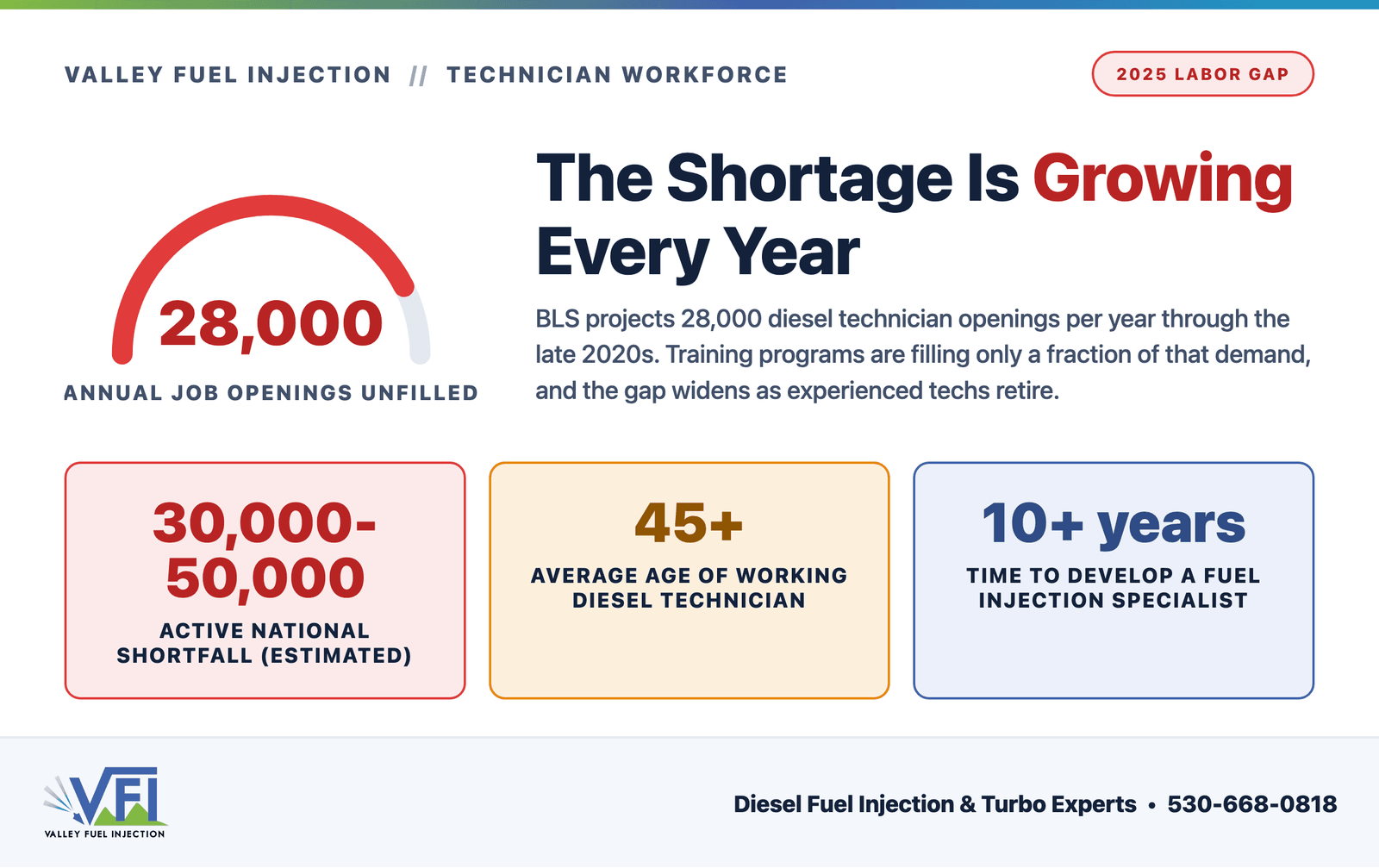
The numbers are sobering. The U.S. Bureau of Labor Statistics projects roughly 28,000 diesel technician job openings per year through the late 2020s, while training programs are producing graduates at a fraction of that pace. Industry groups have estimated the active shortfall at somewhere between 30,000 and 50,000 qualified technicians nationally, and that number is growing as the Baby Boomer cohort of master-level diesel techs continues to age out.
The shortage is not evenly distributed. Entry-level positions at dealerships and fleet maintenance yards are easier to fill than highly specialized roles. The deeper you go into fuel system diagnostics, common rail calibration, and injection pump rebuilding, the thinner the qualified labor pool gets. Those positions require years of hands-on experience with specialized test equipment, and there is no shortcut to developing that expertise.
The average age of a working diesel technician in the United States is now above 45. As the most experienced technicians retire, the institutional knowledge they carry, including how to diagnose intermittent injection faults, calibrate legacy pump systems, and read fuel return data on older platforms, leaves with them. That knowledge takes a decade or more to rebuild in the next generation.
For a deeper look at what the career pipeline actually looks like right now, our Diesel Technician Career Guide covers training paths, certifications, and job outlook in detail.
Why Is the Shortage Hitting Specialized Diesel Injection and Turbo Shops Hardest?
General diesel repair shops can fill most of their needs with mid-level technicians who handle brakes, exhaust, basic electrical, and fluid services. Fuel injection and turbocharger work is a different category entirely, and it is where the shortage bites hardest.
Diesel fuel injection systems, particularly modern common rail systems operating at 30,000 PSI or higher, require a technician who understands hydraulic pressure dynamics, injector flow tolerances measured in milliliters per minute, and the relationship between fuel return rates and injector wear. A technician who can replace a brake caliper cannot simply pick up those skills in an afternoon. The same is true for variable geometry turbocharger diagnosis, VP44 pump electronics, and the calibration procedures required after any high-pressure fuel system repair.
Sending a common rail injection system to a shop without factory-trained injection specialists is a real risk. Improper injector installation torque, missed trim-code programming, or failure to diagnose the root cause of injector failure (contaminated fuel, failed lift pump, worn high-pressure pump) will put you right back in the same situation weeks later, often with more damage. See our post on how common rail injectors are tested to understand what a proper diagnostic process actually involves.
At Valley Fuel Injection, we have been doing this specific work since 1993. The technicians here have accumulated the kind of diagnostic depth that only comes from testing and rebuilding thousands of injection systems across dozens of platforms. That is not something a shop can replicate by hiring a general diesel tech and handing them a service manual.
How Is the Technician Gap Affecting Repair Wait Times, Parts Availability, and Fleet Downtime?
The practical effects of the shortage are showing up in three places: shop scheduling, diagnostic throughput, and parts sourcing.
Shop wait times at qualified specialist facilities have lengthened noticeably. When a shop has two or three technicians capable of performing common rail injector work and the demand for that work is growing, appointment slots fill up. Fleet managers who used to drop equipment off and expect a two-day turnaround are now sometimes looking at a week or more at shops that are short-staffed.
Diagnostic throughput is affected because proper injection system diagnosis is not something you can rush. A technician who is overloaded will spend less time on root-cause analysis and more time replacing the most obvious failed component. That approach often misses the underlying cause, which means the repair does not hold.
Parts availability has its own layer of complexity. The supply chain disruptions of the early 2020s have largely stabilized for common parts, but specialty injection components, particularly for older platforms and agricultural equipment, can still have meaningful lead times. A shop that orders parts only after diagnosis is confirmed will always be slower than one that maintains working relationships with Bosch, Delphi, and Alliant Power distributors and keeps critical components in stock.
| Repair Type | Typical Cost Range (CA Specialist) | Downtime Risk if Delayed |
|---|---|---|
| Single common rail injector (light/medium duty) | Typically $850–$1,800 all-in | Moderate, one injector can mask others failing |
| Full injector set, 6.7 Cummins (6 injectors) | Typically $3,500–$6,500 installed | High, truck is sidelined until complete |
| Full injector set, Class 8 heavy-duty | Typically $5,500–$10,500 installed | Very high, revenue-generating asset offline |
| VP44 pump replacement (5.9 Cummins 24V) | Typically $2,400–$3,800 complete | High, truck is dead without a functioning pump |
| Fuel system diagnostics / evaluation | Typically $250–$550 | Low, catching problems early prevents larger downtime |
Prices reflect typical California specialty-shop ranges as of 2026. Your actual quote depends on the condition of your specific components, parts availability, and current labor rates. Call VFI at 530-668-0818 for an accurate quote on your job.
What Can Fleet Managers Do Right Now to Reduce Exposure to Shop Backlogs?
The most effective strategy is shifting from reactive to proactive maintenance, and doing it before you are staring at a broken-down truck and a two-week shop queue.
Here are the practical steps that make the biggest difference:
1. Establish a relationship with a specialist shop before you need emergency service. Shops prioritize customers they know. If you have brought equipment in for scheduled service and diagnostic work, you are not a stranger when your truck breaks down at 5 PM on a Friday. Call us at 530-668-0818 or schedule a diagnostic visit to get your fleet on our radar before a crisis forces the issue.
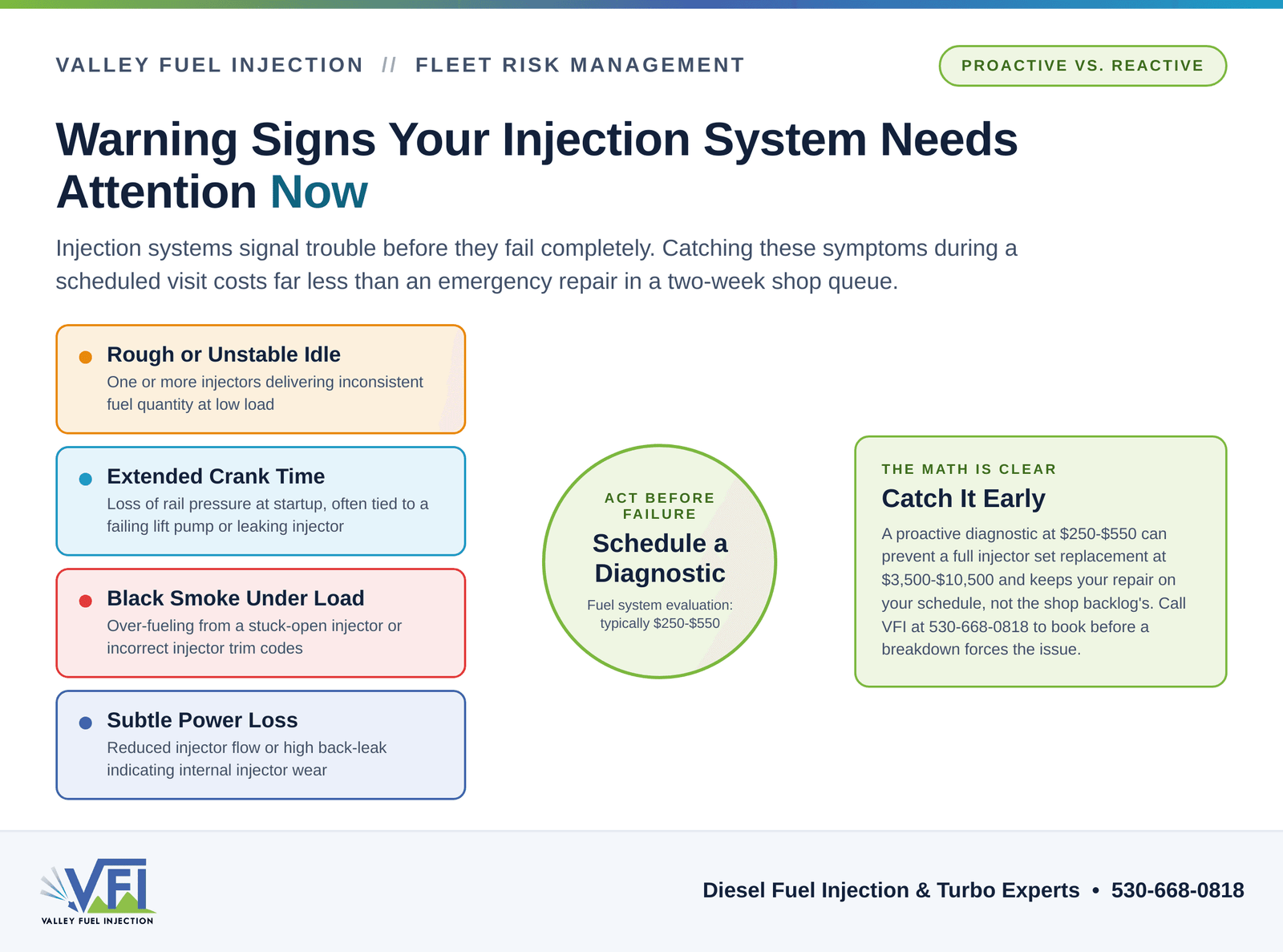
2. Increase fuel system inspection intervals. Injection systems give warning signs before they fail completely. Rough idle, extended crank time, black smoke under load, and subtle power loss are all diagnostic signals. Catching a failing injector during a scheduled inspection costs far less than an emergency repair, and it happens on your timeline rather than the shop’s backlog schedule.
Our diesel engine maintenance page covers what a proper interval-based inspection should include.
3. Pay attention to fuel quality. Contaminated fuel, water intrusion, and biodiesel blends above B20 are leading causes of premature injection system wear in California. Our post on biodiesel injector damage covers the specific risks in this region. Fuel-related failures often take out multiple injectors at once, which multiplies both the repair cost and the wait time.
4. Consider mail-in service for non-emergency pump and injector work. Valley Fuel Injection accepts mail-in injectors and pumps for bench testing, rebuilding, and calibration from customers across the country. If your equipment can be temporarily sidelined while components are serviced, this approach lets you work around local shop backlogs entirely.
5. Budget for repair costs at current pricing levels. Fleets that were quoted injection work three or four years ago and are using those numbers for current budgeting are going to be surprised. Labor rates at California specialty shops run $155–$200 per hour, and parts pricing has moved with inflation. Getting current quotes now, before a repair is urgent, gives you accurate budget data and avoids sticker shock at the worst possible moment.
Ask your specialist shop whether they stock reman injectors for your specific platform. A shop that keeps Bosch or Delphi reman units on the shelf can often turn a repair in a day or two that would otherwise wait a week for parts to arrive. This is one of the real advantages of working with an authorized dealer for Bosch, Delphi, and Alliant Power rather than a general shop that orders everything on demand. See our Bosch injection services page and our Delphi services page for what we keep available.
How Does Working with a Certified Specialist Shop Differ from a General Diesel Shop During a Labor Crunch?
During a labor crunch, the gap between a certified specialist and a general shop widens significantly, because generalist shops are the ones most likely to be short-staffed on the skills your job actually requires.
A general diesel shop might have five technicians on staff, but if none of them have formal training on common rail injection systems or access to a calibrated test bench, your injection work is either going to wait for their one experienced tech or get handed to someone who is learning on your equipment. Neither outcome is good when your truck is a revenue-generating asset.
At Valley Fuel Injection, injection work is not a sideline. It is the entire business. Every technician here works on fuel injection systems daily. We hold factory authorizations from Bosch, Delphi, Alliant Power, Kubota, and Yanmar. We operate a Bosch-certified test bench that can flow-test, back-leak-test, and calibrate injectors to OEM specifications. When we replace an injector, we know whether the replacement unit is performing within spec before it goes back in the engine.
We also have the diagnostic depth to find the root cause rather than just the failed component. A worn injector is often a symptom. The cause might be a failing lift pump, a contaminated fuel supply, a cracked connector tube, or a high-pressure pump that is on its way out. Replacing the injector without addressing the cause means the new injector fails on the same timeline as the old one. That is the kind of repeat-repair cycle that general shops create and specialist shops prevent. Our post on injection pump rebuild cost vs. replace walks through how that diagnostic thinking applies to pump decisions specifically.
Fleet managers in the Sacramento area can bring equipment directly to our shop at 1243 E Beamer St, Suite C, Woodland, CA 95776. We also serve customers shipping components in from across Northern California, Nevada, and the rest of the country. Our Sacramento-area diesel injection services page has more detail on what we cover locally, and customers in the Reno and northern Nevada corridor can find relevant information on our Reno diesel injection page.
A proactive fuel system diagnostic at a specialist shop typically runs $250–$550. Compare that to the cost of a full injector set replacement ($3,500–$10,500 depending on platform) or the revenue loss from a truck sitting in a shop queue for a week. The math on preventive inspection is not complicated. Prices reflect typical California specialty-shop ranges as of 2026. Call VFI at 530-668-0818 for an accurate quote on your specific equipment.
What Is the Long-Term Outlook for Diesel Technician Supply?
The honest answer is that the shortage is not going to resolve quickly. The pipeline problem is structural. Training programs at community colleges and trade schools are expanding in some regions, and manufacturers like Cummins, Delphi, and Bosch have invested in technical training partnerships, but the time required to develop a genuinely skilled fuel injection specialist is measured in years, not months.
The SAE International and various trucking industry associations have flagged the technician gap as a top operational risk for fleets through the end of the decade. Some fleet operators are responding by bringing more maintenance in-house, but injection system work specifically requires capital investment in test equipment and trained personnel that most fleets cannot justify.
The electrification of commercial vehicles is sometimes cited as a factor that will eventually reduce demand for diesel technicians, but that transition is moving slowly in the heavy-duty and agricultural sectors. The equipment that needs diesel injection service today will need it for the next 10 to 20 years, and the technician pool serving that equipment is not growing at a matching pace.
What that means practically is that the shops with established expertise, stable staffing, and long track records are going to become increasingly valuable resources. Shops that have been doing this work for decades, with certified technicians and proper equipment, are the ones that will be able to handle the workload as less-experienced shops struggle to keep up. Valley Fuel Injection has been operating since 1993. Our team has the depth and the certifications to handle the work that other shops cannot. That stability matters more in a tight labor market than it ever did when technicians were easier to find.
For fleet managers thinking about the long game, our Diesel Technician Career Guide also provides useful context on where the industry is investing in workforce development, which gives a clearer picture of the timeline for any meaningful supply increase.
If you are thinking about the DIY option for routine maintenance tasks to reduce shop dependency, our post on diesel injector cleaning: DIY vs. professional service draws an honest line between what an owner-operator can reasonably handle and what genuinely requires a specialist bench.
Valley Fuel Injection has been serving Northern California and Nevada fleets since 1993. We are Bosch-certified, factory-trained on Delphi, Alliant Power, Kubota, and Yanmar systems, and we stock reman components to minimize your wait. Call us at 530-668-0818 or schedule a diagnostic visit at our Woodland shop. We also accept mail-in injectors and pumps from customers nationwide. Do not wait until a breakdown forces the issue.
Frequently Asked Questions About the Diesel Technician Shortage
How long are diesel injection repair wait times right now?
Wait times vary significantly by shop type and region. At general diesel shops that handle injection work as a secondary service, waits of one to three weeks for non-emergency injection repairs are increasingly common. At dedicated specialist shops with established staffing and parts inventory, turnaround is typically faster, though demand has grown across the board. The best way to reduce your wait is to schedule diagnostic work before a failure forces an emergency appointment.
Is it worth shipping my injectors or pump to a specialist shop out of my area?
For many customers, yes. If your local options are limited to general shops without injection-specific expertise or test equipment, shipping components to a certified specialist shop for bench testing, rebuilding, and calibration often produces better results at comparable or lower total cost. Valley Fuel Injection accepts mail-in components from customers across the country. Call us at 530-668-0818 to discuss your specific situation before shipping anything.
Will the diesel technician shortage affect parts availability as well as labor?
Indirectly, yes. Shops that are short-staffed tend to have less bandwidth for proactive parts ordering and inventory management, which can extend repair timelines when parts need to be sourced. Shops with direct dealer relationships with Bosch, Delphi, and Alliant Power have better access to components and can often source parts faster than shops ordering through general distributors.
What certifications should I look for in a diesel injection specialist?
Look for Bosch factory authorization, ASE certification in diesel engine repair (L2 for advanced engine performance), and manufacturer-specific training credentials from Delphi, Cummins, or Alliant Power. Shops that are authorized dealers for these brands are held to documented service standards and have access to factory technical support. A certified test bench, rather than just a scan tool, is a meaningful indicator of genuine injection system capability.
How can preventive maintenance reduce my fleet’s exposure to the technician shortage?
Preventive maintenance shifts your repair activity from emergency, unplanned events to scheduled, planned ones. Scheduled work can be booked in advance, which means you are not competing for emergency slots in a tight labor market. It also catches developing problems early, when they are less expensive and less disruptive to address. Fuel system inspections, injector flow testing, and lift pump evaluation at regular intervals are the highest-value preventive steps for diesel injection longevity. Consult a qualified diesel technician to develop an interval schedule appropriate for your specific platforms and duty cycles.