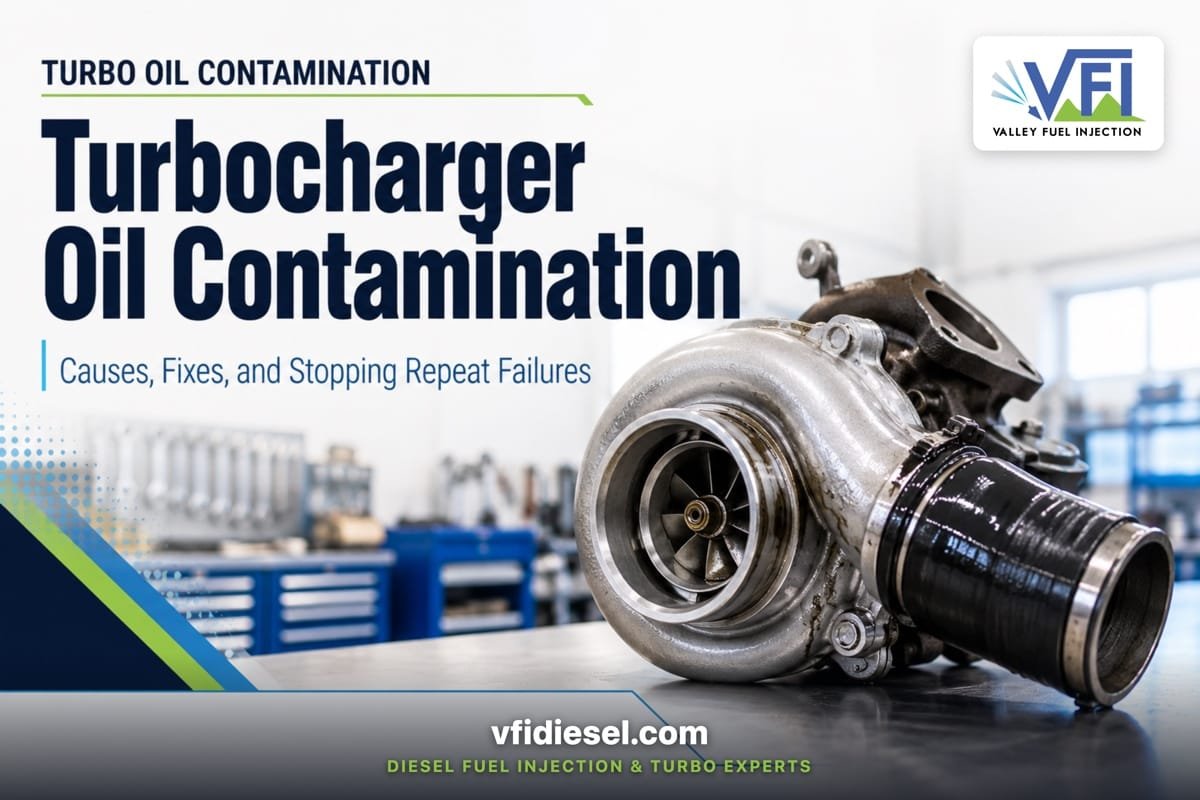

Diesel Turbocharger Oil Contamination: Causes & Fixes
08/03/2026
Diesel Technician Shortage: Repair Wait Times & Fleets
08/09/2026
Leaking Turbo Seal or Worn Rings? Diesel Turbo Oil Diagnosis
Blue smoke, an oily intake boot, and oil you keep topping up but can never find on the ground all lead to the one question every diesel owner dreads: is it a leaking turbo seal, or is the engine itself, worn piston rings and blowby, pushing that oil? At Valley Fuel Injection we sort this out constantly, and it is one of the most frequently misdiagnosed problems in the shop, because a bad turbo and worn rings produce nearly identical symptoms. Get it wrong and you buy a turbo the engine never needed. This guide focuses on the diagnosis: what turbo oil seals do, how to tell a compressor-side leak from a turbine-side leak, how to separate a failing seal from worn rings, and when a seal can be resealed versus when the whole turbo needs rebuilding. For the underlying oil-system causes, blowby, coking, drain-line restriction, see our companion turbocharger oil contamination guide.
A blown turbocharger oil seal does not always mean the turbo is junk. Depending on the root cause and the condition of the housing and wheel, a professional rebuild or CHRA replacement can restore full function. But driving on a leaking seal accelerates bearing failure, contaminates your intake, and can turn a $1,200 repair into a $4,500 replacement job. Act early.
What Do Turbocharger Oil Seals Do, and Why Do They Fail?
Turbocharger oil seals keep engine oil inside the center housing and away from the compressor and turbine sides of the turbo. The turbo shaft spins on a film of pressurized engine oil, and piston ring-style seals at each end of the center housing prevent that oil from migrating into the intake or exhaust stream. These are not rubber seals in the traditional sense. They are precision-machined piston rings, and they rely on a combination of oil drain clearance, pressure balance, and proper crankcase ventilation to do their job.
That design works extremely well under normal conditions, but several things can overwhelm it. High crankcase pressure from worn rings or a clogged PCV system pushes oil past the seals from the inside. Restricted oil drain lines let oil pool in the center housing until it finds a way out. Worn shaft bearings allow the shaft to wobble, which destroys the sealing surface. And extended idle periods cause oil to coking inside the housing, which physically damages the seal rings over time. Understanding which of these applies to your situation matters because fixing the turbo without fixing the root cause just means buying the same repair again in 20,000 miles.
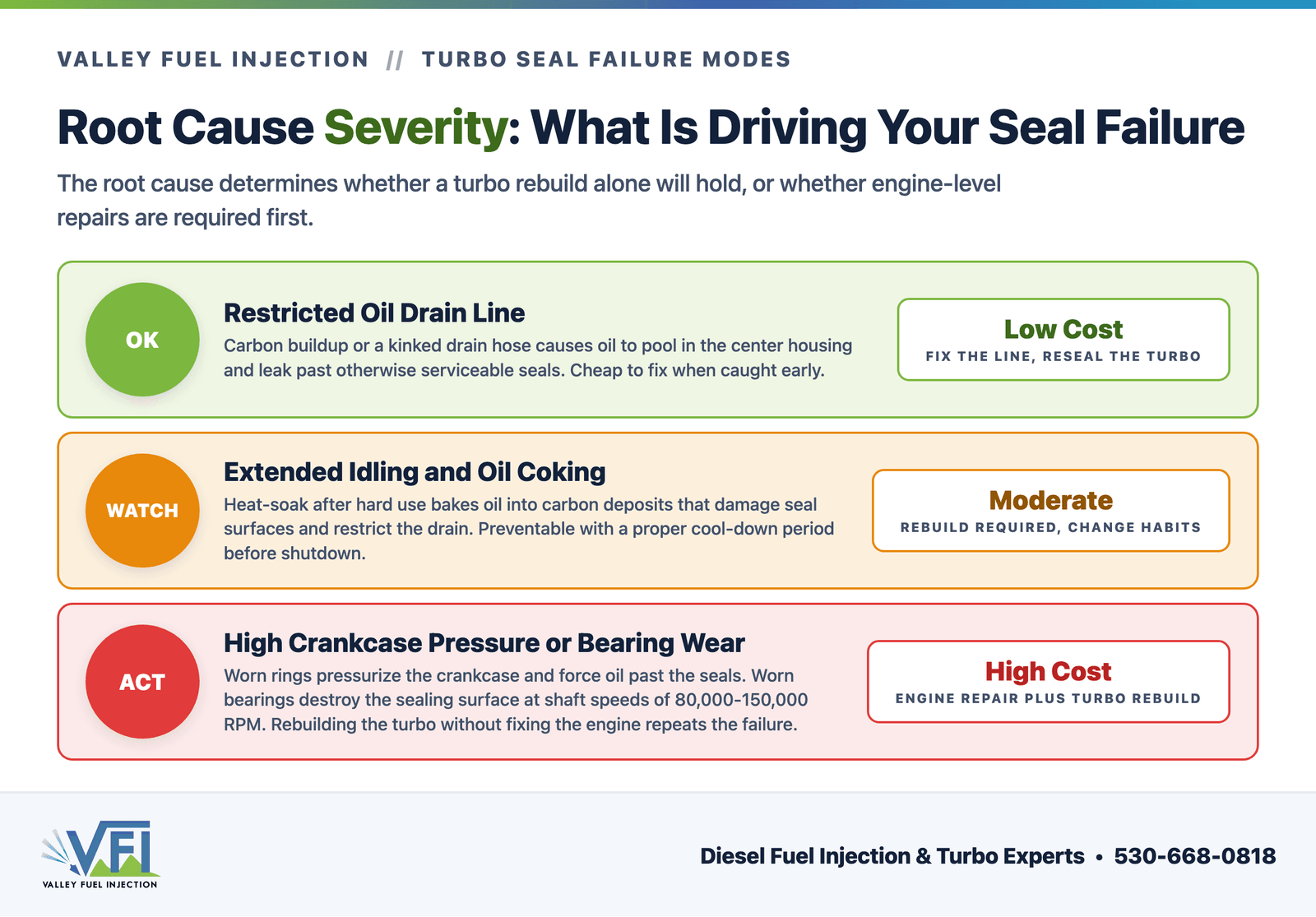
Turbocharger shaft speeds in a typical diesel application range from roughly 80,000 to 150,000 RPM. At those speeds, even a small amount of shaft runout from worn bearings will destroy a piston ring seal surface in a short period of time. This is why bearing condition and seal condition are evaluated together during any professional turbo inspection, they are closely related failures.
What Are the Symptoms of a Diesel Turbo with a Blown Oil Seal?
A leaking turbo seal produces a recognizable set of symptoms, though the specific combination depends on which seal is leaking and how severely.
Compressor-Side Seal Leak
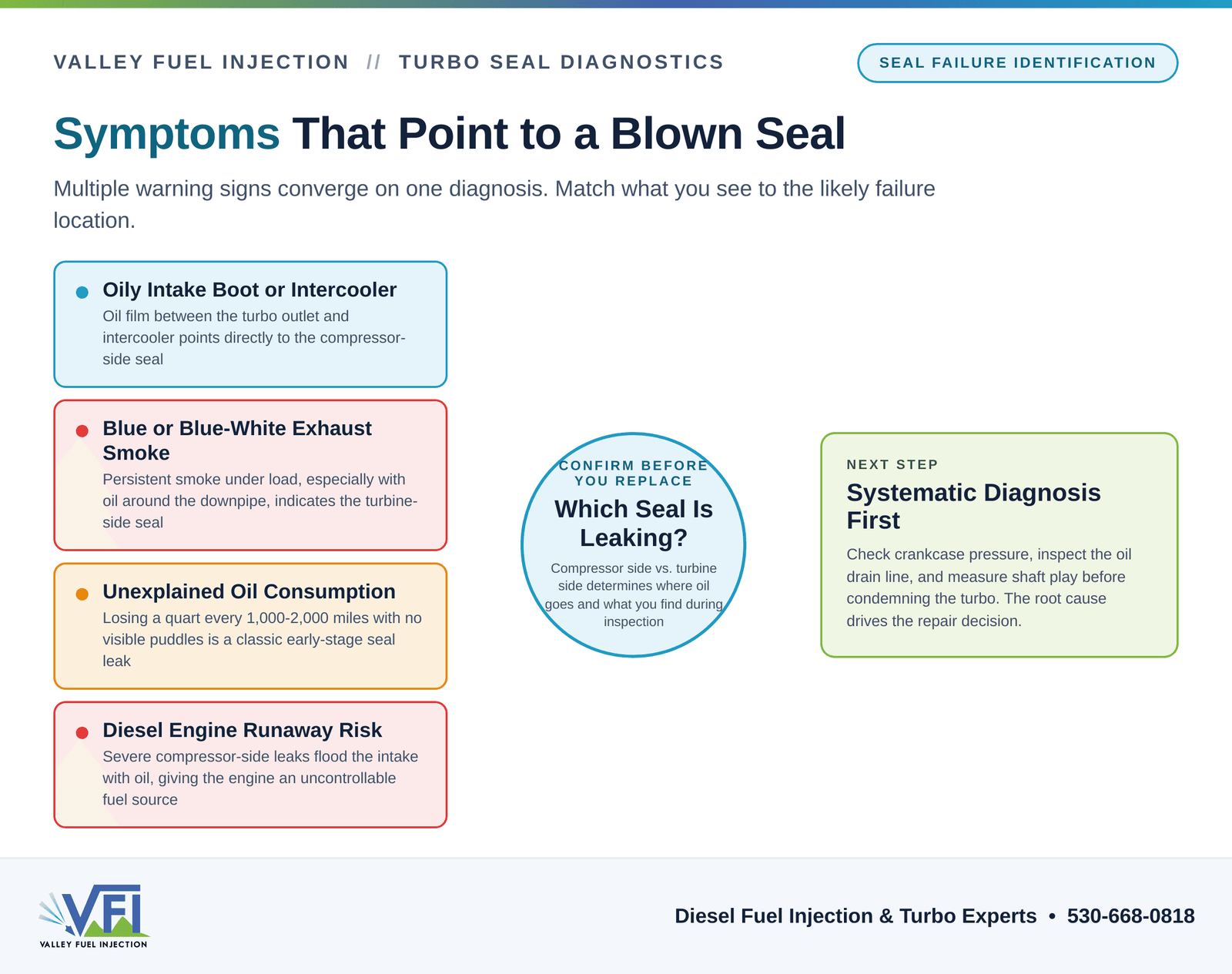
When the compressor-side seal leaks, oil enters the intake tract. You will typically see an oily film inside the intake boot between the turbo and the intercooler, oil residue inside the intercooler itself, and sometimes a bluish-gray smoke at startup that clears after the engine warms up. In severe cases, the oil in the intake can cause a runaway condition in a diesel, where the engine feeds on intake oil as fuel and will not shut down by cutting the throttle. This is a serious safety situation.
Turbine-Side Seal Leak
When the turbine-side seal leaks, oil enters the exhaust stream. This produces blue or blue-white smoke from the exhaust, a burning oil smell from the exhaust, and oil residue around the downpipe or turbo outlet. Because the exhaust side runs at much higher temperatures, the oil burns off more completely, which sometimes makes the smoke intermittent rather than constant.
Oil Consumption Without Obvious Leaks
A slow seal leak may not produce dramatic smoke, especially if combustion temperatures are burning the oil before it exits the tailpipe. Instead, you notice unexplained oil consumption, maybe a quart every 1,000 to 2,000 miles, with no puddles under the truck and no visible external leaks. This is a common presentation in early-stage seal failure, and it is one of the reasons turbo seal leaks often go undiagnosed until they become severe.
| Symptom | Likely Seal Location | Severity Indicator |
|---|---|---|
| Oily intake boot / intercooler | Compressor side | Moderate to severe |
| Blue/gray smoke at startup | Compressor or turbine side | Mild to moderate |
| Persistent blue smoke under load | Turbine side | Moderate to severe |
| Unexplained oil consumption | Either side (slow leak) | Early to moderate |
| Oil around downpipe / turbo outlet | Turbine side | Moderate to severe |
| Engine runaway (diesel) | Compressor side | Severe, stop driving immediately |
For a broader look at turbocharger warning signs beyond seal failure, see our guide on diesel turbocharger failure signs and early detection.
How Do You Confirm an Oil Seal Failure vs. Other Turbo or Engine Problems?
Confirming a turbo seal failure requires ruling out other causes of the same symptoms. Blue smoke and oil consumption can come from worn piston rings, valve stem seals, a cracked head, or a leaking injector. An oily intake can come from a clogged PCV system pushing crankcase oil through the breather. You need a systematic diagnosis, not a parts-swap guess.
A qualified diesel technician will typically start with a visual inspection of the intake tract and intercooler. Oil inside the intake boot on the turbo outlet side (between the turbo and intercooler) points strongly to the compressor seal. Oil on the exhaust side and around the downpipe points to the turbine seal. From there, shaft play is checked by hand and with a dial indicator if needed. Excessive radial or axial play confirms bearing wear, which almost always accompanies seal failure at this stage.
A smoke test or crankcase pressure test helps identify whether elevated blowby is pushing oil past otherwise serviceable seals. If crankcase pressure is the culprit, replacing the turbo without addressing the engine will not solve the problem. UV dye can be added to the oil and traced with a UV light to confirm the leak path in ambiguous cases.
Check the oil drain line from the turbo to the oil pan before condemning the turbo itself. If that line is kinked, clogged with carbon, or has a collapsed inner lining, oil backs up in the center housing and leaks past the seals even when the seals are in good condition. This is a cheap fix that gets missed constantly. A professional diagnostic at a specialty shop typically runs $175–$350 and can save you from replacing a turbo that did not need replacing.
Our team handles this kind of layered diagnosis every week. If you are seeing blue smoke or oil in your intake and are not sure where it is coming from, call us at 530-668-0818 or schedule a diagnostic. We serve diesel owners throughout Northern California and Nevada from our shop in Woodland.
What Causes a Turbo Oil Seal to Leak, and Why the Cause Changes Your Repair
Turbo seals almost never fail on their own. They leak because something upstream forces oil past them or wears the shaft they ride against, most often high crankcase pressure from worn rings (blowby), a restricted or coked oil drain line, oil coking from hot shutdowns, or bearing wear from contaminated oil. That is why the root cause changes your repair decision directly: reseal the turbo without fixing the cause and it simply fails again.
Because those causes are shared across every oil-related turbo failure, we cover each one, how to test for it, and why a parts swap without a system fix guarantees a repeat failure, in depth in our companion guide: Diesel Turbocharger Oil Contamination: Causes & Fixes. For a leaking seal specifically, confirm crankcase pressure and blowby, check the drain line, and fix the cause before you touch the turbo.
If your diesel is consuming oil and you cannot identify an external leak, do not assume it is normal. A slow turbo seal leak that goes unaddressed will eventually become a fast one. By the time you see heavy smoke, the bearings are often already damaged and a simple reseal is no longer possible. Early diagnosis is always cheaper than late diagnosis.
Can a Turbo Oil Seal Be Replaced, or Does the Whole Turbocharger Need Rebuilding?
In most cases, you cannot replace just the oil seal in isolation. The turbo must come off the engine, the CHRA (center housing rotating assembly) must be disassembled, and the seal rings, bearings, thrust components, and mating surfaces all need to be inspected and replaced as a set. This is a full rebuild, not a seal swap.
Whether a rebuild makes sense versus replacing the turbo outright depends on the condition of the housing and wheel. If the compressor or turbine wheel shows contact marks (wheel rub), the housing is scored, or the wheel blades are damaged, a rebuild may not be cost-effective. If the housing and wheels are clean and the damage is limited to the bearings and seals, a quality rebuild is a legitimate and often preferred option.
Here is what the numbers look like at a California specialty shop in 2026:
- Diagnostic inspection (shaft play check, smoke test, UV trace): typically $175–$350
- Turbo R&R labor only (remove and reinstall, no parts): typically $620–$1,600 depending on platform and access difficulty
- Professional turbo rebuild / CHRA reseal (seals, bearings, balancing, labor): typically $800–$1,800 all-in when the core is viable
- Remanufactured replacement turbo, light-duty diesel (part only): typically $1,100–$2,200
- VGT replacement turbo (part only): typically $1,800–$3,500
- Full replacement all-in (part + R&R + lines/gaskets/oil change), light-duty diesel: typically $2,200–$4,500
- Oil feed and return line replacement (done concurrent with R&R): typically $250–$650
- Intercooler cleaning after oil contamination: typically $150–$400
Prices reflect typical California specialty-shop ranges as of 2026. Your actual quote depends on the condition of your specific components, parts availability, and current labor rates. Call VFI at 530-668-0818 for an accurate quote on your job.
Dynamic balancing is a step that separates a quality rebuild from a cheap one. Any time the CHRA is disassembled and reassembled, the rotating assembly must be balanced to within tight tolerances before reinstallation. A shop that does not balance in-house is either sending the core out (which adds time) or skipping the step entirely, which will shorten the life of the rebuild significantly. We balance in-house at our turbocharger service facility.
For a deeper look at how to decide between rebuilding and replacing, see our dedicated guide on turbocharger repair vs. replacement for diesel trucks.
One thing worth noting: when the turbo comes off for a seal job, it is the right time to replace the oil feed and return lines as a matter of course. These lines are often partially clogged with carbon and are a leading cause of repeat seal failures. Replacing them while the turbo is already out adds relatively little to the labor cost compared to doing it as a separate job later.
What Happens to Your Diesel Engine If You Keep Driving on a Leaking Turbo Seal?
Continuing to drive with a known turbo seal leak causes damage that compounds quickly. Here is the progression most engines follow when the problem is ignored.
In the early stages, oil entering the intake coats the intercooler, charge piping, and intake manifold. This reduces intercooler efficiency, which raises charge air temperatures and reduces power. The oil also creates a carbon buildup on intake valves and in the combustion chamber that worsens over time.
As the leak progresses and bearing wear accelerates, shaft runout increases. The compressor or turbine wheel can begin to contact the housing. Wheel contact at 100,000-plus RPM is catastrophic. Wheel fragments can be ingested into the engine or expelled into the exhaust system, causing severe internal engine damage or destroying the catalytic converter or DPF.
Oil in the intake also creates a runaway risk in diesel engines, since diesel engines use air volume rather than a throttle butterfly to control speed. If enough oil enters the intake, the engine can exceed its governed RPM with no way to stop it except cutting off the air supply entirely. This is rare but it happens, and the consequences are engine-destroying.
Finally, the oil being consumed by the turbo is oil that is not protecting your engine bearings and other wear surfaces. Extended operation with low or marginal oil levels accelerates wear throughout the engine, not just at the turbo.
Do not ignore blue smoke or an oily intake boot hoping the problem will stabilize on its own. Turbo seal failures do not self-correct. The bearing wear and seal degradation that cause them are progressive, and the window for a cost-effective repair closes as the damage spreads. A $1,200 rebuild can become a $4,500 replacement, and a $4,500 replacement can become a $15,000 engine repair if wheel contact occurs.
If you are unsure whether what you are seeing is a turbo seal issue or something else, a qualified diesel technician can tell you in one diagnostic session. Do not guess and do not wait. The diesel fuel injection and turbocharger services we provide cover this kind of diagnosis daily, and we will give you a straight answer on what your turbo actually needs.
Diesel owners in Sacramento, Stockton, Chico, and the surrounding region can also review our Sacramento diesel service information or Chico-area diesel service page for more on how we serve customers across Northern California. We also accept mail-in turbos and fuel injection components for testing and rebuilding from customers nationwide.
For context on how turbo problems can intersect with fuel system issues, our post on diesel injector failure symptoms covers the overlap between injector and turbo symptoms that often confuse diagnosis.
Frequently Asked Questions: Diesel Turbocharger Oil Seal Failure
How do I know if my turbo seal is leaking or if my engine has worn rings?
Both can cause blue smoke and oil consumption, which is why a systematic diagnosis matters. A technician will check crankcase pressure (blowby test) to evaluate ring condition separately from the turbo. If crankcase pressure is normal and oil is present inside the intake boot on the turbo outlet side, the compressor seal is the likely culprit. If blowby is elevated, the engine itself may be pushing oil past the turbo seals even if the seals are not worn. In many cases, both problems exist together, and both need to be addressed.
Can I keep driving if my turbo is just leaking a little oil?
We strongly advise against it. A slow seal leak is a sign that bearing wear or a drain restriction is already present. Both conditions worsen over time, and the window for a lower-cost repair closes as the damage progresses. At minimum, have a diesel specialist evaluate the turbo before putting more miles on it. Catching it early can be the difference between a $1,200 rebuild and a $4,500 replacement.
Does a turbo oil seal failure void my engine warranty?
It depends on the cause. If the seal failure resulted from an engine problem such as high blowby or oil contamination, the warranty situation becomes complicated. If it resulted from a manufacturing defect in the turbo itself, that may be covered under the turbo manufacturer’s warranty. Document everything and consult with a qualified diesel technician before authorizing repairs if your truck is still under any form of warranty coverage.
How long does a turbo rebuild take?
At a shop with in-house balancing equipment, a turbo rebuild typically takes one to three business days once the turbo is in hand. The R&R labor (removing and reinstalling the turbo on the truck) adds time depending on the platform. A straightforward single-turbo Cummins or Duramax can often be turned around in two to three days total. Complex platforms with difficult access or twin-turbo configurations take longer.
Should I replace the oil lines when I replace or rebuild my turbo?
Yes, in almost every case. The oil feed and return lines are a common cause of repeat seal failures, and they are relatively inexpensive to replace while the turbo is already off the truck. Skipping this step to save a small amount of money and then having the new or rebuilt turbo fail from oil drain restriction is a costly mistake we see regularly. Budget for line replacement as part of any turbo seal or rebuild job.
Valley Fuel Injection has been diagnosing and rebuilding diesel turbochargers since 1993. We handle everything from simple seal inspections to full VGT rebuilds with in-house dynamic balancing. Our shop is located at 1243 E Beamer St, Suite C, Woodland, CA 95776. Call us at 530-668-0818 or schedule a diagnostic online. We ship nationwide and accept mail-in turbos and injection components for testing and rebuilding.