
Diesel Injection Pump Timing Symptoms Explained
06/24/2026
Best Diesel Fuel Filter: Fleetguard vs Donaldson vs Baldwin vs OEM
06/26/2026
Diesel Engine Blue Smoke: Causes, Diagnosis & What It’s Telling You
Blue smoke from a diesel means it is burning engine oil. Black smoke is too much fuel and white smoke is unburned fuel or coolant; blue or blue-gray smoke with a burnt-oil smell is oil getting into the cylinders or the exhaust. The job is finding where it gets in, because a plugged turbo drain line and a worn set of rings make the same smoke and cost very different money to fix.
The 4 usual sources, roughly from the cheapest fix to the most expensive:
- Crankcase breather or oil level. An overfilled crankcase or an overdue breather (CCV) filter can send oil mist into the intake. Clue: oil in the intake ahead of the turbo, a turbo that checks out fine, or oil above the full mark.
- Turbocharger oil seals. The most common source on a turbo diesel, and often not the turbo’s fault: a restricted oil drain, a plugged air filter or high crankcase pressure will push oil past seals that are otherwise fine. Clue: smoke after a long idle or when you get back on the throttle, and oil in the boot between the turbo and the intercooler.
- Valve stem seals and guides. Oil seeps down worn seals and guides while the engine sits. Clue: a puff of blue smoke at startup that clears in a minute or two, then a clean exhaust.
- Piston rings and cylinder walls. The expensive one. Clue: steady blue smoke under load, heavy blowby out the breather and oil use that keeps climbing. Our guide to telling a leaking turbo seal from worn rings walks through the tests.
Injectors are rarely the direct cause, but a leaking one can thin the oil with fuel and wear the rings over time (more on that below).
Blue smoke from a diesel exhaust means oil is burning in the combustion chamber. The most common culprits are a worn turbocharger oil seal, failed valve stem seals, or worn piston rings. Startup-only blue smoke and load-related blue smoke point to very different root causes, so when and how the smoke appears matters as much as the smoke itself.
What Does Blue Smoke from a Diesel Exhaust Actually Mean?
Blue smoke means combustion is consuming engine oil. When oil enters the combustion chamber, it burns at a lower temperature than diesel fuel and produces a distinctive blue or blue-gray haze. In some lighting conditions it can look more gray than blue, but the sharp, acrid smell is a reliable identifier: it smells like burning oil, not raw fuel.
A small puff of blue smoke on a cold start after a long sit is considered normal on many older diesels, particularly those with high mileage. The issue becomes serious when the smoke is persistent, visible under load, or accompanied by rising oil consumption. If you’re adding a quart of oil every 1,000 miles or less, the engine is telling you something is wrong and getting worse.
Blue smoke is distinct from white smoke, which indicates either unburned fuel during cold starts or coolant entering combustion from a blown head gasket. If you’re unsure which color you’re seeing, the smell is your best diagnostic tool. Blue smoke smells like a burning crankcase. White smoke smells sweet (coolant) or like raw diesel. Black smoke smells like rich, unburned fuel.
Is Blue Smoke at Startup Different from Blue Smoke Under Load?
Yes, and this distinction is one of the most useful diagnostic clues you have without touching a wrench. When and how the blue smoke appears narrows the list of suspects significantly.
Blue smoke only at cold startup, clears within a minute or two: This pattern almost always points to valve stem seals. When the engine sits overnight, oil migrates past worn valve stem seals and pools on top of the valves. On startup, that pooled oil burns off quickly and produces a puff of blue smoke that clears as the engine warms and oil stops migrating. The seals are worn enough to leak when cold and static, but the positive pressure during normal operation limits ongoing leakage.
Blue smoke that appears after deceleration (lifting off the throttle at highway speed): This is a classic turbocharger symptom. When you lift off the throttle, intake manifold vacuum spikes briefly. If the turbo’s oil seals are worn, that vacuum spike pulls oil through the seal and into the intake. It burns on the next acceleration event, producing a puff of blue smoke.
Blue smoke under load or at wide-open throttle: This pattern is more serious. Sustained blue smoke under load typically indicates worn piston rings or cylinder wall wear. The rings can no longer seal combustion pressure, and oil from the crankcase is pushed past the rings and into the combustion chamber. This is the scenario that leads to in-frame rebuilds if left unaddressed.
Constant blue smoke at all operating conditions: This suggests significant internal wear affecting multiple cylinders, a heavily fouled or damaged turbocharger, or in some cases a failed PCV/crankcase ventilation system that is force-feeding oil mist directly into the intake.

Persistent blue smoke combined with a drop in oil level is not a “monitor and drive” situation. Oil entering the combustion chamber can foul injectors, contaminate the DPF or catalytic converter, and accelerate wear on cylinder walls. Continued operation without diagnosis risks turning a $1,500 turbo seal job into a $9,000 in-frame rebuild.
Could Your Turbocharger Be the Source of the Oil Burning?
The turbocharger is the single most common source of blue smoke on modern diesel engines, and it’s the first place we look at our turbocharger service bench. Here’s why turbos are so prone to this problem.
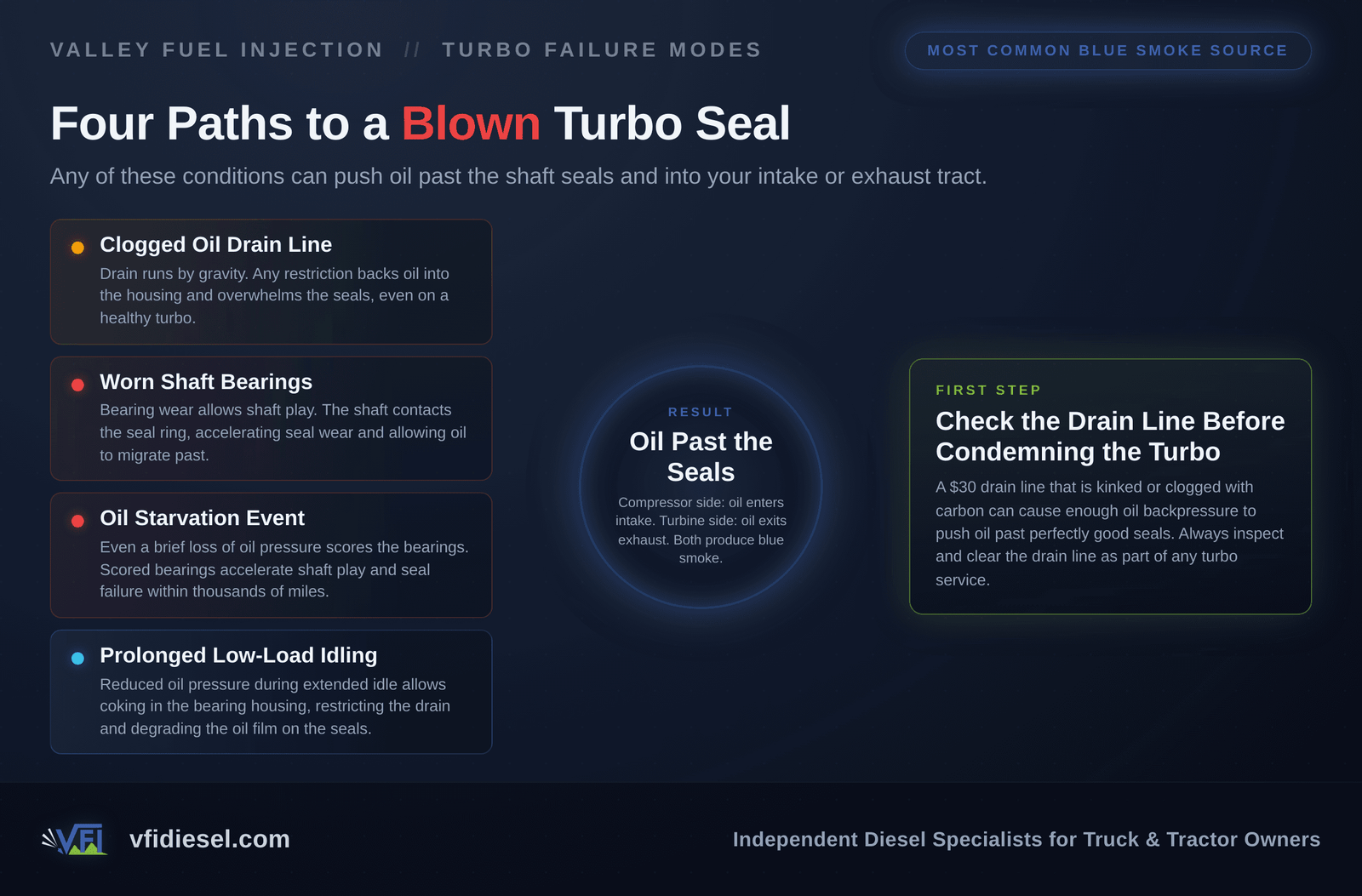
The turbo shaft spins on oil-fed bearings at speeds ranging from 100,000 to 250,000 RPM. The only thing keeping that oil inside the bearing housing and out of the intake and exhaust tracts is a set of oil seals on each end of the shaft. Those seals are not traditional rubber gaskets. They’re precision-machined seal rings that rely on a thin oil film and positive pressure differential to function. When they wear, or when the bearing housing fills with oil due to a clogged drain line, oil migrates into the compressor or turbine side of the turbo.
Oil on the compressor side gets pulled into the intake manifold and burned in the combustion chamber. Oil on the turbine side exits through the exhaust. Both produce blue smoke.
The most common turbo-related causes of blue smoke include:
- Worn shaft bearings allowing shaft play, which wears the oil seals
- A clogged or restricted oil drain line (the drain runs by gravity, and any restriction causes oil to back up into the housing)
- Prolonged idling without load, which reduces oil pressure and allows coking in the bearing housing
- Oil starvation events that score the bearings and accelerate seal wear
- Oversized aftermarket turbos installed without matching the oil feed and drain to the new unit’s requirements
You can get a quick read on turbo health by removing the intake pipe at the compressor inlet and looking for oil pooling or heavy oil coating on the compressor wheel and housing. Some oil mist is normal, but visible pooling or a wet, oily compressor wheel is a red flag. Also check the intercooler: if it’s full of oil, the turbo has been pushing oil into the intake for a long time.
Check the turbo oil drain line before condemning the turbo itself. A $30 drain line that’s kinked, clogged with carbon, or installed with a slight uphill run can cause enough oil backpressure to push oil past perfectly good seals. We’ve seen turbos returned as “bad” that just needed a drain line replacement and a thorough cleaning. Always address the drain line as part of any turbo service. If your engine has been losing oil pressure, see our post on diesel engine losing oil pressure for related diagnostic steps.
When a turbo rebuild is viable (bearings and seals worn but the housing and wheels are intact), the repair typically runs $1,200–$2,500 including removal and reinstallation. When the shaft play has allowed the compressor or turbine wheel to contact the housing, or when the housing is cracked, replacement is the only option. A remanufactured VGT turbo installed on a light-duty diesel typically runs $2,800–$5,500 all-in at a California specialty shop. See our turbocharger service page for more detail on what we can do in-house.
How Do Worn Injectors or a Failing Injection Pump Contribute to Blue Smoke?
Injectors and injection pumps are less common sources of blue smoke than turbos or valve seals, but they can contribute in specific ways that are worth understanding.
A diesel injector that is leaking internally (passing fuel back through the return circuit when it shouldn’t) or that has a worn nozzle tip can dribble fuel into the cylinder during the intake and compression strokes, before the injection event. That raw fuel dilutes the oil film on the cylinder wall and washes it down into the crankcase. Over time, fuel-diluted oil loses its viscosity and lubricating properties, which accelerates ring and cylinder wall wear. That wear then produces blue smoke from oil consumption. So injector problems don’t always produce blue smoke directly. They can cause the conditions that lead to it.
More directly, a leaking injector return circuit can allow fuel to enter the crankcase, raising the oil level on the dipstick. If you notice your oil level rising between changes, or if your oil smells like diesel, you likely have injector return leakage. This is a serious condition that also causes the oil pressure problems that follow from severely thinned oil.
On older rotary and inline injection pumps, a failed internal seal can allow the pump’s internal lubricating fuel to migrate into the engine’s intake system. This shows up as blue smoke and an oily intake manifold, and it’s often misdiagnosed as a turbo problem. A bench test of the injection pump is the only reliable way to confirm this failure mode. Our Bosch fuel injection testing and repair service and Delphi injection service include full bench testing that can identify this type of internal leak.
If you’re running California’s B20 biodiesel blends, injector nozzle wear accelerates significantly. We’ve written about biodiesel injector damage in detail, and worn nozzles from biodiesel exposure are a contributing factor we see regularly in blue smoke cases from California operators.
How Do You Diagnose the Root Cause Without Pulling the Engine Apart?
A systematic approach to blue smoke diagnosis can identify the likely source without major disassembly. Here’s the diagnostic sequence we follow.
| Diagnostic Step | What You’re Looking For | Likely Suspect If Positive |
|---|---|---|
| Note when smoke occurs (startup, decel, load) | Timing pattern of smoke | Valve seals (startup), turbo (decel), rings (load) |
| Check oil level and condition | Consumption rate, fuel smell in oil, rising level | Ring wear (consumption), injector leakback (rising level) |
| Inspect turbo compressor inlet for oil | Pooled oil, wet compressor wheel | Turbo oil seal failure or blocked drain |
| Check intercooler for oil accumulation | Oil pooling at intercooler outlet | Long-standing turbo seal leak |
| Compression test (wet and dry) | Low compression, improvement with oil added | Worn rings or cylinder wall damage |
| Injector return/leakback test | Excessive return flow, cross-contamination | Worn injector nozzles or body seals |
| Crankcase pressure check (blowby test) | Excessive crankcase pressure or blowby | Ring wear, cylinder wall wear |
Parts and labor vary by region, engine condition, and current pricing. Call us at 530-668-0818 for an accurate quote.
A compression test is one of the most cost-effective diagnostic steps for blue smoke. A wet compression test (adding a small amount of oil to the cylinder before testing) that shows significant improvement over the dry test confirms ring and cylinder wall wear as the culprit.

Cylinders that test consistently low regardless of the wet/dry comparison point toward valve issues instead. A compression test at a California specialty shop typically runs $300–$500.
For injection system diagnosis, bench testing is the only reliable method. Visual inspection of injectors tells you almost nothing about spray pattern, opening pressure, or leakback rate. If you’re in the Sacramento area or Northern California, our team at diesel fuel injection Sacramento and our main shop in Woodland can perform full bench testing on your injectors and pump.
A borescope inspection through the glow plug or injector bore can let an experienced tech assess cylinder wall condition and piston crown deposits without removing the head. It won’t replace a compression test, but it can confirm ring land damage or heavy carbon buildup that explains oil consumption. It’s a useful step before committing to a full teardown. If your engine is also suffering from power loss alongside the blue smoke, see our post on diesel engine losing power for related diagnostic context.
How to Fix Blue Smoke on a Diesel
Fix the cause, not the smoke. Work in this order so you do not buy a turbo or an overhaul the engine never needed.
- Confirm it is oil. Blue-gray smoke that smells like burnt oil is oil. A blue-white haze on a cold start that smells like raw diesel and clears as the engine warms is unburned fuel, so start with our white smoke guide instead.
- Pull the dipstick. If the oil is over the full mark, drain it back to full. If the level keeps climbing between changes and the oil smells like diesel, fuel is getting into the crankcase. A leaking injector or pump is a common cause and a bench test settles it. No injection shop near you? Ship the injectors or pump to us through our mail-in rebuild service for bench testing and a firm quote before any work is done.
- Service the air filter and the breather. Replace a dirty air filter and, if the engine has a serviceable crankcase breather (CCV) filter, replace that too. A restricted air filter can pull oil past the turbo’s compressor seal, and a plugged breather builds crankcase pressure that keeps the turbo from draining.
- Inspect the turbo and its oil drain. Pull the intake pipe at the compressor inlet and the boot on the outlet side. Oil on the outlet side with a dry inlet points to the compressor seal. If the inlet is oily too, look at the breather first, since many engines route crankcase vapor into the intake ahead of the turbo. A wheel that rubs the housing when you push it sideways means a rebuild or replacement either way. Before you condemn the turbo, check the drain line for kinks, crushed spots and carbon inside: a drain that cannot flow will make a good turbo leak. Our turbocharger service handles the repair, or supplies a new or remanufactured unit when the old one is past saving. Do not keep driving a turbo that is dumping oil into the intake. It can feed a runaway, where the engine revs on its own oil and the key will not shut it off.
- Smoke only at startup? Look at valve stem seals. A puff for a minute after sitting overnight, then a clean exhaust, points to valve stem seals or worn guides. That is cylinder head work, so if the head comes off, have the guides measured and the seals replaced at the same time.
- Steady smoke under load? Test for blowby. A crankcase pressure (blowby) test and a compression test through the injector or glow plug bores tell you whether the rings and cylinders are worn. A compression test typically runs $300–$500. Do this before you replace a turbo on a high-hour engine: worn rings raise crankcase pressure, which can make a good turbo leak, and a new turbo will not stop ring smoke.
- Clean up after the repair. Flush the oil out of the intercooler and charge pipes, or it keeps smoking after the fix. On a truck with a DPF, have the filter checked: oil leaves ash that a regen cannot burn off, so a long stretch of oil burning can load the DPF early.
Typical repair ranges for these fixes are in the cost estimate further down.
Talk to a Diesel Tech Burning oil? Find the source before you buy a turbo Tell us the engine, when it smokes and how much oil it is using. We will tell you where to look first and quote the repair before any work starts. Two ways in: drive it into our Woodland shop near Sacramento, or ship it to us from anywhere in the country. ☎︎ Call 530-668-0818Out of the area? Start a mail-in rebuild → |
When Is Blue Smoke a DIY Fix vs. a Sign You Need a Specialist?
Some blue smoke causes are approachable for a mechanically capable owner. Others require specialized equipment, calibrated tooling, or the kind of hands-on diesel experience that only comes from working inside these systems every day.
Reasonable DIY territory: Replacing the crankcase ventilation (CCV) filter on engines like the 6.7 Cummins or LML Duramax is a straightforward job that can eliminate a common source of oil mist entering the intake. Checking and replacing a kinked or clogged turbo oil drain line is also within reach for someone comfortable with basic engine work. These are low-cost, low-risk starting points before spending money on diagnostics.
Where you need a specialist: Turbocharger rebuild or replacement requires precision balancing equipment and the knowledge to match the turbo specification to the engine’s fuel system calibration. Installing the wrong turbo or an incorrectly rebuilt unit can cause the same blue smoke problem you started with, plus new problems like unstable idle or power loss. Valve stem seal replacement requires removing the cylinder head, and on most modern diesel engines that means dealing with aluminum head bolts, precision torque sequences, and the risk of finding additional damage once the head is off. Piston ring replacement is a full in-frame rebuild. None of these are weekend-driveway jobs.
Injector and injection pump diagnosis and repair require dedicated bench testing equipment. You cannot reliably evaluate injector spray pattern, opening pressure, or leakback rate without a calibrated test bench. This is core to what we do at Valley Fuel Injection. We’re one of the few shops in the country with the Bosch-certified equipment and factory training to test and remanufacture common rail injectors and VP44 pumps to OEM specifications. Our common rail system repair service covers the full diagnostic and rebuild process.
If you’re not local to Northern California, we also accept mail-in injectors and pumps for bench testing and rebuilding. Diesel owners across the country ship their components to our Woodland, CA shop for the kind of specialized service that most regional shops can’t provide.
- CCV filter replacement (DIY parts): $50–$150
- Turbo oil drain line replacement: $200–$500 installed
- Turbocharger rebuild (bearings and seals, R&R included): $1,200–$2,500
- VGT turbocharger replacement (reman, installed): $2,800–$5,500
- Valve stem seal replacement (full head): $1,500–$3,200
- Piston ring replacement / in-frame rebuild (light-duty): $4,500–$9,000
- Full injector set replacement (6- or 8-cylinder, installed): $4,500–$8,500
- Compression test: $300–$500
Prices reflect typical California specialty-shop ranges as of 2026. Your actual quote depends on the condition of your specific components, parts availability, and current labor rates. Call VFI at 530-668-0818 for an accurate quote on your job.
Whatever the source of your diesel engine blue smoke, the worst thing you can do is keep driving and hoping it resolves on its own. Oil consumption accelerates wear, fouled injectors and DPF systems add repair costs on top of the original problem, and what starts as a $1,500 turbo repair can become a $9,000 engine job if the root cause is ignored long enough.
If you’re seeing blue smoke and want a straight answer about what’s causing it, schedule a diagnostic with our team or call us at 530-668-0818. We’ve been diagnosing and repairing diesel fuel systems since 1993, and we’ve seen every variation of this problem across every platform. Our diesel fuel injection services include full bench testing, turbocharger service, and injection system repair backed by Bosch certification and over 30 years of hands-on experience.
Frequently Asked Questions About Diesel Engine Blue Smoke
Can a diesel engine run with blue smoke, or do I need to stop driving immediately?
It depends on the severity. A small puff of blue smoke on a cold start that clears quickly is generally not an emergency. Persistent blue smoke at all operating conditions, especially combined with rising oil consumption or a drop in oil pressure, means you should limit driving and get a diagnosis as soon as possible. Continued operation with significant oil burning can foul your DPF, damage injectors, and accelerate internal engine wear in ways that multiply the repair cost significantly.
How do I know if blue smoke is coming from the turbo or from the engine internals?
The timing and pattern of the smoke is your best initial clue. Blue smoke that appears after lifting off the throttle at highway speed, or that’s accompanied by oil pooling in the compressor inlet, points strongly to the turbocharger. Blue smoke that appears under hard acceleration or sustained load, especially with high oil consumption and elevated crankcase pressure, suggests ring and cylinder wall wear. A compression test and a turbo inspection together will usually confirm which system is responsible. A qualified diesel technician can narrow this down with a systematic diagnostic before any teardown.
Does blue smoke always mean the engine is worn out?
No. Blue smoke from a turbocharger oil seal failure or a clogged drain line does not mean the engine internals are worn. The turbo is a serviceable component, and many blue smoke cases are resolved with a turbo rebuild or replacement without touching the engine. Valve stem seal failures are also a localized repair. Blue smoke from worn piston rings is a more serious finding, but even that doesn’t necessarily mean the engine is at end-of-life. An in-frame rebuild on a diesel engine can restore it to near-new specification at a fraction of the cost of replacement.
Can bad diesel fuel or contaminated fuel cause blue smoke?
Contaminated fuel can contribute indirectly. Fuel that contains water or excessive biodiesel content can damage injector nozzles, leading to poor spray patterns and incomplete combustion. Over time, injector-related fuel dilution of the crankcase oil accelerates ring and cylinder wall wear, which then produces blue smoke. California’s high biodiesel blend content is a factor we see regularly in accelerated injector wear cases. If you’re running B20 or higher blends, monitoring injector condition is important. See our post on biodiesel injector damage for more on this issue.
How long does a turbocharger rebuild take, and can I get my truck back the same day?
Turbocharger removal, rebuild, and reinstallation typically takes one to two days at a specialty shop, depending on the engine platform and whether any secondary work is needed (intercooler flush, drain line replacement, oil line inspection). On some platforms with difficult access, the timeline extends. We recommend calling ahead so we can confirm parts availability for your specific turbo before you bring the truck in. Reach us at 530-668-0818 to discuss your situation and get a realistic timeline.
Valley Fuel Injection & Turbo, Inc. is a Bosch-certified diesel fuel injection testing, remanufacturing, and repair center located at 1243 E Beamer St, Suite C, Woodland, CA 95776. We serve diesel truck owners, fleet operators, and agricultural equipment owners throughout Northern California and Nevada, and we ship remanufactured injectors, pumps, and parts nationwide. Call us at 530-668-0818 or schedule a diagnostic online. For additional technical background on diesel exhaust diagnosis, the Bosch Diesel Systems resource and EPA nonroad diesel emissions standards provide useful context on how diesel combustion and emissions interact. The SAE International diesel combustion research library is also a strong reference for the engineering behind diesel smoke diagnosis.
Related guides from Valley Fuel Injection
- Diesel White Smoke: Causes, Diagnosis & How to Fix It
- Diesel Black Smoke: 7 Causes, Diagnosis & How to Fix It
- Diesel Turbocharger Failure: 8 Warning Signs
Blue smoke usually means oil is reaching combustion, often from worn turbo seals or valve guides. Valley Fuel Injection rebuilds turbos and diagnoses injection and oil-control issues. Call 530-668-0818.