7.3 Power Stroke Fuel Bowl Problems & Fixes
07/10/2026
Diesel Cold Start Problems: Causes & Fixes
07/19/2026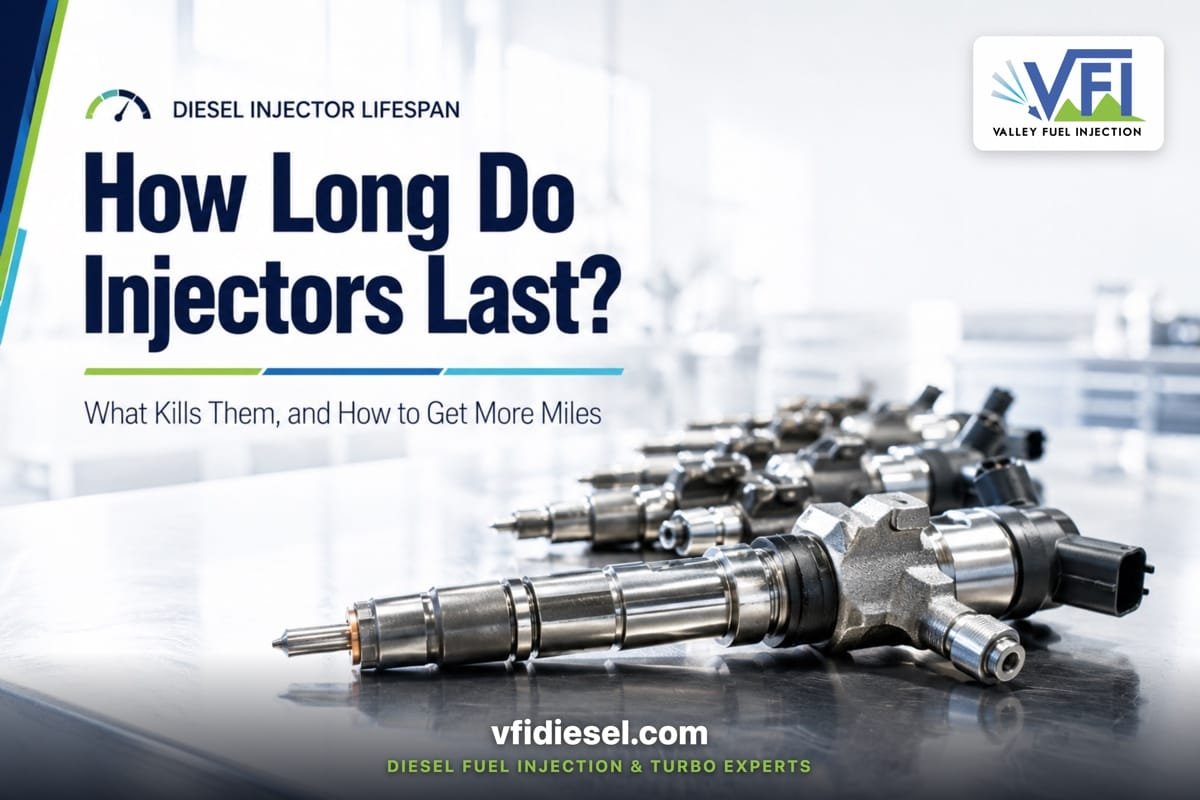
How Long Do Diesel Injectors Last? (And What Kills Them Early)
Diesel injectors typically last between 150,000 and 300,000 miles under normal operating conditions with clean fuel and consistent maintenance. That said, we’ve pulled injectors from well-maintained trucks at 400,000 miles that still flowed within spec, and we’ve seen injectors fail before 80,000 miles on trucks that looked perfectly fine on the outside. The honest answer is that lifespan varies enormously depending on four things: the engine platform, fuel quality, operating load, and whether there’s an underlying problem quietly destroying components upstream. After testing tens of thousands of injectors here at Valley Fuel Injection, we can tell you exactly what separates a long-lived injector from one that fails early.
Most diesel injectors are built to last 150,000–300,000 miles, but fuel contamination, high-load duty cycles, and platform-specific design weaknesses routinely cut that lifespan in half. Knowing which factors apply to your truck is the difference between a planned maintenance decision and an emergency repair bill.
What Is the Realistic Service Life of a Diesel Injector Under Normal Conditions?
Under ideal conditions, a modern common rail diesel injector is engineered to last the life of the engine. In practice, 150,000 to 300,000 miles is the realistic window for most light-duty diesel trucks, and many agricultural and commercial engines push well past that with proper care.
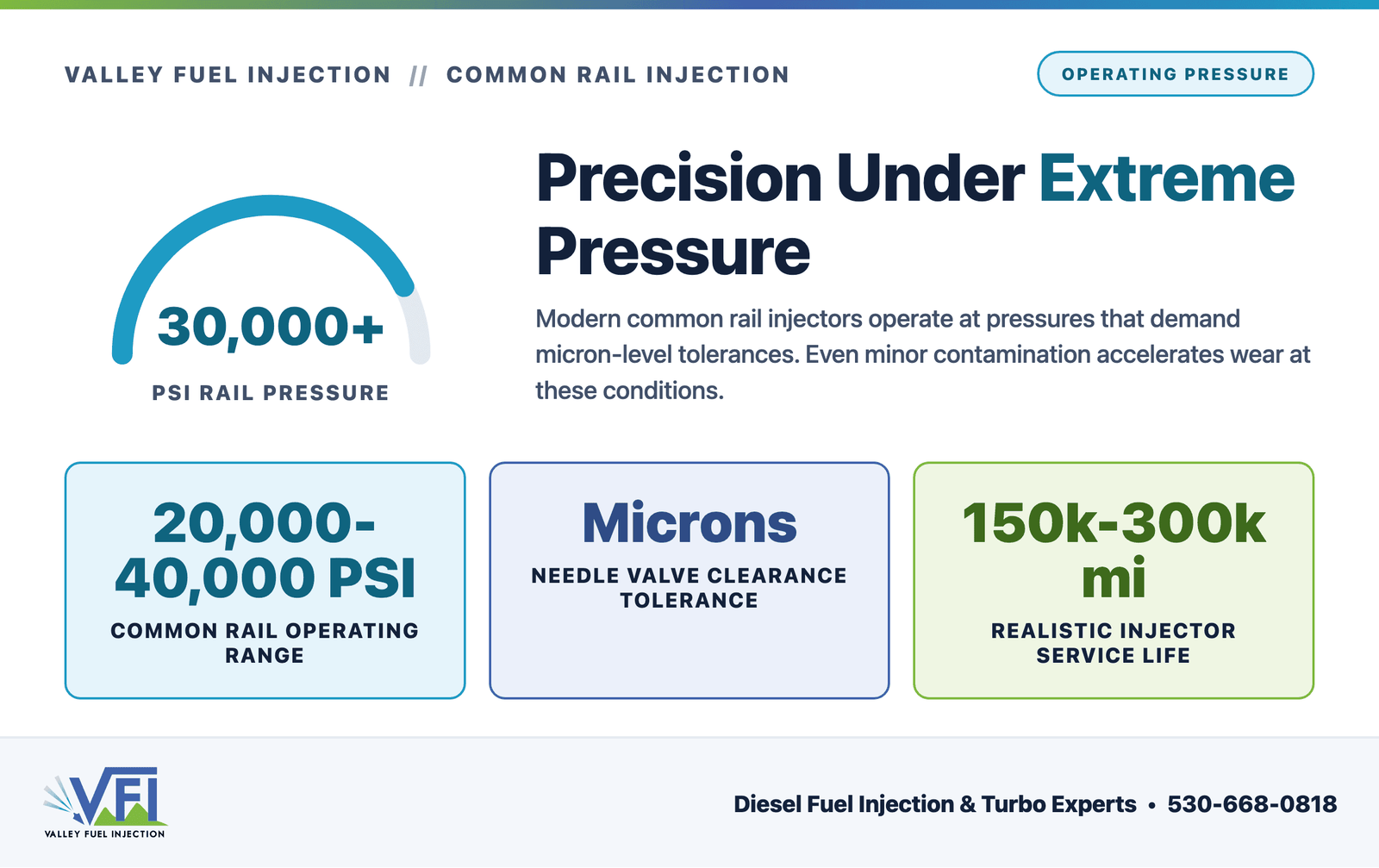
The reason the range is so wide comes down to tolerance. Common rail injectors operate at pressures between 20,000 and 40,000 PSI, and the internal clearances between needle valve and bore are measured in microns. A single-digit micron increase in that clearance, caused by wear or scoring, is enough to change spray pattern and fuel delivery. The injector doesn’t fail catastrophically in most cases. It degrades gradually, and that degradation shows up first as hard starts, rough idle, and declining fuel economy before it ever triggers a fault code.
Older mechanical injectors, like the pop-type units used on pre-common rail engines, were simpler and often more durable in terms of raw longevity. A well-maintained Bosch P7100-fed 12-valve Cummins could run 500,000 miles on its original injectors. The tradeoff is that mechanical systems couldn’t meet modern emissions standards, which is why the industry moved to high-pressure common rail. More precision, more performance, and more sensitivity to everything that touches them.
A common rail injector needle valve and bore are machined to tolerances tighter than a human hair. Even a small amount of abrasive contamination in the fuel acts like sandpaper on those surfaces at 30,000+ PSI. This is why fuel cleanliness is not optional on modern diesel platforms, it’s the primary factor controlling how long your injectors last.
For our diesel fuel injection testing and repair customers, the most common scenario we see is injectors reaching 180,000–220,000 miles before showing measurable degradation in flow rate or spray pattern. At that point, a bench test tells us whether the injector can be cleaned and recalibrated or whether replacement is the right call. You can read more about what that process looks like in our post on how common rail diesel injectors are tested on our Bosch-certified bench.
Which Diesel Platforms Consistently See Early Injector Failure?
Not all diesel engines are equally hard on their injectors, and some platforms have well-documented failure patterns that have nothing to do with how the owner maintains the truck.
The LB7 Duramax (2001–2004) is the most notorious example. GM used injectors with an internal o-ring design that was prone to leaking fuel into the crankcase. Many LB7 owners saw full-set failures before 130,000 miles, sometimes well before. The design was revised in later generations, but the LB7 set the benchmark for what a problematic injector platform looks like.
The 6.0 Powerstroke (2003–2007) carries a different failure mode. The HEUI injector design on the 6.0 depends on high-pressure oil to actuate fuel delivery, and those injectors are extremely sensitive to oil quality and the condition of the High Pressure Oil Pump (HPOP). Injectors on a 6.0 with deferred oil changes or a failing HPOP can fail in the 80,000–120,000 mile range. The injectors themselves aren’t necessarily the root cause, the oil system is.
The 6.7 Powerstroke (2011–present) with the CP4.2 high-pressure fuel pump introduced a different threat entirely. When a CP4.2 fails catastrophically, it sends metal debris throughout the entire fuel system, destroying injectors, the fuel rail, and lines in a single event. We’ve written about this extensively, and the repair bill for a full CP4 contamination event typically runs $10,000–$18,000 or more. The injectors in this case aren’t wearing out, they’re being destroyed by a pump failure upstream.
What these platforms have in common is that injector failure is often a symptom, not the root cause. Replacing injectors without addressing the underlying issue (oil system health, pump integrity, fuel contamination) results in the new injectors failing on the same shortened timeline.
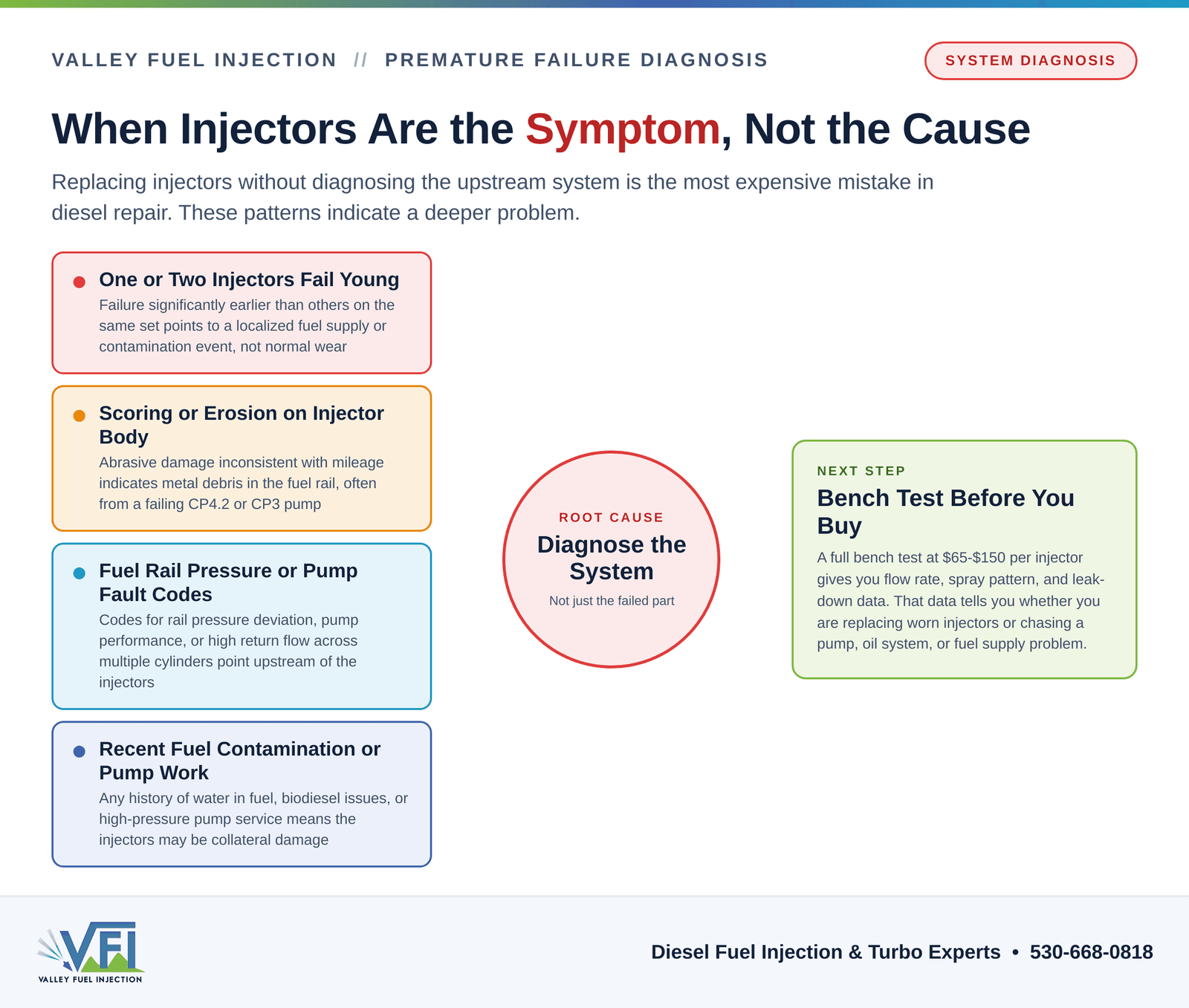
If you’re replacing injectors on a 6.0 Powerstroke, 6.4 Powerstroke, or any CP4-equipped platform without also inspecting and addressing the high-pressure oil or fuel pump, you are setting yourself up to destroy the new injectors on the same timeline. Always diagnose the system, not just the failed component.
If you’re dealing with a Powerstroke platform, our Bosch diesel fuel injection testing and repair service includes full system evaluation before we recommend any parts replacement. Customers in the Sacramento region can also visit our Sacramento diesel fuel injection service page for more information on what we cover.
How Much Does Fuel Quality Actually Reduce Injector Lifespan?
Fuel quality is the single biggest variable in injector longevity, and it’s the one most owners underestimate. Poor fuel quality doesn’t just accelerate wear, it can destroy injectors in a fraction of their expected service life.
Modern ultra-low sulfur diesel (ULSD) removed most of the natural lubricity that older diesel fuel provided. Sulfur wasn’t good for emissions, but it did lubricate injection system components. ULSD requires additive packages to compensate, and when those additives are absent or degraded (as happens with stale or improperly stored fuel), the lubricity deficit accelerates wear on high-pressure pump internals and injector needle valves.
Water contamination is a faster killer. Water doesn’t compress, and at 30,000 PSI it causes hydraulic hammer damage to injector internals. It also promotes microbial growth in fuel tanks, which produces acids and particulates that score injector bores. A single tank of heavily contaminated fuel can cause measurable damage.
Biodiesel blends above B20 introduce their own problems in California’s climate. We covered this in detail in our post on biodiesel injector damage and California’s fuel quality issues. The short version: high biodiesel blends can polymerize inside injectors, causing deposits that alter spray pattern and eventually seize needle valves.
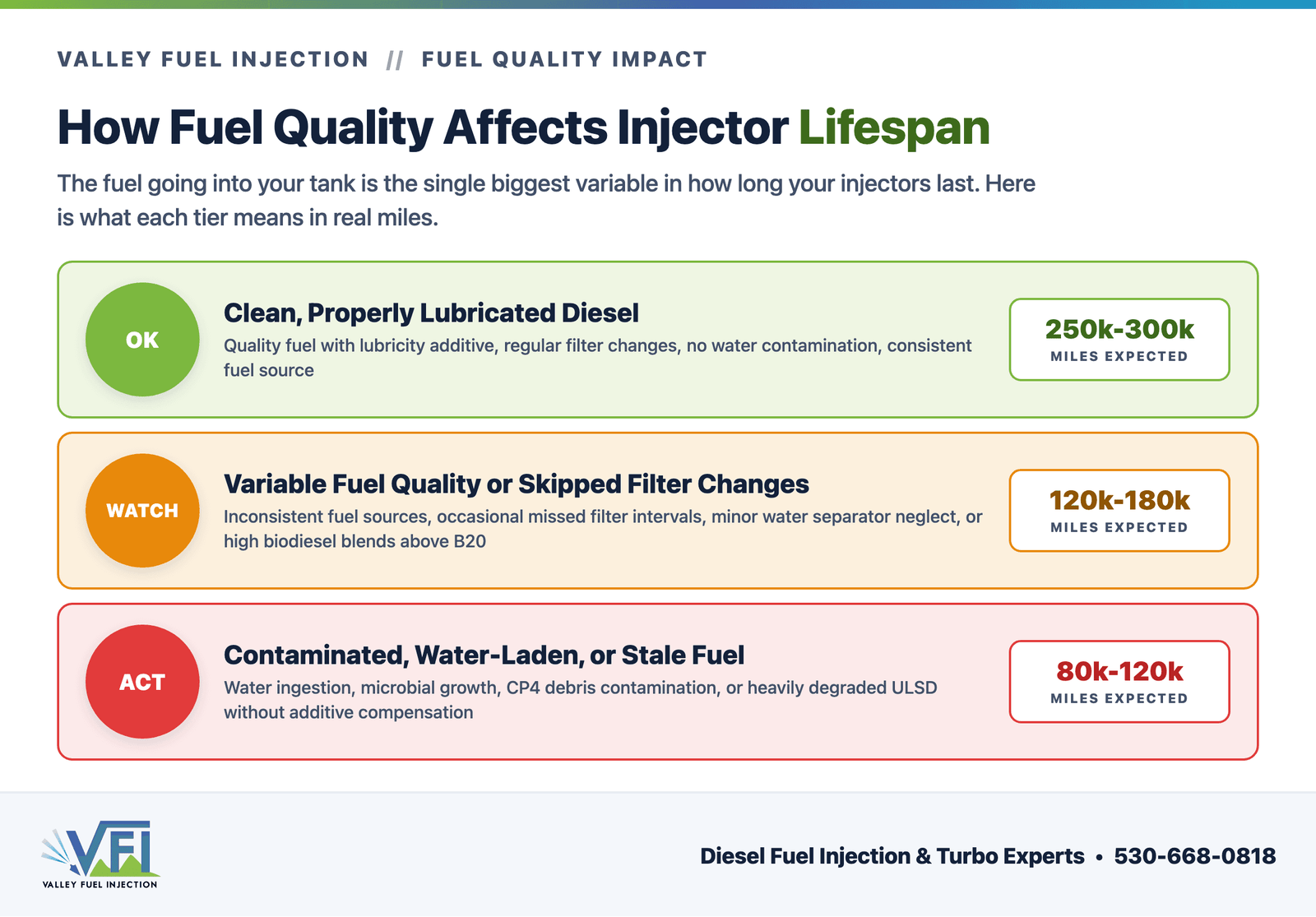
The practical impact on lifespan is significant. A truck running consistently clean, properly lubricated diesel with a quality fuel additive can reasonably expect 250,000–300,000 miles from its injectors. The same truck running fuel from questionable sources, skipping fuel filter changes, or pulling water-contaminated fuel from a compromised tank may see injector problems at 80,000–120,000 miles. That’s not an exaggeration, we see it regularly on the test bench.
Fuel filter change intervals matter more than most owners realize. The factory interval is a maximum under ideal conditions, not a target. In dusty agricultural environments, high-humidity coastal areas, or any situation where fuel source quality varies, cutting that interval in half is cheap insurance compared to the cost of injector replacement. For Kubota equipment specifically, see our guide on essential maintenance tips for diesel fuel injectors in Kubota equipment.
Does Driving Style and Load Affect How Fast Injectors Wear Out?
Yes, and the relationship is more direct than most people expect. Injectors on a truck that hauls heavy loads consistently wear faster than injectors on the same platform driven lightly, even with identical fuel and maintenance.
High-load operation means the injection system is commanded to deliver maximum fuel volume at maximum pressure for extended periods. Every injection event at full load stresses the injector solenoid, needle valve, and return circuit more than a light-throttle cruise. Multiply that across hundreds of thousands of injection events per hour of operation and the cumulative wear adds up.
Cold-start operation is another significant wear factor that doesn’t get enough attention. During cold starts, fuel viscosity is higher, rail pressure takes longer to stabilize, and the engine may fire multiple pilot injection events to smooth combustion. Injectors doing daily cold-start duty in cold climates accumulate wear faster than injectors on a truck that warms up quickly and runs at operating temperature for most of its miles.
Idling is counterintuitively hard on injectors in a different way. Extended idling at low rail pressure causes incomplete combustion and carbon buildup on injector tips. That carbon changes spray pattern over time and can eventually cause tip cracking on some platforms. Trucks that idle for hours daily (construction equipment, refrigerated transport) often show tip deposits on bench inspection well before they show internal wear.
The DPF regeneration cycle also stresses injectors on emissions-equipped engines. Post-injection events used to trigger regen introduce raw fuel into the cylinder late in the combustion cycle, which increases fuel dilution in the oil and puts injectors through additional actuation cycles. Our post on how DPF cycles affect diesel injectors covers this in more detail for fleet operators managing high-regen-cycle equipment.
What Maintenance Steps Extend Injector Life the Longest?
The maintenance steps that most reliably extend injector life are fuel filtration, fuel quality management, and catching upstream problems before they reach the injectors.
| Maintenance Action | Frequency | Why It Matters for Injectors |
|---|---|---|
| Fuel filter replacement | Every 15,000–20,000 miles (or per OEM, whichever is sooner) | Stops abrasive particles before they reach injector bores |
| Water separator drain | Monthly or when warning light triggers | Prevents hydraulic damage and corrosion from water ingestion |
| Fuel lubricity additive | Every fill-up or per product label | Compensates for ULSD lubricity loss, reduces needle valve wear |
| Oil changes (on HEUI platforms) | Strictly on schedule, no extensions | Degraded oil directly damages 6.0/7.3 Powerstroke HEUI injectors |
| Lift pump inspection | Annually or at any sign of low fuel pressure | A weak lift pump starves the high-pressure pump, accelerating wear throughout the system |
| Injector bench test at high mileage | 150,000–200,000 miles, or at first symptom | Identifies which injectors are failing before they cause cylinder damage or contaminate the fuel system |
One maintenance step that’s underused is proactive injector bench testing at high mileage. Most owners wait until they have a misfire code or a driveability complaint. By that point, the injector has often been delivering incorrect fuel quantities for tens of thousands of miles, stressing the engine and potentially damaging the catalytic system. A bench test at 150,000–200,000 miles gives you real data on where your injectors stand before a symptom forces the decision. The cost of a bench test is typically $65–$150 per injector at a specialty diesel shop, which is a small investment compared to a full replacement set.
If you’re in the Reno or Northern Nevada area and want to get your injectors evaluated before making a replacement decision, our Reno-area diesel fuel injection service page has information on what we cover for out-of-area customers, including mail-in injector testing.
Ready to schedule a diagnostic? Call us at 530-668-0818 or reach out online to discuss your situation with our team.
When Is Injector Wear Normal Wear-Out vs. Premature Failure From a Bigger Problem?
This is the most important question to answer before spending money on injectors, and it’s one that requires bench testing and system diagnosis to answer correctly.
Normal wear-out typically looks like this: gradual onset of symptoms after high mileage (150,000 miles or more), multiple injectors showing similar flow degradation, no history of fuel contamination events, and no fault codes pointing to upstream fuel system components. When we see this pattern on the bench, the injectors are the story. Replacement or remanufacturing solves the problem.
Premature failure from an upstream problem looks different. One or two injectors fail significantly younger than the others. The failed injector shows scoring or erosion inconsistent with normal wear. There’s a history of fuel contamination, water in the fuel, or recent pump work. Fault codes include fuel rail pressure faults, pump performance codes, or high return flow readings across multiple cylinders. In these cases, replacing only the injectors without addressing the root cause is a short-term fix at best.
The most common upstream causes of premature injector failure we see at our shop:
- Failing high-pressure fuel pump sending metal debris into the rail (CP4.2 is the most severe version of this)
- Degraded or wrong-spec fuel contaminating the system
- Lift pump failure causing cavitation in the high-pressure pump
- Compromised fuel tank with rust, algae, or water accumulation
- Cracked or leaking injector return lines allowing air ingestion
- Incorrect injector installation (missing seals, improper torque) damaging the injector seat
When we perform injector testing through our common rail system repair service, we’re not just testing the injector in isolation. We’re looking at the full picture: return flow data, spray pattern consistency, leak-down rate, and the condition of the injector body itself. That data tells us whether we’re looking at a component that wore out naturally or one that was killed by something else in the system.
Choosing between OEM and remanufactured injectors is also part of this conversation. If the root cause has been addressed and the system is clean, a quality remanufactured injector from a certified supplier performs as well as new at a meaningfully lower cost. Our post on OEM vs. remanufactured diesel injectors covers that decision in detail. The key word is “certified”, there’s a significant difference between a Bosch Exchange or Alliant Power reman unit and an offshore rebuild with no traceability.
A single common rail injector replacement typically runs $900–$1,800 installed at a California specialty shop, depending on platform and parts tier. A full set of six on a 6.7 Cummins typically runs $4,500–$7,500 installed. A full set of eight on an LB7 Duramax typically runs $6,000–$9,500 installed, reflecting the significant labor involved. An injector bench test to determine whether replacement is actually needed runs $65–$150 per injector, often the smartest first step before committing to a full set. Prices reflect typical California specialty-shop ranges as of 2026. Your actual quote depends on the condition of your specific components, parts availability, and current labor rates. Call VFI at 530-668-0818 for an accurate quote on your job.
For additional technical context on diesel fuel injection standards and injector performance specifications, Bosch Mobility’s diesel systems resource is an authoritative reference. The SAE International also publishes peer-reviewed research on diesel injection system wear and fuel quality effects that underpins much of what the industry understands about injector longevity. For California-specific fuel quality regulations that affect diesel injector life, the California Air Resources Board diesel fuel program sets the standards that govern what’s in the fuel at the pump.
Frequently Asked Questions About Diesel Injector Lifespan
How do I know if my diesel injectors are going bad before they fail completely?
The earliest signs are usually a rough idle, slight increase in fuel consumption, and harder cold starts. As degradation progresses you may notice white or black smoke at startup, a misfire under load, or a fuel smell from the exhaust. Fault codes related to injector balance rates or cylinder contribution are a later-stage indicator. Don’t wait for codes, if you’re past 150,000 miles and noticing any of these symptoms, a bench test is the right next step. Contact our team or consult a qualified diesel technician before assuming the worst.
Can I extend injector life by using fuel additives?
Yes, but with realistic expectations. A quality lubricity additive compensates for ULSD’s reduced lubricity and can meaningfully reduce wear on injector needle valves and pump internals over time. Detergent additives help prevent carbon deposit buildup on injector tips. What additives cannot do is reverse existing wear or compensate for contaminated fuel. They’re a maintenance tool, not a repair solution. Use them consistently from early in the engine’s life for the best effect.
Is it worth replacing all injectors at once, or just the ones that are failing?
On most platforms, replacing the full set makes more sense than replacing one or two. If one injector has worn to the point of causing symptoms at high mileage, the others are at similar wear levels and will follow on a short timeline. Paying labor twice to do the job in two stages costs more overall. The exception is a premature failure caused by a specific event, contamination, an installation error, or a localized fuel supply problem, where the other injectors may genuinely be fine. A bench test on the remaining injectors answers that question definitively.
Does towing or hauling heavy loads shorten injector life significantly?
It does accelerate wear compared to light-duty use, but the effect is manageable with proper maintenance. The bigger risk with heavy towing is that it also stresses the fuel system as a whole, lift pump, high-pressure pump, and rail pressure regulation. Keeping those components healthy protects the injectors. If you tow regularly, shortening your fuel filter interval and adding a quality lift pump upgrade (like an FASS or AirDog system) are two of the most effective steps you can take.
How much does it cost to have diesel injectors tested without committing to replacement?
A bench test at a specialty diesel shop typically runs $65–$150 per injector, which includes flow rate data, spray pattern evaluation, leak-down testing, and a clear pass/fail recommendation. For a set of six or eight injectors, that’s $400–$1,200 for complete information on the health of your fuel system before you commit to any repair. We offer this service here at Valley Fuel Injection and also accept mail-in injectors for testing from customers outside Northern California. Call us at 530-668-0818 to discuss your situation.
At Valley Fuel Injection, we’ve been testing and rebuilding diesel fuel injection systems since 1993. We’re a Bosch-certified shop with the equipment and experience to tell you exactly what’s going on with your injectors before you make any repair decision. Call us at 530-668-0818, schedule a diagnostic online, or visit us at 1243 E Beamer St, Suite C, Woodland, CA 95776. We also accept mail-in injectors and pumps for testing and remanufacturing from customers nationwide.