
Kubota Engine Identification: How to Find Your Model and Serial Number (and Why It Matters for Parts)
07/23/2026
Monster VP44 Pump Explained: Stages, Cost, Worth It?
07/25/2026
If your diesel engine runs rough when warm but starts and idles fine when cold, you’re dealing with a specific failure mode that most generic troubleshooting guides miss entirely. Cold-start roughness and warm-engine roughness point to completely different root causes, and chasing the wrong one wastes time and money. The most common culprits behind heat-related rough running are injector tip wear, injection pump internal leakage, return line restriction, and fuel pressure drop under thermal load. This guide walks through all six causes and how to diagnose each one correctly.
A diesel that runs fine cold but rough once it reaches operating temperature most often has a fuel delivery or injector problem. Heat exposes worn clearances, softened seals, and restricted fuel passages that cold viscosity temporarily masks. Hot-engine tests on the truck narrow it down, and a bench test confirms a pump or injector before you buy one.
Why Would a Diesel Run Fine When Cold but Rough Once It Reaches Operating Temperature?
Cold diesel fuel is thicker and more viscous, which temporarily compensates for worn injector nozzles, loose pump tolerances, and marginal fuel pressure, the same way a thicker oil masks worn engine bearings. Once the engine reaches operating temperature (typically 180–210°F coolant temp), fuel viscosity drops, system pressures change, and thermal expansion shifts component clearances. Any weakness in the fuel system that cold fuel was masking suddenly becomes a running problem.
There are also thermal expansion effects inside the injection pump itself. Worn pump components that hold acceptable delivery at cold startup begin leaking internally once the fuel is hot and thinner. The result: adequate fuel delivery when cold, insufficient or inconsistent delivery when hot. This is a classic sign of a pump that’s near the end of its service life but hasn’t failed completely yet.
Diesel fuel viscosity drops significantly as temperature rises. That viscosity difference is enough to mask injector nozzle wear, return line restrictions, and pump leakage that only become apparent at operating temperature.
Could a Failing Injector Cause Rough Running Only When the Engine Is Hot?
Yes, and this is one of the most commonly misdiagnosed scenarios in diesel repair. Injector tip wear, coking, and nozzle erosion all behave differently depending on fuel temperature and pressure. Here’s why heat makes it worse:
Nozzle tip coking: Carbon deposits build up on injector tips over time. A partially coked nozzle sprays in an irregular pattern, producing incomplete combustion, rough running, and sometimes visible black smoke under load.
Worn nozzle needle and seat: The needle-to-seat interface in a diesel injector is machined to extremely tight tolerances. As wear accumulates, the needle no longer seals cleanly at operating pressure. Cold fuel’s higher viscosity helps maintain a marginal seal; hot, thin fuel leaks past the worn seat, causing dribble injection and misfires on the affected cylinder(s).
Common rail injector internal leakage: Modern common rail injectors use a control valve and return circuit to manage injection timing and duration. When the control valve wears, hot fuel leaks back through the return circuit faster than it should, reducing effective injection pressure on that injector. The ECM may not flag a fault code until the leak rate exceeds a programmed threshold, meaning you can have a rough-running engine with no active codes.
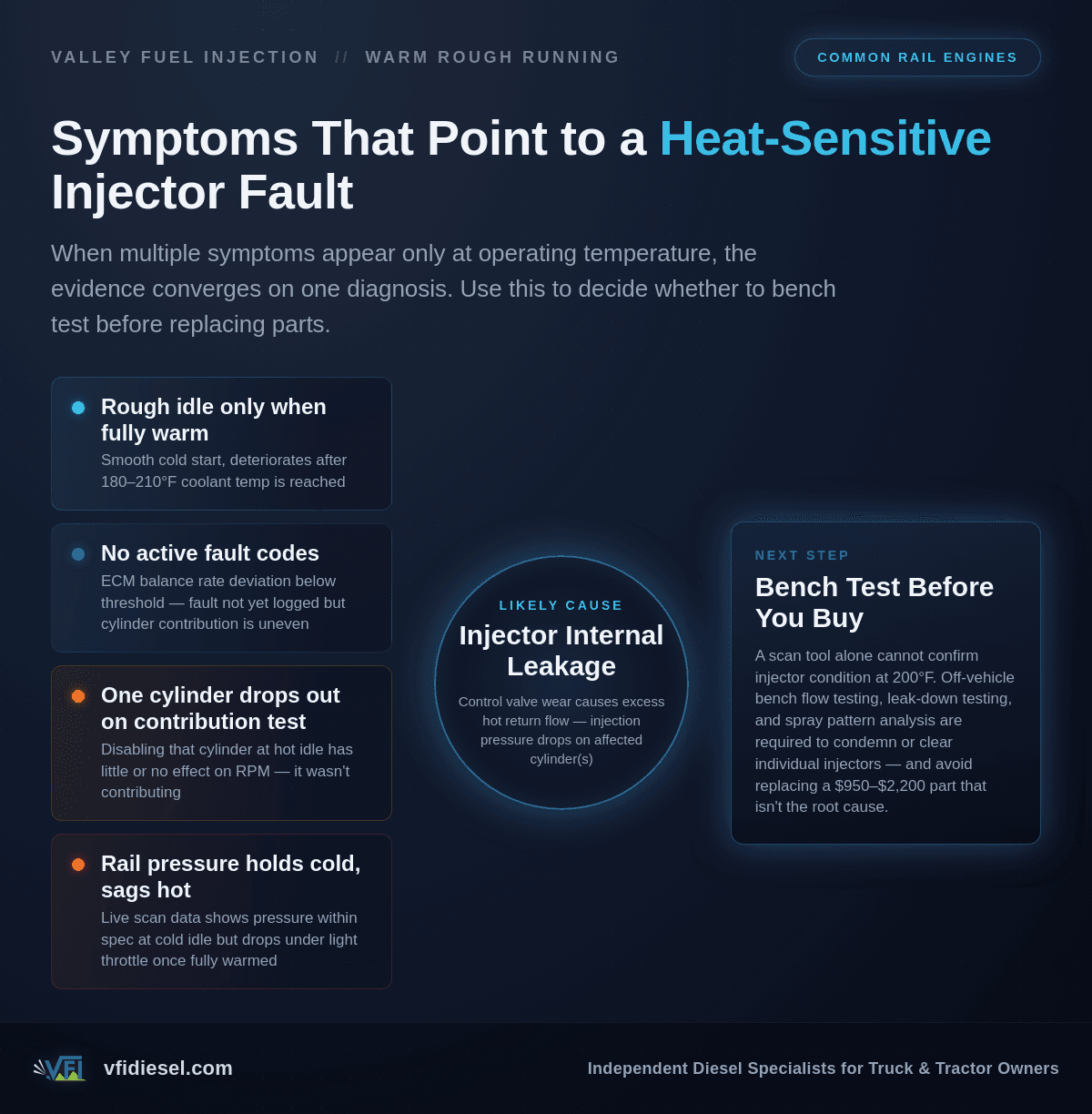
If you suspect injector issues, our Bosch diesel injector testing and repair service includes full bench flow testing, leak-down testing, and spray pattern analysis, the only reliable way to confirm injector condition.
On common rail engines, use a bidirectional scan tool to check injector balance rates (also called contribution values) at operating temperature, not just at idle. A cylinder that shows normal balance rates when cold but falls out of range when hot points to that cylinder: check its injector wiring and compression, and a bench test confirms the injector. This test takes about 20 minutes and can save you from replacing parts blindly.
How Does Injection Pump Wear Show Up Differently at Operating Temperature vs. Cold Start?
Injection pump wear is one of the most temperature-sensitive failure modes in diesel fuel systems, and it’s the reason a pump can pass a cold-start test but fail under real operating conditions. The physics are straightforward: hot fuel is thinner, so it leaks faster through worn internal clearances that cold fuel still seals.
Rotary pump wear (VP44, VE, Stanadyne): The distributor rotor and housing in a rotary pump are machined to extremely tight clearances. As these surfaces wear, internal bypass leakage increases. Cold, viscous fuel partially seals these worn clearances, the pump delivers adequate pressure. Hot fuel flows right through the worn gaps, and rail pressure or injection pressure drops below what the engine needs for clean combustion. The result is rough running, power loss, and sometimes a hard-restart condition after a hot soak.
VP44 pump specifically: The VP44 used on 1998.5–2002 5.9L Cummins engines is notorious for this exact failure pattern. The pump’s internal solenoid and rotor wear produces adequate cold-start performance but deteriorating hot performance. Many VP44 failures are first noticed as warm rough running or hesitation before the pump fails completely. If you’re seeing this on a 24-valve Cummins, read our related post on diesel engines that won’t stay running: VP44 failure often progresses from rough running to stalling.
CP3 and high-pressure common rail pumps: The CP3 pump used on Duramax and Cummins common rail engines is more durable, but worn CP3 pumps show a similar pattern: adequate cold-start rail pressure, marginal hot rail pressure. The ECM will typically log a low rail pressure fault code eventually, but early-stage wear may only show up as warm rough running without codes.
What Role Do Return Lines, Check Valves, and Fuel Pressure Play in Heat-Related Rough Running?
Fuel return line restriction is one of the most overlooked causes of warm rough running, and it’s entirely separate from the injection pump or injectors themselves. Here’s how it works: every diesel injection system has a return circuit that routes excess fuel back to the tank. This return fuel is hot, it’s been pressurized, circulated through the injection system, and released. If the return circuit is restricted, back-pressure builds in the system, affecting injection timing, spray quality, and in severe cases, causing injector damage.
Why it’s worse when hot: Return line restrictions that are marginal at cold startup become critical at operating temperature because hot fuel expands and the volume of return flow increases. A partially kinked return line, a collapsed rubber section, or a clogged check valve that passes adequate flow when cold may create enough back-pressure when hot to cause rough running, misfires, or even injector failure over time.
Common rail return circuit: On common rail systems, each injector has its own return port. A restriction anywhere in the return rail, including a stuck check valve, a pinched banjo fitting, or a corroded return line, can cause uneven back-pressure across injectors, making one or more cylinders run rich or with degraded spray quality. This shows up as rough running that’s worse at idle and under light load.
Lift pump pressure and heat: Low lift pump pressure is another heat-sensitive issue. Many lift pumps deliver marginal pressure even when new. As they wear, pressure drops further.
Cold fuel’s higher viscosity partially compensates; hot fuel at lower viscosity requires the lift pump to work harder to maintain adequate inlet pressure at the injection pump. A worn lift pump that holds adequate pressure cold may drop below the minimum threshold for proper VP44 or CP3 operation once the fuel is hot. Our detailed guide on diesel lift pumps covers this failure mode in depth.
Never ignore a return line restriction on a common rail system. Excess back-pressure in the injector return circuit can cause injector control valve damage and accelerate wear on the high-pressure pump. What starts as a rough-running complaint can turn into a full injector set replacement if the root cause isn’t addressed. On CP4-equipped engines (2011+ 6.7 Power Stroke, 2011–2016 LML Duramax), fuel system contamination from a failing pump can destroy the entire fuel system, a repair that typically runs $10,000–$18,000+.
How Do You Diagnose Warm-Engine Roughness Without Misreading Cold-Start Symptoms?
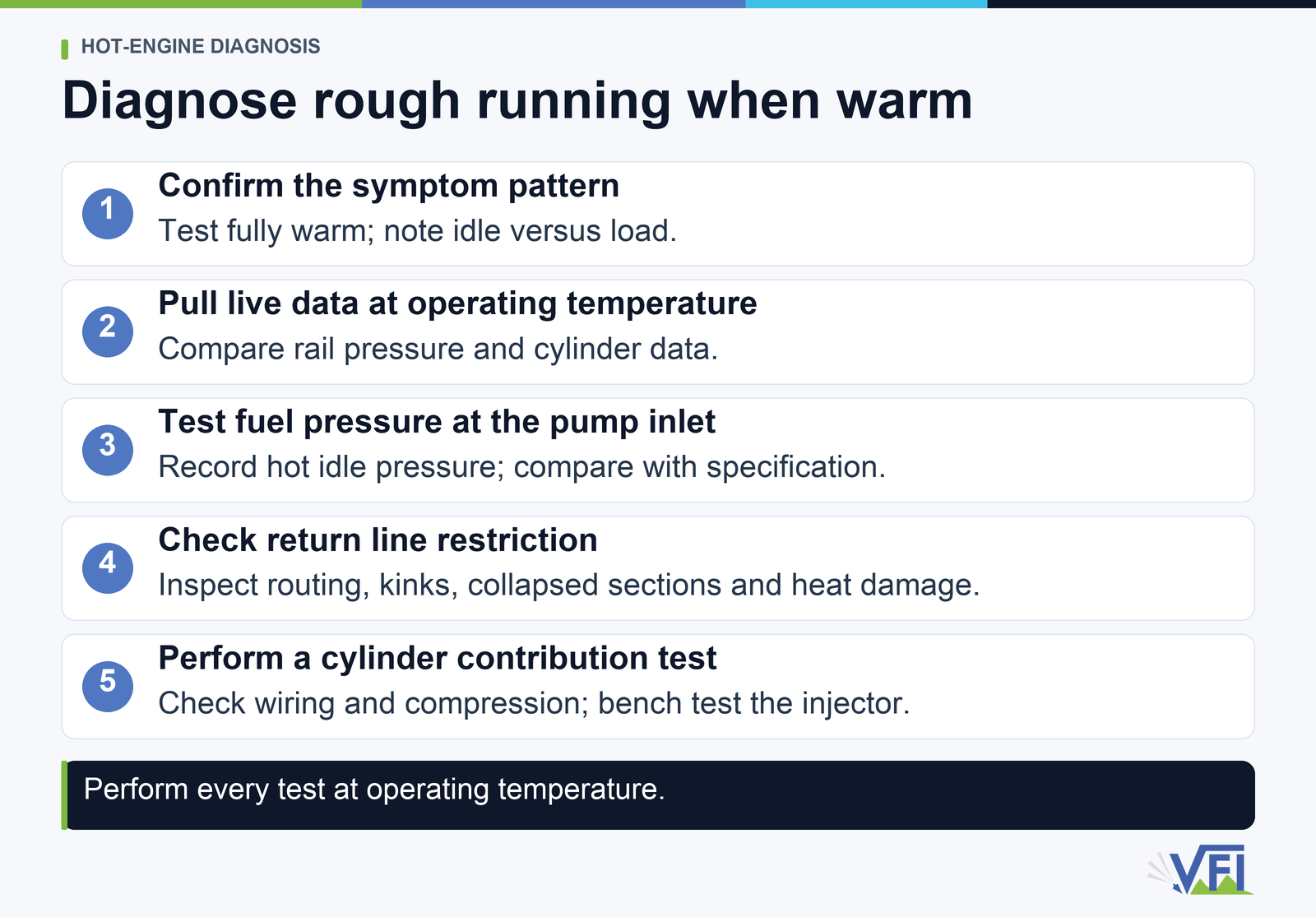
The key to accurate diagnosis is performing every test at operating temperature, not during warmup and not after a cold soak. This sounds obvious, but it’s where most DIY diagnostics go wrong. Here’s a structured approach:
Step 1: Confirm the symptom pattern. Drive the vehicle until fully warmed up (coolant temp stable at operating range, typically 180–210°F). Note exactly when roughness begins, at idle, under load, or both. A rough idle that smooths out under load points toward injectors or return circuit. Roughness that worsens under load points toward pump pressure or lift pump issues. Our post on diesel engines losing power in hot weather covers the load-related side of this diagnosis.
Step 2: Pull live data at operating temperature. Connect a quality bidirectional scan tool and monitor: rail pressure (common rail engines), injector balance rates or contribution values, fuel trim data, and any pending or stored fault codes. Compare readings at idle vs. light throttle vs. moderate load, all while fully warmed up. A rail pressure that drops below spec only at operating temperature is a clear pump or return circuit indicator.
Step 3: Fuel pressure test at the pump inlet (hot). Install a mechanical fuel pressure gauge at the injection pump inlet and record pressure at idle, at operating temperature. Compare to spec. For VP44 trucks, the 2002 Dodge service manual calls for at least 10 PSI lift pump pressure with the engine running (7 PSI minimum while cranking); anything below that under hot conditions points to a failing lift pump or a restricted supply line.
Step 4: Return line restriction test. With the engine at operating temperature, carefully check return line routing for kinks, collapsed sections, or heat damage. On common rail systems, a technician can perform a back-pressure test on the return circuit using a simple gauge adapter. Pressure above the maker’s limit for that system indicates restriction.
Step 5: Cylinder contribution test. On engines with the capability (most common rail applications via scan tool, and mechanical engines via manual cut-out), disable cylinders one at a time at idle and note which cylinder(s) have the least effect on idle quality. A cylinder that makes no difference when cut out is the one not contributing: check its injector wiring and compression, and a bench test confirms the injector.
If you’re doing a fuel pressure test on a VP44-equipped Cummins, do it twice, once cold and once after a full warm-up drive. A pump that shows 10 PSI inlet pressure cold but only 4 PSI hot is telling you the lift pump is failing under thermal load. Replacing the lift pump before the VP44 fails can save you $2,200–$4,500 in pump replacement costs. See our diesel fuel injection services for fuel system testing and repair.
When Does Warm Rough Running Require Professional Injection Testing vs. a DIY Fix?
Some warm rough running causes are genuinely DIY-accessible. Others require specialized equipment that simply isn’t available outside a certified injection shop. Knowing which is which saves you from either over-spending on professional service for a simple fix, or under-spending on a DIY attempt that misses the real problem.

At Valley Fuel Injection, our common rail service and Bosch injector testing capabilities include full hot-test bench simulation, we can replicate operating temperature conditions on the bench and measure exactly what your pump or injectors are delivering. This is the only way to confirm whether a component is within spec or needs rebuilding. Diesel truck owners throughout Sacramento and Reno bring us pumps and injectors for this exact reason, because a scan tool alone can’t tell you what’s happening inside a worn injector at 200°F.
Diagnostic scan + fuel system pressure test (hot): typically $185–$350
Injector bench flow test (per injector, off-vehicle): typically $55–$120 per injector; full 6-cylinder set all-in typically $600–$950
Lift pump replacement (installed): typically $550–$1,400 depending on application and parts tier
VP44 pump replacement (installed, CA specialty shop): typically $2,200–$4,500
Common rail injector replacement (single, light-duty pickup): typically $950–$2,200
Full injector set (6-cylinder common rail, installed): typically $4,500–$8,500
Prices reflect typical California specialty-shop ranges as of 2026. Your actual quote depends on the condition of your specific components, parts availability, and current labor rates. Call VFI at 530-668-0818 for an accurate quote on your job.
Summary: 6 Causes of Diesel Rough Running When Warm
- Injector tip coking or nozzle wear, spray pattern degrades at operating temperature when fuel viscosity drops
- Common rail injector internal leakage, control valve wear causes excess return flow and reduced injection pressure when hot
- Injection pump internal wear, worn rotor/housing clearances leak past at operating temperature; cold viscosity masks the problem
- Return line restriction or check valve failure, back-pressure in the return circuit disrupts injection timing and spray quality
- Lift pump pressure drop under thermal load, marginal lift pumps deliver adequate cold pressure but fall below spec when hot
- Fuel supply restriction, partially clogged filters, kinked supply lines, or a failing fuel pressure regulator that worsens under hot operating conditions
Don’t guess, a warm rough running complaint that goes undiagnosed can turn a $350 diagnostic into a $8,500 injector set replacement. Our team at Valley Fuel Injection has been diagnosing and repairing diesel fuel injection systems since 1993. We have the Bosch-certified bench testing equipment to tell you exactly what’s failing and what it will cost to fix it, before you commit to any parts.
Call us at 530-668-0818 or schedule a diagnostic. We’re located at 1243 E Beamer St, Suite C, Woodland, CA 95776, serving Northern California and Nevada. We also accept mail-in injectors and pumps for bench testing and rebuilding from customers nationwide. Visit our diesel fuel injection services page to learn more.
Frequently Asked Questions: Diesel Engine Runs Rough When Warm
Why does my diesel idle rough only after it warms up, with no fault codes?
This is a classic sign of a heat-sensitive fuel delivery issue, most commonly injector internal leakage, injection pump wear, or a return line restriction. Many of these faults don’t trigger fault codes until the deviation exceeds the ECM’s programmed threshold. A bidirectional scan tool monitoring live injector balance rates at operating temperature, combined with a fuel pressure test at the pump inlet, will usually narrow down the problem without relying on stored codes. Consult a qualified diesel technician for a proper hot-engine diagnostic.
Can a bad fuel filter cause a diesel to run rough only when warm?
It can. A partially clogged filter that passes enough fuel at idle can starve the pump once the engine is working, which is often when it is warm. Always replace the fuel filter as the first step in any warm rough running diagnosis, it’s the cheapest test you can do and eliminates a common variable.
How do I know if my VP44 pump is failing vs. my lift pump causing warm rough running?
Perform a fuel pressure test at the VP44 inlet at operating temperature. If inlet pressure is below 10 PSI when hot, the lift pump is the primary suspect. If inlet pressure is adequate but the engine still runs rough, the VP44 itself is likely worn internally. A failing lift pump is a much cheaper fix ($550–$1,400 installed) than a VP44 replacement ($2,200–$4,500 installed), so always confirm lift pump pressure before condemning the injection pump.
Can I drive my diesel if it only runs rough when warm?
Short-term, yes, but it’s not advisable to continue driving without diagnosis. Warm rough running that’s caused by injector leakage or return line restriction can accelerate injector and pump wear, potentially turning a manageable repair into a full fuel system replacement. If the roughness is accompanied by white or black smoke, power loss, or a hard-restart condition after a hot soak, treat it as urgent and have it inspected promptly.
Does warm rough running always mean I need new injectors?
Not necessarily. Injectors are one of six possible causes, and they’re not always the most likely one. A failing lift pump, restricted return line, or worn injection pump can all produce identical symptoms. Replacing injectors without confirming they’re actually at fault is an expensive mistake, a full set on a 6-cylinder common rail engine typically runs $4,500–$8,500 installed. Always perform a proper hot-engine diagnostic, including bench testing of removed injectors, before authorizing replacement.