

Monster VP44 Pump Explained: Stages, Cost, Worth It?
07/25/2026
6.0 Powerstroke Blue Spring Upgrade Explained
07/31/2026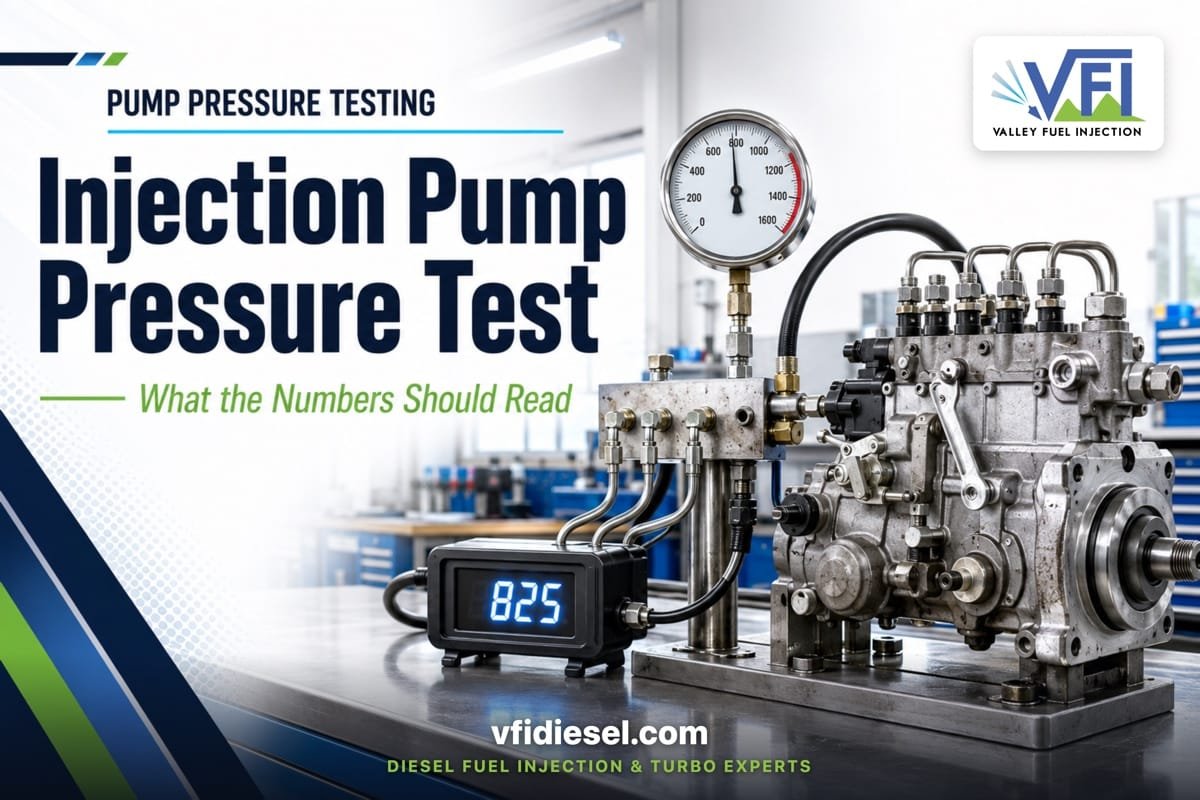
Diesel Injection Pump Pressure Test: What the Numbers Mean and When to Worry
A diesel injection pump pressure test is the single most reliable diagnostic tool for confirming whether your fuel system is delivering the volume and pressure your engine actually needs. Before you spend money on injectors, a pump rebuild, or a full fuel system overhaul, a proper pressure test tells you exactly where the problem lives. Whether you’re dealing with hard starts, black smoke, low power, or a rough idle, the numbers from a pressure test cut through the guesswork and point directly at the failed component.
Fuel delivery pressure is the foundation of diesel engine performance. A certified bench pressure test catches failing lift pumps, worn injection pumps, and restricted fuel lines before they cause catastrophic damage. Know your target numbers, test at the right points, and use the results to make smart repair decisions.
Why Is Fuel Delivery Pressure the Single Most Important Number in Your Diesel Fuel System?
Fuel delivery pressure determines whether your injection pump receives a consistent, adequate supply of fuel at the right pressure to do its job. Every other component downstream depends on it.
Think of it this way: your injection pump is a precision instrument built to tight tolerances. It assumes fuel is arriving at a specific pressure and volume. When supply pressure drops below spec, the pump has to work harder, cavitates internally, and begins to wear at an accelerated rate. On electronic systems like the VP44, low supply pressure is the leading cause of premature pump failure. On common rail systems, inadequate supply pressure starves the high-pressure pump and prevents the rail from reaching operating pressure, which triggers limp mode and fault codes before you even know there’s a fuel delivery problem.
High-pressure side readings matter just as much. A common rail system running a 6.7 Cummins or an LML Duramax operates at 23,000–29,000 PSI at the rail. If your CP3 or CP4 can’t hit those numbers under load, power drops, combustion quality suffers, and the ECM starts pulling timing to protect the engine. The pressure test is where all of this becomes measurable instead of theoretical.
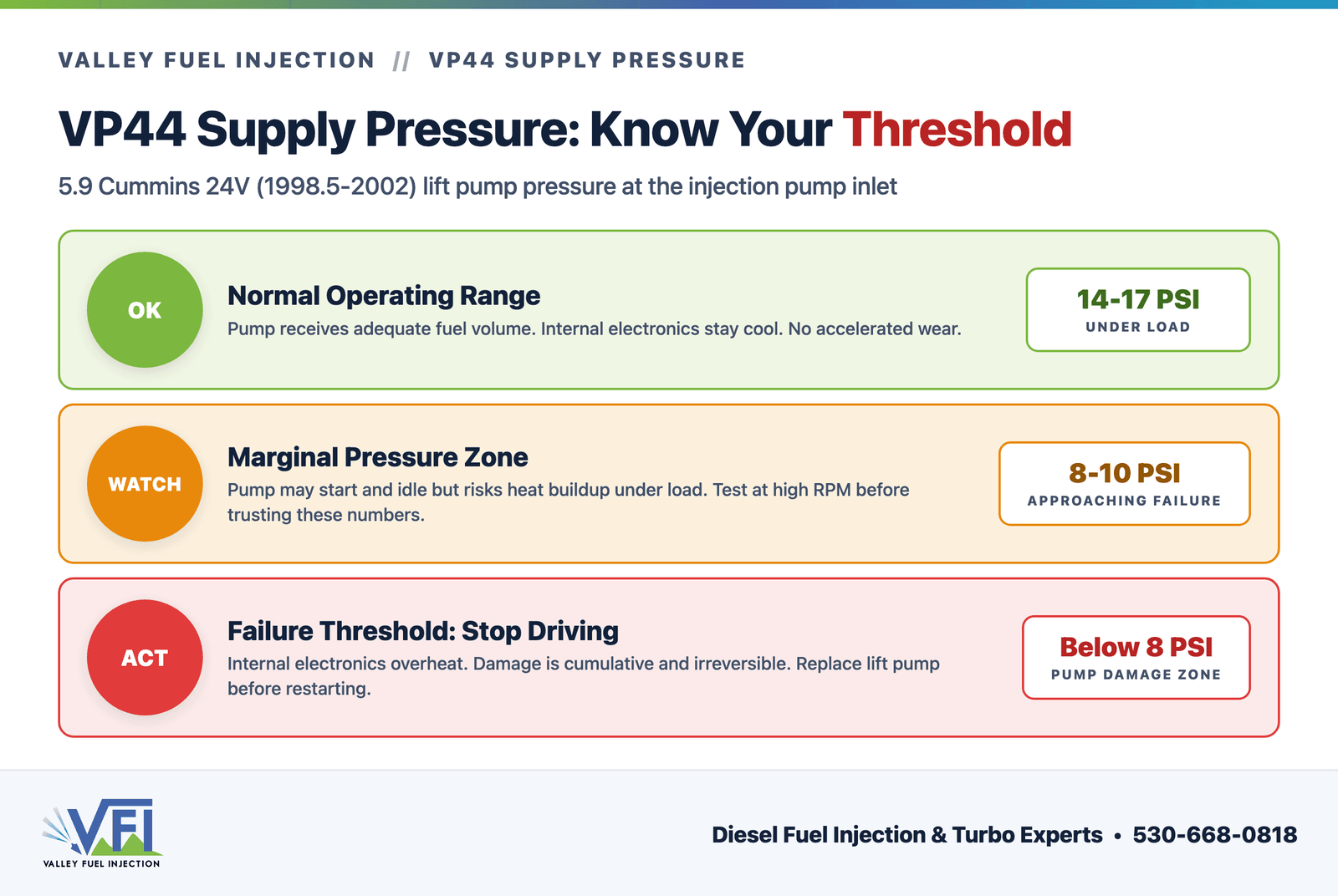
The VP44 injection pump used on 1998.5–2002 5.9 Cummins engines requires a minimum of 10 PSI supply pressure at idle and closer to 14–17 PSI under load. Anything below those numbers and the pump’s internal electronics begin to overheat, leading to failure that looks like an electrical problem but is actually a fuel delivery problem. See our post on diesel injection pump losing prime for related causes.
What Are Normal vs. Failure-Range Pressure Readings for Common Rail, VP44, and Rotary Pump Systems?
Normal pressure ranges vary significantly by system type, so testing without knowing your target numbers is meaningless. Here are the benchmarks we use at our Bosch-certified shop.
Supply (Lift Pump) Pressure: All Systems
| System | Minimum Supply Pressure | Target Range | Failure Threshold |
|---|---|---|---|
| VP44 (5.9 24V Cummins) | 10 PSI idle | 14–17 PSI under load | Below 8 PSI |
| CP3 (5.9/6.7 Cummins, Duramax) | 7–10 PSI idle | 10–16 PSI under load | Below 6 PSI |
| 7.3 Powerstroke (HEUI) | 45–65 PSI idle | 65–80 PSI under load | Below 40 PSI |
| Bosch VE / Rotary (mechanical) | 3–5 PSI idle | 5–10 PSI | Below 2 PSI |
| P7100 Inline (12V Cummins) | 5–7 PSI idle | 8–14 PSI under load | Below 4 PSI |
High-Pressure Rail Pressure: Common Rail Systems
| Engine | Idle Rail Pressure | WOT Rail Pressure | Concern Threshold |
|---|---|---|---|
| 6.7 Cummins (ISB) | ~5,000 PSI | 23,000–26,000 PSI | Below 20,000 PSI at WOT |
| LML Duramax (CP4) | ~4,500 PSI | 26,000–29,000 PSI | Below 23,000 PSI at WOT |
| LB7–LMM Duramax (CP3) | ~3,600 PSI | 23,000–26,000 PSI | Below 20,000 PSI at WOT |
| 6.7 Powerstroke | ~4,000 PSI | 23,000–26,000 PSI | Below 20,000 PSI at WOT |
Rail pressure values are read via OBD-II scan tool or dedicated diesel diagnostic software. Supply pressure is measured with a mechanical or digital fuel pressure gauge at the inlet fitting of the injection pump.
How Do You Properly Test Fuel Delivery Pressure: Tools, Procedures, and Test Points?
A proper diesel injection pump pressure test requires the right tools, the right test points, and a clear understanding of what you’re measuring at each stage.
Tools You Need
- Mechanical fuel pressure gauge (0–100 PSI range for supply testing)
- Diesel-rated fuel line adapters and fittings for your specific platform
- OBD-II scan tool with live data capability for common rail rail pressure (a basic code reader won’t cut it)
- Dedicated diesel diagnostic software (Cummins INSITE, Tech Authority, or equivalent) for professional-level testing
- Flow meter (optional but valuable for volume testing, not just pressure)
Pressure alone doesn’t tell the whole story. A lift pump can show acceptable pressure at idle but completely collapse under load. Always test at idle AND under a load condition (high RPM or during a snap throttle test) to catch pumps that are marginal rather than fully failed. A pump that passes at idle but drops 40% under load is still a failing pump.
Where to Test
For supply pressure, tap in at the inlet fitting on the injection pump itself, not at the fuel filter housing. Testing at the filter housing tells you what the lift pump produces. Testing at the pump inlet tells you what actually arrives after accounting for filter restriction and line losses. Both numbers matter, and a big gap between them points to a clogged filter or a collapsing supply line.
For common rail systems, rail pressure is read electronically through the rail pressure sensor. You should never physically tap into a high-pressure common rail line without the proper equipment and training. The pressures involved (up to 29,000 PSI) are lethal. This is one of the primary reasons professional bench testing at a certified facility matters.
The Bench Test Standard
When a pump comes off the engine and goes onto a Bosch-certified test stand, we can evaluate it under controlled, repeatable conditions that an in-vehicle test simply cannot replicate. A bench test measures delivery volume at multiple RPM points, checks internal bypass pressure, verifies governor response, and confirms calibration against factory specifications. This is the diagnostic standard we hold ourselves to at our Bosch injection pump testing and repair facility. A bench test typically runs $150–$350 depending on pump type and the depth of calibration data required.
For common rail systems, bench testing of individual injectors (pop testing) runs $50–$100 per injector and confirms spray pattern, opening pressure, and return flow. These numbers, combined with rail pressure data from the scan tool, give a complete picture of system health. Learn more about our full common rail system repair services.
What Does Low Fuel Pressure Tell You About Your Lift Pump, Injection Pump, or Fuel Lines?
Low fuel pressure at the injection pump inlet is one of the most actionable findings in diesel diagnostics because it narrows the problem to a short list of components.
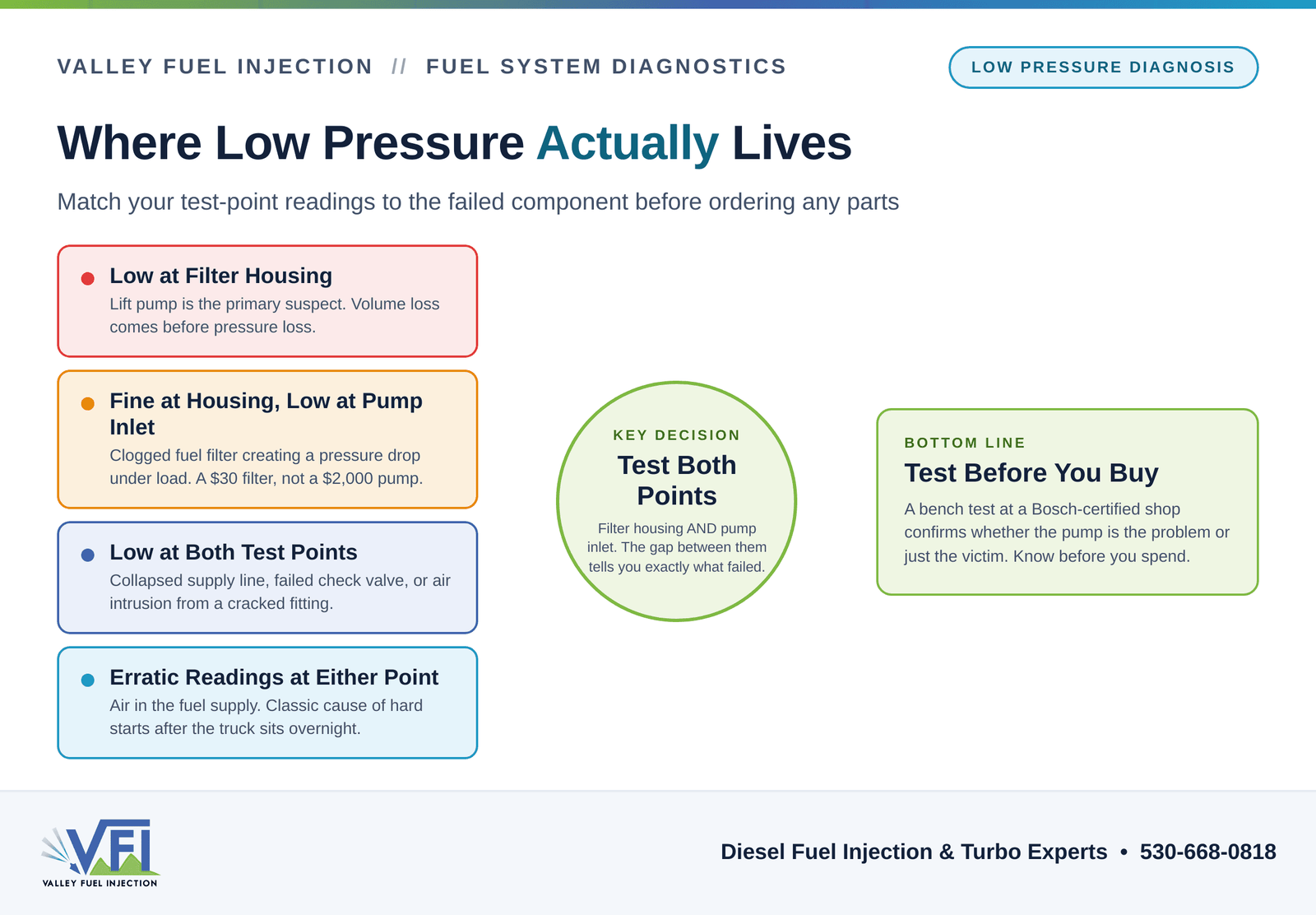
If pressure is low at the filter housing, the lift pump is the primary suspect. A worn or failing lift pump loses volume before it loses pressure, which is why flow testing is more revealing than a static pressure check. On VP44 platforms, a weak lift pump is so reliably the cause of pump failure that we treat lift pump replacement as a mandatory co-repair any time a VP44 is rebuilt. Installing a new VP44 on a weak lift pump is a warranty-voiding mistake we see regularly. Expect to spend $350–$650 installed for a quality lift pump replacement on these platforms.
If pressure at the filter housing is fine but drops significantly at the pump inlet, look at the fuel filter itself. A partially clogged filter creates a pressure differential that starves the pump under load. On many trucks, the filter is changed too infrequently, and the first symptom is low-power complaints under towing conditions. The fix is a $30 filter, not a $2,000 pump.
If both test points show low pressure, consider a collapsed or kinked supply line, a failing check valve in the lift pump, or air intrusion from a cracked fitting or a weeping injector return line. Air in the fuel supply causes erratic pressure readings and is a classic cause of hard starting after the truck sits overnight.
Our post on diesel injection pump losing prime covers air intrusion causes in detail.
On 1998.5–2002 5.9 Cummins trucks with VP44 pumps, running the engine with supply pressure below 10 PSI for even short periods causes heat buildup inside the pump’s electronic module. This damage is cumulative and irreversible. By the time the pump throws a code or fails to start, the internal electronics are already destroyed. Don’t wait for a hard failure to test your lift pump pressure.
Can High Fuel Pressure Cause Damage, and What Systems Are Most at Risk?
Yes, high fuel pressure causes real damage, and the systems most at risk are the ones where pressure regulation is handled by sensitive electronic components rather than simple mechanical relief valves.
On common rail systems, the fuel pressure regulator (on the high-pressure pump) and the pressure relief valve (on the rail) work together to cap rail pressure within safe limits. When either component fails in the open direction, rail pressure drops. But when a pressure control valve sticks closed or a regulator fails to bleed off excess pressure, rail pressure climbs above spec. At extreme rail pressures, injector tips can be damaged, return flow volumes increase dramatically, and the rail itself can develop cracks at fittings. A rail pressure sensor reading consistently above the commanded target is a red flag that demands immediate attention.
On mechanical rotary and inline pump systems, the internal transfer pump generates supply pressure inside the pump housing. If the pressure regulating valve inside the pump wears or sticks, internal housing pressure climbs. This accelerates seal wear, causes fuel leakage past the drive shaft seal, and can distort the distributor rotor in VE-style pumps. The symptom is usually a fuel-wet pump exterior combined with erratic delivery.
High supply pressure from an oversized aftermarket lift pump is a less common but real concern on VP44 systems. Some high-output lift pumps push 20+ PSI, which exceeds the inlet design pressure of the VP44. The fix is a pressure regulator inline on the supply side, not a different pump. This is worth knowing if you’re upgrading to a FASS or AirDog system on a 24V Cummins.
For more on how timing interacts with pressure symptoms, see our post on diesel injection pump timing symptoms.
When Do Pressure Test Results Mean Rebuild, and When Do They Mean Replace?
This is where pressure test data translates directly into repair decisions, and it’s where the difference between a certified bench test and a quick in-vehicle check really matters.
A pump that fails supply pressure testing but passes bench testing tells you the problem is upstream, lift pump, filter, or lines. The injection pump itself is fine, and you’ve just saved yourself a major unnecessary repair.
A pump that fails bench testing but shows consistent, predictable wear patterns (low delivery volume across all cylinders, gradual pressure drop, no contamination) is typically a rebuild candidate. This is especially true for mechanical pumps like the P7100, Bosch VE, Stanadyne DB4, and similar units where worn plungers, delivery valves, or governor springs are serviceable components. A P7100 rebuild at a certified shop typically runs $1,500–$3,500 depending on core condition and which hard parts need replacement. A Bosch VE rebuild runs $900–$1,500.
A pump that shows contamination damage, water intrusion, metal particles, diesel bug, or abrasive wear from bad fuel, is a different story. Contamination damage is rarely limited to one component. When we see contaminated fuel on a common rail system, we’re looking at a full fuel system inspection because the particles that damaged the pump have already passed through every injector in the system.
This is the scenario where replacement of multiple components (or a full system flush) is the only responsible recommendation.
Bench pressure test / diagnostic (pump-off): typically $150–$350. VP44 certified rebuild or reman exchange: typically $1,800–$2,800 installed. Bosch P7100 rebuild/recalibrate: typically $1,500–$3,500. 6.7 Cummins common rail injector set of 6, parts and labor: typically $3,200–$5,500. Prices reflect California specialty-shop rates and vary by core condition, parts choice (OEM vs. reman), and current labor rates. Call VFI at 530-668-0818 for an accurate quote on your specific job.
For VP44 systems, the rebuild-vs.-replace decision also involves the exchange program option. A remanufactured exchange unit from a certified source like Alliant Power costs less than a full custom rebuild and comes with a warranty. If your core is contaminated or the electronic module is damaged, an exchange unit is almost always the better path. We cover this in detail in our post on the diesel injection pump exchange program.
For a deeper look at the cost side of this decision across all pump types, see our diesel injection pump rebuild cost vs. replace guide.
Diesel owners throughout the Sacramento region, including those searching for service in Sacramento and Woodland, bring pumps to us specifically because we have the certified test equipment to give them a real answer before committing to a repair. That’s the value of a proper bench test: it converts a symptom into a confirmed diagnosis.
Before authorizing any injection pump rebuild or replacement, ask your shop to show you the bench test data. A legitimate Bosch-certified shop can print a calibration report showing delivery volumes at multiple test points compared to factory spec. If a shop can’t produce that data, they’re not bench testing the pump, they’re guessing. Our team at Valley Fuel Injection has been doing this work since 1993, and every rebuild decision we make is backed by documented test data.
We also accept mail-in pumps and injectors for bench testing and rebuilding from customers across the country. If you’re not in Northern California, ship your pump to us and we’ll test it, document the findings, and give you a repair recommendation before any work begins. Contact us through our diesel fuel injection services page for mail-in details.
Bosch’s own technical documentation on injection system tolerances and test procedures is an authoritative reference for understanding why these pressure specifications matter at the engineering level. You can find technical resources at Bosch Mobility. For emissions-related fuel system regulations affecting California diesel owners, the California Air Resources Board (CARB) publishes current compliance requirements. SAE International also maintains peer-reviewed research on diesel fuel system diagnostics at sae.org for those who want to go deeper on the engineering side. The EPA’s diesel engine emissions standards, which directly shape injection system design pressures, are available at epa.gov/diesel-fuel-standards.
Valley Fuel Injection is a Bosch-certified diesel fuel injection testing and repair center with over 30 years of hands-on experience. We have the test equipment, the training, and the data to tell you exactly what’s wrong before you spend a dollar on parts. Call us at 530-668-0818 or schedule a diagnostic. Walk-ins welcome at 1243 E Beamer St, Suite C, Woodland, CA 95776. We also ship remanufactured pumps and accept mail-in units nationwide.
Prices reflect typical California specialty-shop ranges as of 2026. Your actual quote depends on the condition of your specific components, parts availability, and current labor rates. Call VFI at 530-668-0818 for an accurate quote on your job.
Frequently Asked Questions About Diesel Injection Pump Pressure Testing
How do I know if my diesel injection pump pressure test results are accurate?
Accuracy depends on where you test, what tools you use, and whether you test under load conditions. Testing only at idle with a cheap gauge at the filter housing gives you incomplete data. A certified bench test on a calibrated Bosch test stand, with the pump removed from the vehicle, is the most accurate method because it removes all variables related to lift pump condition, line restriction, and engine load. If you’re testing in-vehicle, always test at both the filter housing and the pump inlet, and always repeat the test at a loaded RPM, not just at idle.
Can a diesel injection pump fail a pressure test but still run the engine?
Yes, and this is one of the most dangerous scenarios in diesel diagnostics. A pump that is marginally below spec may still start and idle the engine, but it will fail under load, during towing, acceleration, or high-RPM operation. The engine may run fine around town and then go into limp mode or lose power on the highway. This is why load-testing is essential. A pump that passes at idle but drops significantly under load is a failing pump, and continuing to run it risks damaging downstream components including injectors and the high-pressure pump on common rail systems.
What is the difference between supply pressure testing and rail pressure testing on a common rail diesel?
Supply pressure testing measures the low-pressure side of the system: the fuel delivered by the lift pump to the inlet of the high-pressure pump. This is measured in PSI (typically 7–17 PSI depending on platform) with a mechanical gauge. Rail pressure testing measures the high-pressure side: the fuel pressure inside the common rail itself, which ranges from roughly 3,600 PSI at idle to 29,000 PSI at wide-open throttle. Rail pressure is read electronically through the rail pressure sensor via a scan tool. Both tests are necessary for a complete diagnosis. Low supply pressure causes the high-pressure pump to cavitate. Low rail pressure with adequate supply pressure points to a worn high-pressure pump or leaking injectors.
How much does a diesel injection pump pressure test cost?
An in-vehicle supply pressure test using a gauge is a relatively quick procedure and is often included in a broader diagnostic visit, which typically runs $150–$300 for a scan and basic fuel system check. A full bench test with the pump removed from the vehicle, tested on a certified Bosch test stand with calibration data, typically runs $150–$350 depending on pump type and the level of reporting required. This cost is almost always worth it because it either confirms the pump needs service or rules it out entirely, saving you from misdiagnosed repairs.
Does a VP44 pressure test require special equipment?
For the supply side, a standard fuel pressure gauge with the correct adapter fitting for the VP44 inlet is sufficient. For evaluating the pump’s internal performance and electronic module function, a Bosch-certified test stand is required. The VP44 is an electronically controlled rotary pump with an integrated ECU, and its performance can only be fully evaluated under controlled bench conditions that replicate engine operating parameters. Shops without a certified test stand cannot properly diagnose a VP44 beyond confirming whether supply pressure is adequate. If your shop can’t bench test a VP44, find one that can before authorizing a rebuild or replacement.