New Stanadyne DB2, DB4 & DE Injection Pumps: John Deere, CAT & Perkins Applications
07/22/2026
Diesel Engine Runs Rough When Warm: 6 Causes
07/25/2026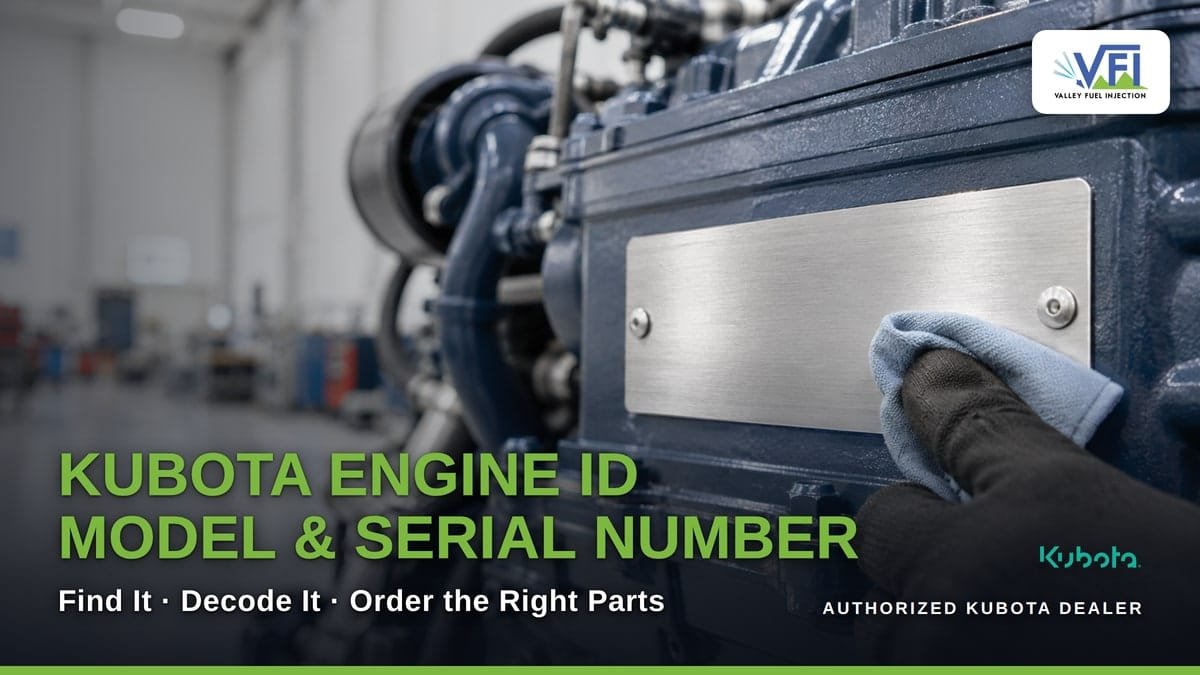
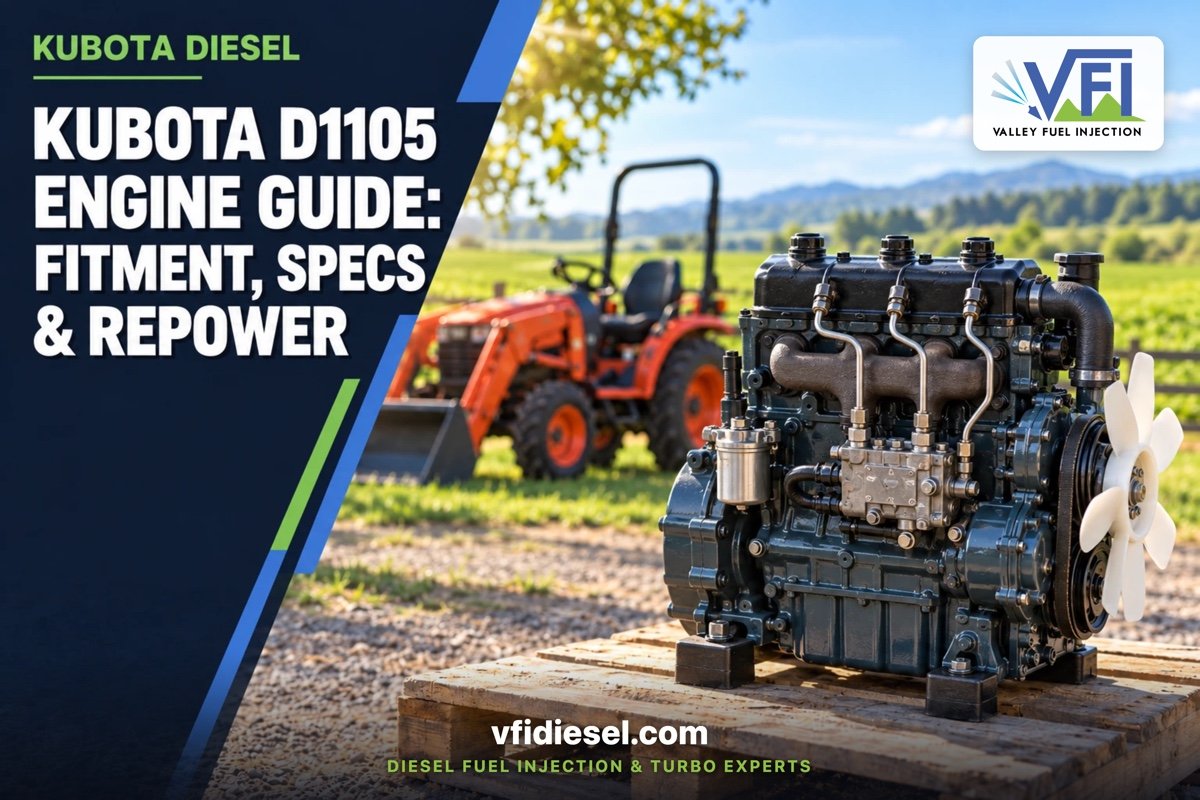
Kubota engine identification looks easy until the moment you actually need it. The valve cover sticker is sun-baked into a white smear, the parts counter is asking for a spec number you have never heard of, and the only markings you can find are a casting that reads 675CC and a serial number that tells you nothing by itself.
Kubota diesels also power far more than orange tractors: they sit inside Bobcat skid steers built before about 2015, ONAN-badged generator sets, RTVs, compact track loaders, and thousands of gensets and OEM machines that never say Kubota anywhere on the sheet metal. Order injectors, an injection pump, or a cylinder head with only a guess at the model, and there is a real chance the parts will not fit.
This guide covers the whole identification chain: where the serial number is stamped on every major engine series, how to decode the model designation (including the CR, DI, T, TI, and E4B suffixes almost nobody explains), how to read the build year out of a post-2012 serial number, and why the spec number (the KEA code) is the piece that actually guarantees parts fitment.
Where Is the Serial Number on a Kubota Engine?
Start with the easy spot. Most Kubota engines carry a printed label, usually on the valve cover, that lists the engine model and serial number. If that label is intact, you are done in thirty seconds. Photograph it now, before another season of sun and degreaser finishes it off.
The permanent record is the stamp. Kubota stamps the model and serial number directly into a machined boss on the crankcase, and the location of that boss depends on the engine series:
The stamp usually pairs the model with the serial, for example D650-925522: model first, then the serial. Engines built before 1997 carry a plain sequential serial; later engines use an alphanumeric code that encodes the build date (decoded below).
Kubota also stamps the number over the cylinder head on many engines. The emissions label is not a reliable identifier for parts purposes; Kubota’s own guidance points you to the stamped boss. Gasoline and dual-fuel WG engines follow their diesel donors: a WG752 is stamped like a Super Mini, a WG1605 like an 05 series.
How Does Kubota Engine Identification Work When the Sticker Is Worn Off?
This is the number one complaint in owner forums: the label is gone, the machine badge says ONAN or Bobcat instead of Kubota, and nobody ever told you the stamped location varies by series. Work through it in this order:
- Clean the boss locations for your suspected series. Degrease and wire-brush the spots in the table above. The stamps are shallow, so rake a flashlight across the surface at a low angle.
- Do not trust casting numbers. One genset owner assumed his engine was a “675CC” model because that is what the block casting said; the actual stamp on the flat beside the injection pump read D650-925522. Cast CC figures are approximate casting marks, not model numbers.
- Pull the parts catalog for the machine. On some older engines the model name appears only in the illustrated parts list for the equipment, not anywhere on the engine itself.
- Use the machine to narrow the family. OEM applications are well documented. A Bobcat 743 left the factory with a Kubota V1702, no matter whose name is on the valve cover paint.
- Do not identify by tape measure. External dimensions will fool you: the D1403 and D1703 share identical external dimensions with different displacement and power. When two candidates remain, only the stamped serial plus a dealer lookup settles it.
One more trap: the serial plate on the tractor or loader frame is not the engine serial. Frame serials contain no date information, and Kubota does not build year-model machines, only series.
What Do Kubota Engine Model Numbers Mean?
Most Kubota designations are assembled from the same blocks: a cylinder-count letter, displacement digits, a series code, then suffixes for injection type, aspiration, and emission generation.
Worked example, the V3800-CR-TIE4B used in larger Kubota and OEM machines: V means four cylinders, 38 means 3.8 liters, the V3 series block, CR means Denso common rail injection, TI means turbocharged and intercooled, and E4B is the Tier 4 Final certification generation. Now compare D902-E4B: D means three cylinders, 90 means roughly 900 cc, the trailing 2 marks the Super Mini series, no injection suffix means indirect injection with a mechanical mini pump, and E4B is again the current emission generation.
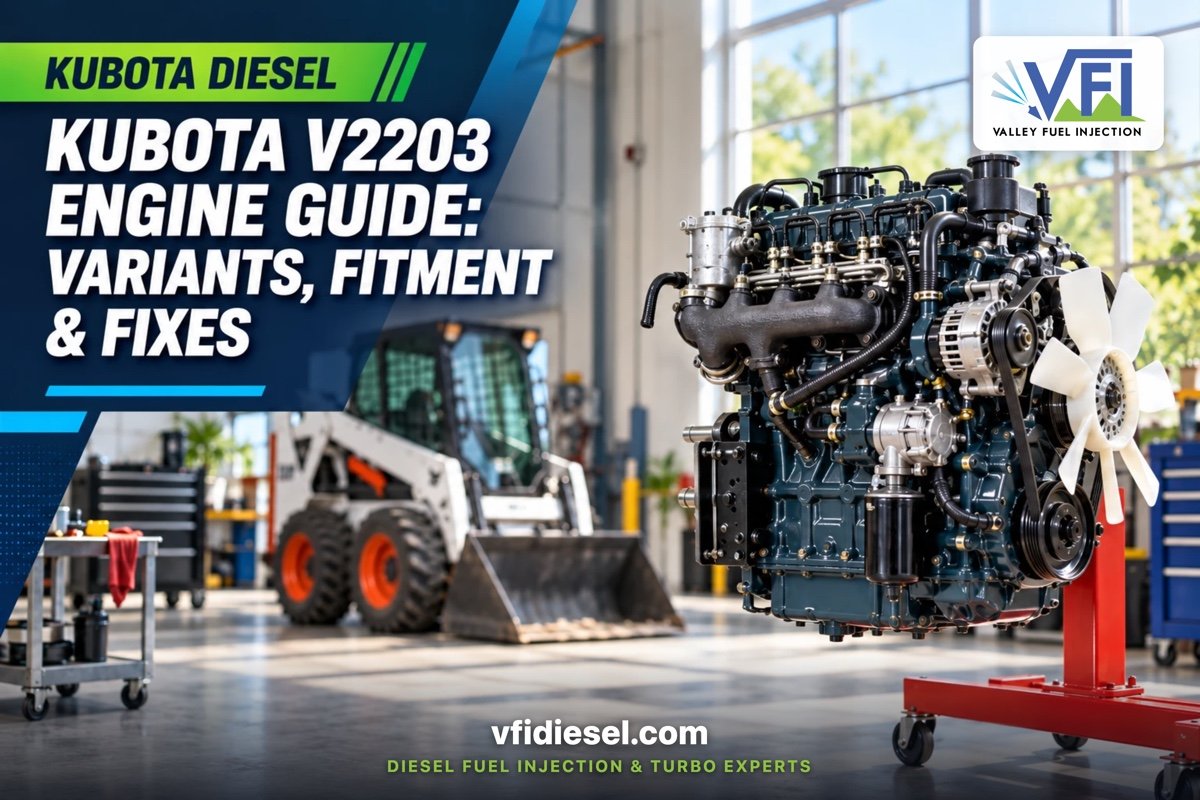
A caution on lookalikes: the V2203 and V2403 are both 03-series four-cylinders and are nearly identical externally, since the V2403 is in essence a longer-stroke development of the V2203. Verify by the stamp on the injection pump mounting surface, never by eye.
What Does E4B, E3B, or E2 Mean on a Kubota Engine Model?
The E-suffix is the emission certification generation. Kubota re-engineered each family as EPA and EU rules tightened, and the suffix tells you which certification package your engine was built to:
Two caveats. First, EPA tiers phased in by power band, so the same suffix generation can carry a slightly different certified tier depending on the engine’s kW rating; the emission label on your engine states the exact certification.
Second, and this is the part that costs people money: do not assume parts interchange across emission generations. A D1005-E2 and a D1005-E4B share a name, not an injection system. Pumps, nozzles, and timing specifications changed with each generation. On the common rail Tier 4 models (V3307-CR-T, V3800-CR-TIE4B), the injection system has its own failure patterns: see our Kubota injector maintenance tips for how to prevent them.
How Do I Tell What Year My Kubota Engine Is From the Serial Number?
It depends which serial format you have, and this is where most online guides mislead people, because they explain only one of the two.
Engines built before 1997 carry a plain sequential serial, such as the 925522 in D650-925522. There is no date encoded in it at all. The only way to date one of these engines is a Kubota dealer lookup against the serial number.
From 1997 through May 2012, Kubota used alphanumeric serials with year and month codes. In this format the first character is the year and the second the month. Kubota’s own example, XJ5050, is 1999 (X), May (J), sequence 5050.
Engines built from June 1, 2012 onward use a seven-character alphanumeric serial that is unique across all Kubota production plants: the first character identifies the engine series, the second the year, the third the month, and the final four the sequence.
The third character gives the month, with two codes assigned to each:
Example: Kubota’s own sample serial, V3307 8CMA001, decodes as series 8, year C (2012), month M (June) and sequence A001. If your serial is a plain string of digits, do not try to read a date out of it; it is sequential, and the dealer lookup is the answer.
What Is a KEA Spec Number and Why Do Parts Suppliers Ask for It?
Here is the layer most identification guides skip entirely, and it is the one that decides whether your parts fit. Kubota builds each base model in many configurations for different OEM applications. The same base engine can leave the factory with different cylinder heads, different fuel injection pumps, and different cooling system setups. The base model narrows you to a family; the spec number pins down the exact build.
You will see it written like D1005-E4B-KEA-1, often alongside a Kubota code such as 1J998. KEA marks a Kubota Engine America specification, the trailing digit is the variant, and the code prefix keys the entire parts breakdown for that build. When a parts site or a dealer asks for your spec number, this is what they are protecting you from: two D1005-E4B engines that look identical on paper but take different pumps or head hardware.
Serial number breaks matter for the same reason. Kubota parts catalogs frequently change a part number mid-production, listed as applying from a given engine serial onward. So even within one model and spec, the serial decides which injector, gasket, or pump variant is correct.
The OEM-branding angle has a cost dimension too. Owners of ONAN-badged gensets routinely find the OEM-boxed parts painfully expensive and cross-reference to Kubota part numbers instead, which works well for wear items. But never assume major components such as heads, blocks and pistons cross between models; check the part number for each build.
The practical routine: photograph the label, the crankcase stamp, and the head stamp, and record model, serial, and spec together. With those three numbers, an authorized dealer can pull the exact parts fiche for your build. That is precisely what we do through our Kubota engine sales, parts, and service program, and if the injection pump itself is what you are chasing, a rebuild matched to your spec is often the cleaner path: see our tractor injection pump rebuild guide.
What About Kubota Engine Identification in Bobcat, ONAN, and Generator Equipment?
A huge share of identification headaches come from engines that never say Kubota. Bobcat skid steers built before roughly 2015, ONAN-badged generator sets, and many other gensets shipped with Kubota diesels wearing the OEM’s paint, decals, and part numbers. Owners hunt for engine documentation under the wrong brand.
Once you have found the stamp, everything downstream is standard Kubota. If you crack fuel lines or swap filters along the way, the system will need air purged: our guide to bleeding a Kubota diesel fuel system covers every model layout. And once the engine is identified, it deserves the same care as any orange-badged unit: start with these Kubota injector maintenance tips.

Frequently Asked Questions
Where is the serial number on a Kubota engine?
Check the printed label on the valve cover first. The permanent stamp is on a machined crankcase boss whose location varies by series: beside the injection pump on Super Mini engines, below the exhaust manifold at the flywheel end on 05 series, on the injection pump mounting surface on 03 series, below the intake manifold at the fan end on 07 series, and below the intake manifold at the flywheel end on V3 series.
Does the Kubota serial number tell you the model or displacement?
No. The serial alone is a sequence (plus build date codes on engines built from 1997 on). The model comes from the designation stamped alongside it, the valve cover label, or a dealer lookup against the serial. Cast figures like 675CC on the block are approximate casting displacement marks, not model numbers.
Is the tractor or frame serial number the same as the engine serial number?
No. The frame or chassis serial identifies the machine, contains no build date data, and does not decode to an engine model. Kubota does not build year-model machines, only series, and a dealer can usually tell you when a machine was sold rather than when it was built.
What does CR, DI, T, or TI mean in a Kubota engine designation?
They describe the injection and air systems: a blank injection field means indirect injection, DI means direct injection, CR means common rail, and K marks Kubota’s TVCR system. T means turbocharged and TI means turbocharged with an intercooler, as in V3800-CR-TIE4B.
How do I tell what year my Kubota engine was built?
If the serial is seven characters, the first character is the engine series, the second is the year (C is 2012, D is 2013, up through T for 2026) and the third is the month. Serials from 1997 through May 2012 also carry year and month codes. If the serial is a plain sequential number, the engine was built before 1997 and carries no date code; a Kubota dealer can date it from the serial.
Why does my block casting not match my engine model number?
Casting marks identify the raw casting, not the finished engine, and cast CC figures are approximate. A D650 can carry a 675CC casting mark. Only the stamped model and serial on the machined boss, or a dealer lookup, identify the engine.
What is the spec number on a Kubota engine, such as D1005-E4B-KEA-1?
It identifies the exact factory build of a base model: which head, injection pump, and cooling configuration the engine left the factory with, keyed to a Kubota code such as 1J998. Parts suppliers ask for it because two engines with the same base model can take different parts, and catalogs also change part numbers at serial number breaks.
Need Help Identifying Your Kubota Engine or Sourcing Parts?
Valley Fuel Injection is an authorized Kubota engine dealer and has specialized in diesel fuel injection since 1993. If you are staring at a half-legible stamp, send us photos: we will confirm the model, emission generation, and spec, then quote the correct injectors, injection pump, or engine parts the first time. Call 530-668-0818 or contact us online. We are in Woodland, California, serving the Sacramento Valley, and for readers farther out our mail-in rebuild service and mail-in injector testing cover the whole country.