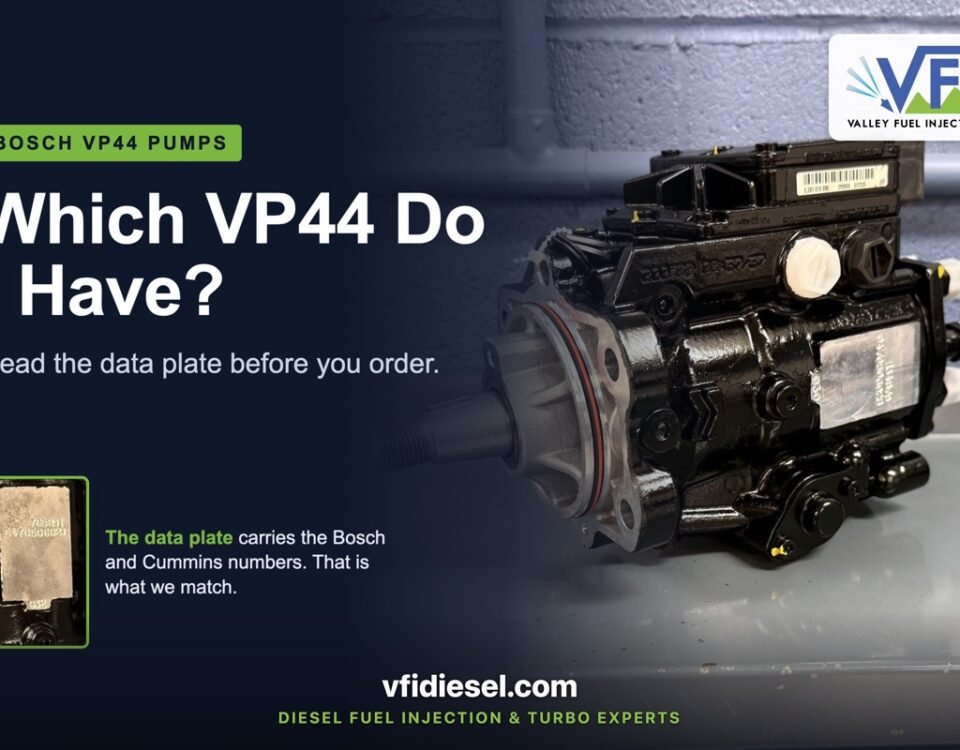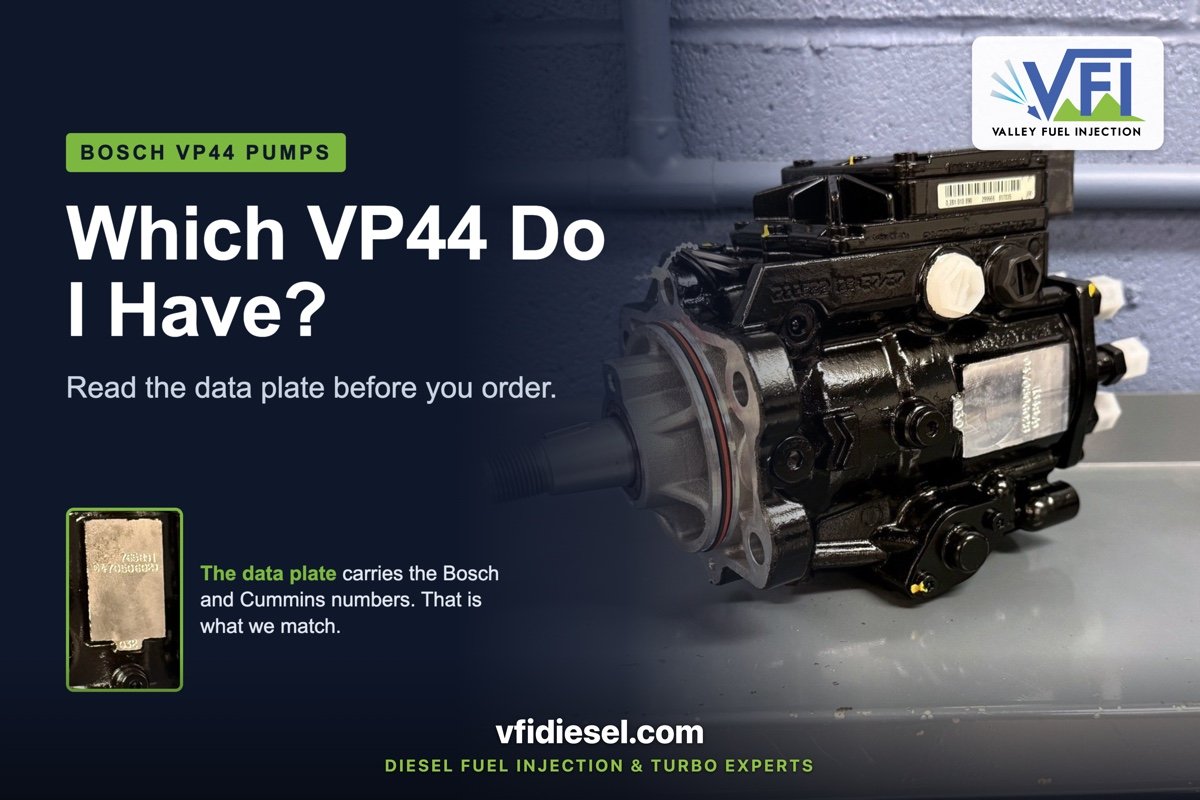
Which VP44 Do I Have? Read the Tag Before Ordering
10/24/2026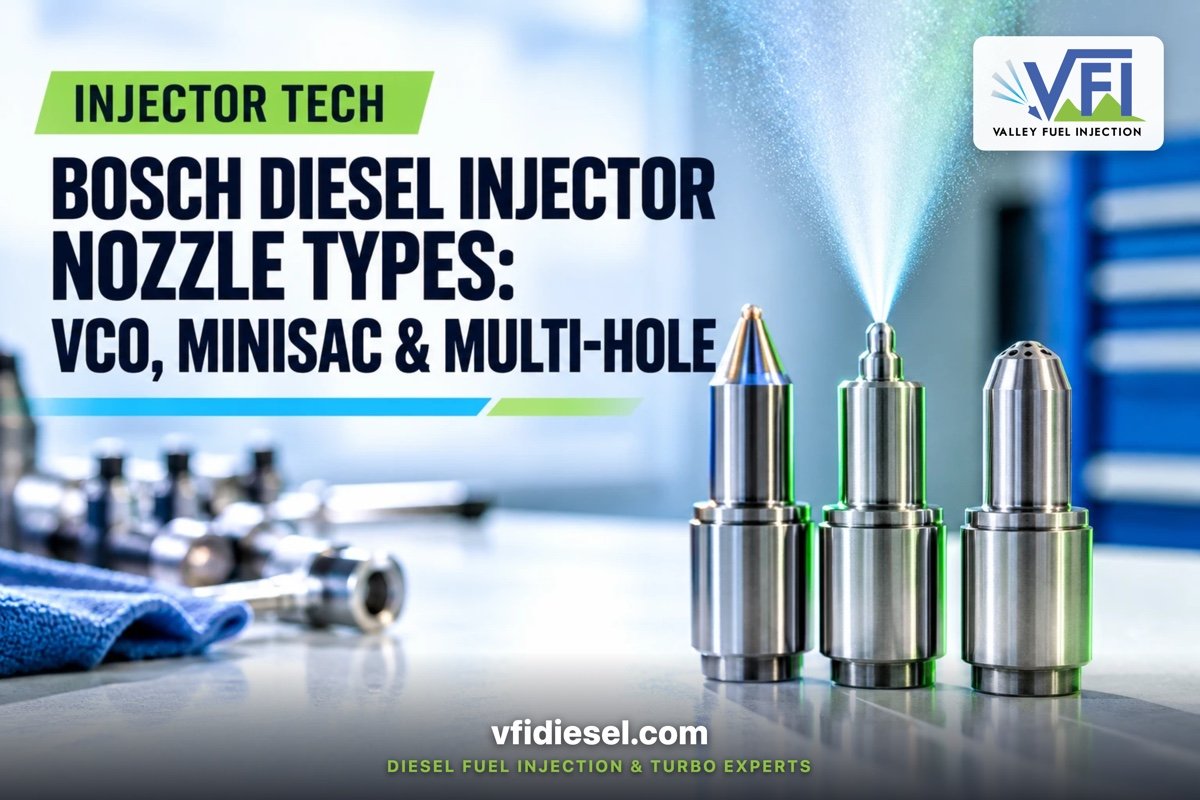
There are two basic diesel injector nozzle types: pintle nozzles, built for indirect-injection (IDI) engines with a prechamber or swirl chamber, and multi-hole (hole-type) nozzles, used on direct-injection (DI) engines from a mechanical 12-valve Cummins to a late-model common rail truck. VCO (valve covered orifice) and mini-sac are not separate nozzle types. They are two ways of building the tip of a multi-hole nozzle, and the difference is how much fuel is left below the needle seat when the nozzle closes. Here is how each one works, what wears out, and how the bench decides between a new nozzle and a new injector.
The combustion chamber picks the nozzle: pintle for IDI, multi-hole for DI. Inside the multi-hole family, the sac, mini-sac or VCO tip is set by the engine maker for that chamber and pressure; it is not an upgrade you choose. Whatever the type, nozzle condition shows up on a test bench, not in a visual check: opening pressure, seat leakage and spray pattern on mechanical injectors, and delivery at several test points on common rail.
Two Nozzle Families, Matched to the Combustion Chamber
Engineering references sort diesel nozzles into two families, hole-type and throttling pintle, not three. Which one an engine gets depends on where the fuel goes.
In an IDI engine, fuel is sprayed into a small prechamber or swirl chamber in the head, and the air swirling in that chamber does most of the mixing. A single cone of spray at moderate pressure does the job. In a DI engine, fuel goes straight into the bowl in the piston crown, so the nozzle itself has to split the fuel into several fine jets aimed at the air. That is the whole reason one engine gets a pintle and another gets a multi-hole nozzle.
| Pintle Nozzle | Multi-Hole Nozzle | |
|---|---|---|
| Engine type | Indirect injection (prechamber or swirl chamber) | Direct injection (fuel into the piston bowl) |
| Spray | One cone from the gap around the pintle | Several fine jets, one per hole |
| Opening pressure, mechanical injectors (factory specs) | Kubota E-TVCS: 13.73–14.70 MPa (about 1,990–2,130 psi). Yanmar TNV IDI: 11.8–12.8 MPa (1,711–1,842 psi) | Yanmar TNV DI: 19.6–22.6 MPa (2,843–3,278 psi) |
| Where you see it | Kubota E-TVCS engines (Z482, D722, D1105, V1505, V2203-M, V2403-M), Yanmar 2TNV70, 3TNV70 and 3TNV76, GM 6.2 and 6.5 | 5.9 Cummins on VE, P7100 or VP44 pumps, common rail pickups, Kubota DI and CR engines, Yanmar TNV DI engines |
| Tip designs | Standard or throttling pintle | Sac, mini-sac or VCO |

Either way, nozzle condition is not something you can judge by looking at the tip. A calibrated bench measures opening pressure, seat leakage, spray pattern and flow, and that is what we do at our common rail service facility as a Bosch Authorized Service shop.
Pintle Nozzles: The IDI Standard on Kubota, Yanmar and GM 6.2/6.5
A pintle nozzle has one opening. The tip of the needle, the pintle, sticks through the hole in the nozzle body, and fuel leaves through the ring-shaped gap between them as a single cone. A throttling pintle is shaped so that gap stays very small for the first part of needle lift. That keeps the first bit of injection small and gives the soft start to combustion that prechamber and swirl chamber engines are built around.
This is the nozzle on a lot of the compact ag and equipment engines that come across our bench. Kubota’s E-TVCS engines are indirect injection, and Kubota still builds them: it lists the V2203-M-E4-BG2 as indirect injection and EU Stage V compliant. Kubota’s workshop manuals list an OPD mini nozzle for E-TVCS engines like the V2203-M and V2403-M: a Bosch throttle-type nozzle in the 2006 manual, a Denso nozzle in the later E3B manual. The D1105 and V1505 list a DNOPD mini nozzle, and a Carrier manual for the Kubota Z482 and D722 lists a Bosch throttle-type nozzle. All are set to open at 13.73 MPa (1,991 psi). Yanmar’s 2TNV70, 3TNV70 and 3TNV76 are swirl chamber IDI engines with pintle injectors. The GM 6.2 and 6.5 are prechamber diesels as well.
Read the engine plate before you order injectors. Kubota builds a V2403-M (indirect injection, pintle nozzle), a V2403-M-DI (direct injection, mechanical pump, hole-type nozzle) and a V2403-CR (direct injection, common rail). Same displacement, three different injectors. DI or CR in the model name means a hole-type (multi-hole) nozzle.
What the Bench Checks on a Pintle Injector
- Opening pressure: Kubota specifies 13.73–14.70 MPa (about 1,990–2,130 psi) for its E-TVCS engines. Yanmar specifies 11.8–12.8 MPa (1,711–1,842 psi) for TNV IDI injectors. Pressure is set with shims or adjusting washers in the holder.
- Seat tightness: Kubota’s test holds 12.75 MPa (1,849 psi) for 10 seconds with no leak at the tip.
- Spray pattern: Yanmar describes a good IDI spray as a fine, roughly uniform cone of 5 to 10 degrees. A one-sided spray usually points to carbon on the tip. A solid stream with drips points to a damaged, worn or dirty seat.
- New versus used settings: Yanmar’s pressures are for used injectors. It notes a new IDI injector opens about 72.5 psi (0.5 MPa) higher than one with five or more hours on it, so a fresh nozzle is set slightly above the used spec.
The fix on a pintle injector is usually straightforward: a new nozzle, a clean holder, opening pressure reset with shims, and a pop test for pressure, seat leakage and spray. That is what our mechanical injector testing and rebuild service does, for one injector or a full set, local or mail-in.
Talk to a Diesel Tech Kubota or Yanmar injectors knocking, smoking or dribbling? We pop-test every injector for opening pressure, seat leakage and spray, fit new nozzles where needed and reset each one to factory opening pressure. Two ways in: drive it into our Woodland shop near Sacramento, or ship it to us from anywhere in the country. ☎︎ Call 530-668-0818Out of the area? Start a mail-in rebuild → |
Multi-Hole Nozzles: The Direct-Injection Standard
Direct-injection diesels use hole-type nozzles. That goes for the 5.9 Cummins on a VE, P7100 or VP44 pump as much as a 6.7 on common rail. What changed over the years is pressure and precision, not the basic type.
Pressure climbed fast once common rail arrived. Bosch’s first-generation common rail system in 1997 ran 1,350 bar (about 19,600 psi). Bosch’s CRS2 runs up to 2,000 bar, and Bosch announced a 2,500 bar (about 36,000 psi) system for commercial vehicles in 2012. More pressure lets the nozzle push fuel through smaller holes and atomize it finer.
The details that set a multi-hole nozzle’s behavior:
- Hole count: factory truck injectors typically carry five to eight holes. More holes spread the fuel more evenly, but each hole gets smaller.
- Hole size: tiny. A Bosch solenoid common rail injector that Sandia National Laboratories uses as a reference nozzle has 0.090 mm holes.
- Spray angle (included angle): the angle between opposite jets is matched to the piston bowl of that engine.
- Hydro-erosive grinding (HE grinding): an abrasive fluid is pumped through the nozzle to round the hole inlets, which improves and steadies flow. The Sandia reference nozzle is smoothed this way.
- Tip design: sac, mini-sac or VCO, covered below.
On mechanical DI trucks, hole size is the classic performance change. Bigger holes flow more fuel per event, and without the timing, air and pump capacity to burn it, you get smoke and exhaust temperature, not power.
Sac and Mini-Sac Tips
On a sac-type nozzle, the spray holes are drilled into a small chamber, the sac, below the needle seat. When the needle closes, the fuel left in the sac can keep seeping out of the holes at low pressure, unatomized and late in the cycle, and that dribble shows up as particulate emissions. A mini-sac shrinks that volume. The Bosch reference nozzle above has a mini-sac of 0.2 mm³. The upside of keeping a sac is a stronger tip and a steadier spray at low needle lift.
VCO (Valve Covered Orifice) Tips
On a VCO nozzle, the holes start in the seat cone itself, so when the needle seats it covers the hole entrances. Almost no fuel is left below the seat, which is why VCO was developed: less unburned fuel dribbling into the cylinder and less hydrocarbon in the exhaust.
Two tradeoffs come with it. First, tip strength: the holes run through the seat area, so the tip wall cannot be made very thin. Lucas patent literature puts the practical minimum at 1 mm, or 0.8 mm at the very least, because a thin VCO tip can be blown off at high injection pressure. Second, spray consistency at low lift: the needle sits right at the hole entrances, so a needle running slightly off-center changes how much fuel each hole gets. Research on multi-hole VCO nozzles calls spray irregularity at low needle lift the major drawback of the design.
That is why the choice has gone back and forth. Researchers tracing multi-hole nozzle history note VCO replaced mini-sac on first-generation common rail injectors, then multiple injections at low needle lift made a very small sac the better compromise again. A published SAE comparison ran a VCO nozzle and a mini-sac nozzle on the same high-speed DI diesel and found longer ignition delays with the VCO. The engine maker picks the tip for the chamber, pressure and emissions target. There is no universal upgrade.
| Sac / Mini-Sac | VCO | |
|---|---|---|
| Where the holes start | In a small sac below the needle seat | In the seat cone, covered by the needle |
| Fuel left after closing | Small (0.2 mm³ on the Bosch reference mini-sac) | The least of any design |
| Main advantage | Stronger tip, steadier spray at low needle lift | Least dribble and unburned hydrocarbons |
| Main tradeoff | Sac fuel can dribble late in the cycle | Thicker tip wall needed; spray more sensitive to needle position at low lift |
On late-model trucks (LML/LMM Duramax, 6.7 Cummins, 6.7 Power Stroke), the multi-hole nozzle sits inside a common rail injector, and its condition is judged on a test bench, not by eye. Our post on how common rail injectors are tested on our Bosch-certified bench explains what that covers.
How Nozzle Wear Changes Spray Pattern, and What Symptoms Follow
Nozzle wear is gradual and mostly invisible until the engine tells you. How it wears depends on the nozzle.
Multi-Hole Nozzles: Hole Erosion and Carbon
On high-pressure common rail systems, the classic wear mode is erosion at the hole inlets and inside the holes. Hard particles that get past the filters hit those holes at very high velocity, and over time the holes open up. Biodiesel blends add another variable, as we covered in our analysis of biodiesel injector damage in California.
Bigger holes flow more fuel for the same command. On common rail engines the ECM’s cylinder balance correction can hide some of that at idle, but only within its limits. Past that point it shows up as:
- Black or gray smoke under load
- Increased fuel consumption with no corresponding power gain
- Rising exhaust gas temperatures
- DPF regeneration cycles becoming more frequent
- Injector balance rate codes (on common rail systems with individual cylinder trim)
Flow area goes with the square of the hole diameter. A hole worn just 5% larger has about 10% more area, so at the same pressure and on-time it flows roughly 10% more fuel. That is why a flow test on the bench matters more than a spray pattern that looks fine.
Spray angle problems are a separate failure from flow change. A nozzle can flow within spec but put fuel in the wrong place, usually because carbon or debris partly blocks one or more holes. One part of the chamber runs rich and makes soot while another runs lean, and the engine smokes even though total delivery tests fine.
Pintle and Mechanical Nozzles: Seat Wear, Carbon and Tired Springs
On mechanical injectors, the seat and the spring are the usual suspects. A worn or pitted seat lets fuel seep past the needle at low lift and after closing, the classic dribble behind rough idle, white or blue smoke on startup, and carbon on the tip and piston crown. A tired spring or worn shims drop the opening pressure, so injection starts early and atomization suffers.
Pintle nozzles have one more weak spot: carbon in the throttling gap. Patent literature on throttling pintle nozzles lists what that carbon does. It cuts the throttling effect, which brings on knocking, it hurts emissions through incomplete combustion, and it reduces flow through the nozzle. When an IDI engine starts to knock, smoke and lose power, put the injectors on a pop tester early in the diagnosis.
A nozzle with a worn or pitted seat keeps feeding fuel into the cylinder after it should be shut. That dribble leads to carbon on the piston crown, injector tip coking and smoke at idle. If an older mechanical engine smokes black at idle, nozzle seat wear is near the top of the list. See our post on diesel injector deposit buildup symptoms and causes for what to look for.
This is why injector cleaning alone does not fix a worn nozzle. Cleaning restores flow through blocked holes, but it cannot restore eroded holes or a worn seat. As we explain in our comparison of DIY vs. professional injector cleaning, cleaning is maintenance, not a substitute for bench testing.
Nozzle or Whole Injector? Let the Bench Decide
On mechanical injectors, pintle or hole-type, a new nozzle is the standard repair. The holder (body, spring and shims) usually outlives several nozzles as long as it tests in spec, and a new nozzle, a reset opening pressure and a pop test put the injector back to factory spec.
Common rail injectors are different. The injector body also carries the control valve and the solenoid or piezo actuator, and those wear on their own. A new nozzle on an injector with a worn control valve can still leave you with slow response or high return flow, so the whole injector has to go on the bench before anyone decides what to replace.
| What the Bench Shows | What Usually Makes Sense | Why |
|---|---|---|
| Mechanical injector: low pressure, poor spray or dribble, holder in spec | New nozzle, reset opening pressure, pop test | The nozzle is the wear part; the holder has life left |
| Mechanical injector: holder damaged or out of spec | Replace the injector | Nothing sound left to build on |
| Common rail injector: nozzle out, control valve and actuator test good | Rebuild with a new nozzle, then retest | Keeps a good body in service |
| Common rail injector: control valve or actuator out of spec | Service the valve or replace the injector | A new nozzle will not fix a slow or leaking valve |
| Any injector after a contaminated fuel event (water, metal, wrong fluid) | Test the whole set, expect replacements, inspect the whole fuel system | Contamination damages body internals, not just the nozzle |
Pricing follows what the bench finds. As a guide at California specialty-shop rates in 2026: bench or pop testing typically runs $50–$100 per injector. A single common rail injector typically runs $300–$800 for the part alone, with new OEM at the high end. Installed sets typically run $3,500–$6,500 for a 6.7 Cummins (6 injectors), $4,500–$7,000 for an LB7 Duramax (8) and $5,500–$8,500 for a 6.7 Power Stroke (8). On Kubota Tier 4 engines, an injector typically runs $200–$600 as a part, a 3- or 4-cylinder set $900–$2,800 or more in parts, and replacement labor $600–$1,400 because access on compact equipment is tight. Mechanical injector rebuilds are quoted per set.
Prices reflect typical California specialty-shop ranges as of 2026. Your actual quote depends on the condition of your specific components, parts availability, and current labor rates. Call VFI at 530-668-0818 for an accurate quote on your job.
One more step on common rail: when injectors are replaced or rebuilt, most systems need the new trim codes entered in the ECM so it can balance fueling across cylinders. Skipping it causes rough idle, smoke and fuel trim codes, so budget scan-tool time for it.
If you are in the Sacramento area or shipping from further out, Valley Fuel Injection & Turbo tests and rebuilds both nozzle families in-house at our Woodland shop: pintle and hole-type mechanical injectors through our mechanical injector service, and common rail injectors through our common rail injector testing and rebuild service. We accept mail-in injectors for testing from anywhere in the U.S. For Kubota and Yanmar equipment, see our Kubota service and Yanmar service pages.
Frequently Asked Questions
Are VCO and mini-sac different nozzle types?
No. Both are multi-hole (hole-type) nozzles for direct-injection engines. The difference is where the spray holes start. On a mini-sac nozzle they start in a small sac below the needle seat. On a VCO nozzle they start in the seat itself, so the needle covers them when it closes. The other basic nozzle type is the pintle nozzle, used in indirect-injection engines.
Do Kubota and Yanmar engines use pintle or multi-hole nozzles?
Both, depending on the engine. Kubota’s E-TVCS engines (such as the D722, D1105, V1505, V2203-M and V2403-M) are indirect injection and use a throttle-type pintle nozzle. Kubota’s CR engines, such as the V2403-CR and V3307-CR, are direct-injection common rail with multi-hole nozzles. Kubota’s DI models, such as the V2403-M-DI, are direct injection with hole-type nozzles on a mechanical pump. Yanmar’s 2TNV70, 3TNV70 and 3TNV76 are indirect injection; its 3TNV82A through 4TNV106 are direct injection. Check the model on the engine plate before ordering injectors. Our post on maintaining Kubota diesel injectors covers what to watch for on those platforms.
Can I visually inspect my injector nozzle to check its condition?
Not reliably. You can see obvious physical damage, a cracked tip, heavy coking, or a visibly deformed orifice, but you cannot see orifice enlargement, asymmetric spray angle, or seat leakage by looking at the nozzle. Those failures require a calibrated test bench with precise flow measurement and spray visualization. Visual inspection tells you if a nozzle is catastrophically damaged; it tells you nothing about whether it’s performing within spec.
Are aftermarket nozzles as good as OEM Bosch nozzles?
It depends heavily on the tier of aftermarket part. New Bosch replacement nozzles are built to the same specification as original equipment. Low-cost nozzles can differ in hole finish, seat finish and material, and on a high-pressure common rail system running 2,000+ bar those differences show up quickly as spray and flow problems and a shorter service life. For emissions-critical applications, we recommend OEM Bosch nozzles or verified Bosch-spec remanufactured units.
How do I know if my nozzle wear is causing my DPF to regenerate more often?
Increased DPF regen frequency is a downstream symptom of incomplete combustion, which worn nozzles cause by producing poor atomization and asymmetric spray patterns. If regen intervals have shortened significantly and you’ve ruled out EGR issues and fuel quality problems, injector bench testing is the next logical step. A flow rate test will show whether any injectors are delivering more fuel than commanded, which is the most common nozzle-wear signature on common rail engines.
What’s the difference between nozzle opening pressure and injection pressure?
Nozzle opening pressure (NOP, or pop pressure) is the pressure at which fuel lifts the needle off its seat against the spring in a mechanical injector. It is set with shims and depends on the engine: Kubota lists 13.73–14.70 MPa (about 1,990–2,130 psi) for its E-TVCS IDI engines, while Yanmar lists 19.6–22.6 MPa (2,843–3,278 psi) for its TNV direct-injection engines. Injection pressure is the pressure driving fuel through the nozzle during the injection event. On common rail, the needle is opened by the injector’s solenoid or piezo control valve rather than by a spring setting, and rail pressure, up to 2,000 bar on Bosch CRS2 and 2,500 bar on some Bosch systems, is set by the pump and pressure control. On mechanical systems, low opening pressure causes early injection and poor atomization; on common rail, the equivalent failure is a slow or sticking control valve.
Need your injectors bench-tested by a Bosch Authorized Service shop? Whether you’re local or shipping injectors in from across the country, we can check opening pressure, seat leakage, spray pattern and flow on a calibrated bench, for pintle, hole-type and common rail injectors.
Call us at 530-668-0818 or schedule a diagnostic. Visit us at 1243 E Beamer St, Suite C, Woodland, CA 95776. We also ship remanufactured injectors and accept mail-in cores nationwide, learn about our Bosch injector services.