

6.0 Powerstroke Injector Symptoms (G2.8) + HPOP Failure: Buyer’s Guide
07/21/2026
Kubota D722 vs D902 vs V1505: Small Diesel Engine Guide (RTV900, BX, ZD and More)
07/22/2026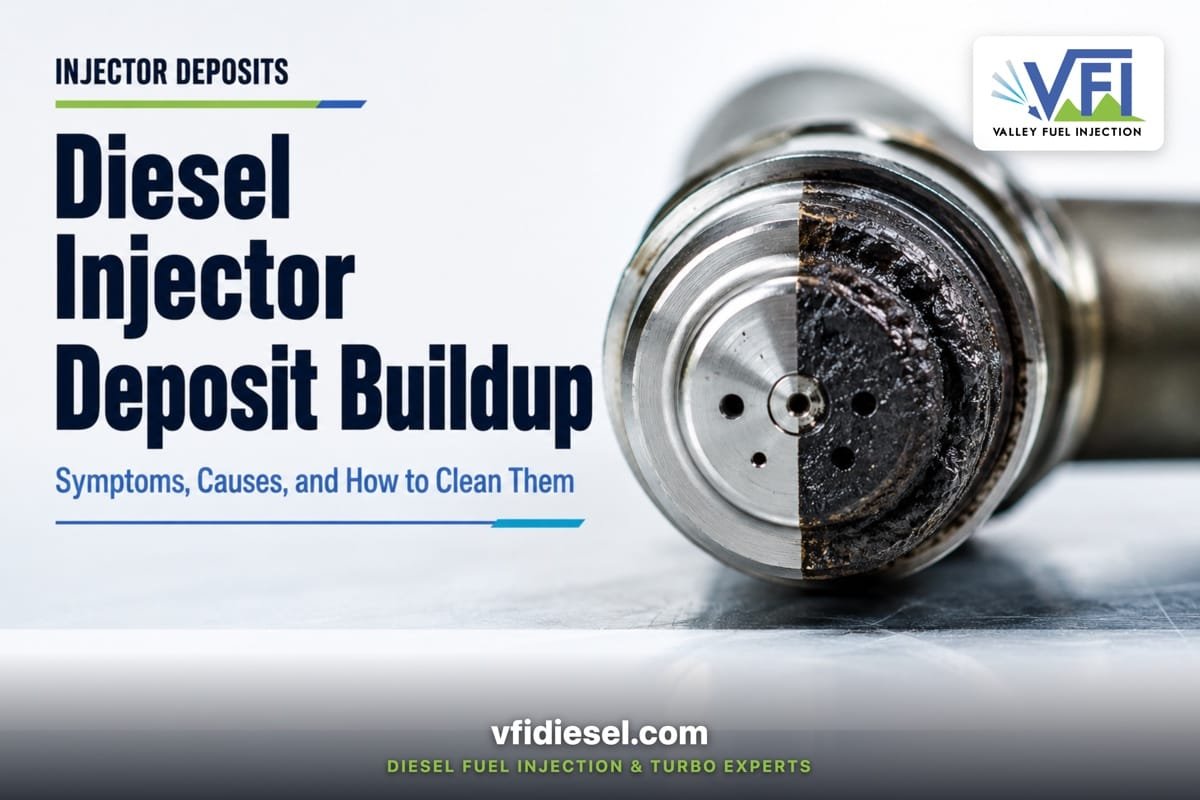
Diesel Injector Deposit Buildup: Symptoms, Causes, and What Cleaning Actually Does
Diesel injector deposit buildup is one of the most misdiagnosed problems in diesel fuel systems. The symptoms, rough idle, black smoke, sluggish throttle response, and declining fuel economy, look almost identical to a failing injector, a worn pump, or even a boost leak. But in many cases, the hardware is fine and the real culprit is a layer of carbon, lacquer, or waxy residue sitting right at the nozzle tip or inside the injector body.
Knowing the difference between a deposit problem and a mechanical failure can save you hundreds or thousands of dollars in unnecessary parts. This post breaks down why deposits form, what they actually do to injector performance, and how to tell when cleaning is the right call versus when it’s time for a bench test.
Deposit buildup and mechanical injector failure share many of the same symptoms, but they have different causes and different fixes. Cleaning removes contamination from a functional injector. It cannot fix worn needle valves, cracked nozzles, or internal wear. If symptoms persist after a professional cleaning, the next step is a calibrated bench test, not another cleaning.
What Causes Carbon and Waxy Deposit Buildup Inside Diesel Injectors?
Deposits form when combustion byproducts, fuel residue, and heat combine in a place where they can’t be flushed away. Inside a diesel injector, that place is the nozzle tip and the internal passages just upstream of it.
There are two primary types of deposits to understand. The first is carbonaceous (hard carbon) deposits, which form on the exterior of the nozzle tip from incomplete combustion. Fuel left on the tip after each injection bakes in the combustion heat into a hard crust. Over time, this crust narrows the spray holes and distorts the spray pattern.
The second type is internal lacquer and waxy deposits, which form inside the injector body, on the needle valve, and in the sac volume at the base of the nozzle. These come from fuel that thermally degrades under the heat soak that occurs after engine shutdown, when there is no fuel flow to cool the injector body.
Several factors accelerate both types. Short-trip driving is one of the worst offenders because the engine never reaches full operating temperature, fuel combustion stays incomplete, and the injector tips never get hot enough to self-clean. Low-load idling creates a similar problem. Engines that sit for extended periods between uses, agricultural equipment, standby generators, and seasonal work trucks, are especially prone to waxy internal deposits because fuel degrades in the injector body during storage.
If you operate equipment seasonally, a quality fuel stabilizer added at the end of the season can significantly reduce the waxy deposit formation that happens when fuel sits in the injector body for months at a time. It’s cheap insurance compared to a cleaning service. See our maintenance tips for Kubota diesel injectors for a full seasonal prep checklist.
Internal deposits have more than one chemical cause; published Afton Chemical work identified sodium salts from fuel contaminants and corrosion-inhibitor chemistry. Heat soak is another factor. When you shut a hot engine down, coolant flow stops but the injectors retain heat. Fuel left in the nozzle passages oxidizes in that heat into sticky lacquer, which is why idling down before shutdown matters more than most owners realize.
What Symptoms Does Deposit Buildup Cause, and How Do They Differ from Injector Failure?
The symptom overlap between deposit buildup and mechanical injector failure is significant, but there are patterns that help separate the two.
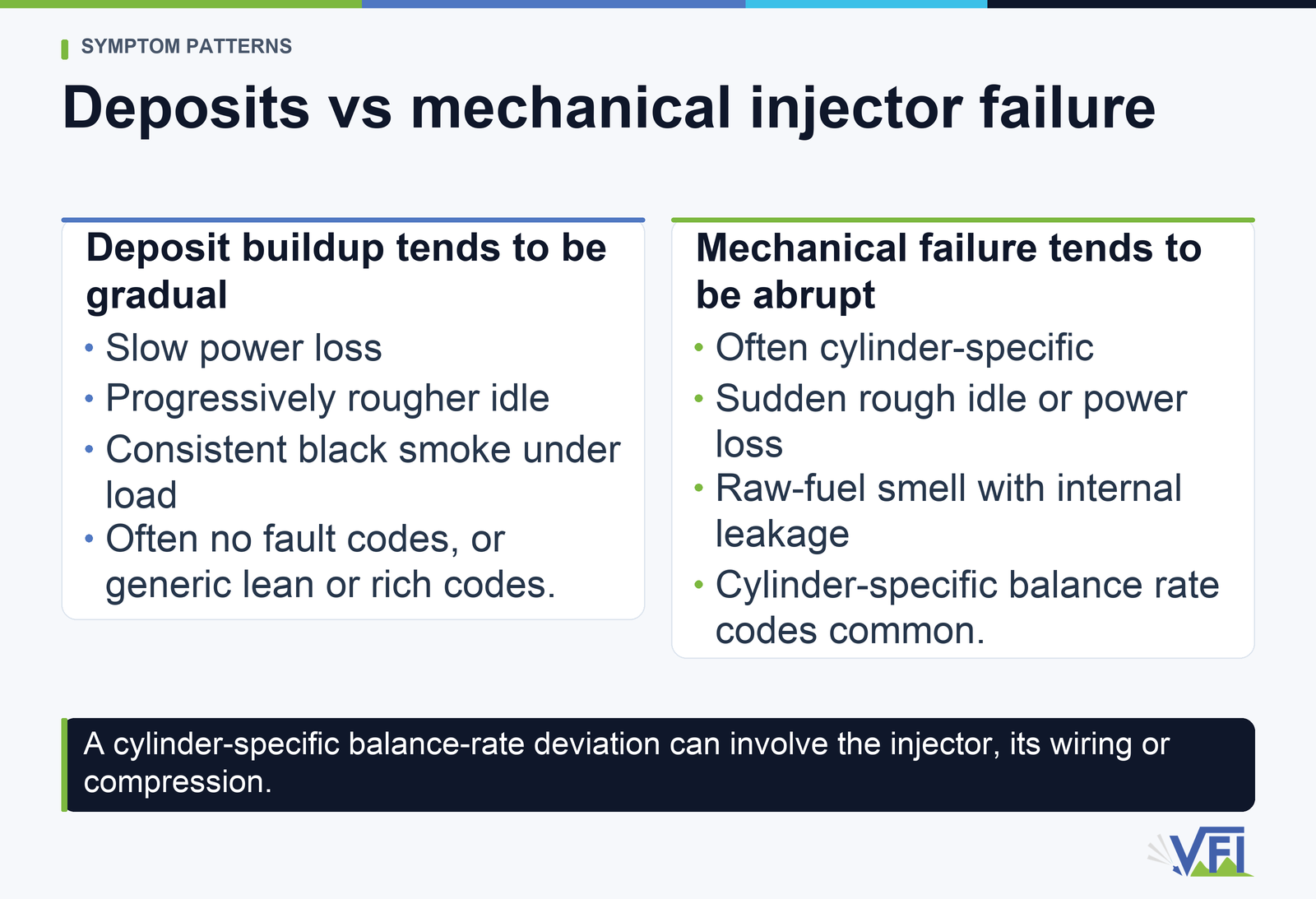
Deposit buildup tends to produce symptoms that are gradual and symmetrical. Fuel economy drops slowly over thousands of miles. Power feels progressively softer rather than suddenly absent. Idle quality gets rougher over time but doesn’t usually produce hard misfires or cylinder-specific fault codes early on. Black smoke appears under load because the distorted spray pattern produces uneven atomization, but it’s typically consistent rather than intermittent.
Mechanical injector failure, by contrast, tends to be abrupt and cylinder-specific. A needle valve that has seized or a nozzle tip that has cracked will usually trigger a balance rate fault on a specific cylinder. A leaking injector produces a distinctive raw-fuel smell at startup, white smoke on cold starts that doesn’t clear, and in severe cases, hydraulic lock risk from fuel pooling in the cylinder. An injector that is stuck open will cause hard starting, excessive cranking, and sometimes a noticeable knock from that cylinder.
One practical diagnostic step before spending money on anything: pull a live balance rate reading with a bi-directional scan tool at operating temperature. If one or two cylinders are pulling hard in one direction while others look normal, you likely have a problem in those cylinders: the injector, its wiring or compression. A shop-performed balance rate check typically runs $95–$200 depending on the platform and scan tool required.
How Do ULSD, Biodiesel Blends, and Poor-Quality Fuel Accelerate Deposits?
Fuel quality is one of the biggest variables in how fast deposits accumulate, and it’s a factor that many owners don’t think about until something goes wrong.
Ultra-low sulfur diesel (ULSD), which has been the standard on-highway fuel since the mid-2000s, has lower lubricity than older high-sulfur formulations. The refining process that removes sulfur also strips away many of the natural lubricating compounds in diesel. This matters mostly for wear: low-lubricity fuel wears pumps and injectors faster, which is why ASTM D975 sets a lubricity limit for diesel fuel.
ULSD also has a slightly lower energy density, which means injectors must deliver more volume for the same power output, increasing the thermal load on the nozzle tip.
Biodiesel blends introduce a different set of problems. B20 and higher blends have higher cloud points, meaning they gel at warmer temperatures than petroleum diesel. In cold weather, partially gelled biodiesel can leave waxy deposits in injector passages that petroleum diesel would have carried away. Biodiesel also has a higher oxygen content, which can accelerate oxidation of fuel sitting in the injector body during heat soak.
California’s fuel market has seen increasing biodiesel blend percentages in recent years, and we’ve written in detail about the specific damage patterns this creates in our post on biodiesel injector damage in California.
Poor-quality or contaminated fuel is the fastest path to severe injector deposits. Off-road diesel that has been stored in dirty tanks, fuel with water contamination, and fuel from low-turnover stations can introduce particulates and microbial growth that deposit aggressively inside injectors. A single tank of heavily contaminated fuel can cause damage that no cleaning service can fully reverse. If you suspect fuel contamination, have your tank inspected and consider a full fuel system flush before addressing the injectors. The EPA’s diesel fuel standards set minimum quality thresholds, but enforcement at the retail level varies.
Poor-quality fuel from low-turnover stations is a real problem that doesn’t get enough attention. Diesel that has been sitting in a storage tank for months degrades. The lighter, more volatile fractions evaporate, leaving heavier compounds that atomize poorly and burn incompletely. The result is accelerated carbon deposit formation at the nozzle tip and increased soot loading in the combustion chamber.
What Does Professional Injector Cleaning Actually Remove, and What Does It Miss?
Professional cleaning is effective at removing soft and moderate deposits, but it has real limits, and understanding those limits helps you set the right expectations before you authorize the service.
An on-vehicle pressurized chemical flush is effective at dissolving lacquer and light-to-moderate waxy deposits from the internal passages and the nozzle tip. It does not remove hard, baked-on carbon deposits from the exterior of the nozzle tip, and it cannot restore flow characteristics to injectors with worn or damaged needle valve seats. Expect to pay typically $250–$500 at a California specialty diesel shop for this service.
An off-vehicle ultrasonic cleaning is more thorough. The injectors are removed, disassembled to the extent the design allows, and placed in an ultrasonic bath where high-frequency sound waves create cavitation bubbles that physically scrub deposit material from internal surfaces. This can remove deposits that chemical flushes leave behind, and it allows for a full flow test before and after cleaning to verify the result. At a specialty shop, off-car ultrasonic cleaning with a flow test runs typically $75–$200 per injector for the bench work alone.
When you add the labor to remove and reinstall the injectors, a complete set on a six- or eight-cylinder engine typically runs $900–$1,800 all-in. We cover the full comparison of cleaning methods in our post on diesel fuel injector cleaning: DIY vs. professional service.
What cleaning cannot fix: worn needle valve seats that allow internal leakage, cracked or eroded nozzle tips, damaged solenoids or piezo actuators, and worn internal bores.
If an injector has been operating with severe deposits for an extended period, the restriction caused by those deposits often forces the ECM to command higher injection pressures and longer pulse widths to maintain fueling targets. This added stress accelerates mechanical wear inside the injector body. By the time the deposits are severe enough to cause noticeable symptoms, there may already be underlying mechanical damage that cleaning cannot address.
On-vehicle chemical flush: typically $250–$500. Off-vehicle ultrasonic clean and flow test (per injector, bench only): typically $75–$200. Full set cleaning with removal and reinstall (6–8 injectors): typically $900–$1,800. If injectors need refurbishment after cleaning, add $200–$450 per injector. Prices reflect typical California specialty-shop ranges as of 2026. Your actual quote depends on the condition of your specific components, parts availability, and current labor rates. Call VFI at 530-668-0818 for an accurate quote on your job.
Can Diesel Fuel Additives Prevent Deposit Buildup, or Only Slow It Down?
Fuel additives can genuinely help prevent deposit formation, but they work best as a maintenance tool rather than a corrective one. Once significant deposits have formed, no additive will dissolve them fast enough to restore performance on its own.
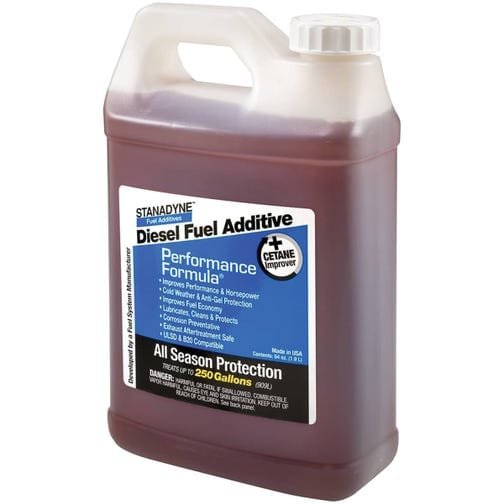
Detergent packages bond to metal surfaces inside the injector and prevent deposit precursors from adhering. Used consistently from early in an engine’s life, they can meaningfully extend the interval between cleaning services. Quality options include Stanadyne Performance Formula (typically $0.04–$0.06 per gallon treated), Power Service (typically $0.03–$0.05 per gallon), and Hot Shot’s Secret (typically $0.08–$0.12 per gallon).
Additives that claim to restore injector performance in a heavily deposited engine are a different category, and the results are inconsistent. Some concentrated detergent treatments can soften and partially remove light-to-moderate internal deposits over several tanks of fuel. But hard carbon deposits on the nozzle exterior, and any deposits that have caused mechanical wear, are beyond what any additive can address. Detergent additives work best as prevention; no additive repairs an injector that is already worn.
Modern common rail injectors operate at rail pressures from 23,000 to over 30,000 PSI. The spray holes in the nozzle tip can be as small as 0.006 inches in diameter. A deposit layer that is invisible to the naked eye can meaningfully restrict flow through an orifice that small. This is why even minor deposit buildup causes measurable performance changes in high-pressure common rail systems long before it causes obvious symptoms.
Lubricity additives are a separate but related category. Because ULSD has reduced natural lubricity, adding a lubricity improver, many quality diesel additives combine detergent and lubricity chemistry in one product, can reduce pump and injector wear. This is especially relevant for engines that see a lot of ULSD without any fuel additive program.
For a deeper look at how DPF-equipped engines interact with injector deposits, our post on the DPF effect on diesel injectors covers the post-injection and late-injection strategies that increase deposit risk on emissions-equipped engines.

When Does Deposit Buildup Mean It’s Time for Injector Testing Instead of Cleaning?
Cleaning is the right first step when symptoms are gradual, there are no cylinder-specific fault codes, and the engine has reasonable mileage without a history of fuel contamination events. But there are specific situations where cleaning is the wrong call and testing should come first.
The clearest signal is persistent symptoms after a professional cleaning. If symptoms come back soon after a quality ultrasonic cleaning with pre- and post-flow tests, or never improve, bench test the injectors for mechanical wear before paying for another cleaning.
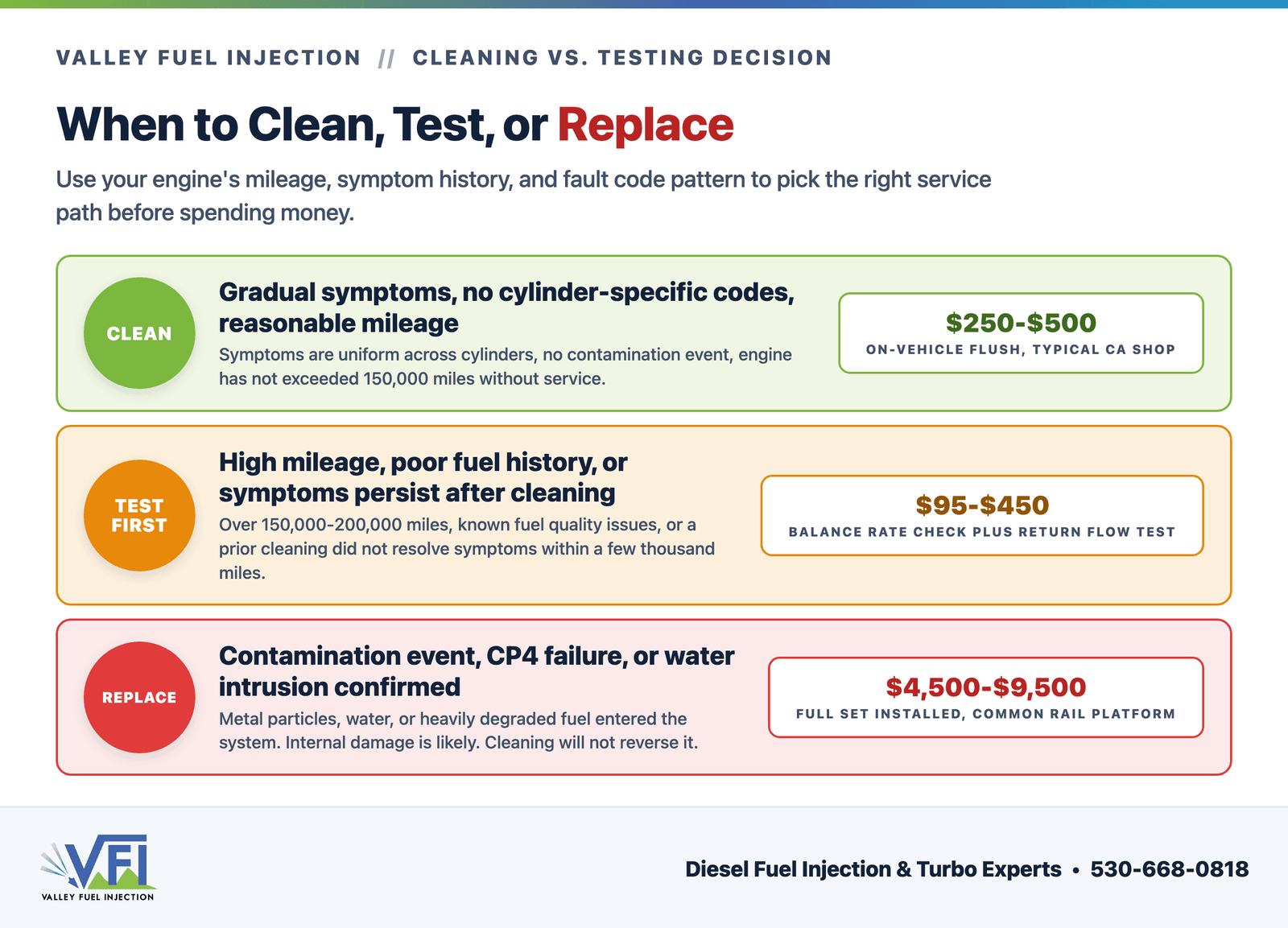
The second signal is high mileage combined with a history of poor fuel quality or neglected maintenance. On a 6.7 Cummins or LB7 Duramax with 200,000-plus miles that has never had injector service, the probability that deposit buildup has caused underlying mechanical wear is high enough that testing before cleaning makes more sense economically. If the bench test shows the injectors are within spec, they are not the problem. If they are out of spec, a cleaning and retest shows whether deposits or wear caused it, and worn injectors go to refurbishment or replacement.
The third signal is a contamination event. If water, metal particles from a CP4 failure, or heavily degraded fuel has entered the system, cleaning is not the answer. Follow the maker’s contamination procedure first; on many modern trucks it calls for replacing parts outright. Where it does not, the injectors come out for a bench test before any decision about cleaning.
A full set replacement on a modern common rail platform, if contamination has caused internal damage, typically runs $4,500–$7,500 installed for a 6.7 Cummins and $5,500–$9,500 for an eight-injector Duramax or Power Stroke application. Catching the problem before it reaches that point is always the better outcome.
Our Bosch-certified test bench at the Woodland shop can evaluate injectors across all the key parameters: static and dynamic flow rates, spray pattern quality, return flow volume, and opening pressure. The process is documented in detail in our post on how common rail injectors are tested.
For owners who aren’t local, we also accept mail-in injectors for bench testing and rebuilding. A full bench test gives you a data-backed answer about whether your injectors are worth cleaning, worth refurbishing, or need to be replaced, rather than spending money on cleaning that may not solve the problem.
If you’re unsure whether you need cleaning or testing, start with a shop-performed balance rate check and a return flow test before authorizing any service. A return flow test measures how much fuel leaks back through the injector’s internal control valve and guide clearances, which cleaning cannot fix. An on-vehicle return flow test typically runs $200–$450 at a California specialty shop and can save you from spending money on cleaning an injector that actually needs refurbishment. Diesel truck owners near Sacramento can bring their vehicle to our Woodland shop, and owners across Northern California can reach us at 530-668-0818 to discuss what diagnostic approach makes sense for their situation.
The bottom line is that deposit buildup and mechanical injector failure are not the same problem, even when they look the same from the driver’s seat. Getting the diagnosis right first is what determines whether you spend a few hundred dollars on a cleaning service or several thousand on injectors that didn’t actually need to be replaced.
A qualified diesel technician with the right test equipment can give you that answer before you commit to either path. For diesel owners in the Sacramento area and across Northern California and Nevada, we’re here to help you make that call with real data rather than guesswork.
Questions about your specific engine? Schedule a diagnostic or call us directly at 530-668-0818. Our shop is located at 1243 E Beamer St, Suite C, Woodland, CA 95776. We ship remanufactured injectors and accept mail-in pumps and injectors for testing and rebuilding nationwide.
Frequently Asked Questions About Diesel Injector Deposit Buildup
How do I know if my rough idle is from deposit buildup or a bad injector?
The most reliable first step is a live balance rate check with a bi-directional scan tool at operating temperature. If one or two cylinders have significantly higher or lower balance rates than the others, you probably have a problem in those cylinders: the injector, its wiring or compression. A shop-performed balance rate check typically costs $95–$200 and gives you a data point that neither a visual inspection nor a simple code scan can provide.
Can I use a fuel additive to fix injector deposit buildup without taking anything apart?
Fuel additives with quality detergent chemistry can dissolve light-to-moderate internal deposits over several tanks of treated fuel, and they are genuinely effective for prevention. But they cannot remove hard carbon deposits from the nozzle tip exterior, and they cannot restore performance to injectors where deposits have caused mechanical wear to the needle valve seat or nozzle orifices. If your symptoms are noticeable enough that you’re researching the problem, an additive alone is unlikely to fully resolve it.
A professional cleaning service is a more reliable corrective step, and bench testing is the right call if symptoms are severe or have been present for a long time.
Is ultrasonic injector cleaning worth the cost compared to just buying new injectors?
It depends on the condition of the injectors. If a bench test shows the injectors are within spec and the problem is purely deposit-related, ultrasonic cleaning at $75–$200 per injector (bench only) is a fraction of the cost of new or remanufactured injectors at $300–$900 each. If the bench test shows the injectors are out of spec due to mechanical wear, cleaning is money wasted and refurbishment or replacement is the correct path.
This is why we recommend testing before cleaning on high-mileage engines or any engine with a history of fuel quality issues.
Does biodiesel cause more injector deposit buildup than regular diesel?
Yes, in several ways. Biodiesel blends have higher cloud points and can leave waxy deposits in cold weather, higher oxidation potential during heat soak after shutdown, and different combustion characteristics that can increase nozzle tip carbon formation. Higher-percentage blends (B20 and above) are more problematic than lower blends. California’s fuel market has seen increasing biodiesel content in recent years, which is a contributing factor in the deposit patterns we see at the shop. Our post on biodiesel injector damage in California covers this topic in depth.
How often should diesel injectors be cleaned as preventive maintenance?
There is no universal interval because it depends on fuel quality, duty cycle, engine type, and whether a consistent fuel additive program is in place. Engines that see a lot of short-trip driving, low-quality fuel, or extended idle time may need service sooner. Agricultural and seasonal equipment should be evaluated at the start of each season. Consult a qualified diesel technician to determine the right interval for your specific application.